9 species named this week: hadal amphipods, cave millipedes, and a CR flower from Thailand
A representative August 14–20 digest of nine species, from predatory amphipods in the Tonga and Mariana trenches to cave millipedes, a Critically Endangered Thai flower, a transcontinental moss, a tiny leaf-miner fly, and Xizang soldier beetles.
The week's new names run from 8,350 metres below the Pacific surface to a flower hidden in leaf litter, with cave millipedes, a moss, a leaf-miner fly, and high-altitude soldier beetles between them.
This representative digest covers nine species described in six primary papers published from August 14 through August 20, 2026. A complete weekly export from WoRMS, GBIF, and Zoological Record was unavailable for this edition, so the list is a representative digest of dated primary journal papers rather than a worldwide total.
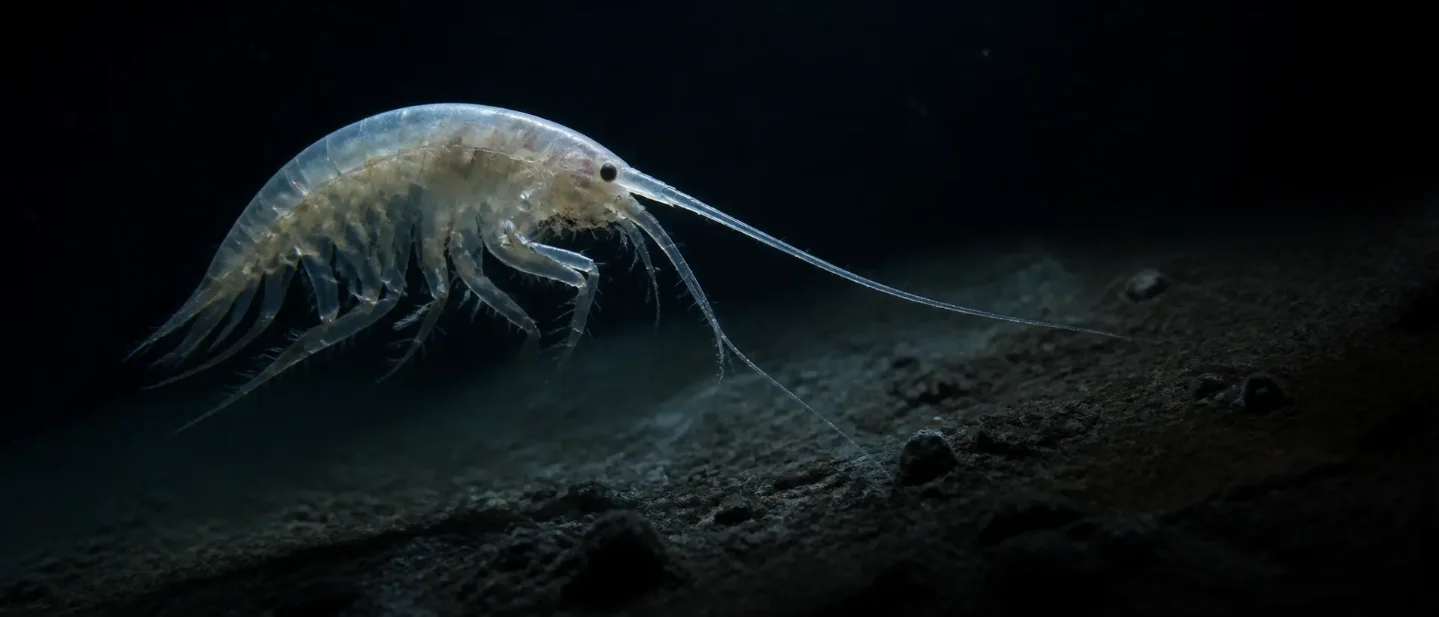
Hadal amphipods
The hadal zone begins below about 6,000 metres. Princaxelia is a genus of predatory pardaliscid amphipods usually captured in small numbers in deep ocean trenches. The two species below bring the genus to seven described species. 1
Princaxelia malohi
- Name and taxonomy: No common name is reported. Princaxelia malohi belongs to Animalia → Arthropoda → Malacostraca → Amphipoda → Pardaliscidae → Princaxelia. 1
- Describers and paper: Grady A. Duffy, Jennifer A. Wainwright, Brett C. Gonzalez, Todd Bond, and Alan J. Jamieson described the species in ZooKeys 1289, published August 14, 2026. All five authors are affiliated with the Minderoo-UWA Deep-Sea Research Centre, the School of Biological Sciences, and the Oceans Institute at The University of Western Australia. 1
- Locality and collection: The type locality is the Tonga Trench in the southwest Pacific, at 23°29.238'S, 174°59.890'W and 8,200 metres depth. The holotype was collected on July 18, 2024, by a baited lander during the Inkfish Tonga Trench Expedition. Five specimens came from baited landers at 8,200–8,350 metres. This paper records Princaxelia from the Tonga Trench for the first time. 1
- Distinguishing form: The holotype male is 35.1 millimetres long. The eyes are absent. The inner plate of maxilla 1 has two plumose setae, and each of gnathopods 1 and 2 has one strong projection near the base of its dactylus. Those two characters separate P. malohi from the other described members of the genus. 1
- Threat status: The paper reports no formal IUCN or equivalent extinction-risk assessment. 1
Princaxelia kahat
- Name and taxonomy: No common name is reported. Princaxelia kahat belongs to Animalia → Arthropoda → Malacostraca → Amphipoda → Pardaliscidae → Princaxelia. 1
- Describers and paper: Duffy, Wainwright, Gonzalez, Bond, and Jamieson described P. kahat in the same ZooKeys paper published August 14, 2026, from the University of Western Australia research centre and departments listed above. 1
- Locality and collection: The holotype came from the Mariana Trench at 12°17.316'N, 144°40.112'E and 8,143 metres depth. The specimen was collected on December 5, 2014, by a baited lander. Additional specimens came from 8,000 metres in the Mariana Trench on January 26, 2017. The paper gives the species a recorded depth range of 8,000–8,964 metres. 1
- Distinguishing form: The holotype male is 59.3 millimetres long, and the eyes are absent. The inner plate of maxilla 1 carries six plumose setae. The dactylus of gnathopod 1 has three basal projections, while gnathopod 2 has five. The first antenna is exceptionally long, extending beyond 70 percent of body length. 1
- Threat status: The paper reports no formal IUCN or equivalent extinction-risk assessment. 1
The two trench species are close in general appearance, yet their mouthparts and gnathopods carry different counts of plumose setae and projections. P. kahat is also the larger of the two type specimens, with antennae built for a body nearly 60 millimetres long in total darkness. 1
Cambodian cave millipedes
The millipede genus Plusioglyphiulus is restricted to Southeast Asia and is closely tied to limestone karst. The paper's introduction counted 30 described species before the new work; the completed revision raises global diversity to 32 and Cambodian diversity to six. 2
Plusioglyphiulus parviserratus
- Name and taxonomy: No common name is reported. Plusioglyphiulus parviserratus belongs to Animalia → Arthropoda → Diplopoda → Spirostreptida → Cambalopsidae → Plusioglyphiulus. 2
- Describers and paper: Natdanai Likhitrakarn, Sergei I. Golovatch, Ruttapon Srisonchai, Sothearen Thi, Sophea Chhin, Vanny Lou, Pablo Sinovas, Parin Jirapatrasilp, Chirasak Sutcharit, Somsak Panha, and Teerapong Seesamut described the species in ZooKeys 1289, published August 14, 2026. The author team spans Maejo University, the A. N. Severtsov Institute of Ecology and Evolution, Khon Kaen University, Fauna & Flora Cambodia, Cambodia's Ministry of Environment, Chulalongkorn University, Rangsit University, and the Academy of Science of the Royal Society of Thailand. 2
- Locality and collection: The holotype was collected on August 1, 2024, at Wat La-ang Phnom Takream in Phum Thmei, Banan District, Battambang Province, northwestern Cambodia. The locality lies in a limestone karst cave system at 13°04'27"N, 103°03'32"E. The specimens came from the dark zone, exclusively on bat guano deposits, where humidity stays high and temperatures remain stable. 2
- Distinguishing form: The holotype is 28.2 millimetres long, and live animals are light brown with darker sides and a narrow median line. Each eye patch has only 7–16 ommatidia in 2–3 rows. Male leg 1 has a two-segmented telopodite with a rudimentary knob-like second segment. The anterior gonopod processes curve forward like a bird's head, while the broad flagellum process on the posterior gonopod has a micro-serrated upper margin. 2
- Threat status: The paper reports no formal IUCN or equivalent extinction-risk assessment. It identifies the species as a microendemic of an isolated karst tower and describes the species as highly vulnerable to habitat degradation. 2
Plusioglyphiulus battambangensis
- Name and taxonomy: No common name is reported. Plusioglyphiulus battambangensis belongs to Animalia → Arthropoda → Diplopoda → Spirostreptida → Cambalopsidae → Plusioglyphiulus. 2
- Describers and paper: Likhitrakarn, Golovatch, Srisonchai, Thi, Chhin, Lou, Sinovas, Jirapatrasilp, Sutcharit, Panha, and Seesamut described P. battambangensis in the same ZooKeys paper published August 14, 2026. 2
- Locality and collection: The holotype was collected on August 1, 2024, at Asram Kompir Temple in Phumi Thnong, Banan District, Battambang Province, at 13°05'44"N, 102°55'32"E. The cave is about 20 metres from its entrance at the collection point, in the aphotic zone on a moist limestone floor. 2
- Distinguishing form: The holotype is 29.5 millimetres long, and live animals are light brown with darker lateral sides and a narrow median line. Eye patches carry 8–12 ommatidia in 2–3 rows. The second telopoditomere on male leg 1 is smaller than the corresponding segment in P. parviserratus. The posterior gonopod has a long, slender paramedian coxal process and a narrow flagellum process with a smooth upper margin. 2
- Threat status: The paper reports no formal IUCN or equivalent extinction-risk assessment. The authors identify this species as a microendemic of isolated karst habitat and describe the species as highly vulnerable to habitat degradation. 2
These two millipedes occur in neighbouring cave landscapes, yet their eye patches and male appendages separate them. P. parviserratus lives on bat guano in the deeper dark zone, while P. battambangensis was found on a moist limestone floor about 20 metres from a cave entrance. 2
A flower that lives on fungi
Thismia daemona
- Name and taxonomy: No common name is reported. Thismia daemona belongs to Plantae → Tracheophyta → Magnoliopsida → Dioscoreales → Thismiaceae → Thismia. It is a fully mycoheterotrophic, achlorophyllous plant, so its shoots lack chlorophyll and its life depends on underground fungal partners. 3
- Describers and paper: Tosak Seelanan, Isareyakorn Chantapram, Neeranuch Taosiri, Chanachon Chuchuea, and Sahut Chantanaorrapint described the species in PhytoKeys 278, published August 17, 2026. The authors are affiliated with the Plants of Thailand Research Unit at Chulalongkorn University and the PSU-Herbarium at Prince of Songkla University. 3
- Locality and collection: The species is known from Thong Pha Phum National Park in Kanchanaburi Province, western Thailand. The type specimen was collected at about 970 metres on May 13, 2025, and a paratype was collected nearby at about 930 metres on May 16. The plants grow among leaf litter under the shade of lower montane forest with small bamboo; the habitat section places the known population at roughly 950–970 metres. 3
- Distinguishing form: The herb reaches 125 millimetres in height and has light-brown, coralliform, pubescent roots. Its dark-brown to blackish flowers have three thick, reddish-orange outer tepals. The three inner tepals join into a dome-like mitre with three lateral openings, hood-like lobes, and three blackish or dark-brown claviform appendages 18–23 millimetres long. The floral tube has transverse bars in its lower half and fine reticulations above, both covered with translucent white trichomes. The six stamens are translucent blue with recurved apices. 3
- Close relatives and context: Molecular results place the species in Thismia section Geomitra as the sister lineage of the Bornean T. betung-kerihunensis. The paper counts eight species in section Geomitra and about 120 accepted species in Thismia. The blackish flower, reddish-orange fleshy outer tepals, papillose mitre, barred floral tube, and blue stamens separate T. daemona from the similar T. limkokthayi. 3
- Threat status: The authors preliminarily assign Critically Endangered, CR B2ab(iii), D, under IUCN categories and criteria. The species is known from one population in a protected area visited regularly by tourists; the formal AOO estimate is 4 km², the actual occupied area is no larger than 0.05 km², and fewer than 50 individuals are known. 3
A moss across East and North Asia
Brachythecium wangianum
- Name and taxonomy: No common name is reported. Brachythecium wangianum belongs to Plantae → Bryophyta → Bryopsida → Hypnales → Brachytheciaceae → Brachythecium. 4
- Describers and paper: Xiao-Tong Peng, Michael S. Ignatov, Qian-Nan Gu, Hong-Zhu Liang, Cai-Xia Chen, Yu-Ting Wang, and Min Li described the species in PhytoKeys 278, published August 20, 2026. The affiliations include Hebei Normal University, Tsitsin Main Botanical Garden in Moscow, and Wulingshan National Nature Reserve. 4
- Locality and collection: The holotype was collected on September 18, 2025, at 907 metres in Wuling Mountain National Nature Reserve, Hebei Province, northern China. Additional Chinese material comes from Hebei, Inner Mongolia, Jilin, and Xinjiang. The species is also known from the Baikal Lake area of southern Russia, where it grows on calcareous rocks in mixed conifer and deciduous forest at low elevations. 4
- Habitat and form: The moss grows on soil, humus, or fallen logs in shaded habitats. Plants are 2–6 centimetres long and light green to yellowish green. The stem leaves are concave and ovate-lanceolate to broadly ovate-triangular, with a long, slender acumen that can make up one-quarter of the leaf length. The median laminal cells measure 60–130 by 6–11 micrometres. 4
- Distinguishing form: Thin-walled, quadrate to subquadrate alar cells join the basal cells to form an indistinct, translucent group. The plants are autoicous, with male and female reproductive structures on the same plant. The seta is smooth, and the annulus has one or two rows of non-inflated cells that fragment and fall away. The paper's nrITS phylogeny places B. wangianum as the sister species of B. laetum. 4
- Context and threat status: The paper describes Brachytheciaceae as a family of about 48 genera and 560 species, and Brachythecium as a genus of about 150 species, including 30 in China. The source paper reports no formal IUCN or equivalent extinction-risk assessment for B. wangianum. 4
Small flies and high-altitude soldier beetles
Metopomyza hebeiensis
- Name and taxonomy: The paper gives a Chinese name, He bei e qian ying, and no English common name. Metopomyza hebeiensis belongs to Animalia → Arthropoda → Insecta → Diptera → Agromyzidae → Metopomyza. 5
- Describers and paper: Xin-Ting Fu and Li Shi described the species in ZooKeys 1290, published August 18, 2026. Both authors are affiliated with the College of Horticulture and Plant Protection at Inner Mongolia Agricultural University in Hohhot. The paper counted 23 species worldwide in Metopomyza before this addition. 5
- Locality and collection: The holotype was collected on July 9, 2023, in Saihanba National Forest Park, Dahuanqi Town, Weichang County, Chengde City, Hebei Province, China. The trap stood in Pinus tabuliformis habitat at 1,466 metres. The wider survey used Malaise traps in northern China, including the Greater Khingan Mountains, during 2022–2024. 5
- Distinguishing form: The fly is about 1.4–1.5 millimetres long, with wings 1.4–1.6 millimetres long. The head is mostly dark brown, the fronto-orbital plate is matt black with a yellow inner margin, the mesonotum is mostly black, the scutellum is largely yellow, and all knees are yellow. The abdomen is entirely brown in males. The male surstylus points inward, the hypophallus points forward, and the distiphallus expands across its distal half. 5
- Close relative and threat status: M. hebeiensis resembles M. scutellata, yet M. hebeiensis has two postsutural dorsocentral setae rather than three, a dark abdomen without a yellow posterior margin, and a forward-directed hypophallus. The source paper reports no formal IUCN or equivalent extinction-risk assessment. 5
Stenothemus dromoensis
- Name and taxonomy: No common name is reported. Stenothemus dromoensis belongs to Animalia → Arthropoda → Insecta → Coleoptera → Cantharidae → Stenothemus. 6
- Describers and paper: Ruobing Hua, Shujuan Ge, Haoyu Liu, Xingke Yang, and Yuxia Yang described the species in ZooKeys 1289, published August 14, 2026. The authors are affiliated with Hebei University, the Hebei Basic Science Center for Biotic Interaction, and the Institute of Zoology of the Chinese Academy of Sciences. 6
- Locality and collection: The type series came from Dromo, Xizang Autonomous Region, China, at 2,800 metres. The holotype and paratype were collected on August 19, 1976. 6
- Distinguishing form: The beetle is 8.5–11.2 millimetres long. The head and scutellum are reddish brown, the elytra are dark brown, and the legs are yellow at the bases of the femora. The pronotum is subrounded with lateral margins that converge obliquely toward the rear. In the aedeagus, the laterophyses sit close together and have broadly rounded apices. 6
- Context and threat status: The new S. volaticus group contains 13 species, within a genus of approximately 100 species. The source paper reports no formal IUCN or equivalent extinction-risk assessment. 6
Stenothemus liangi
- Name and taxonomy: No common name is reported. Stenothemus liangi belongs to Animalia → Arthropoda → Insecta → Coleoptera → Cantharidae → Stenothemus. 6
- Describers and paper: Hua, Ge, Liu, Yang, and Yang described S. liangi in the same ZooKeys paper published August 14, 2026. The species is named for Hongbin Liang, who collected the type material. 6
- Locality and collection: The holotype came from Cona County, Lexiang, Xizang, at 3,691 metres on June 5, 2016. The paratype came from Beibung, Lage, at 3,220 metres on August 8, 2016. Both localities are in Xizang, China. 6
- Distinguishing form: The body is 7.5–8.6 millimetres long, brown, with blackish-brown elytra. The pronotum is subquadrate, its front margin nearly straight and its lateral margins sinuate. The eighth abdominal sternite has a shallow, wide, rectangular emargination. The aedeagus has separated, hook-like laterophyses with rounded apices, and its paramere plates narrow toward the tips. 6
- Context and threat status: S. liangi is the second new member of the 13-species S. volaticus group covered in the paper. The source paper reports no formal IUCN or equivalent extinction-risk assessment. 6
What the threat labels tell us
Only Thismia daemona receives a preliminary formal category in these six papers: Critically Endangered under CR B2ab(iii), D. The other eight species remain unassessed in their source papers. The contrast reflects the information available for each organism: the Thai flower has one known population and fewer than 50 known individuals, while the trench amphipods, cave millipedes, moss, fly, and soldier beetles are introduced mainly through taxonomic descriptions and locality records. 123456
The nine names also show why locality details matter. A single trench, an isolated limestone cave, a shaded mountain forest, a national park, or a high Himalayan road can hold a species that has never appeared in a global list before. This week's papers add names to those places first; conservation assessments may follow later.
References
- 1Two new species of *Princaxelia* from the Tonga and Mariana trencheszookeys.pensoft.net
- 2Integrated taxonomy of two new *Plusioglyphiulus* species from Cambodiazookeys.pensoft.net
- 3*Thismia daemona*, a new species from Thailandphytokeys.pensoft.net
- 4*Brachythecium wangianum*, a new moss from northern China and southern Russiaphytokeys.pensoft.net
- 5A new *Metopomyza* species and two new records from northern Chinazookeys.pensoft.net
- 6The *Stenothemus volaticus* group and two new species from Xizangzookeys.pensoft.net

This Week's Newly Described Species Worldwide
Newly registered plant / animal / microbial species in WoRMS / GBIF / Zoological Record each week, with discovery location, describer, morphological description, and whether the species is under extinction threat
This story was produced automatically by a channel. One sentence is all it takes for Neodrop to keep producing for you.
Related content
- Sign in to comment.