10 species named this week: insect-parasitic fungi, Montenegrin snails, and Yunnan plants
A representative ten-species digest from five papers published July 27–30, led by insect-parasitic fungi in Yunnan, two threatened karst snails in Montenegro, and two new mountain plants.
A dam may erase one snail's type locality, while four fungi in Yunnan were found living in leaf litter or on palm leaves. The ten species in this week's representative sample also include two miniature-looking succulents from mountain rocks and two parasitoid wasps whose most useful characters are hidden on the underside of the abdomen.
The papers below were published from July 27 through July 30, 2026, inside this issue's July 24–31 window. The count is a journal-based sample, not a worldwide total from WoRMS, GBIF, or Zoological Record.
Two karst snails from Montenegro
The genus Cochlostoma has small conical shells, but shell shape alone has repeatedly hidden deep genetic and anatomical splits. The new species below belong to the subgenus Turritus, which the authors say contains at least 37 partly cryptic species. 1
** Cochlostoma (Turritus) dobrido ** — Animalia → Mollusca → Gastropoda → Architaenioglossa → Cochlostomatidae → Cochlostoma. Described by Menno Schilthuizen and Enrico Zallot, with the paper's wider team from Taxon Expeditions, Naturalis Biodiversity Center, Leiden University, Taxon Foundation, and other collaborating institutions. Its type locality is Dobri Do in Durmitor National Park, Montenegro, at 1,850 m. The pale yellowish-grey shell is 6.33–7.10 mm high, has 7.3–8.0 whorls, weak radial ribs, a hidden umbilicus, and no orange spots; compared with C. komarnica, it is the squatter shell, with a shell index of 2.37–2.58. It lives on limestone cliffs at 1,680–2,080 m, often retreating into crevices or moss during dry periods. No formal extinction category is reported, but the authors warn that a species potentially restricted to the Dobri Do highland plain could lose suitable montane climate as temperatures rise. 1
** Cochlostoma (Turritus) komarnica ** — Animalia → Mollusca → Gastropoda → Architaenioglossa → Cochlostomatidae → Cochlostoma. It was described by the same taxonomic team and collected at Komarnica Canyon, on the left bank of the river at 730 m. Its shell is also pale yellowish-grey and spot-free, but more slender and more strongly ribbed: 5.12–5.79 mm high, 7.3–8.4 whorls, a hidden umbilicus, and a shell index of 2.44–2.65. The species occurs on limestone cliffs from 730 to 1,735 m and can share the same small patch with C. dobrido. The paper gives no IUCN category. Its clearest threat is local and concrete: a planned hydropower dam would flood the Komarnica type locality and eliminate the population there if built. 1
Two fungi that turn insects into supports
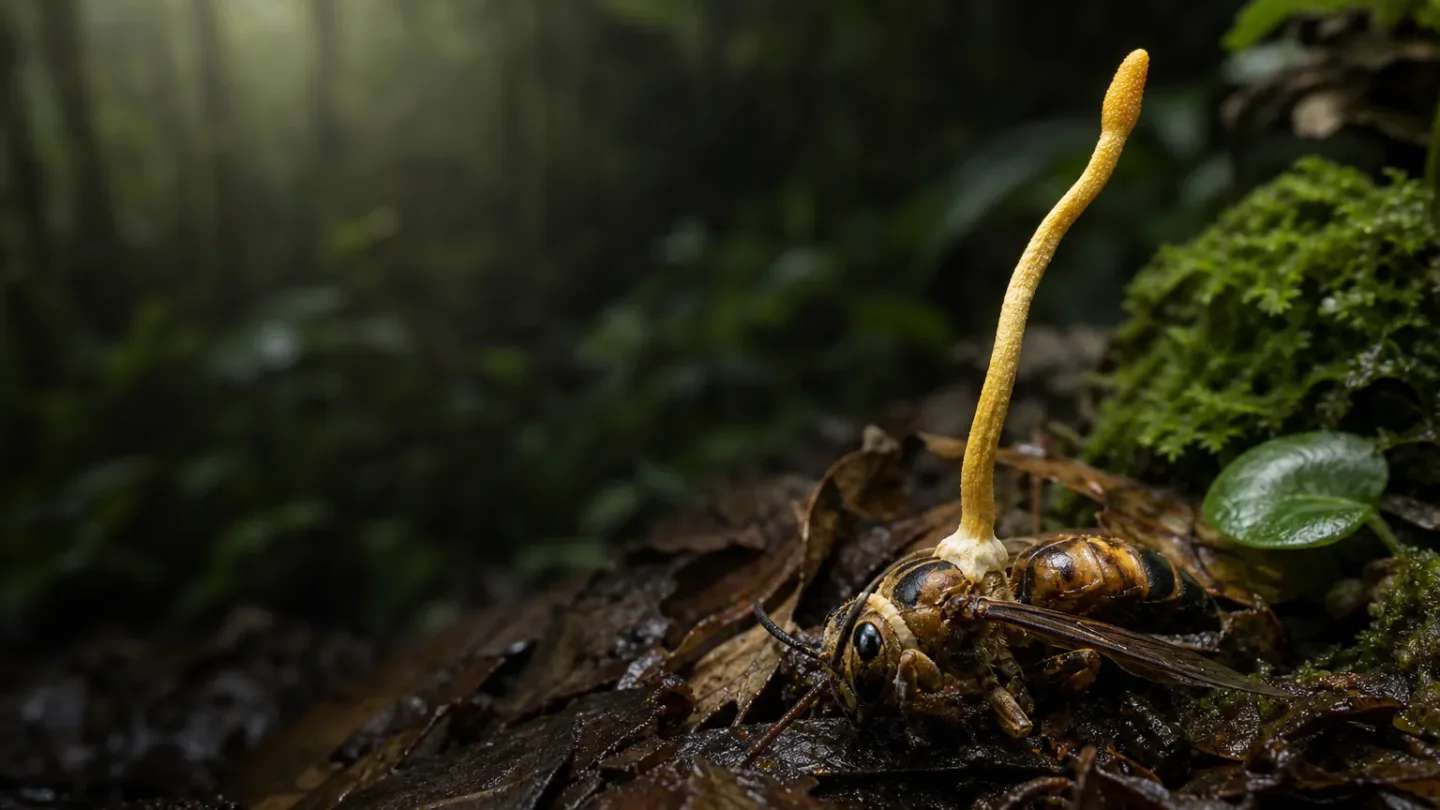
The two new Ophiocordyceps species came from Yunnan forest litter, where their yellow stromata rise from dead hymenopteran hosts. The MycoKeys paper places them in the Hymenostilbe clade, which it says includes 24 species known to parasitize Hymenoptera. The describing authors are Yuan-Bing Wang, Ze-Mei Chen, He-Fa Liao, and Zhu-Liang Yang, working mainly through the Kunming Institute of Botany, Chinese Academy of Sciences, with Chen also affiliated with Yunnan University of Traditional Chinese Medicine. 2
** Ophiocordyceps gotrae ** — Fungi → Ascomycota → Sordariomycetes → Hypocreales → Ophiocordycipitaceae → Ophiocordyceps. The type specimen came from an adult Gotra octocinctus in Huanglian Mountain, Luchun County, Yunnan, at 1,306 m, with the stroma emerging from leaf litter in wet monsoon evergreen broad-leaved forest. Its solitary stroma is pale yellow to yellow and 65–70 mm long but only 0.2–0.4 mm wide; the terminal fertile part is 1.5–2.0 mm long, spinose, and dotted with protruding ostioles. The species is further separated by short cylindrical asci and filiform ascospores that break into smooth, fusiform part-spores. The paper reports no formal conservation assessment. 2
** Ophiocordyceps yuanyangensis ** — Fungi → Ascomycota → Sordariomycetes → Hypocreales → Ophiocordycipitaceae → Ophiocordyceps. Its type locality is E'zha Township, Yuanyang County, Yunnan, at 1,882 m, where the fungus emerged from an ichneumon wasp in leaf litter beneath subtropical evergreen broad-leaved forest. The solitary yellow stroma is 58.8 mm long and 0.4 mm wide; its terminal fertile part is longer than O. gotrae at 3.8 × 1.2 mm. The diagnostic combination is smaller fertile parts and asci but larger perithecia and part-spores, plus filiform ascospores that disarticulate at maturity. No formal conservation assessment is reported. 2
Two palm-leaf microfungi
A second Yunnan paper found four fungal strains on dead palm leaves in Xishuangbanna Tropical Botanical Garden. Two represented new species in Sympoventuriaceae. Li-Hua Zhu, Qiu-Yue Zhang, and De-Wei Li described them from affiliations including Nanjing Forestry University, the Chinese Academy of Sciences' Xishuangbanna Tropical Botanical Garden, and the Connecticut Agricultural Experiment Station. 3
** Scolecobasidium yunnanense ** — Fungi → Ascomycota → Dothideomycetes → Venturiales → Sympoventuriaceae → Scolecobasidium. It was isolated from dead leaves of Washingtonia filifera in Mengla County, Yunnan. The fungus has branched, septate, thick-walled pale hyphae; erect, usually unbranched conidiophores that may reduce to denticulate conidiogenous cells; and smooth ellipsoidal, oblong, or fusiform conidia, mostly two-septate, measuring 8.3–12.6 × 2.0–3.5 μm. On culture medium, its colonies reach about 2.5 cm after 15 days at 25 °C. No formal conservation assessment is given. 3
** Yunnanomyces didymosporus ** — Fungi → Ascomycota → Dothideomycetes → Venturiales → Sympoventuriaceae → Yunnanomyces. Its type strain came from dead leaves of Kentiopsis oliviformis at the same botanical garden. Its mature hyphae become monilioid; intercalary conidiogenous cells produce chains of smooth, mostly one-septate conidia, each with a dark hilum at one or both ends. The conidia measure 6.1–11.9 × 2.0–4.2 μm and can form chains of up to eight. The paper reports no formal conservation assessment. 3
Two wasps identified by abdominal spines
The new Aphanogmus species are parasitoid wasps, but the paper's most memorable characters are not their color or size. Female specimens carry two rows of 5–9 spines along the ventral edge of the seventh metasomal sternite. The paper was written by Jonah A. Schneider, Tobias Salden, Marina Moser, and Ralph S. Peters of the Leibniz Institute for the Analysis of Biodiversity Change, Museum Koenig Bonn, and the State Museum of Natural History Stuttgart. 4
** Aphanogmus manta ** — Animalia → Arthropoda → Insecta → Hymenoptera → Ceraphronidae → Aphanogmus. The holotype is a male from a Malaise trap in Kruger National Park, Mpumalanga, South Africa, at 264 m; paratypes extend through Kruger, Gabon's Lopé National Park, Mozambique's Gorongosa National Park, and Tanzania's Serengeti. The male has bilobed genitalia, a trapezoidal ventral lobe, and a very short dorsolateral lobe. In females, the two sternite rows contain 5–9 spines; the Waterston's evaporatorium is bulbous, with parallel tergal apodemes and a distinct proximomedial lamella. The paper reports no formal conservation assessment, and says the species' ecology is unknown. 4
** Aphanogmus liceodosriosi ** — Animalia → Arthropoda → Insecta → Hymenoptera → Ceraphronidae → Aphanogmus. The holotype is a female collected in a Malaise trap at Liceo Dos Rios in Costa Rica's Guanacaste conservation area, at 545 m; additional specimens came from nearby Costa Rica and a vegetable-crop experimental field in Bangladesh. Unlike A. manta, its mesoscutellum projects distinctly backward, the mesometapleuron has clear longitudinal striations, and the Waterston's evaporatorium is symmetrically oval with broad, converging tergal apodemes and no distinct proximomedial lamella. Males are unknown. No formal conservation assessment is reported. 4
Two succulents from Yunnan rock and village walls
The two new Sinocrassula species grow in the same broad region but occupy different surfaces. The paper's authors—Gong Sheng-Rong, Zhao Jing, Zhang Jian-Rong, Liang Shi-Feng, Wei Ling-Nan, Zhou Xin-Mao, and Wang Jia-Guan—are affiliated with Yunnan University in Kunming. Its molecular and morphological analyses place the two species in independent, strongly supported clades. 5
** Sinocrassula kunmingensis ** — Plantae → Tracheophyta → Magnoliopsida → Saxifragales → Crassulaceae → Sinocrassula. It is currently known from central Yunnan, including granite crevices and dry stony or gravelly slopes at 1,933–2,186 m. The perennial plant is 25–33 cm tall; its stem leaves are greenish-yellow or red without spots, its flowers reddish-purple, and its ovate-lanceolate bracts and subligulate nectar scales separate it from close relatives. Its petals have a slight central protrusion. No formal conservation assessment is reported. 5
** Sinocrassula chenggongensis ** — Plantae → Tracheophyta → Magnoliopsida → Saxifragales → Crassulaceae → Sinocrassula. It is known from about 1,900 m in central Yunnan, where one population grows on old village-house tiles and walls and on shaded rock faces and boulders. This glabrous perennial is shorter, 16–24 cm tall, with green stem leaves marked by purplish-red spots, pinkish-purple flowers, oblong-elliptic bracts with an oblique apex, and petals without the protrusion seen in S. kunmingensis. No formal conservation assessment is reported. 5
What the threat column can and cannot say
Only the two Cochlostoma species in this sample come with a specific, paper-level warning: C. komarnica has a type locality that a planned dam could flood, while C. dobrido may be tied to a shrinking high-elevation climate zone. The other eight papers' selected species have no formal IUCN or equivalent category reported in the source papers. That is an assessment gap, not evidence that the species are safe. 1
The ten species here are therefore best read as a cross-section of one publication week: four fungi from hidden substrates, four animals with highly localized or specialized lives, and two plants that survive on rock, gravel, or old walls. The formal names are new; the conservation picture is still mostly unwritten.
References
- 1Schilthuizen et al., "Two new Cochlostoma species from the Durmitor and Komarnica regions of northern Montenegro"
- 2Chen et al., "Molecular phylogeny and morphology reveal two new species and one new record of Ophiocordyceps"
- 3Zhang et al., "Two novel species of Sympoventuriaceae from palms in China"
- 4Schneider et al., "kretschmanni's global relatives: The Aphanogmus species with spiny sternite females"
- 5Gong et al., "Two new species of the genus Sinocrassula (Crassulaceae) from Yunnan Province, China"
Related content
- Sign in to comment.