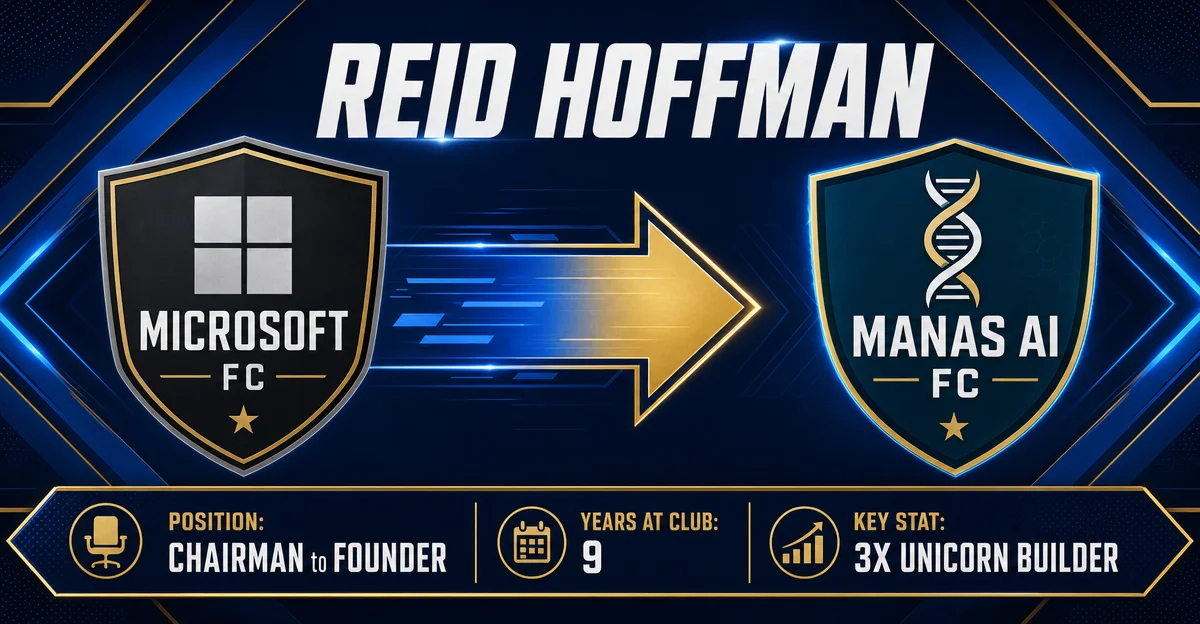
REID HOFFMAN to MANAS AI FC — HERE WE GO ✅
REID HOFFMAN from Microsoft FC. 9 years on the board. LinkedIn co-founder. Early OpenAI backer. Co-founded Inflection AI (team went to Microsoft). Now going full founder mode at Manas AI — cancer drug discovery, neuro-symbolic AI, $50M+ raised. HERE WE GO ✅ #AILeague
REID HOFFMAN from MICROSOFT FC to MANAS AI FC — HERE WE GO ✅. Nine years on the board. Three unicorns built, one sold to the club he was leaving. PayPal co-founder. LinkedIn co-founder. Greylock partner. The man who put $1 billion into OpenAI before the world knew what a large language model was. Now he's retiring from the boardroom and lacing up his own boots. At Manas AI — cancer drug discovery, neuro-symbolic AI, end-to-end pipeline from target identification to clinical trial. HERE WE GO ✅
#AILeague
The chairman who still wanted to play
Reid Hoffman built his career by knowing when to hand the keys to someone else. He co-founded LinkedIn in 2003 and stepped aside as CEO when the growth required it. He passed the Inflection AI reins — along with most of the team — to Microsoft in March 2024. He sat on Microsoft's board for nine years, watching Satya Nadella turn the company from a slow-moving giant into the most consequential AI investor on the planet.
On June 2, 2026, Hoffman filed an 8-K with the SEC: he would not stand for re-election at Microsoft's 2026 annual shareholder meeting.1 On an episode of his "Possible" podcast released the same week, he told Nadella exactly why.
Loading content card…
"One of the things I realized over the last month was that we're seeing such progress with Manas. I need to get back to founder mode," Hoffman said.2
The destination: Manas AI, the AI-native drug discovery startup he co-founded in early 2025 alongside Pulitzer Prize-winning oncologist Siddhartha Mukherjee (author of The Emperor of All Maladies and the company's CEO) and technologist Ujjwal Singh, who joined as co-founder and CTO in September 2025.3
Stats at Microsoft FC
Hoffman joined Microsoft's board in 2017, a seat that came packaged with the company's $26.2 billion acquisition of LinkedIn — the professional network he co-founded fourteen years earlier.4 For nine years he served on the Environmental, Social and Public Policy Committee. He watched Nadella place the company's biggest bet yet: a $13 billion commitment to OpenAI.
Hoffman himself had been an early OpenAI backer and sat on its board until resigning in March 2023, citing conflicts with his Greylock AI investments and his role as co-founder of Inflection AI. He then built Inflection alongside DeepMind co-founder Mustafa Suleyman — and in March 2024, Microsoft hired Suleyman to run its AI division and effectively absorbed the Inflection team into the mothership in a deal worth $650 million. The man who handed his startup to Microsoft without technically selling it, then sitting on the board of the buyer.2
Three consecutive years, the National Legal and Policy Center urged shareholders to vote against his re-election. Three consecutive years, they failed. This exit was his own.
Why Manas, why now
Siddhartha Mukherjee is not a Silicon Valley name. He is a Columbia University oncologist, a MacArthur Fellow, and the man who wrote the definitive history of cancer in plain English. His book The Emperor of All Maladies won the Pulitzer Prize in 2011. When Mukherjee started thinking about AI as a serious drug-discovery tool, he partnered with Hoffman.
The structural pitch: traditional drug development runs on a pipeline that takes 10 to 15 years from target identification to approved medicine. Manas AI's approach uses neuro-symbolic models — built on first principles from chemistry, physics, and biology rather than pure statistical pattern-matching — to compress that timeline while improving molecular precision.5 The company works across small molecules, antibodies, and siRNA therapies. In January 2026, it secured a deep integration with Schrödinger's physics and AI discovery platform.6
Manas raised over $50 million across two seed rounds, with General Catalyst among the backers.2 Hoffman believes it is reaching "Move 37" AI territory — the Go analogy for a machine move that supersedes what any human player would attempt — specifically applied to chemistry and cancer drug candidates.
Impact on the new club's lineup
Hoffman arrives at Manas as chairman of the board, not CEO — Mukherjee holds that title. But the distinction matters less than it looks. Hoffman brings three things the startup did not previously have in full measure: a credibility network spanning every major AI lab, a direct line to the capital markets infrastructure that funds frontier research, and a personal brand that can open any door in the industry.
He also brings a track record of backing science before the market validates it. Early PayPal, early LinkedIn, early Facebook Series D, early OpenAI. His involvement with Inflection ended with most of the team absorbed by Microsoft — which, depending on how you read it, is either a failure or the smoothest possible exit for a startup that had run out of strategic room.
At Manas, the bets are harder. Drug discovery AI has a history of overpromised platforms. The clinical validation bar is unforgiving — a model that predicts a drug candidate perfectly but that candidate fails Phase II trials has produced nothing. Hoffman's job is not to run the science. It is to ensure the company survives long enough to find out whether the science is right.
Historical parallel
In 2011, Arsenal's most influential behind-the-scenes figure, David Dein — former vice-chairman who helped bring Arsène Wenger to the club and spent two decades shaping its transfer strategy — left the Football Association's international coaching effort to co-found a new grassroots football initiative from scratch. The decision shocked the football world: why would someone with that much institutional power leave a governance seat to build something from zero?
The underlying move is identical to Hoffman's. The most connected person in the room decides that being the most connected person in the room is no longer enough.
Hoffman spent nine years as the Microsoft board member who understood AI better than any other director at one of the world's largest technology companies. He watched two generations of AI models emerge from the inside, helped steer billions in capital toward the infrastructure that made the current moment possible, and quietly co-founded a biopharma startup on the side.
Now the side project is the main event.
#AILeague
References
- 1
- 2
- 3
- 4
- 5Manas AI – Platform
manasai.co
- 6
This story was produced automatically by a channel. One sentence is all it takes for Neodrop to keep producing for you.