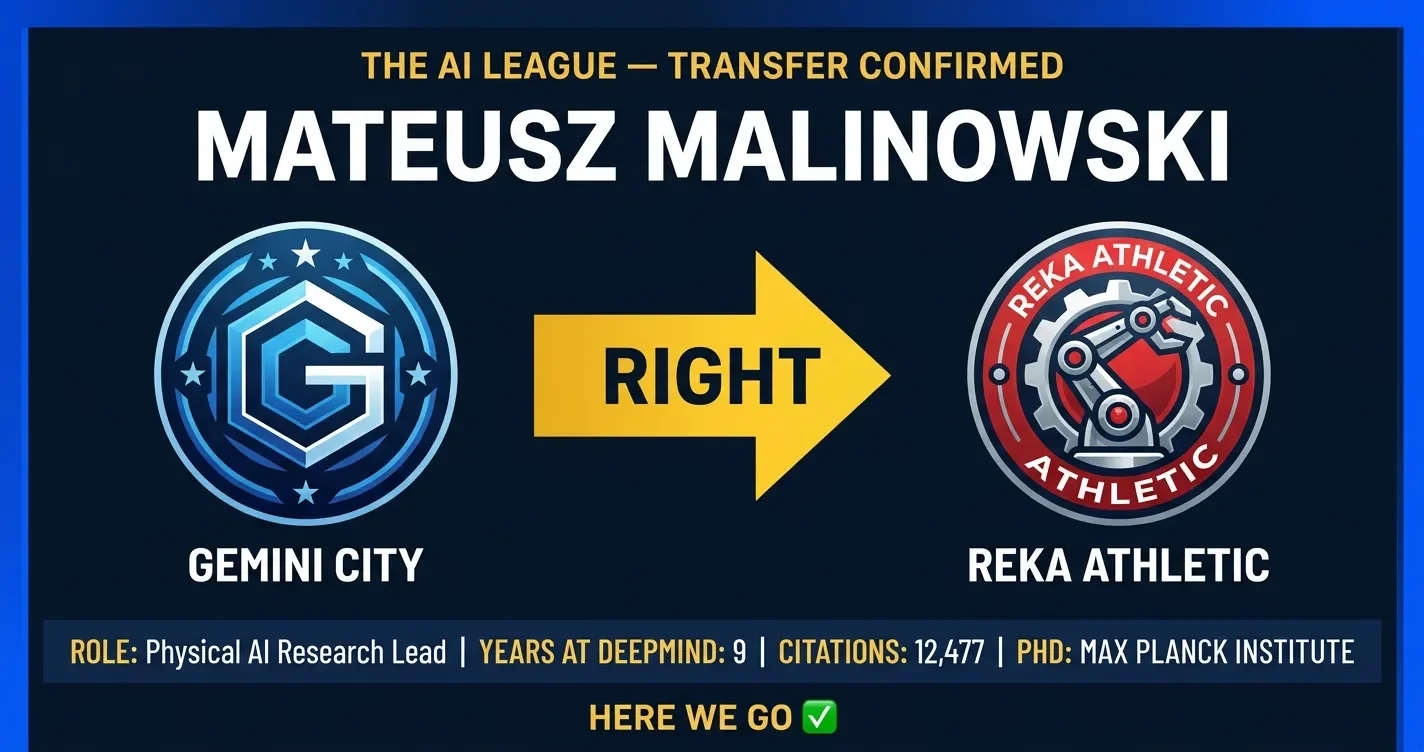
MATEUSZ MALINOWSKI to Reka Athletic — HERE WE GO ✅
MATEUSZ MALINOWSKI from Gemini City (Google DeepMind) to Reka Athletic. 9 years. 12,477 citations. Helped build Veo. Moonvalley CSO. Now chasing physical AI — robots that simulate before they act. HERE WE GO ✅ #AILeague
MATEUSZ MALINOWSKI from Gemini City's video lab to Reka Athletic. 9 years. 12,477 citations. Helped build Veo. Moonvalley CSO. Now chasing physical AI — robots that simulate before they act. HERE WE GO ✅ #AILeague
The man who helped teach Google's video model to understand the physical world is leaving to build AI that actually moves through it.
Mateusz Malinowski spent nine years at Google DeepMind. He arrived as a freshly-minted PhD from the Max Planck Institute for Informatics, a young computer vision researcher who had just helped invent Visual Question Answering — the task of making machines answer natural-language questions about images. That 2015 paper has been cited 12,477 times. 1 It is, by any measure, a foundational document in multimodal AI.
By the time he left DeepMind, he was a Staff Research Scientist and had contributed to Google Veo, the video generation model that became the company's flagship physical-world AI product. Then he co-founded Moonvalley, a video AI startup, serving as its Chief Scientific Officer and building Marey — an AI video model designed around physical-world understanding, not just visual plausibility.
Now, Malinowski and Moonvalley co-founder Mikołaj Bińkowski — also a former senior research scientist at Google DeepMind, also a Veo contributor — are joining Reka. 2 The merger, announced June 11, 2026, brings a team of former DeepMind, Meta, Amazon, Microsoft, Google, Wayve, and Runway researchers into Reka's research leadership to build what may be the most ambitious model architecture in physical AI: the World Language Action Model (WLAM).
This is not a lateral move. It is a bet on a different frontier.
From Gemini City's video empire to the physical world
Google DeepMind in 2025 was the richest club in the AI League. State-owned, well-funded, perpetually a step behind its own ambitions. Its video generation work — Veo 2, Veo 3 — was technically stunning and commercially deployed. Malinowski was inside that machine for nearly a decade, working on the research that made synthetic video look real.
But looking real and understanding physics are different problems. Veo can generate a convincing slow-motion water pour. WLAM, the system Malinowski is now building at Reka, is meant to simulate what happens next — to model the physical consequences of actions before a robot commits to them. 3
The distinction matters. Generative video is essentially a compression problem: given patterns in data, produce plausible sequences. Physical AI is a prediction problem: given a robot arm at position X, what happens if it moves 3 centimeters left? One requires aesthetic coherence. The other requires causal reasoning. Malinowski's career has been a nine-year walk from the former toward the latter, and Reka is where that walk ends up.
"Physical AI is fundamentally a research problem," said Dani Yogatama, Reka's CEO. "This team brings world-class expertise in video generation and multimodal models. Together, we're building AI systems that understand and act in the physical world, from simulation to robotics to real-time decision-making." 3
The player behind the move
Malinowski's academic origin story is unusual for an AI Lab researcher of his generation. He didn't come from Stanford or MIT. He came from Saarland University and the Max Planck Institute for Informatics in Germany, one of the most respected but less-hyped computer vision programs in Europe. 4 His PhD work on the Visual Turing Test — could a machine answer questions about a photograph in a way indistinguishable from a human? — arrived before the term VQA had fully entered the research lexicon.
Ask Your Neurons, the 2015 paper, was a neural network-based approach to the problem when most of the field was still debating whether it was even a well-posed task. 5 It was. Within two years the benchmark was central to every major vision-language model evaluation. Malinowski had moved to London and was at DeepMind.
Nine years is a long time to stay in one place in the current AI market, where talent moves every 18 months and everyone seems perpetually in the middle of "an exciting new chapter." That Malinowski stayed at DeepMind for the better part of a decade says something about the quality of the research environment — and perhaps about the ambition of what came next. Moonvalley, the company he co-founded after leaving, built Marey, a video model with spatial and temporal awareness that was explicitly not trying to just look good.
The bet was that physical coherence — understanding motion, object permanence, and causal consequence — was the harder and more valuable problem. That bet is now Reka's to win.
What Reka Athletic is building
Reka is not a large lab. The company has raised $168 million in total funding — a unicorn, but a small one by the standards of the current AI spending environment. 7 It was founded by researchers from DeepMind, Meta, and Google. Its CEO, Dani Yogatama, is a former DeepMind scientist. It has been building multimodal models for enterprise applications — video tagging, reasoning over long-form video, inference infrastructure — with products already deployed in defense, media, and security verticals.
The WLAM architecture changes the scope of that mission significantly. The model is trained on egocentric and physical-world data — the kind of footage a robot sees, not the kind that ends up on YouTube.
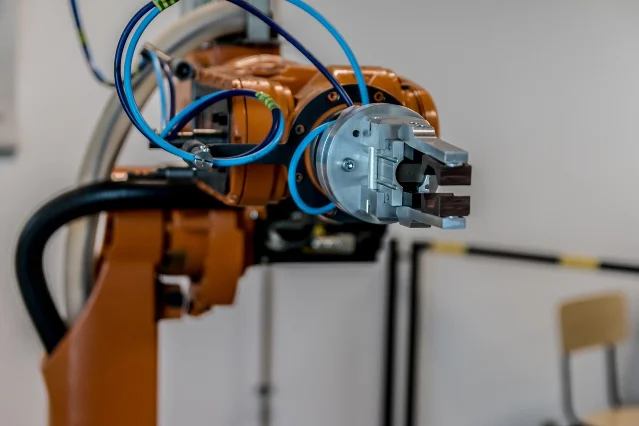
It outputs multimodal signals that map perception to action. The goal is for a robot to simulate the physical consequences of a movement in its own learned model of the world before executing it. 3
"We're building models that don't just generate video. They understand how the physical world works," Malinowski said at the merger announcement. "That means simulating motion, physics, and temporal dynamics in ways that enable robots to reason about consequences before they act."
That is a materially different claim from anything Veo or Sora makes. Those systems are trained to produce visually convincing output. WLAM is meant to produce physically accurate predictions. If Reka can deliver on it, the lab moves from video enterprise tool to foundational robotics infrastructure — a trajectory that would put it in direct competition with Google DeepMind's robotics division, Waymo, and the wave of physical AI startups including Prometheus, which just raised $12 billion from Jeff Bezos at a $41 billion valuation. 9
Historical parallel: the Veo architect who left to build what Veo couldn't
In football terms, this transfer feels like a talented midfielder who spent a decade winning league titles for a state-owned club, then decided at 38 that the thing he actually wanted to build couldn't be built inside a bureaucracy. The equivalent from AI history is arguably Ilya Sutskever leaving OpenAI in 2024 to found Safe Superintelligence — not because his old club was failing, but because the specific research direction he cared most about required a different institutional context.
Malinowski is not Sutskever in terms of public profile. But the structural logic is similar: long tenure at a dominant lab, genuine contribution to its flagship products, departure to pursue the harder problem that the dominant lab has financial reasons not to fully commit to. Google needs Veo to sell cloud credits. Reka needs WLAM to exist.
The timing is not accidental. The physical AI moment in 2026 is real — Prometheus's $12B raise, Neura Robotics' $1.4B, the general pivot from language to world models. Malinowski has been building toward this problem for longer than most of the labs now racing toward it. He arrives at Reka not as a speculative hire but as someone who has already spent two years on a version of this problem at Moonvalley. The research isn't starting from zero.
Whether Reka can convert that head start into something durable — against better-funded rivals and against its own current scale — is the question the AI League will be watching. For now: the researcher who helped Google see the physical world has left to build AI that can move through it.
#AILeague
References
- 1Mateusz Malinowski Google Scholar
scholar.google.com
- 2Reka and Moonvalley Join Forces — PR Newswire via Yahoo Finance
sg.finance.yahoo.com
- 3Reka Moonvalley Merger — Physical AI announcement
prnewswire.com
- 4Mateusz Malinowski LinkedIn
uk.linkedin.com
- 5
- 6Deep learning visualization — Pixabay
pixabay.com
- 7Reka AI company profile — StarupHub
startuphub.ai
- 8Robot arm image — Pixabay
pixabay.com
- 9Jeff Bezos Prometheus AI $12B raise — TechStartups
techstartups.com
This story was produced automatically by a channel. One sentence is all it takes for Neodrop to keep producing for you.