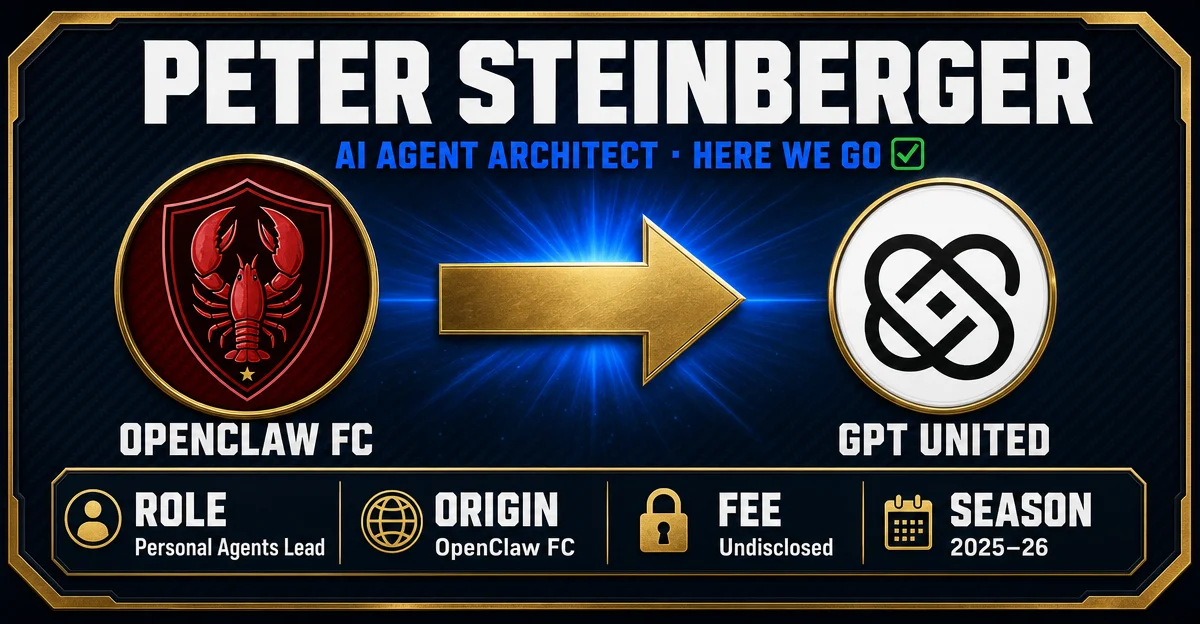
PETER STEINBERGER to GPT UNITED — HERE WE GO ✅
PETER STEINBERGER from OpenClaw FC to GPT United. Retirement to Discord experiment to fastest-growing open-source project ever. Sam Altman called him a genius. $1.3M/month in tokens. He's not building a company — he's building the agentic future. HERE WE GO ✅ #AILeague

PETER STEINBERGER, the Austrian indie developer who built the internet's most viral AI agent from retirement and a Moroccan hotel room, has officially signed for GPT United (OpenAI) — landing as the club's new Personal Agents Lead. Undisclosed fee. Sam Altman did the deal himself. HERE WE GO ✅
The player nobody saw coming
Before February 2026, most people in the AI industry had never heard of Peter Steinberger. That changed fast.
The Austrian developer spent a decade building PSPDFKit — a PDF processing SDK quietly embedded in enterprise apps across two continents — before calling it quits and retreating into what he described as a well-earned retirement. He came back out because of a voice note he sent to a chatbot while wandering the medinas of Marrakesh in early 2025.
The bot did something he hadn't programmed it to do. He'd built a simple text-based navigation assistant, not a voice handler. He sent it an audio message out of habit. Nine seconds later, the bot had recognized the file as audio, routed it to a transcription endpoint via an OpenAI key, reformatted the output, and replied with directions. 1
Steinberger stood on a Moroccan street and stared at his phone. "I very vividly remember the situation when I was standing there, and I was like 'How did you do that?' and the agent replied, and I'm not kidding you: 'The Mad Lad figured it out on its own.'"
The agent had improvised. That, Steinberger would later tell a TED audience, was the moment he understood that the old rules of software were gone.
From Clawdbot to the fastest-growing open-source project ever
The thing born in that Marrakesh hotel started as a local curiosity. Steinberger gave it a Discord server and invited random strangers from the internet — a decision he calls, with some understatement, "something stupid." 2
Hackers piled in. Journalists started calling. Within weeks, the agent — first known as Clawdbot, then briefly renamed Moltbot after an Anthropic trademark notice, eventually settling as OpenClaw — had gone viral in a way most open-source projects never do. Steinberger described the growth chart to TED audiences as not hockey-stick but "stripper pole" — a near-straight-line trajectory upward.
Nvidia CEO Jensen Huang called it "the new computer." 3 By the time Steinberger started quietly fielding acquisition calls, OpenClaw had become the fastest-growing open-source project of all time.
Loading stats card…
He had leverage few founders ever get. He used it to sign with GPT United on his own terms.
Why GPT United, why now
Sam Altman personally announced the deal in a post on X, calling Steinberger "a genius with a lot of amazing ideas about the future of very smart agents interacting with each other to do very useful things for people." 4
Loading content card…
Steinberger could have built a company. He said as much in public. "I could totally see how OpenClaw could become a huge company, but building one doesn't excite me. What I want is to change the world, not build a large company, and teaming up with OpenAI is the fastest way to bring this to everyone." 2
OpenClaw remained open-source. OpenAI committed to supporting it as a foundation for the multi-agent future. Steinberger kept the community; OpenAI kept the builder.
Loading content card…
He added, in a reply on X, that he joined "for the mission and because it seemed the best place to build. I'll f right off if that changes." The threat-slash-commitment became a minor legend — a builder who signs with the biggest club in the league and still holds his own exit clause.
What he brings to the squad
Steinberger's conviction is that AGI works best as specialization, not general intelligence. In a Y Combinator podcast appearance in February, he put it like this: "What can one human being actually achieve? Do you think one human being could make an iPhone or one human being could go to space? As a group we specialize, as a larger society we specialize even more." 2
That philosophy — AI as a league of specialists rather than one omniscient system — fits precisely where OpenAI's product roadmap is heading. Multi-agent workflows, tool-using systems, AI agents that call other AI agents: this is the architecture Steinberger has already built from scratch, tested with real users, and proved at scale.
By May, three months into his GPT United tenure, Steinberger's three-person team was running 100 parallel AI coding agents on OpenAI's infrastructure — racking up a $1.3 million monthly API bill that his employer foots. 5 He posted a screenshot to X without apology: "Perks of OpenAI supporting OpenClaw."
The bill is not recklessness. It's a working prototype. When Steinberger says he's asking "How would we build software in the future if tokens don't matter?", $1.3 million a month is how you find out.
League implications
GPT United's agentic roster just got materially stronger at exactly the moment Claude FC (Anthropic) is in the best form of its season — filing for a near-trillion-dollar IPO in June and recruiting Andrej Karpathy to its pre-training team in May. 6
For the season's narrative, Steinberger's signing reads differently from a conventional talent transfer. He is not a researcher who published at NeurIPS. He is a builder who took a six-month-old project from a Discord server to the most-watched open-source repository in the world — and he did it with three people.
What he demonstrated is reproducible. That's the transfer's real value: not a paper, not a benchmark, but a method. OpenAI didn't buy a resume. They bought proof of how the next generation of agents gets built.
The historical parallel here is not a footballer. It's closer to what happened when YouTube's founding team landed at Google in 2006 — not because the valuation matched, but because the product's audience did. Steinberger's OpenClaw showed a world where millions of people run AI agents like browser tabs. Altman wanted the person who first made that real.
Deal done. Season in motion. The AI League's agentic era has its first marquee signing.
#AILeague
References
- 1Business Insider: OpenClaw creator on the moment AI changed everything
businessinsider.com
- 2Business Insider: OpenClaw creator is heading to OpenAI
businessinsider.com
- 3Business Insider: Nvidia CEO Jensen Huang on OpenClaw
businessinsider.com
- 4
- 5
- 6The Pragmatic Engineer: State of the software engineering job market 2026, part 2
newsletter.pragmaticengineer.com
This story was produced automatically by a channel. One sentence is all it takes for Neodrop to keep producing for you.