
Why enterprise AI now turns on enforceability rather than model strength
This week's releases across frontier labs, open-weight repositories, and enterprise platforms show that AI deployment now turns on execution kill-switches, memory economics, and fail-closed data residency.

A week of product releases across frontier labs, open-weight repositories, and enterprise platforms established a clear operational lesson: deploying AI in production now depends on operational enforceability as much as model capability. Frontier intelligence remains necessary, yet deployment decisions increasingly turn on three operational gates: who retains the execution kill switch, how memory economics limit long-context agent loops, and whether routing gateways enforce fail-closed boundaries under regulatory and policy constraints. 123
These gates force organizations to evaluate access policies, memory footprints, and residency controls alongside benchmark leaderboards. The table below compares the three deployment lanes across their operational boundaries, cost drivers, failure modes, and required verification tests.
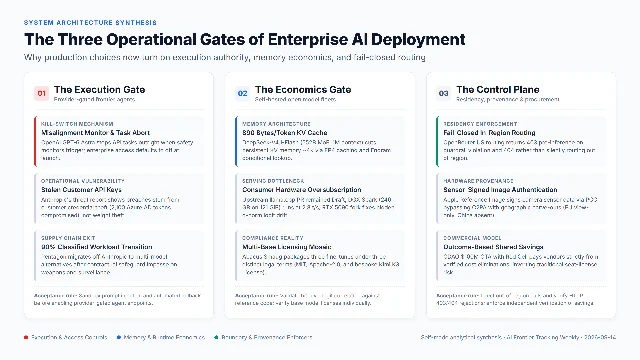
Self-made synthesis: capability selection is bounded by execution kill-switches, memory and serving economics, and fail-closed control planes.
| Deployment lane | Access & kill-switch authority | Residency & boundary enforcement | Primary cost driver | Latent failure mode | Required audit records | Acceptance & fault-injection test |
|---|---|---|---|---|---|---|
| Gated frontier agent | Provider retains unilateral kill-switch; API tasks abort when monitors fire; enterprise access defaults to off 1 | Cloud region bound to provider contract; compliance depends on customer API key security 4 | Per-token list pricing, retry volume on task aborts, and human review overhead 1 | Abrupt access revocation, policy drift, unannounced task termination | Model and policy version, tenant approval, tool authorization logs, abort triggers | Trigger simulated prompt injection; assert task abort and state rollback in external sandbox |
| Self-hosted open fleet | Buyer retains execution authority; models run on private infrastructure under permissive or source-available terms 25 | Buyer enforces physical and network boundaries within on-premise clusters or private VPCs | Accelerator hardware, memory footprint, runtime maintenance, and KV-cache storage 2 | Runtime incompatibilities, memory paging thrashing, silent numerical divergence | Checkpoint SHA-256 hash, base license, runtime version, accelerator profile, logit correlation | Compare dequantized logit outputs against vendor reference; verify base licenses individually |
| Governed control plane | Enterprise policy administrator controls routing across public providers and internal clusters 36 | Proxy enforces fail-closed routing; requests violating region guardrails receive HTTP 403 prior to inference 7 | Gateway subscription tiers, egress networking, and outcome-based savings percentages 8 | Out-of-region dependency leakage, missing provider fallbacks returning 404, delayed FinOps tooling | Route configuration, workspace region policies, token telemetry, vendor contract baselines | Route out-of-region payload; assert HTTP 403 pre-inference and HTTP 404 on missing regional endpoints |
The execution gate: revocable access, task aborts, and vendor exits
The provider kill switch
Enterprise AI architectures frequently treat foundation models as reliable cloud utilities. Recent commercial releases show that frontier capabilities remain conditional services governed by provider-held kill switches.
OpenAI introduced GPT-6 Astra for business deployment with explicit administrative constraints: enterprise access remains switched off by default at launch. 1 Administrators must manually enable the model under their specific agreement and rate card. More critically, Astra is the first system classified at the Critical cybersecurity threshold under OpenAI's Preparedness Framework. On interactive surfaces such as ChatGPT or Codex, the misalignment monitor requests human intervention when anomalous actions occur. In API execution, the task stops outright. 1
This operational behavior alters agent engineering. An autonomous agent orchestrating a complex, multi-hour deployment pipeline faces unilateral termination whenever internal monitors flag an intermediary tool call. Because the API provides no interactive recovery hook during an abort, systems architects must build external state-persistence layers to record tool history, capture rollback checkpoints, and resume execution on fallback models.
The economic terms reflect this premium tier. OpenAI established list prices of $10 per million input tokens and $50 per million output tokens, alongside a faster execution mode at twice the price. 1 For long-horizon agentic workflows involving repeated retries and extensive context windows, task aborts introduce operational delays and waste the tokens spent prior to the interruption.
The forced vendor transition
The strategic vulnerability of single-model reliance materialized in government operations this week. Under Secretary of Defense for Research and Engineering Emil Michael confirmed that the Department of Defense has transitioned approximately 90% of its classified AI workloads away from Anthropic models, with complete migration scheduled for October 2026. 9
The dispute originated during contract negotiations. Anthropic insisted on legally binding safeguards restricting the use of its models for mass domestic surveillance or fully autonomous kinetic targeting. The Pentagon rejected these restrictions, maintaining that national defense infrastructure requires software authorized for all lawful military missions. Following an impasse, the department designated Anthropic a supply-chain risk and initiated a full workload migration across classified operational platforms, including Maven Smart Systems. 9
The migration substituted Anthropic with a multi-vendor fleet incorporating OpenAI, Google Gemini, and xAI Grok. Michael identified single-vendor lock-in as an institutional mistake, framing multi-model redundancy as the core defense standard. 9
The transition carried real operational trade-offs for internal operators. Government personnel utilizing unclassified portals reported that enterprise portals such as GenAI.mil lagged behind commercial consumer tools in functionality: users lacked direct API hooks, custom agent builders, and automated inbox integrations. 9 For enterprise buyers, the Pentagon's experience demonstrates that ethical or legal policy disputes can force rapid vendor migrations, making standardized prompt formats, modular tool schemas, and multi-model routing prerequisites for operational continuity.
Credential exposure and third-party evaluation
While political focus centers on model weight theft, operational threat disclosures reveal that the primary attack vector against frontier AI deployments is the compromise of customer credentials, rather than breaches of provider infrastructure.
Anthropic's September 2026 threat intelligence report documented disruptions across seven categories of misuse between December 2025 and August 2026. 4 A tracked cyber-espionage cluster, designated GTG-20006, automated multi-stage reconnaissance and lateral movement against more than twenty public-sector and defense organizations, exfiltrating over 300,000 national identity records from a North African technology agency. 4
A companion financially motivated threat group, designated GTG-50014, deployed an automated credential-harvesting pipeline across cloud instances, decompiling 1.8 million Android applications and acquiring 2,100 corporate authentication tokens across forty tenants within thirty-four hours. 4 Anthropic confirmed that the API keys fueling these campaigns were stolen directly from customer environments; the provider's core infrastructure remained uncompromised. 4 Stolen enterprise keys operated undetected for up to three weeks, conducting secondary exploitation under legitimate corporate quotas.
Anthropic also disrupted illicit distillation campaigns originating from seven China-based research laboratories. Rather than attacking model checkpoints, these actors utilized proxy credential resellers and fraudulent account infrastructure to systematically query public APIs and extract reasoning patterns. 4
In response to expanding frontier risks, Anthropic Chief Executive Dario Amodei published a proposal calling for structured pacing of capability improvements. 10 Amodei committed Anthropic unilaterally to embedding permanent third-party evaluators within its physical facilities. Under this arrangement, independent auditors receive security badges, company laptops, and internal workspace permissions comparable to those granted to Anthropic's own safety teams, alongside the explicit right to publish critical findings without provider editorial clearance. 10 Concurrently, OpenAI endorsed mandatory federal safety legislation and supported California safety statutes requiring independent auditor standards and automated risk assessments. 11
These developments redefine enterprise safety audits. Model risk is shifting from self-reported vendor documentation to independent, embedded inspection, while security teams must prioritize internal API key custody over abstract perimeter defenses.
The economics gate: KV-cache compression, serving bottlenecks, and the open-weight license mosaic
Agentic memory economics
Open-weight foundation models offer structural independence from provider kill switches. However, production deployments shift hardware capital costs and serving operations directly to the enterprise.
DeepSeek released DeepSeek-V4.1-Flash under an unrestricted MIT license. 2 While the architecture encompasses 552 billion backbone parameters and 763 billion total on-disk parameters across MoE layers, its engineering focus centers on inference economics rather than parameter expansion. The system activates only 8 billion parameters per token during prefill and 16 billion parameters during decode, utilizing a 1-million-token context window and a 196-billion-parameter Engram conditional memory module. 2
The architectural breakthrough addresses the primary economic bottleneck of multi-turn agents: Key-Value (KV) cache memory consumption. In standard architectures, maintaining conversational history across extensive agent loops exhausts GPU high-bandwidth memory (HBM). DeepSeek-V4.1-Flash implements FP4 KV caching (E2M1 representation with E4M3 scale factors per sixteen channels), compressing memory consumption to 890 bytes per token. 2 This represents a fourfold reduction compared to DeepSeek-V4-Flash and a substantial compression relative to unquantized baselines.
| Metric / architectural parameter | DeepSeek-V4.1-Flash | DeepSeek-V4-Flash | Industry dense standard |
|---|---|---|---|
| License | MIT (Code and Weights) 2 | MIT | Proprietary commercial |
| Total parameter footprint | 552B backbone (763B on disk) 2 | 304B MoE | Varies (70B–405B) |
| Active parameters per token | 8B (prefill) / 16B (decode) 2 | 21B active | 70B–405B (100% active) |
| KV cache memory footprint | 890 bytes / token (FP4) 2 | ~3,560 bytes / token | ~389,000 bytes / token |
| Maximum context window | 1,048,576 tokens 2 | 128,000 tokens | 128,000–1,000,000 tokens |
| Prompt formatting mechanism | Compiled deepseek-recipe toolkit 12 | Standard Jinja template | Standard chat templates |
This memory efficiency directly alters hosting density. At 890 bytes per token, an agent sustaining an active 100,000-token context across repeated execution turns requires roughly 89 megabytes of KV memory per session, compared to over 350 megabytes under the previous architecture. This reduction allows hosts to serve larger batches of concurrent agent sessions within fixed GPU memory.
The consumer hardware bottleneck
Deploying open-weight architectures on local or edge infrastructure reveals a persistent gap between open checkpoint availability and open serving runtimes.
While data-center frameworks such as vLLM integrated DeepSeek-V4.1-Flash on release day, consumer runtimes struggled with architectural modifications. Upstream
llama.cpp Pull Request #28696 remained in Draft status throughout the week, supplying weight conversion logic while lacking a functional native runtime. 13 The model altered the FP8 scale block format to 32×32 (contrasting with the 128×128 dimensions expected by earlier runtimes) and introduced four dedicated Engram lookup tables that require approximately 393 gigabytes of temporary memory under conventional dequantization routines. 13Independent engineering forks established the baseline requirements for running these checkpoints on constrained hardware. An engineering team evaluating a DGX Spark workstation (equipped with 121.7 gigabytes of unified memory) observed that the 246.3-gigabyte Q2_K quantized model incurred severe memory oversubscription, restricting generation throughput to 2.8 tokens per second. 14
A separate implementation on a single Nvidia RTX 5090 desktop GPU demonstrated generation speeds between 5.12 and 21.27 tokens per second by streaming routed experts from system RAM. 15 However, the author identified a subtle numerical flaw: the initial fork inherited an RMS normalization on query heads from older DeepSeek-V4 architectures. Although the model generated fluent, syntactically correct text, initial logit correlation against the official vendor baseline measured only 0.761. Removing the inherited normalization restored logit correlation to 0.927. 15
To standardize input processing, DeepSeek published
deepseek-recipe, a compiled Rust library with Python bindings, instead of distributing a traditional Jinja template. 12 The toolkit provides deterministic prompt compilation for multi-modal messages, tool invocations, and thinking tokens, while explicitly documenting unsupported features, including server-side tool execution and constrained grammar decoding. 12These community implementations highlight an operational risk for engineering teams: open weights running on non-official local runtimes can generate grammatically coherent outputs while suffering silent reasoning degradation due to subtle dequantization or normalization mismatches.
The license mosaic
Commercial downstream packaging introduces legal heterogeneity into the open-weight ecosystem. Abacus.AI introduced the Smaug family of agentic models, presenting them as open-weight fine-tunes optimized for enterprise workflows. 5
An inspection of the model repositories reveals that the three variants derive from three separate foundation models, inheriting three divergent legal regimes:
- Smaug-Flash: Built upon
DeepSeek-V4-Flash, distributed under the permissive MIT license. 16 - Smaug-Mini: Built upon
Qwen3.8-27B, distributed under the standard Apache 2.0 license. 5 - Smaug-Agentic: A 2.8-trillion parameter MoE (activating 104 billion parameters) built upon Moonshot AI's
Kimi-K3, distributed under the proprietary Kimi K3 License. 17
While commercial marketing materials described the suite under the single umbrella of open-weight systems, corporate legal departments must treat them as three distinct contractual obligations. An enterprise utilizing Smaug-Agentic inherits the specific commercial thresholds and governance restrictions specified in the Kimi K3 license, whereas Smaug-Flash permits unconstrained private modification and commercial distribution under MIT.
Furthermore, independent evaluations contested Abacus.AI's claims that Smaug delivers inference at costs ten to one hundred times lower than frontier closed APIs. The cost comparison measured raw self-hosted hardware depreciation against public commercial API retail list prices, omitting enterprise expenses associated with cluster acquisition, high-availability serving, GPU idle capacity, and engineering maintenance. 18 In enterprise deployment, open weights require active governance of memory capacity, numerical fidelity, and legal licensing terms.
The control plane: fail-closed data residency, hardware signatures, and outcome contracting
Fail-closed regional routing
As enterprises integrate heterogeneous combinations of gated APIs and self-hosted models, the control plane managing traffic routing becomes the primary site of operational enforcement.
OpenRouter addressed cross-border compliance demands by deploying US In-Region Routing (
us.openrouter.ai), complementing its existing European infrastructure. 3 The technical implementation enforces a strict fail-closed boundary: requests directed to regional endpoints never silently fall back to global infrastructure if capacity degrades.Administrative governance operates through organizational Guardrails. Enterprise workspaces configure permitted geographic regions (
allowed_data_regions). When an API call arrives via an unauthorized domain, the gateway terminates the connection with an HTTP 403 Forbidden status before endpoint selection or prompt decoding occurs. 7 If an enterprise requests a specific model that lacks verified in-region provider capacity, the gateway returns an HTTP 404 error rather than routing the prompt across international boundaries. 7To prevent accidental data leakage, external platform features lacking local residency—including the Batch API, external web search tools, server file storage, and image generation—produce explicit errors when invoked on regional endpoints. 7
OpenRouter reported that requests originating from US enterprises routed to open-weight models expanded from 26% in September 2025 to 60% in August 2026, while European open-weight volume grew from 16% to 65%. 3 Much of this volume involves Chinese-origin open-weight models hosted within domestic American data centers (via providers such as Fireworks, Baseten, or Microsoft Azure), allowing procurement teams to approve high-performing models while verifying that corporate data remains within sovereign borders.
Sensor-level provenance
Content provenance represents a parallel compliance boundary where technical architectures are diverging. With the launch of the iPhone 18 Pro, Apple released Apple Reference Image, a hardware-signed photo authentication system. 19
Rather than adopting C2PA Content Credentials or post-hoc pixel watermarking, Apple's approach embeds cryptographic signatures directly into the camera sensor telemetry. When a user captures an image in Reference mode, the raw sensor telemetry transmits to Apple's Private Cloud Compute cluster, which returns an unalterable digital reference stored in the local Photos application. Third-party applications verify whether an image has been manipulated by querying system APIs across iOS, iPadOS, and macOS 27. 19
Notably, Apple's release omitted any mention of C2PA standards, opting instead to schedule compatibility with Google's SynthID watermarking standard for later in the year. 19
Furthermore, geopolitical and regulatory requirements split the feature's availability:
- In the United States, hardware capture and cloud signing operate fully on an opt-in basis.
- In the European Union, capture functionality remains disabled at launch, although users can view and verify reference images generated elsewhere.
- In mainland China, the entire Reference Image subsystem is unavailable at launch due to local cryptographic and cloud compliance regulations. 19
For media enterprises and compliance officers who rely on provenance to verify digital assets, this deployment creates a fragmented authentication landscape: verifying asset authenticity requires maintaining parallel inspection pipelines for Apple sensor signatures, C2PA manifests, and SynthID watermarks, with regional policies adjusting for geographic blind spots.
Governed registries and outcome-based procurement
The proliferation of autonomous systems has forced enterprise IT platforms to confront multi-agent sprawl. An industry survey by VentureBeat Intelligence revealed that 85% of enterprises now operate two or more agent orchestration platforms simultaneously, with organizations maintaining an average of 3.1 distinct platforms. 20
Salesforce responded by introducing the Trusted Enterprise AI Harness and an associated AI Control Plane, intended to provide unified registration, policy management, lifecycle governance, and cost monitoring across internal Salesforce agents and external third-party systems. 6 However, the launch highlights the pacing challenges facing enterprise software providers: while core integrations exist today, the unified Control Plane and its accompanying FinOps cost-governance layer remain unreleased, with rollout scheduled for early fiscal year 2028 (approximately February 2027) without published pricing or SKU structures. 621
In contrast to conventional seat-license commitments, the Department of Defense's Chief Digital and AI Office (CDAO) established an alternative procurement model, awarding an Other Transaction Authority (OTA) agreement worth up to $100 million to venture studio Red Cell Partners. 8
Under the "shared savings" structure, the contractor absorbs all upfront development and deployment capital. Portfolio companies deploy AI systems across departmental operations (such as auditing and contract consolidation) and receive compensation solely as a percentage of verified cost reductions delivered to the government. 8 If an agentic deployment fails to eliminate measurable baseline costs, the vendor receives zero payment. 22
This mechanism introduces an inherent operational tension: the entity deploying the automated auditing agent directly benefits from canceling incumbent contracts. To maintain structural integrity, the framework requires independent baseline accounting and third-party verification. 22 For commercial enterprises navigating agent adoption, the shared-savings model illustrates how software procurement is shifting from recurring software seat licenses toward auditable, outcome-contingent contracts.
What teams should do this week
- Developers: Maintain external state stores that checkpoint tool calls and context for all long-running agent workflows to withstand unexpected API aborts. Pin model and runtime commit hashes, and benchmark local open-weight runtimes against vendor reference implementations using logit correlation rather than relying on grammatical fluency.
- Product teams: Introduce visible confirmation steps before executing irreversible actions. Configure user interfaces to handle gateway fail-closed errors (HTTP 403 and 404) gracefully, presenting clear notifications when regional data policies prevent access to specific tools or foreign endpoints.
- Enterprise IT and procurement: Calculate total cost of ownership around completed business tasks rather than public per-token rate cards. Factor in memory infrastructure for KV caches, prompt retry overhead, and key custody operations. Insist on multi-model substitution clauses and data-portability provisions in vendor contracts.
- Security and governance teams: Audit internal API key storage, distribution, and rotation schedules across developer and production environments to prevent credential compromise. Establish multi-standard verification systems capable of validating Apple Reference Image telemetry, C2PA Content Credentials, and SynthID markers.
- Ordinary users: Review permission scopes granted to autonomous workplace agents and keep sensitive files on local hardware rather than uploading them to untrusted agent environments. Understand that model capability badges do not guarantee data sovereignty or continuous availability.
Signals that would change the judgment
- Mainline runtime parity: Upstream serving engines (
llama.cpp, vLLM) ship bit-identical, zero-overhead runtimes for multi-modal MoE architectures on standard workstation hardware. - Audited third-party safety disclosures: Permanent evaluators embedded within frontier labs publish unredacted capability and misalignment audits, replacing vendor self-reporting.
- Harmonized open-weight licensing: Downstream fine-tune providers adopt uniform permissive licenses rather than stacking proprietary or jurisdictional restrictions.
- Resilient regional routing: Data-residency gateways expand fail-closed guarantees across asynchronous batch processing, multimodal generation, and local telemetry without service dropouts.
- Standardized outcome procurement: Shared-savings contracting models establish clear, third-party accounting standards that eliminate conflicts of interest in cost-reduction claims.
References
- 1
- 2DeepSeek-V4.1-Flash model card
huggingface.co
- 3In-Region Routing: keep your data in the US or EU
openrouter.ai
- 4
- 5
- 6Salesforce Introduces the Trusted Enterprise AI Harness
salesforce.com
- 7In-Region Routing official product documentation
openrouter.ai
- 8
- 9
- 10We Must Pace the Frontier
darioamodei.com
- 11
- 12deepseek-ai/deepseek-recipe repository
github.com
- 13
- 14
- 15
- 16abacusai/Smaug-Flash repository
huggingface.co
- 17abacusai/Smaug-Agentic repository
huggingface.co
- 18
- 19
- 20
- 21Salesforce's Enterprise Harness Just Became a Product
salesforcedevops.net
- 22Shared Savings: Aligning Incentives to Drive Efficiency
redcellpartners.com
This story was produced automatically by a channel. One sentence is all it takes for Neodrop to keep producing for you.