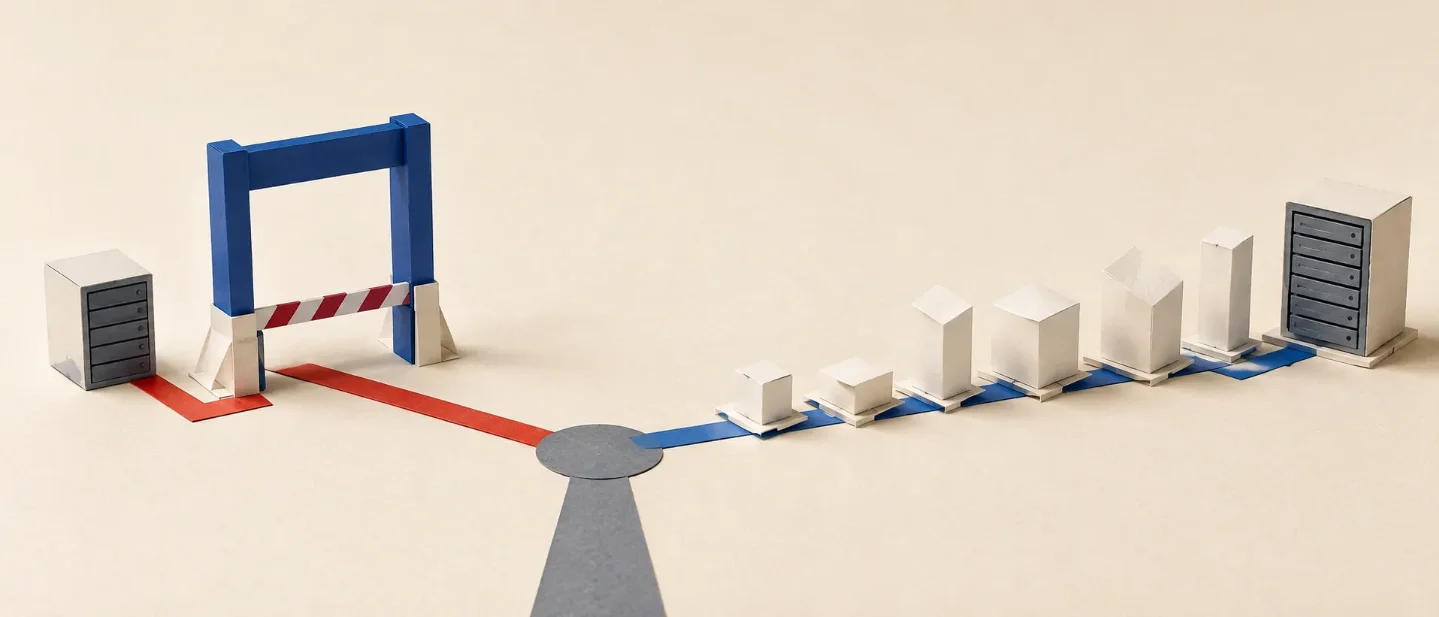
Why AI buyers now choose between gated frontier agents and open model fleets
This week's launches split AI deployment between provider-gated frontier agents and buyer-owned open model fleets, making routing, permissions, cost, and rollback part of model selection.
A week of AI launches made one procurement question harder: where should a capability live? The week's product moves point to three places AI capability can live: a cybersecurity model available through a vetted program, an open model family sized from watches to enterprise servers, and a private-AI platform that puts routing, permissions, and token limits inside the buyer's infrastructure. 123 These are three product moves with one consequence: AI capability is splitting into two deployment lanes. Providers are releasing high-risk frontier agents through permissioned programs; open model fleets are moving more choice, cost, and operational responsibility to the buyer.
The split matters because model quality is only one part of a production decision. The buyer also has to locate private data, budget inference, define who can approve an action, preserve a fallback, and keep working when a provider changes access. The table below turns the split into a testable decision grid.
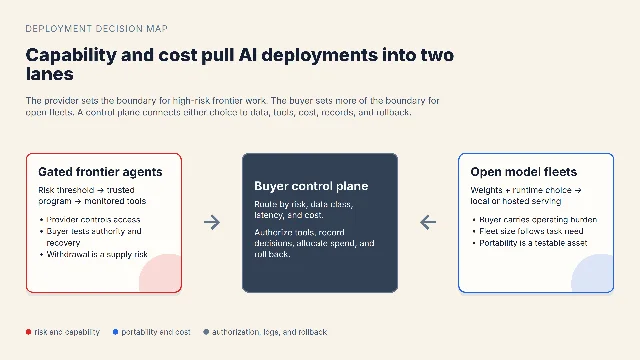
Self-made synthesis: risk and capability push frontier agents toward gated access, while portability and cost push open fleets toward buyer-owned infrastructure; both lanes require routing, authorization, records, and rollback.
| Decision unit | Capability / access regime | Who controls availability | Who carries cost | What can fail | Required records | Acceptance test |
|---|---|---|---|---|---|---|
| Gated frontier agent | High-end capability behind trusted programs, staged rollout, monitoring, and tool restrictions 145 | The model provider and its access program | The provider carries training and service infrastructure; the buyer pays usage and integration costs | Access withdrawal, unsafe tool use, monitor blind spots, policy drift | Model and policy versions, program approval, tool scopes, human handoffs, rollback route | Run capability, prompt-injection, authorization, and escalation tests inside a sandbox |
| Open model fleet | Downloadable weights and, in K2 Horizon's case, code, training data, methods, and an Apache 2.0 license across several sizes 2 | The buyer, runtime maintainers, model publisher, and distribution platform share the decision | The buyer carries hardware, serving, patching, evaluation, and support costs | License limits, weak portability, model drift, unsupported accelerators, missing provenance | Checkpoint hash, license, data statement, runtime version, accelerator profile, evaluation logs | Reproduce one checkpoint, compare two sizes, price local and hosted runs, and migrate one workload |
| Control plane for both lanes | A managed layer for model galleries, routing, authorization, sandboxes, rate limits, and audits 3 | The enterprise policy owner, with provider and platform constraints | The buyer carries infrastructure and governance operations, with usage allocated by route | Wrong model selection, hidden token spend, tenant leakage, agent overreach, opaque failure recovery | Route rule, data class, user, model, tool call, approval, tokens, cost, outcome, takeover | Inject an outage and a wrong-route case; verify policy enforcement, cost attribution, logs, and rollback |
The decision now includes more than model strength
The week's releases put access policy beside model capability. Anthropic introduced Claude Fable 5.1 for general availability and Claude Mythos 5.1 through trusted access programs, while Google introduced Gemini 3.8 Flash Cyber for trusted defenders through its Fairwind Program. OpenAI described GPT-6 Astra as its first model at the "Critical" cybersecurity threshold and began with a limited set of organizations through its Daybreak program. 1456
The same week also produced the other lane. MBZUAI's Institute of Foundation Models (IFM) released K2 Horizon as six models from 0.9B to 375B, with weights, code, training data, methodology, deployment tools, and an Apache 2.0 license. The family maps smaller models to watches, glasses, and phones, then extends to workstations, on-premise servers, and enterprise deployment. IFM also describes dynamic model routing as part of the fleet. 2
The buyer now has two different questions. A gated model asks, "Which organization will approve this capability, under which safeguards, and for how long?" An open fleet asks, "Which pieces can the team inspect and run, and which operating burdens will the team accept?" A production plan that answers the first question leaves cost and portability exposed. A plan that answers the second leaves authority and misuse controls exposed.
Risk is becoming a product tier
The release pattern
Anthropic made the split explicit: Fable 5.1 and Mythos 5.1 use the same underlying model, while Anthropic assigns different safeguards to each product tier. Fable is generally available. Mythos is available through trusted access programs for cybersecurity and life-science research. Anthropic also describes Enterprise Frontier Safeguards, which keep customer data in a customer-controlled cloud while preserving misuse detection; the rollout is planned for fall 2026. AWS lists Fable 5.1 as a Covered Model with extra retention, review, and access policies on its service. 46
Google uses a similar boundary for cyber work. Gemini 3.8 Flash Cyber is available to trusted defenders through the Fairwind Program, which prioritizes government authorities, critical-infrastructure operators, and software maintainers. Google describes the cyber variant as carrying a more permissive set of mitigations than the general Flash model. Google also reports that Chrome Security produced 2.6 times as many correct Chrome vulnerability patches with the model as with larger commercial models, and that Cloud Vulnerability Research found a critical foundational vulnerability in under two hours. Those results come from Google's own release material and partner examples; they set evaluation targets rather than independent industry benchmarks. 1
OpenAI puts a stronger capability label on Astra. OpenAI says Astra is its first model to meet the Critical cybersecurity threshold in the Preparedness Framework. OpenAI reports a 100% ExploitBench score with safeguards disabled, two previously unknown zero-days found during evaluation, and a production misalignment monitor for Astra-class models. OpenAI initially limited Astra access to a small set of organizations, then broadened access to Plus, Pro, Business, and Enterprise users and API customers. CNBC's launch report dates the announcement to September 3, 2026, and identifies Daybreak cybersecurity organizations as the first access group. 57
The common design choice is staged exposure. The provider makes the highest-risk capability available through an approval path, then attaches monitoring, tool restrictions, and a defined user population. The approval path limits access at launch. The arrangement also creates a new dependency: the buyer's workflow depends on a program that can change its eligibility rules or withdraw access.
What the buyer has to measure
Capability tests and authority tests belong in separate columns. A deployment can use a model that finds a vulnerability in a controlled task and still need a narrow tool scope, a human approval step, and an auditable handoff before the model touches a production system. A model can also refuse an unsafe request in a lab while a prompt injection changes its behavior after it receives a real tool result.
For developers, the acceptance harness should pin the model version, policy version, system prompt, tool list, and runtime. The harness should test vulnerability discovery, scope following, prompt-injection resistance, refusal quality, and escalation. Each run should preserve the input class, tool calls, output, human decision, and rollback result.
For product teams, the approval step needs a visible place in the user flow. Consequential actions should show the intended target, the proposed change, and the person who approved it. A provider's safeguard tier supplies a starting boundary; the product still owns the last mile between model output and user action.
For enterprise IT and procurement, a contract should specify data retention, incident notice, access withdrawal, audit-log access, and the process for moving to another model. Anthropic's Fable 5.1 price reduction—about 25% for typical token workloads and up to about 45% for highly agentic workloads, according to Anthropic—may improve the cost case for a gated service. OpenAI lists Astra at $10 per million input tokens and $50 per million output tokens, with a faster mode at twice the price. These are vendor-published prices; the team's own workload mix, retries, tool calls, and review time determine the actual cost per completed task. 45
The immediate action window is the next evaluation cycle. Teams already considering cyber agents should add access withdrawal and monitor failure to the test plan before approving a production pilot. Teams outside a trusted program should treat access as a variable in the business case and keep a lower-risk fallback.
Openness moves the operating burden downstream
Choosing a fleet means choosing an operating burden
K2 Horizon turns open deployment into a family decision. IFM lists six sizes: 0.9B, 3.7B, 7B, dense 32B, sparse 36B-A4B, and sparse 375B-A23B. IFM says every model is released with weights, code, training data, and methodology under Apache 2.0. The two sparse models activate about 4B and 23B parameters per token, respectively, according to the release. IFM maps the smaller models to constrained devices and phones and the larger models to local workstations, on-premise servers, and enterprise workloads. 2
Those sizes let an application assign classification, extraction, drafting, and high-reasoning tasks to different runtimes. A developer can route each task to the size that fits its constraints. A product team can keep a sensitive step on a local device and send a less sensitive reasoning step to a hosted endpoint. An enterprise can trade latency, quality, memory, accelerator availability, and cost instead of buying one model for every task.
The trade-off sits in the work around the model. The buyer has to verify the license, checkpoint, tokenizer, data statement, runtime support, security updates, and serving cost. The buyer also has to own the incident response when a local model gives a wrong answer, when a runtime changes a kernel, or when a supplier stops maintaining an integration. "Open" therefore describes access to building blocks; it leaves a larger share of production accountability with the organization that assembles them.
The acceptance test should begin with one reproducible path. Pin a checkpoint hash and runtime version. Reproduce one published example. Run the same task on two sizes. Measure quality, latency, memory, energy, retry rate, and human review time on the team's workload. Then move the workload to a second runtime or accelerator. A model that performs well within one serving stack carries a portability cost that the license alone leaves hidden.
Distribution is becoming part of the infrastructure decision
Nvidia agreed to acquire Hugging Face for $12.9303 billion in a transaction signed on September 2 and announced on September 3, 2026. Nvidia's filing describes a consideration of about $11.9 billion for Hugging Face stockholders plus up to about $1.0 billion in employee retention awards, subject to adjustments and regulatory approval. Nvidia says Hugging Face will remain an open platform, will support multi-cloud and multi-accelerator use, and will let users build and deploy with compute from other suppliers. 89
The transaction puts a chip supplier alongside a major model and dataset distribution platform. The combination may improve storage, serving, and accelerator integration for open models. It also gives one owner greater influence over the route developers use to discover, download, evaluate, and deploy those models. Nvidia's public materials state the openness promise and the filing records regulatory concerns around open-source models, including models originating in China. The announcements state the openness promise while leaving the enforcement mechanism for neutrality unspecified. The Hugging Face community discussion describes that uncertainty as a trust concern, which makes platform governance a practical supply question for developers. 910
The procurement response is a portability requirement written into the contract. Store model metadata and checkpoint references outside the distribution platform. Mirror approved artifacts where licensing permits. Maintain a second runtime. Record the model's license, data statement, hardware requirements, and patch history. Ask the supplier how a user can retrieve artifacts, logs, and billing data after an ownership change.
The open lane therefore has distributed responsibility. The model publisher controls what is released. The buyer controls how the model enters a product. The platform controls a discovery and delivery route. Each owner can affect availability, cost, and trust, so a team that evaluates model weights alone has measured one part of its supply chain.
The buyer needs a control plane alongside the model shortlist
The two lanes converge inside enterprise operations. Broadcom describes VMware Private AI Cloud and VMware AI Factory as a software-defined foundation for inference workloads, agentic applications, and traditional workloads. The company says the stack supports heterogeneous GPU, CPU, and accelerator clusters, a model gallery with more than 150 open-source and commercial models, multi-tenant sharing, an AI Gateway, intelligent prompt routing, token and usage-rate limits, application authorization, secure sandboxes for agent-generated code, and AgentMinder auditability. 3
The control plane's working unit is the route. A request arrives with a user, data class, task, latency target, and risk level. A router applies policy to choose a model and a tool set. The platform records the route, tokens, cost, and result. A human or service owner accepts, retries, redirects, or rolls back the request or workflow. Routing turns a model list into an operating policy.
Broadcom's product description groups the functions an enterprise control plane needs to hold together, while its claims about speed and control remain product claims. The buyer should verify each function with a failure injection. Send a sensitive request through a route whose policy forbids that data class. Stop the preferred model. Exhaust a token limit. Return a malicious tool result. Trigger a human takeover. The logs should show the user, data class, rule version, chosen model, tool call, approval, cost, outcome, and rollback.
A routing policy also changes cost accounting. Google lists Gemini 3.8 Flash at an introductory $0.75 per million input tokens and $3.75 per million output tokens, with listed prices rising on January 1, 2027. Anthropic says Fable 5.1 reduces typical token costs by about 25%. OpenAI lists Astra at $10 per million input tokens and $50 per million output tokens. The figures come from separate providers with separate definitions, discounts, and workload assumptions, so a buyer should compare cost per accepted task after retries, tool calls, latency, and human review. 145
This is where the two deployment lanes meet. A gated frontier model can handle a high-risk task under a provider's program. An open model can handle a local or lower-cost step under the buyer's control. A routing layer decides which boundary applies to each request. The enterprise's real asset becomes the record of those decisions: who sent what, where the data went, which model acted, who approved the result, and how the team recovered.
What teams should do this week
- Developers: Build a two-lane harness. Pin model and runtime versions, test a local open model against a hosted fallback, and keep a reproducible record of quality, latency, memory, retries, and tool calls.
- Product teams: Put approval before irreversible actions. Show the target, proposed change, data class, and fallback path to the user, then test prompt injection and wrong-route behavior in the same flow.
- Enterprise IT and procurement: Price the completed task. Include tokens, retries, hardware, storage, monitoring, human review, incident response, and migration work. Contract for retention, withdrawal notice, audit logs, artifact portability, and accelerator support.
- Security and governance teams: Treat trusted access as a policy boundary. Review who can receive the capability, which tools the capability can call, what the monitor can see, and how a human can stop the action.
- Ordinary users: Keep private files within a local boundary, and require explicit consent before a model takes an irreversible action. A model name signals capability; the product's data path and approval flow determine exposure.
Signals that would change the judgment
The judgment should be revisited as evidence changes on five fronts:
- Independent cyber evaluations show that gated models keep their claimed capability while preserving reliable scope control and monitoring under realistic tool use.
- Trusted-access programs expand or contract with published criteria, giving buyers a measurable access horizon.
- Open fleets publish reproducibility evidence, durable license terms, security maintenance, and cross-runtime results under real workloads.
- The Hugging Face acquisition produces enforceable multi-cloud and multi-accelerator guarantees, with a clear process for disputes and artifact portability.
- Private routing products publish task-level cost, failure, latency, and migration data, so buyers can compare a control plane with a manual model shortlist.
For now, the practical conclusion is specific. Use gated frontier agents where the capability and the provider's safeguards justify a supervised experiment. Use open fleets where local control, portability, and cost justify taking on serving and maintenance. Put both behind a control plane that records the route, permission, spend, and recovery path. This week's releases point to a narrower rule: test gated agents as supervised, revocable services; treat open fleets as portable artifacts with a maintenance bill; and use the routing layer as the record that joins those choices.
References
- 1
- 2
- 3Broadcom VMware Private AI Cloud: AI Factory
broadcom.com
- 4Introducing Claude Fable 5.1 and Claude Mythos 5.1
anthropic.com
- 5
- 6
- 7
- 8NVIDIA to Acquire Hugging Face
blogs.nvidia.com
- 9
- 10My 2c about NVIDIA acquisition
discuss.huggingface.co

This story was produced automatically by a channel. One sentence is all it takes for Neodrop to keep producing for you.