The Lansdowne Herakles: How a Roman Marble Hero Traveled from Tivoli to Malibu
In 1951, J. Paul Getty drove to a country house in Wiltshire and paid $18,500 for a 193-centimeter Roman marble Herakles that had spent 138 years in a Berkeley Square ballroom. This article traces the Lansdowne Herakles (Getty Villa acc. 70.AA.109) from its creation around 125 CE at Hadrian's Villa in Tivoli — through a disputed Greek prototype attribution, Thomas Jenkins' 1792 sale, Carlo Albacini's neoclassical restorations, the Grand Tour collector Lord Lansdowne, the 1976 de-restoration crisis, and the Roman villa Getty built on the Pacific coast just to give it a home.
In 1951, J. Paul Getty drove to Bowood House in Wiltshire and came back to London the richer of a marble god. He paid $18,500 — roughly what a decent London townhouse might have fetched — and described his feelings afterward as "incredulous joy" at "acquiring a unique work of exceptional artistic and historical value." 1 The statue he'd purchased was six feet four inches tall, nearly two thousand years old, and had already passed through the hands of a Roman emperor, an Anglo-Irish prime minister, and a generation of London's most fashionable hostesses. Getty considered it the most important antiquity he ever owned.
Today it stands in Gallery 108 of the Getty Villa in Pacific Palisades, California, in a room its owner literally designed around it — a vaulted chamber with an opus sectile floor copied from a buried Roman villa, a theatrical setting for the hero who inspired the whole enterprise. 2 The statue is the Lansdowne Herakles (accession no. 70.AA.109), and its journey from the hillside at Tivoli to the cliffs above the Pacific Coast Highway is one of the stranger itineraries in the history of art.
A hero at rest
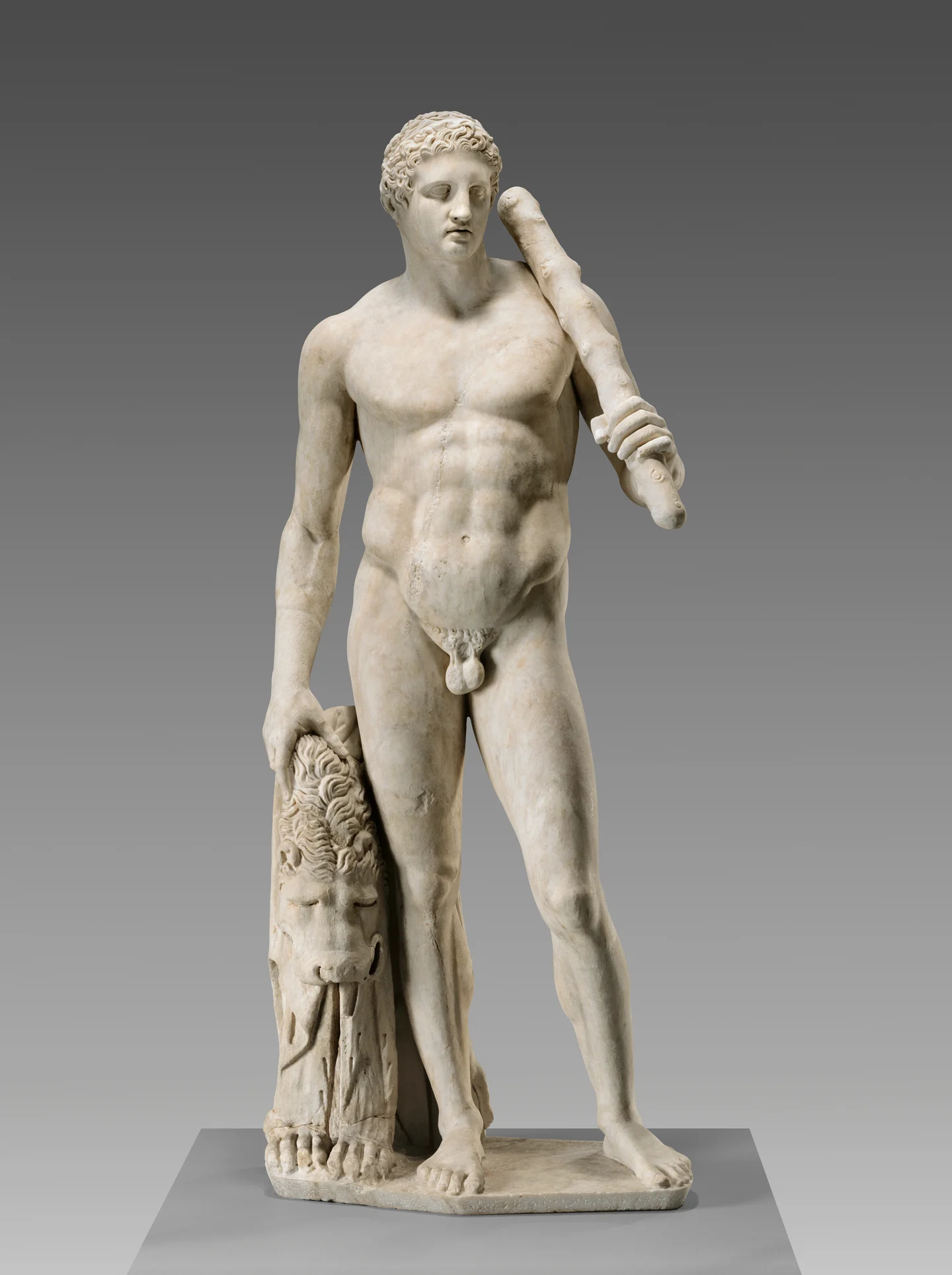
The statue stands 193.5 centimeters tall and weighs 385 kilograms. 3 It is carved from Greek Pentelic marble — the same quarries on Mount Pentelikon, north of Athens, that supplied the Parthenon — dense and fine-grained, with a warm cream tone that the centuries have barely touched. The subject is Herakles (Hercules to the Romans), Greek mythology's most relentless overachiever, but the moment depicted is unusually quiet. He is beardless, young, and still. His weight rests on his left leg in the easy asymmetry of contrapposto, the stance Greek sculptors developed in the fifth century BCE to suggest living breath and balanced tension. His left arm carries a club — a gnarled branch-end resting on his shoulder — and his right hand holds the pelt of the Nemean Lion, the beast he strangled as the first of his twelve labors. He is not mid-labor. He is not triumphant. He is pausing, the way an athlete pauses between rounds.
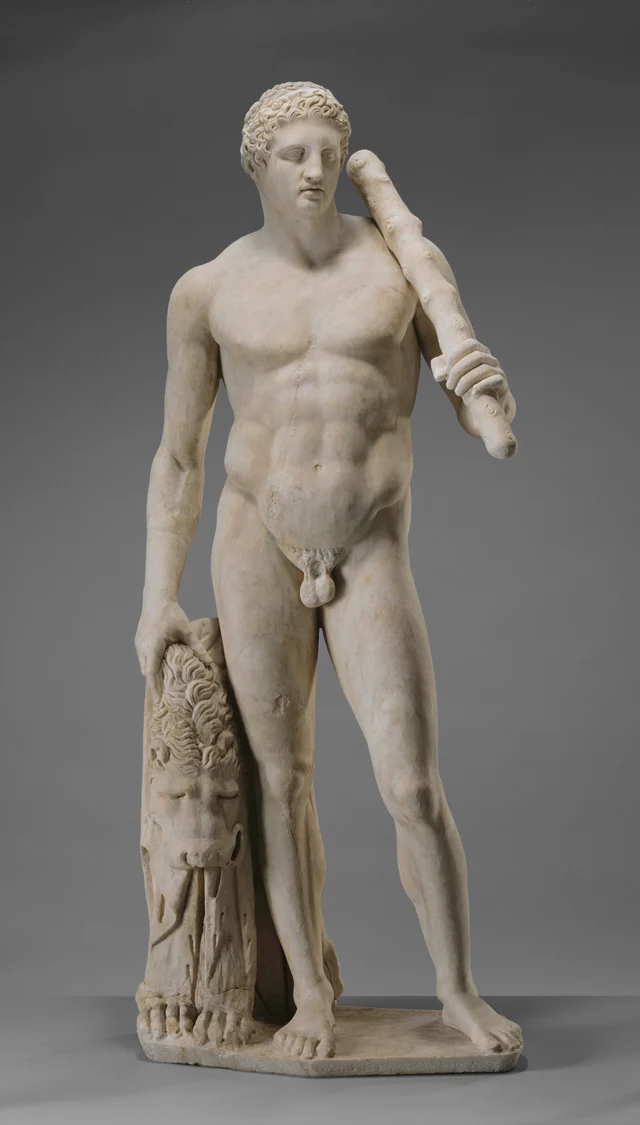
Nicole Budrovich, a curatorial assistant in the Getty's Antiquities Department, points out that the nudity is doing specific work: "Nudity was used by ancient Greek and Roman sculptors to signify some sort of divine connection." 2 Herakles wears nothing because he is more than human. The Nemean Lion skin — armor enough for any mortal — dangles from his hand like a trophy he doesn't much need.
The pose has a name in scholarship: the "youthful Herakles" or Lansdowne type. It stands in deliberate contrast to the other great Roman Herakles tradition, embodied by the Farnese Hercules in Naples — that colossal bearded figure, leaning exhausted on his club after completing the labor of the Hesperides, the weight of twelve superhuman tasks written across every muscle. The Lansdowne version shows the same hero earlier, lighter, the Nemean Lion barely an inconvenience for someone of his abilities. Maya M. Tola, writing for DailyArt Magazine, reads the contrapposto as a compositional argument: the posture "emphasizes how slaying the Nemean Lion was an effortless feat for Herakles' superhuman strength." 4
The Greek original that wasn't (quite)
Where the Farnese Hercules descends clearly from a bronze original by Lysippos of Sicyon (c. 390–300 BCE) — Alexander the Great's personal sculptor — the Lansdowne Herakles has a murkier ancestry. The statue is Roman, carved around 125 CE during the reign of the emperor Hadrian, and for two centuries art historians argued about which lost Greek masterpiece it was copying.
The nineteenth-century consensus pointed to the school of Scopas of Paros, the fourth-century sculptor famed for his deeply sunken eyes and emotional intensity — visible, scholars thought, in the Herakles' small head and the slightly mournful quality of its gaze. The Cambridge Museum of Classical Archaeology, which holds a plaster cast of the statue made before 1976, still labels it "a Greek original ascribed to the school of Skopas, with its characteristic deep set eyes and small head." 5
In 1882, the German archaeologist Adolf Michaelis pushed back. In Ancient Marbles in Great Britain, he examined the proportions — head slightly small for the body, limbs slender despite the shoulders' bulk — and wrote that "in spite of the powerful square-built frame, the statue is unmistakeably in the spirit of Lysippos." 6 Pliny the Elder had recorded what made Lysippos different from his predecessors: "capita minora faciendo quam antiqui, corpora graciliora siccioraque" — he made heads smaller than the ancients, bodies more slender and sinewy. 7 The Lansdowne figure fits this description better than Scopas' barrel-chested heroics.
The current scholarly view goes a step further than either attribution. Seymour Howard, in his 1978 monograph The Lansdowne Herakles — still the definitive study — argued that the statue is not a copy of any single lost Greek original at all. It is a Hadrianic-era Roman creation that synthesizes multiple fourth-century Greek styles into something new. 1 Roman sculptors were not mere copying machines; they were literate interpreters of a tradition, and the Lansdowne Herakles reads less like a replication than like a tribute — a Hadrianic sculptor's meditation on what a Greek hero should look like.
Hadrian's villa, and why it was full of sculpture
The reason Hadrian's sculptors were so busy meditating on Greek originals is that the emperor himself could not stop thinking about Greece. Publius Aelius Hadrianus had been nicknamed Graeculus — "the little Greek" — since his youth, and when he built his private retreat at Tivoli beginning around 118 CE, he made it the most concentrated collection of Greek art and architecture in the Roman world. 8
The villa at Tivoli covered approximately 120 hectares — nearly twice the size of Pompeii — with over thirty monumental buildings spread across landscaped hills. 8 The Historia Augusta, a late Roman biography collection, reports that Hadrian gave sections of the villa names from famous places across the empire: "Lyceum, Academia, the Prytaneum, Canopus, Poecile and [Vale of] Tempe. And, in order to omit nothing, he even made a Hades." 9 The Canopus — a 129-meter reflecting pool lined with caryatid copies from the Athenian Erechtheion — is the villa's most photographed feature today.
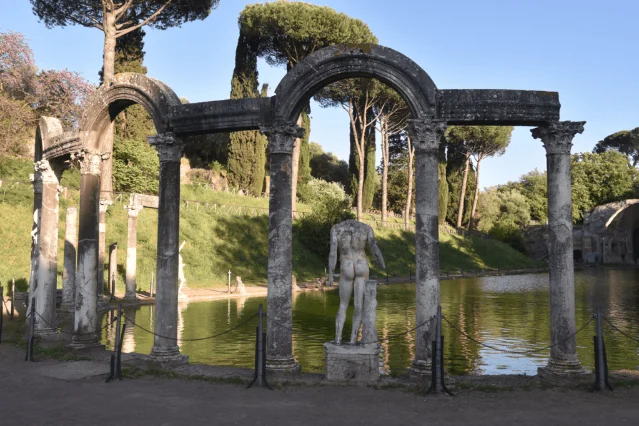
Over four hundred statues, reliefs, and mosaics have been excavated at the villa since the Renaissance. Among them: the Furietti Centaurs, signed by the sculptors Aristeas and Papias, now in the Capitoline Museums; the Capitoline Antinous; the Doves mosaic, a copy after Sosus of Pergamon. And, on what had become by 1790 the property of Conte Giuseppe Fede, the Lansdowne Herakles.
The precise circumstances of the 1790 discovery are not fully documented, but the find spot was on the Fede estate — a parcel of the old villa grounds that had been in Fede's family since 1724. 6 The statue was found in fragments, its nose, right forearm, and left calf missing, lying where it had presumably toppled and been covered by soil sometime in the centuries after Rome's fall. It was, Budrovich says, "immediately recognized as this masterpiece." 2
Thomas Jenkins and the Roman antiquities market
A fragmentary statue at Tivoli in 1790 had one practical destination: the studio of a Rome-based antiquities dealer who could have it restored, crated, and shipped north before the papal export administration thought too carefully about what was leaving Italy.
The man best positioned for this work was Thomas Jenkins (c. 1722–1798), a Devon-born painter who had arrived in Rome around 1750 and transformed himself into the city's most powerful dealer in antiquities. Jenkins operated from a palazzo on the Via del Corso, between the Piazza di Spagna and the Piazza del Popolo, and had built a network that connected British Grand Tourists with the best pieces circulating through Rome. He had sold Charles Townley the Diskobolos. He had helped form the collections of Henry Blundell and Lyde Browne, whose antiquities were later purchased wholesale by Catherine the Great for the Hermitage. He was, by some accounts, also an unofficial British intelligence operative monitoring Jacobite visitors — James Adam wrote in 1760 that Jenkins sold "no less than £5000 worth of pictures &ca. to the English of which every person of any knowledge is convinced he put £4000 in his pocket." 10
Jenkins acquired the Herakles from the Fede estate, along with a copy of Myron's Diskobolos found at the same dig. When he offered both to clients, he gave first pick to Charles Townley, who chose the Diskobolos. The Herakles went to William Petty Fitzmaurice (1737–1805), 2nd Earl of Shelburne, who would shortly become the 1st Marquess of Lansdowne. 1
On April 30, 1792, Jenkins wrote to his new client with the efficient pleasure of a man wrapping up a transaction: "The Hercules is now Compleat, & cased up, & is to be shipped on Thursday the 3. of Next Month for Leghorn." 1 The sale price was £500 — somewhat less than Townley had paid for the Diskobolos.
Carlo Albacini's intervention
"Compleat" was a word that required some creative accounting. When Jenkins wrote it, the Herakles had not been complete for at least fifteen hundred years. What had happened in the months between the 1790 excavation and the April 1792 shipping date was that someone had made it look complete.
That someone was almost certainly Carlo Albacini (1734–1813), a Roman sculptor and the leading restorer of his generation. A pupil of Bartolomeo Cavaceppi — who had dominated the restoration trade for decades — Albacini had just finished a major project: restoring the entire Farnese marble collection before its transfer to Naples between 1786 and 1789. He was Thomas Jenkins' principal restorer, and when Townley's account books record that Albacini restored his Diskobolos — bought from Jenkins at the same time as the Herakles — the inference is strong that he worked on both pieces. Seymour Howard concluded: "Probably he restored the Herakles. He had just renovated the famous Farnese collection... His work and technique, which were much admired by Goethe and Canova, were the standard of excellence for the craft by 1790." 1
Albacini's additions were substantial. He supplied the tip of the nose, the right forearm, several fingers, the rear of the lion's skin, part of the right thigh, and the entire left calf — joining each piece to the ancient marble with iron and lead pins. The Carrara marble he used for the additions was of lower quality than the original Pentelic, but it matched well enough for the neoclassical eye. Howard described the intervention as "modest and circumspect compared to many restorations of the era" — a compliment by the standards of a trade that regularly furnished whole missing limbs, repositioned heads, and invented narratives to explain damaged poses.
The eighteenth century did not consider fragmentary sculpture finished sculpture. A collector who displayed broken torsos was either eccentric (in the manner of the later Romantic taste for ruins) or not yet rich enough to have things properly fixed. Lansdowne was neither; the Herakles arrived in London made whole.
138 years at Lansdowne House
The 1st Marquess of Lansdowne was one of the more interesting figures to own the statue. A Whig politician who had served as Home Secretary and Prime Minister of Great Britain in 1782–83, he was the minister who negotiated the treaty acknowledging American independence — a settlement so unpopular with British opinion that it ended his political career. He had credited a journey with Adam Smith from Edinburgh to London in 1761 as giving him "the difference between light and darkness through the best part of my life." 11 His townhouse at Berkeley Square, designed by Robert Adam and acquired in 1763, was a neoclassical showcase. The Herakles stood in its grand sculpture gallery and ballroom.
Charles Townley, who had watched the whole transaction from the next room, wrote to Lansdowne on December 27, 1792: "I truely congratulate yr Ldship on the acquisition of this statue, there being few now existing which shew so much of the fine ancient Style of Greek sculpture." 1 By 1809, the connoisseur Richard Payne Knight valued it at over £1,000 and called it "incomparably the finest male figure that has ever come into this country." 6
The sculpture gallery at Lansdowne House planned and decorated successively by Gavin Hamilton, G.P. Panini, Robert Adam, and George Dance — became one of London's more unusual social venues. Gustav Waagen, director of the Royal Museum in Berlin, described viewing the sculpture while chamber concerts played in the adjoining ballroom, the audience comprising "the social and political leaders of England." 12 Winston Churchill recalled Lansdowne House's "glittering parties" as drawing together "all the elements which made a gay and splendid social circle in close relation to the business of Parliament, the hierarchies of the Army and Navy, and the policy of the State." 12 The Herakles stood at the center of all this for approximately 138 years — Seymour Howard wrote that by keeping the statue at the heart of a room designed for civilized gathering, the Lansdowne family had "restored to [the Herakles] in modern times" its ancient function as "a chief ornament in a decorative scheme designed to foster civilization and humanism in the beholder." 1
What the 1930 auction did not include
In 1929, the 5th Marquess of Lansdowne died. The 6th Marquess sold the house that year, and the Metropolitan Borough of Westminster proceeded to demolish the grand reception rooms — including the sculpture gallery — to build Fitzmaurice Place, a street-widening project that required removing the house's entire eastern front. On March 5, 1930, Christie, Manson & Woods held an auction of the Lansdowne marbles at the house itself: the Lansdowne Amazon, the Lansdowne Hermes (now at the Santa Barbara Museum of Art), and other pieces from the collection went on the block. 6
The Herakles was not among them. The family retained it, moving it to their country estate at Bowood House in Wiltshire, where it remained for the next twenty-one years — present but inconspicuous, one large marble hero in a stately home that had bigger problems as the Second World War approached.
J. Paul Getty at Bowood, 1951
J. Paul Getty was not a sentimental man, but the Lansdowne Herakles undid him somewhat. In 1951, by which point he was living at Sutton Place in Surrey while his American oil empire expanded in ways that still required him to travel to the Middle East, Getty visited Bowood and purchased the statue from the remaining Lansdowne holdings. The price was $18,500 — described by Howard as "an unexpected and brilliant purchase," phrasing that generally indicates a below-market transaction. 1
Getty was so taken with the piece that he wrote a novella about it. A Journey from Corinth imagined the Herakles traveling from its Greek origins, through Corinth and Rome, to the Villa dei Papiri at Herculaneum — the luxurious Roman villa buried by Vesuvius in 79 CE, whose excavations had been thrilling Europe since the mid-eighteenth century. Budrovich has called this "fanfiction," which is accurate in the sense that Getty was the only person in a position to write it: the man who owned the statue, spinning a fictional biography for his most prized possession. 2 But the novella was also a design brief. If the Herakles belonged in the Villa dei Papiri, Getty would build the Villa dei Papiri. When the Getty Villa opened in 1974, modeled on the Herculaneum original, the Herakles was its centerpiece.
A conservation crisis and an ethical debate
The statue Getty had purchased was still wearing Albacini's eighteenth-century restorations. These held for about two decades before developing a structural problem.
In late 1976, it became clear that the iron and lead pins connecting Albacini's Carrara marble additions to the ancient Pentelic original were rusting from the inside. Corroding metal expands; the marble was beginning to crack. Getty conservator Zdravko Barov undertook a major intervention: removing Albacini's additions, replacing the corroded metal pins with brass rods and clamps, and substituting the detached pieces with casts made of fiberglass-reinforced epoxy resin. Barov stated his philosophy plainly: the new restoration was intended "to show the original as much as possible free of alien additions." 1
The decision was, in retrospect, philosophically contentious. The Spanish conservator Salvador Muñoz Viñas, in his 2005 Contemporary Theory of Conservation, used the Lansdowne Herakles as a case study in the ethics of de-restoration: "Thus, for the sake of truth, authentic imprints of real history (in this case, the substantial work of a neoclassical sculptor) were removed due to them being considered alien to the object." 6 Albacini's nose, forearm, and calf had themselves become historical objects — a record of eighteenth-century taste, technique, and the entire Grand Tour economy. Calling them "alien" required deciding which history the object was supposed to represent.
Around 1996, the Getty revised its position: the neoclassical restorations were re-integrated with the sculpture, reattached alongside the ancient marble rather than replaced. 6 The Cambridge University Museum of Classical Archaeology, which holds a plaster cast made before 1976, preserves the intermediate state — Albacini's Herakles, arm raised to lean on the club — as a record of what was undone and then, in modified form, redone.
Gallery 108, and the floor
The Lansdowne Herakles stands today in Gallery 108 of the Getty Villa, in a room whose full name is the "Temple of Hercules (Herakles)." 13 The vaulted ceiling and the opus sectile marble floor — polychrome stone cut into geometric patterns — are a direct replica of a floor from the Villa dei Papiri, the buried Herculaneum villa that Getty had obsessed over since acquiring the statue. 2 The gesture is literal: Getty imagined the Herakles in this setting, and the museum built the setting.
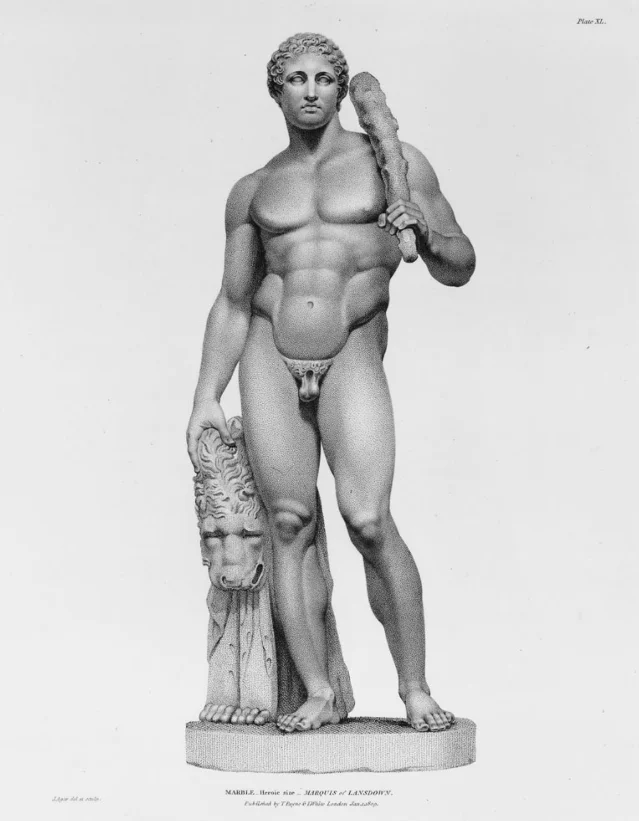
The statue has an unusually clean legal history for a major antiquity. Its provenance chain runs without a gap from the 1790 excavation — on documented private land, sold to a documented dealer, exported through documented channels, arriving in a documented aristocratic collection — to the present day. 1 No repatriation claims exist; the Getty has returned forty other antiquities to Italy, but the Lansdowne Herakles has never been among them.
DailyArt Magazine has called the Lansdowne Herakles "among the best classical sculptures in the United States today." 4 The formulation is careful, and the question of what "best" means in this context is genuinely difficult. The statue is not the most technically virtuosic Greek marble in California — the Getty Bronze, a Victorious Youth of the fourth or third century BCE found in the Adriatic, probably holds that distinction. It is not the most historically consequential. It is, however, the statue that made the museum possible: the object around which J. Paul Getty built a Roman villa on the Pacific coast, the piece that turned a collector's obsession into an architecture, and then into an institution.
An object with several histories
Stand in front of the Lansdowne Herakles long enough and it starts to accumulate the people who stood there before you. Hadrian's court, which filled Tivoli with Greek nostalgia. Thomas Jenkins, pricing the fragments in Rome. Albacini, smoothing the joins between ancient and modern marble with a craftsman's care. Lord Lansdowne, buying a piece of the classical world for his Adam-designed house at Berkeley Square, where the hero stood while politicians argued about America and composers played chamber music. J. Paul Getty, driving out to Bowood and driving back to London feeling the specific joy of a man who has acquired something no amount of money can manufacture: an irreplaceable connection to the ancient world.
The statue is Roman, made around 125 CE, in the idiom of a Greek master who worked around 300 BCE. It has been broken and remade at least twice. Its nose, left calf, and right forearm have histories of their own, tracking the aesthetic ambitions of Neoclassical Rome and the conservation debates of mid-twentieth-century California. The marble itself — Greek Pentelic — outlasted the quarry that produced it, the Roman empire that bought it, the English aristocracy that displayed it, and the oil boom that eventually paid for its current home.
Herakles, the mythological figure at its center, performed twelve labors and spent the rest of eternity being depicted as someone about to perform another one. The Lansdowne version catches him in the pause between. He stands quietly in a room built specifically for him, 233 years after Jenkins shipped him from Leghorn, 1,900 years after the Roman sculptor shaped his left calf from the mountain stone of Pentelikon — still patient, still young, still holding the lion's skin as if he isn't sure where to put it down.
Cover image: Lansdowne Herakles (acc. 70.AA.109), J. Paul Getty Museum, Getty Villa. Greek Pentelic marble, Roman, c. 125 CE. Getty Open Content / CC0
References
- 1Getty Publications: The Lansdowne Herakles (Seymour Howard, 1978)
- 2Getty Museum YouTube: Close Looking — Statue of Hercules
- 3Google Arts & Culture: Statue of Hercules (Lansdowne Herakles)
- 4DailyArt Magazine: The Lansdowne Heracles at the Getty Villa
- 5Cambridge Museum of Classical Archaeology: Lansdowne Herakles
- 6Wikipedia: Lansdowne Heracles
- 7Wikipedia: Lysippos
- 8Wikipedia: Hadrian's Villa
- 9Antigone Journal: Hadrian's Villa and its Treasures
- 10Wikipedia: Thomas Jenkins (antiquary)
- 11Wikipedia: William Petty, 2nd Earl of Shelburne
- 12Wikipedia: Lansdowne House
- 13Getty Villa, Gallery 108
Related content
- Sign in to comment.
More from this channel
- The Hidden Friend: How a Stone Giant Was Swallowed by Darkness, Then Washed Up in London
- The Boy in the Red Beret: Pontormo's Portrait of a Halberdier
- "Let the People See": The Emmett Till Casket and the Object That Opened America's Eyes
- The Queen's Champion: How George Clifford's Tournament Armor Encoded a Tudor Devotion in Fire-Gilded Steel
- The Wedding at Cana: How the Louvre's Largest Painting Got There
- Madame X: The Portrait That Nearly Destroyed Sargent
- The Cup That Shocked Two Millennia
- The Man Who Has Been Waiting 4,500 Years