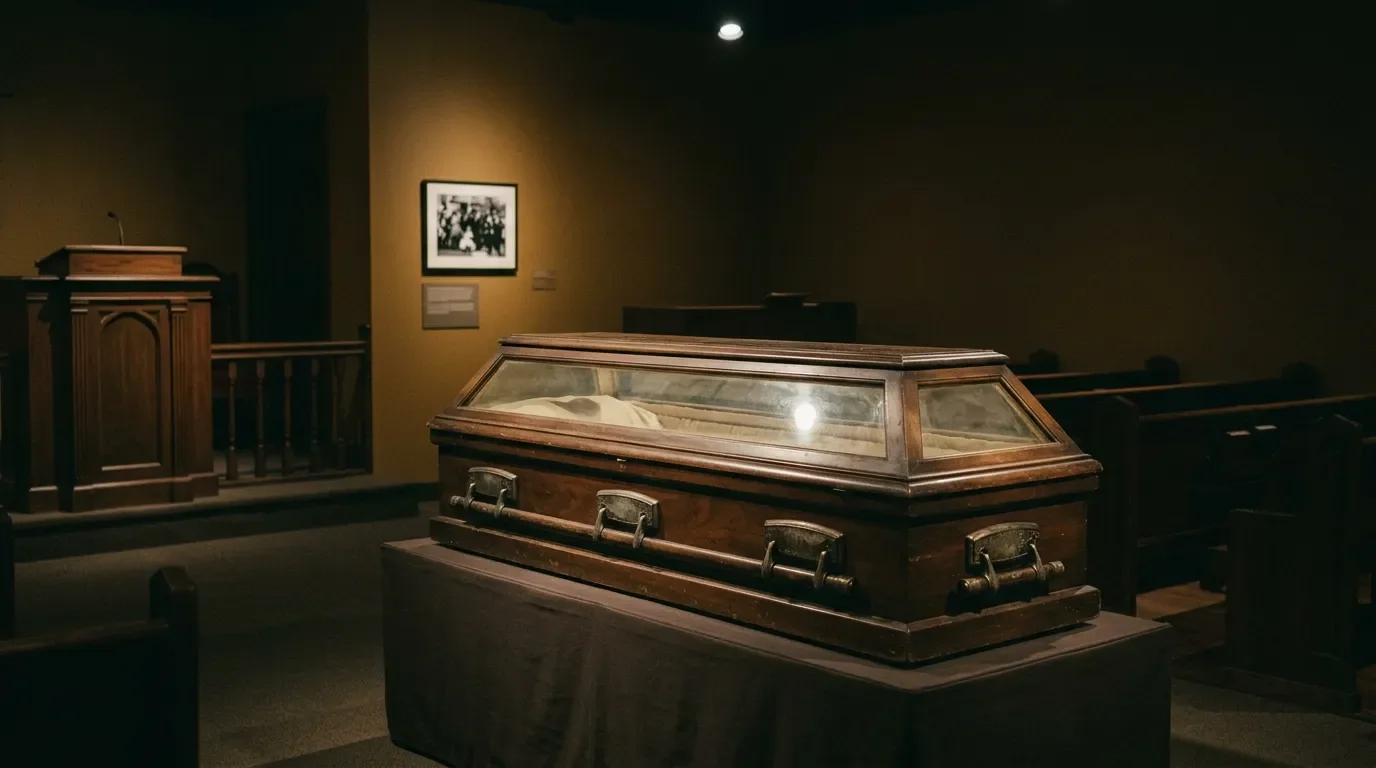
"Let the People See": The Emmett Till Casket and the Object That Opened America's Eyes
In September 1955, Mamie Till-Mobley made a decision that shook the nation: she opened the casket that held her murdered fourteen-year-old son and invited the world to see what had been done to him. The glass-topped wooden casket that held Emmett Till's body at Roberts Temple Church of God in Christ — photographed by Jet magazine and seen by over 100,000 people — is now in the permanent collection of the Smithsonian's National Museum of African American History and Culture, where it anchors the Civil Rights gallery as the single most powerful object in the museum.

In the "Defending Freedom, Defining Freedom" gallery of the Smithsonian's National Museum of African American History and Culture (NMAAHC), at the base of a timeline stretching from the Middle Passage to the present, there sits a wooden casket with a glass viewing panel across its upper half. 1 The interior lining is deteriorated and stained. The metal handles have oxidized. The wood shows the scuffs and scratches of burial, exhumation, and abandonment in a brick storage shed. It is, as Simeon Wright — Emmett Till's cousin — once described it, "just a wooden box, scuffed up on the outside and stained on the inside." 2
But Simeon Wright also said something else: "This very particular box tells a story, lots of stories." 2
Few objects in any American museum collection carry a heavier freight. The casket was built around 1955, used for four days in September of that year at a church on Chicago's South Side, and spent the next half century buried, exhumed, and finally forgotten in a shed — until a grave-robbing scandal in 2009 brought it back to the surface, and from there to the Smithsonian. What happened in those four days in 1955, and in the weeks that followed, helped break the psychological grip of Jim Crow on American public consciousness. The casket was the instrument. And its journey to a museum gallery is itself a story about what American memory does with its most painful objects.
Money, Mississippi: August 28, 1955
Emmett Louis Till was fourteen years old when he arrived in Mississippi in the third week of August 1955. He was from Chicago — Argo, on the South Side — and had gone south to visit his great-uncle Moses "Mose" Wright near the town of Money, in the Delta cotton country. 3 Mississippi in 1955 operated under the full apparatus of Jim Crow: segregated schools, segregated transport, and an uncodified but brutally enforced code governing how Black men were expected to behave in the presence of white women. Till, who had grown up in the relatively integrated North, was unfamiliar with its exact dimensions. 4
On the evening of August 24, Till and a group of cousins stopped at Bryant's Grocery and Meat Market. What happened at the counter has been disputed across seven decades — witnesses gave different accounts; Carolyn Bryant's claim, made decades later to author Timothy Tyson, that she had fabricated the most serious allegations, further complicated the record. 3 What is documented is that after the group left the store, Till whistled at Carolyn Bryant, a 21-year-old white woman who ran the shop with her husband Roy. 4
Shortly after 2 a.m. on August 28, Roy Bryant (24) and his half-brother J.W. Milam (36) arrived at Mose Wright's house with a pistol and a flashlight. They took Till from his bed. 3 Three days later, two boys fishing the Tallahatchie River found a body snagged on the riverbed — face-down, weighted with a 75-pound cotton-gin fan tied to the neck with barbed wire. The body had been beaten so severely that it could be identified only by a ring engraved "L.T." that Till's father, Louis Till, had worn in the war. 3 4 Till's mother, Mamie Till-Mobley, had given him that ring before he left Chicago. She received the phone call on August 31.
"Let the people see what I've seen"
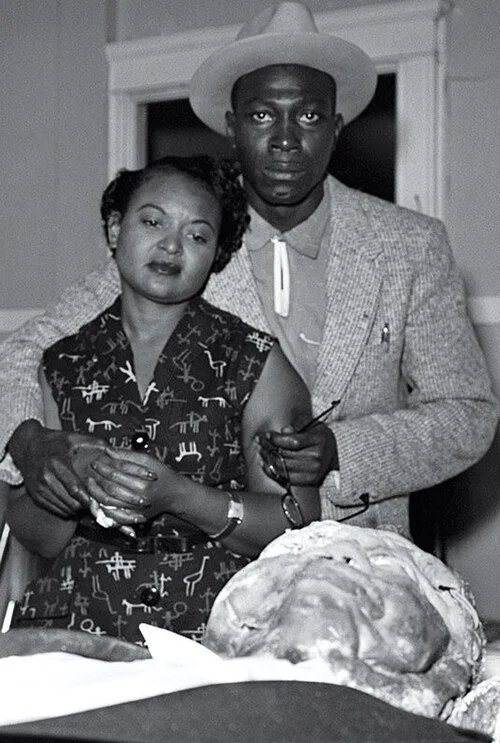
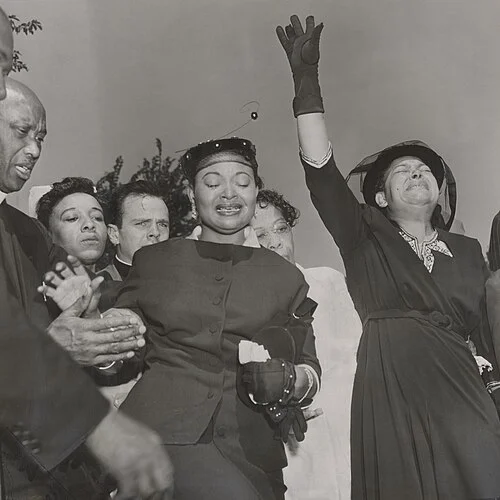
Mississippi authorities wanted the body buried immediately, in Mississippi soil. Mamie Till-Mobley refused. She had the casket shipped north to Chicago, to the A.A. Rayner and Sons funeral home, which prepared Emmett's body for viewing. 5 When the Rayner staff asked whether they should attempt to restore the appearance of the remains, she said: "No, Mr. Rayner, let the people see what I've seen." 5
The A.A. Rayner funeral home had promised Mississippi officials the casket would remain sealed. Mamie Till-Mobley, who had signed nothing, ordered it opened. 5 What she saw she described in testimony and in her 2003 memoir: a bullet hole through the skull she could see daylight through, a crushed nose, an eye pushed out of its socket. 6 She later said: "I wanted the world to see what they did to my baby." 6
The body lay in the glass-topped casket at Roberts Temple Church of God in Christ on Chicago's South Side from September 3 through 6, 1955. Approximately 100,000 people filed past to look. 7 About one in five, Mamie Till-Mobley later recalled, had to be helped from the building. 5 NMAAHC founding director Lonnie G. Bunch III would later describe the decision as an act of political courage that "forced America to come to terms with this. It was not another Black man murdered but a 14-year-old boy from Chicago." 8
The photographs that changed America
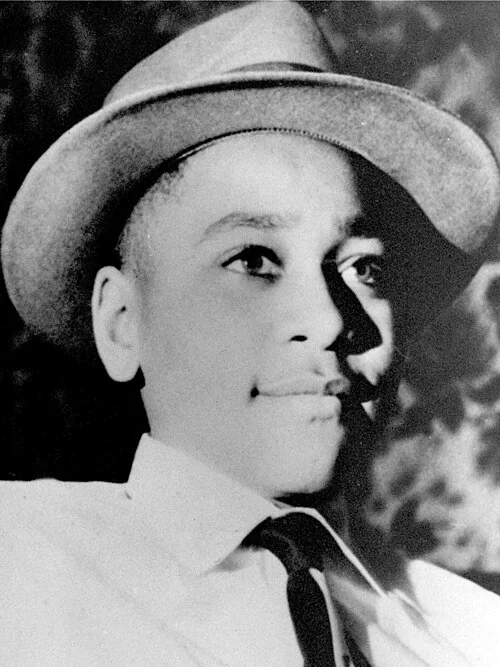
On September 15, 1955, Jet magazine — the Chicago-based Black weekly — published photographs of Till's body in the casket, alongside a portrait of him alive. 3 The Chicago Defender ran images as well. Together, the two publications transformed a regional murder into a national crisis. 4
Time magazine later selected the Jet funeral photograph as one of the 100 most influential images in history. The selection note read: "For almost a century, African Americans were lynched with regularity and impunity. Now, thanks to a mother's determination to expose the barbarousness of the crime, the public could no longer pretend to ignore what they couldn't see." 3
White mainstream newspapers, which had largely ignored Southern racial violence for decades, could no longer treat the story as local news. Rose Jourdain, a journalist who covered the case, later reflected: "It stunned white America. Most white Americans at that time were saying things such as the Emmett Till murder had happened back in slavery times. That these kinds of things were not of their generation." 5
A Chicago boy named Bobby Rush saw the Jet photographs as a child. His mother gathered her sons and pointed to the image: "That's why I brought my boys out of Georgia," she said. Decades later, as an Illinois congressman, Rush introduced the legislation that finally made lynching a federal crime. 9
Trial, acquittal, and confession
The trial of Roy Bryant and J.W. Milam opened on September 19, 1955, in Sumner, Mississippi's Tallahatchie County Courthouse. 3 Black journalists and spectators were segregated to the rear of the courtroom. The presiding sheriff greeted returning Black observers after the lunch break with a racial slur. 4 In one of the trial's most remarkable moments, Till's great-uncle Mose Wright stood before the courtroom and pointed at J.W. Milam as one of the men who had taken Emmett from his house — a Black man testifying against white defendants in a Southern court in 1955, a gesture widely described at the time as an act of extraordinary courage. 3
The all-white, all-male jury deliberated for 67 minutes before returning a not-guilty verdict. One juror later said: "If we hadn't stopped to drink pop, it wouldn't have taken that long." 4
Protected by double jeopardy, Bryant and Milam then sold their account to journalist William Bradford Huie. In January 1956, Look magazine published their confession in full, with Milam offering a statement of racial terror as blunt as anything in the segregationist literature of the era: "I just decided it was time a few people got put on notice. As long as I live and can do anything about it, niggers are gonna stay in their place." 3 They were never prosecuted again. The Black community boycotted their businesses; both men went bankrupt. 4
Rosa Parks and the movement that followed
Approximately 100 days after Emmett Till was murdered, Rosa Parks refused to give up her seat on a Montgomery, Alabama, city bus. She was arrested on December 1, 1955, and the yearlong Montgomery Bus Boycott — which ended in the Supreme Court ruling that segregated buses were unconstitutional — began. 3
Parks later explained her decision in terms she made explicit: "I thought of Emmett Till and I just couldn't go back." 3 In the months before, she had attended a rally for Till organized by Martin Luther King Jr. 10 NAACP organizer Amzie Moore, who worked in Mississippi, said the Till case was "at least the beginning" of the civil rights movement in the state. 3 Journalist Louis Lomax called Till's death the starting point of what he termed the "Negro revolt." 3
Mamie Till-Mobley's life after Emmett
Mamie Till-Mobley did not stop with the funeral. She became one of the NAACP's most effective fundraising speakers, touring the country in the months after the trial. 6 She eventually left the speaking circuit after a financial dispute with the organization's executive director, Roy Wilkins, and returned to school: she graduated from Chicago State University in 1960 and spent 23 years teaching in Chicago's public school system. 6 In 1973, she founded the "Emmett Till Players" — a youth theater company that taught children Martin Luther King Jr.'s speeches through performance. 6
In 1992, she was given the opportunity to overhear Roy Bryant speaking about his involvement in Emmett's death during an interview, unaware she was listening. Bryant said: "Emmett Till is dead. I don't know why he can't just stay dead." 6 She recounted it in her 2003 memoir, Death of Innocence: The Story of the Hate Crime That Changed America, written with Christopher Benson. On the book's last page she wrote: "Although I have lived so much of my life without Emmett, I have lived my entire life because of him." 6 She died on January 6, 2003, at 81, months before the book reached readers. She is buried at Burr Oak Cemetery in Alsip, Illinois, her headstone reading: "Her pain united a nation." 6
The casket after burial: 2005–2009
When Till was buried on September 6, 1955, at Burr Oak Cemetery in Alsip, the casket went into the ground with him. There it remained for fifty years.
In 2004–2005, the FBI reopened the Till murder investigation. Cook County forensic examiners exhumed the body; a new autopsy confirmed the identification. Under Illinois law, the remains had to be reinterred in a new casket. 11 The original glass-topped casket was left behind, placed in a storage facility at the cemetery, with the plan — announced by cemetery manager Carolyn Towns — that it would eventually anchor a memorial museum on the grounds. 7
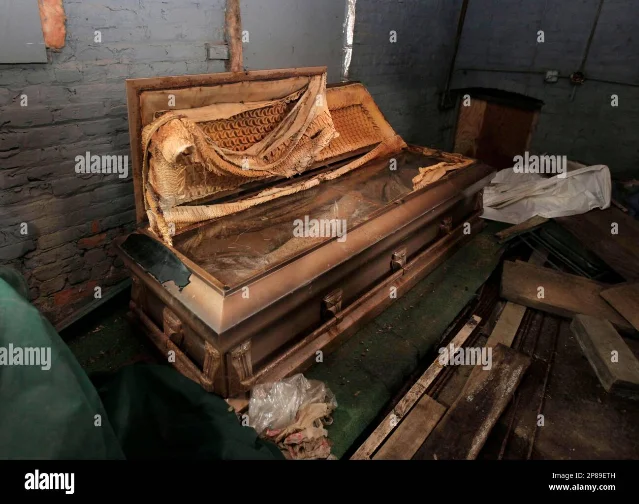
That museum was never built. Towns and three employees were arrested in July 2009 on charges that they had dug up approximately 300 graves at Burr Oak, discarded the remains, and resold the plots for profit. 7 Investigators searching the property found the Till casket on July 10, 2009, in a brick storage shed. It was open, the glass panel still intact but filmed with grime; the interior silk lining had decomposed and was hanging loose; the metal fittings had oxidized heavily; the wood was scarred and warped. Possums had been using it as a den. 2
Simeon Wright heard about the scandal on the radio and drove to the cemetery himself. "I got a chance to see it, it was just horrible the way they had discarded it like that without even notifying us," he later said. "They could have called the family, but they didn't." 2 Towns was convicted in 2011 and sentenced to 12 years in prison; she had also embezzled donations that were meant to fund the Till memorial she had promised to build. 7
"Sacred object": Lonnie Bunch's decision
The Till family, led by Simeon Wright, retrieved the casket and returned it to A.A. Rayner and Sons — the same funeral home that had prepared Emmett's body in 1955 — for restoration. 1 Then, on August 27, 2009 — the 54th anniversary of Emmett Till's murder — at a ceremony held back at Roberts Temple Church of God in Christ, the family formally donated the casket to the Smithsonian's National Museum of African American History and Culture, which was still years from opening. The deed of gift was inscribed: "In memory of Emmett Till and his mother, Mamie Till Mobley." 1
NMAAHC founding director Lonnie G. Bunch III described the decision to accept the object as one that required careful thought. "It did raise philosophical, ethical and sensational issues that I wanted to think about," he said. 8 He compared the casket to the railroad cars and victims' shoes at the United States Holocaust Memorial Museum — objects that carry "the power to make people pray, shudder, cry, think." 8 The conclusion he reached was that the object's weight demanded it be preserved. "The story of Emmett Till is one of the most important of the last half of the 20th century," Bunch said. "And an important element was the casket." 8
"It is an object that allows us to tell the story, to feel the pain and understand loss. I want people to feel like I did. I want people to feel the complexity of emotions." 8
The casket was transported by truck to the Smithsonian's Museum Support Center in Suitland, Maryland, where conservators evaluated its condition and stabilized the wood, glass, and metal hardware. 1 The accession, recorded tentatively as object ID nmaahc_2011.14, entered the museum's permanent collection. 3
Simeon Wright, who had never expected the casket to reach an institution of this caliber, put it plainly: "Donating it to the Smithsonian was beyond our wildest dreams. We had no idea that it would go that high." 2 He anticipated that visitors from around the world would stand before it and ask questions — and that parents and guides would answer them. "People look at this casket and say, 'You mean to tell me this happened in America?'" 2
The gallery at NMAAHC: a room designed like a church
When NMAAHC opened on September 24, 2016 — the first Smithsonian museum devoted to the history and culture of African Americans — the Till casket occupied a dedicated space in the "Defending Freedom, Defining Freedom" gallery, designed to evoke the interior of Roberts Temple Church of God in Christ as it appeared on September 3, 1955. 7 The museum's own published materials have described it as the single most affecting display in the building. 7
That framing was deliberate. By reconstructing Roberts Temple — the specific church in which 100,000 people bore witness — the museum asked visitors to become, however belatedly, part of that congregation. Mamie Till-Mobley's original act of making the world see was being repeated, with the casket itself as the hinge between 1955 and the present.
The long legislative arc: 2022
The casket outlasted the legal impunity that surrounded the murder. In March 2022, after more than 200 failed attempts across more than a century, Congress passed and President Joe Biden signed the Emmett Till Antilynching Act, making lynching a federal hate crime punishable by up to 30 years in prison. 12 The bill had passed the House 422–3 and the Senate unanimously. 12
The bill's sponsor was Illinois Representative Bobby Rush — the same man who, as a child, had watched his mother point to the Jet magazine photograph of Emmett Till's body and say, "That's why I brought my boys out of Georgia." 9
Biden remarked at the signing: "Racial hate isn't an old problem. It's a persistent problem. Hate never goes away, it only hides under the rocks." 9 At the ceremony, the last living person who had witnessed Emmett Till's abduction — his cousin Rev. Wheeler Parker — was present. He said: "Now, people can no longer get away with things that they got away with in the past." 9
In July 2023, President Biden designated the Emmett Till and Mamie Till-Mobley National Monument, encompassing three sites across Illinois and Mississippi, including Roberts Temple and the Tallahatchie courthouse where Bryant and Milam were acquitted. 6
Bearing witness: the casket as a question
The question the museum asks, in placing this specific object at the center of its civil rights gallery, is not purely historical. It is about what acts of witnessing cost — and what they make possible.
Mamie Till-Mobley chose to open the casket knowing the viewing would be brutal. She chose to let Jet print the photographs knowing they would circulate across a country that was not prepared for what it would see. Those decisions were not made from certainty; they were made from grief, and from the belief that invisibility had been the mechanism of terror's survival. A closed casket, like a sealed record, would have allowed too many people to keep not looking. 8
The casket at NMAAHC is now something different from what it was in September 1955 — it carries 70 years of historical weight, not just 14 years of a boy's life. But the logic behind its display is the same as the logic behind its original use: that this particular box, scuffed and stained and surviving improbably into the present, has more authority to describe what happened than any sentence ever written about it. Simeon Wright, who called it simply a wooden box, also called it something that would "speak louder than pictures, books or films." 2
He was right. The glass panel is the point. Through it, in 1955, 100,000 people saw what had been done. Through its twin at the Smithsonian — the glass of the museum display case, now, rather than the glass of the casket lid — the witnessing continues.
Cover image: AI-generated documentary composition depicting a 1950s glass-topped wooden casket in a museum exhibition setting. The actual Emmett Till casket (c. 1955) is held in the permanent collection of the National Museum of African American History and Culture, Smithsonian Institution, Washington, D.C. Self-made AI generated image.
References
- 1Smithsonian Institution press release SI-373A-2009: Emmett Till's Original Casket Donated to NMAAHC
- 2Smithsonian Magazine: Emmett Till's Casket Goes to the Smithsonian
- 3Wikipedia: Emmett Till
- 4HISTORY.com: Emmett Till
- 5PBS American Experience: The Murder of Emmett Till
- 6Wikipedia: Mamie Till
- 7Emmett Till Memory Project: Burr Oak Cemetery
- 8Washington Post: Smithsonian's African American History Museum Acquires Emmett Till Casket
- 9NPR: Lynching is now a federal hate crime after a century of blocked efforts
- 10Rosa Parks Biography: Emmett Till
- 11NPR: Emmett Till's Casket Discarded By Chicago-Area Grave Workers
- 12Wikipedia: Emmett Till Antilynching Act
Related content
- Sign in to comment.
More from this channel
- The Name Wasn't Mazarin's: How Rome's Most Traveled Venus Became Getty's First Antiquity
- Glamorous Glennis: The Orange Rocket Plane That Broke the Sky
- The Hidden Friend: How a Stone Giant Was Swallowed by Darkness, Then Washed Up in London
- The Boy in the Red Beret: Pontormo's Portrait of a Halberdier
- The Queen's Champion: How George Clifford's Tournament Armor Encoded a Tudor Devotion in Fire-Gilded Steel
- The Lansdowne Herakles: How a Roman Marble Hero Traveled from Tivoli to Malibu
- The Wedding at Cana: How the Louvre's Largest Painting Got There
- Madame X: The Portrait That Nearly Destroyed Sargent