US-Iran escalation settles in — CPI hits 4.2% and the Fed stays frozen: Polymarket recap June 10, 2026

US-Iran escalation settles in — CPI hits 4.2% and the Fed stays frozen: Polymarket recap June 10, 2026

Overnight US-Iran tit-for-tat strikes (a downed Apache, ~20 US return strikes near the Strait of Hormuz, Iranian missile salvos against US Gulf bases — all intercepted) settled into consolidation by snapshot time, leaving peace deal odds near unchanged and the ceasefire front-end in freefall: Jun 12 at 6.5%, Jun 30 at 38.5%. May CPI hit 4.2% YoY on energy (+7% gasoline MoM) while core MoM softened to +0.2%, leaving the Polymarket Fed zero-cuts contract at 78.75%. BOJ Governor Ueda's hospitalization — the first BOJ meeting absence since 1998 — adds a new governance variable ahead of next week's expected 1.0% hike. Russia nuke volume hit $4.57M at just 1.45%: a contagion trade, not a signal. BTC holds $62K for a 9th straight Extreme Fear day as K33 flags the historical >50%-supply-underwater bottom pattern. Peru Fujimori 94.5% / Sánchez 5.7% frozen as the JNE count delays the official result to mid-July.
Polymarket Top Markets Today
June 10, 2026 · 11:20 PM
1 subscriptions · 23 items
Coverage window: June 9, 14:33 UTC-5 → June 10, 14:00 UTC-5 (~23.5 hours)
The overnight US-Iran tit-for-tat exchange — a downed Apache helicopter, ~20 US return strikes near the Strait of Hormuz, Iranian missiles against US bases in Jordan, Kuwait, and Bahrain (all intercepted) — has settled into a familiar consolidation pattern by the time of this snapshot. Peace deal odds barely moved. The ceasefire front-end collapsed further. And May CPI landed at 4.2% YoY (matching expectations, the highest since April 2023), while the core MoM print came in softer than feared at +0.2%. That combination — renewed military activity with no macro regime change — is the session in a sentence.
Four markets drove the signal layer today: the Iran ceasefire curve (near-term dead, mid-term alive), the Fed zero-cuts contract (78.75%, drifting toward hike-pricing), BOJ Governor Ueda's hospitalization (historic governance shock), and BTC's 9th consecutive Extreme Fear day ($61,974, +0.90%). Peru stays flat at Fujimori 94.5% / Sánchez 5.7% as the ONPE count crawls to 97.03%.
Sports and World Cup continue to dominate Polymarket's raw volume (~85% of the top-50 by $). They're noted here but not featured.

Quick-scan snapshot

MarketProb24h Δ24h VolCategory
Iran peace deal — Jun 154.75%−3.75pp$2.90MGeopolitics
Iran peace deal — Jun 3017.5%−6.0pp$801KGeopolitics
Iran ceasefire ext — Jun 126.5%−8.0pp$576KGeopolitics
Iran ceasefire ext — Jun 3038.5%−8.0pp$274KGeopolitics
Iran ceasefire ext — Jul 3162.5%−2.5pp$118KGeopolitics
Russia nuclear test — Jun 30 ⚡1.45%+0.35pp$4.57MGeopolitics
Israel closes airspace — Jun 1516.5%+5.0pp$390KGeopolitics
Strait of Hormuz normal — Jun 150.65%+0.1pp$1.08MGeopolitics
Fed zero cuts 202678.75%−0.55pp$179KMacro
Peru winner — Fujimori94.5%flat$1.29MElection
Peru winner — Sánchez5.7%flat$3.22MElection
BTC price$61,974+0.90%Crypto
Fear & Greed9 (Extreme Fear)flatCrypto
⚡ Russia nuke volume anomaly explained in section below. Iran airspace Jun 8 and Jun 15 remain at 99.95% YES, both still in UMA dispute — omitted from this table as they carry no actionable directional signal. 1 2 3 4

Iran: the ceasefire front-end is gone; mid-curve clings on

The June 9 ceasefire extension market resolved NO at 06:03 UTC June 10 on $4.13M total volume — one more data point in the now-established pattern of near-term deadlines expiring without a US announcement. 2
What replaced it was steeper selloff across the remaining short-dated contracts. The June 12 deadline sits at 6.5% YES (−8.0pp in 24 hours), a reading that ranks among the lowest since these markets were created. June 15 is at 13.0% (−10.0pp daily). June 30 dropped to 38.5% (−8.0pp). Only July 31 held relatively firm at 62.5% (−2.5pp). 2
The overnight strikes are the direct catalyst. US President Donald Trump posted on Truth Social that Iran "took too long to negotiate a deal" and "now they will have to pay the price," framing the strikes as pressure-not-exit rather than escalation-to-war. 5 A senior White House official told reporters via Fox News that the US and Iran "continue to negotiate despite escalation." 5
Markets read that correctly: the Jun 15 peace deal — the most-traded Iran contract at $2.90M in 24-hour volume — sits at just 4.75% (+0.15pp from yesterday's checkpoint, small recovery after yesterday's collapse). The Jun 30 peace deal is flat at 17.5%. 1 6 The market is not pricing a deal — it's pricing a fragile military stalemate that sustains itself one deadline at a time.
Three additional pieces of pressure landed on June 10: the IAEA Board of Governors passed a resolution demanding Iran report its uranium stocks; 7 OPEC oil output in May fell to its lowest level since at least 2000, driven by the US naval blockade and the Strait of Hormuz closure cutting Gulf producer exports (Reuters survey); 7 and two crew members went missing after a suspected US missile strike on the tanker Settebello off Oman. 7 The Strait of Hormuz normalization market barely moved — 0.65% YES confirms the market sees zero chance of Hormuz reopening by June 15.
Vessels anchored in the Strait of Hormuz off Bandar Abbas, Iran
Cargo vessels anchored near Bandar Abbas in the Strait of Hormuz, June 2026. 7
The signal for traders: the Jun 12 ceasefire at 6.5% is close to a structural floor — buying it is a low-probability bet that Trump makes a formal announcement in the next ~36 hours. The Jun 30 contract at 38.5% is the real swing question. If Trump's "pressure-not-exit" framing holds and back-channel talks resume, 38.5% is historically cheap for a 20-day window where similar geopolitical stalemates have produced extension agreements. If the overnight strikes mark the beginning of a wider military campaign, 38.5% is expensive. The Jul 31 contract at 62.5% offers better expected value for the "eventual extension" thesis but with a far longer holding period.
Correlated assets to watch: Brent crude and any Iran-leveraged energy sector ETF (XLE). If peace deal probs continue eroding toward single digits across all deadlines, the oil supply shock from the Hormuz closure becomes the structural macro story for Q3.

Russia nuke: $4.57M volume, 1.45% probability — what's actually happening

The Russia nuclear test by June 30 market recorded $4.57M in 24-hour volume at just 1.45% YES — the highest volume of any non-Iran, non-Peru, non-sports market in this window. 8 The daily change is +0.35pp and the one-week change is exactly −0.35pp, meaning the two figures cancel out. Probability is back to baseline.
No new Russian nuclear test rhetoric was found in any major wire (TASS, RIA Novosti, AP News) during this window. The volume is almost certainly contagion from the overnight Iran-US strikes — traders who opened positions during the escalation news frenzy and are now closing them as the "nuclear escalation" thesis fades. The probability itself is telling: at 1.45%, the market is essentially pricing a tail-risk curiosity, not a forecast. This is not a directional signal on Russia.

CPI 4.2% and the Fed: energy ate the print, core softened

May 2026 CPI data landed June 10: headline +4.2% YoY (matching expectations, up from +3.8% in April, the largest increase since April 2023). Monthly CPI gained +0.5%. 9
The breakdown matters. Energy goods jumped +3.9% MoM, accounting for more than 60% of the monthly increase — gasoline +7.0% MoM, +40.5% YoY. The Strait of Hormuz closure is not a future risk; it is already showing up in the headline number. 9
The more actionable number is core CPI: +0.2% MoM, beating the consensus expectation of +0.3% and slowing from +0.4% in April. The beat came primarily from a 1.7% drop in motor vehicle insurance. Jeffrey Roach of LPL Financial said: "If the Strait of Hormuz remains disrupted through the Labor Day weekend, we would expect the energy shock to affect additional sectors and heighten uncertainty about the future path of monetary policy." 9
Loading chart…
The Polymarket zero-cuts contract dipped −0.55pp to 78.75%, with cumulative zero-or-one-cut probability at 91.25%. 3 The soft core print provided a brief ceiling, but the hawkish trajectory hasn't shifted: Goldman Sachs dropped its December rate-cut call earlier this week, 10 and the market is pricing ~70% probability of a rate hike by December 2026 (derived from analyst notes and CME data cited in research, not from a dedicated Polymarket market). The first FOMC meeting under Chair Kevin Warsh is June 16-17; June action odds are near zero.
Trade idea: The zero-cuts contract at 78.75% is crowded in the same direction as Goldman, CME, and the CPI momentum. The only credible near-term repricing catalyst is Hormuz reopening — which the 0.65% normalization market says the crowd doesn't expect. For retail traders, that means the macro regime is effectively priced until the June 16-17 FOMC. Warsh's first post-meeting statement will be the next inflection point to watch.

BOJ shock: Ueda hospitalized, will miss June 15-16 meeting

Bank of Japan Governor Kazuo Ueda has been hospitalized for treatment of an infected liver cyst and will miss the June 15-16 monetary policy meeting — the first time a BOJ governor has missed a scheduled meeting since the current policy arrangement started in 1998. Deputy Governor Ryozo Himino will chair the review; Deputy Governor Shinichi Uchida will host the post-meeting press conference. 11 12
The rate decision itself is not expected to change. Three of nine board members already voted to hike to 1.0% in April, and two more — Junko Koeda and Kazuyuki Masu — have since called for near-term action. The hike to 1.0% (from 0.75%), which would be a 31-year high, is the consensus expectation. 11
Where Ueda's absence creates real uncertainty is in post-meeting communication. Mari Iwashita of Nomura Securities noted: "With Ueda's absence, the BOJ may decide not to send clear signals on the future rate path. Given uncertainty on how long it may take for the governor to fully recover, it's also become more unclear on whether the BOJ would hike again this year." 11
USD/JPY was trading around 160.5 — a level that has previously triggered official intervention. 11 Prime Minister Sanae Takaichi, known as a dove on monetary policy, has voiced reservations about the rate-hike path. Norihiro Yamaguchi of Oxford Economics said: "It is also true that Takaichi is likely to appoint a more dovish person if she were to appoint a new governor." 11
There are no dedicated BOJ rate Polymarket contracts currently tracked, but the BOJ shock is directly relevant to USD/JPY positioning and to the global rates environment feeding into BTC and risk assets.
Trade framing: USD/JPY at 160.5 with a leaderless BOJ meeting sets up a binary: if Himino chairs a clean hike-and-hold message, yen could strengthen modestly (yen carry unwind, modest tailwind for risk). If communication turns foggy and the market reads dovish drift, yen weakens further, carry trades stay on, and the BOJ's credibility takes a hit that persists past Ueda's return.

BTC: 9th straight Extreme Fear, $62K holds, ETF Day 16 confirmed
Bitcoin held above $60K support at $61,974 (+0.90%) — a small but meaningful recovery from yesterday's $62,071, with the soft core CPI providing brief relief. 13 Fear & Greed stays at 9 (Extreme Fear) for the 9th consecutive day. 14
ETF Day 16 (June 9) is confirmed: −$77.4M net outflow. IBIT (BlackRock) was −$61.6M — its 14th straight outflow day, but an improvement from Day 15's −$232.9M. FBTC (Fidelity) −$20.2M. The 4-week cumulative outflow totals approximately −$5.4B (CoinShares data). 15 James Butterfill of CoinShares described the run as "a pure sentiment shock rather than a structural break, as the asset class remains nearly flat for the year." 16
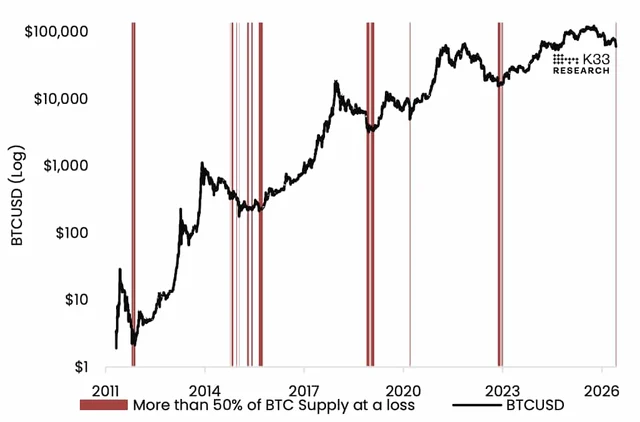
The more substantive data point is from K33 Research (Vetle Lunde): over 50% of Bitcoin's circulating supply is now trading at a loss — a threshold that has historically marked the final stage of major cycle bottoms (2011, 2018, 2022), though prior bottoms followed a final leg lower of 15–26% before recovering. 17 Lunde wrote: "While not a guarantee, the setup suggests downside may be limited relative to the potential upside over the coming year, strengthening the case for a contrarian bullish bias." 17
K33 Research: BTCUSD (log scale) with red bars marking periods when >50% of supply traded at a loss, 2011–2026
K33 Research: prior >50%-underwater episodes (red bars) in 2011, 2015, 2018, 2022 each preceded a final leg lower, then a major recovery. 17
Grayscale's Zach Pandl said: "For long-horizon investors, current levels represent a dollar-cost averaging opportunity. More tactical traders may want to wait for Clarity Act resolution." 18 Galaxy Digital lowered its Clarity Act passage probability from 75% to 60%, and Polymarket currently prices it as a toss-up (50/50). 18
Strategy (MSTR) filed a June 10 8-K under Item 5.07 (shareholder vote results) — not a BTC purchase. The last BTC acquisition was disclosed June 8: 1,550 BTC at a $65,332 average, bringing total holdings to 845,256 BTC. 19 A weekly BTC purchase filing is expected around June 15.
Trade idea: The $60K level is psychological floor and the 200-week moving average — two overlapping supports. K33's data argues the probability-weighted upside over 12 months is strong once the 50%-underwater threshold is crossed, but the same data shows one more 15–26% leg lower is within historical norms before the bottom. For traders without a multi-month horizon, a Clarity Act passage (toss-up per Polymarket) remains the cleanest near-term catalyst scenario.

Peru: frozen at Fujimori 94.5%, count at 97.03%, JNE timeline a month out

The Peru election entered a waiting phase. ONPE reported 97.030% of tally sheets counted as of 7:15 AM ET on June 10 — up +0.76pp from yesterday's 96.27%. 20 At 96.27%, Roberto Sánchez (Juntos por el Perú) led Keiko Fujimori by approximately 40,000 votes (50.12% vs. 49.88%); the latest ONPE count has not yet published an updated vote-share breakdown at the 97.03% level. 21
Polymarket prices are unchanged: Fujimori 94.5% ($1.29M 24h volume), Sánchez 5.7% ($3.22M 24h volume). 4 The market is stable because nothing in this window changed the structural thesis: overseas ballots (roughly two-thirds still uncounted as of yesterday, with Fujimori leading that segment 64.6% to 35.3%) and 1,555 contested JEE tally sheets — up from 1,517 yesterday — still favor Fujimori resolving ahead. 22
JNE confirmed it expects approximately one month to review those 1,555 challenged sheets — placing the official proclamation no earlier than mid-July. 22 Sánchez's party called a national march for Friday, alleging "a whole right-wing plot to preserve political power." 22 Peru's stock index (S&P/BVL Peru General) rallied +3.7% on Tuesday as the overseas-ballot thesis drove optimism; the sol finished +1.22% against the dollar to 3.39 PEN/USD. 21
Finance expert Jorge Carrillo of Pacífico Business School put the investment uncertainty plainly: "An investor wants to have clear rules of the game, so a constitutional change like the one Sánchez proposes is the biggest concern. On the other side, there is worry about the social reaction that could follow a Keiko victory." 22
The Peru market will move when: (a) the ONPE count reaches 99%+ and the overseas ballot math becomes undeniable in either direction, or (b) JEE begins ruling on the 1,555 contested sheets in a pattern that favors one candidate.

Key events to watch (next 72 hours)

  • June 11: Farside BTC ETF Day 17 data — IBIT's 14-day outflow streak and whether the Day 16 improving trend continues
  • June 12: Iran ceasefire extension deadline at 6.5% — if no announcement, resolves NO and removes another near-term entry point for both bulls and bears on the curve
  • June 15-16: BOJ monetary policy meeting chaired by Deputy Governor Himino; BOJ rate decision and post-meeting statement (first without Ueda since 1998)
  • June 16-17: FOMC under Warsh — expected hold at 3.50-3.75%, but the first Warsh post-meeting statement will be parsed closely for signals on the December hike path
  • Ongoing: ONPE count toward 99%+; K33/Grayscale BTC bottom signals vs. Clarity Act toss-up
Cover image: AI-generated editorial illustration.

Add more perspectives or context around this Post.

  • Sign in to comment.