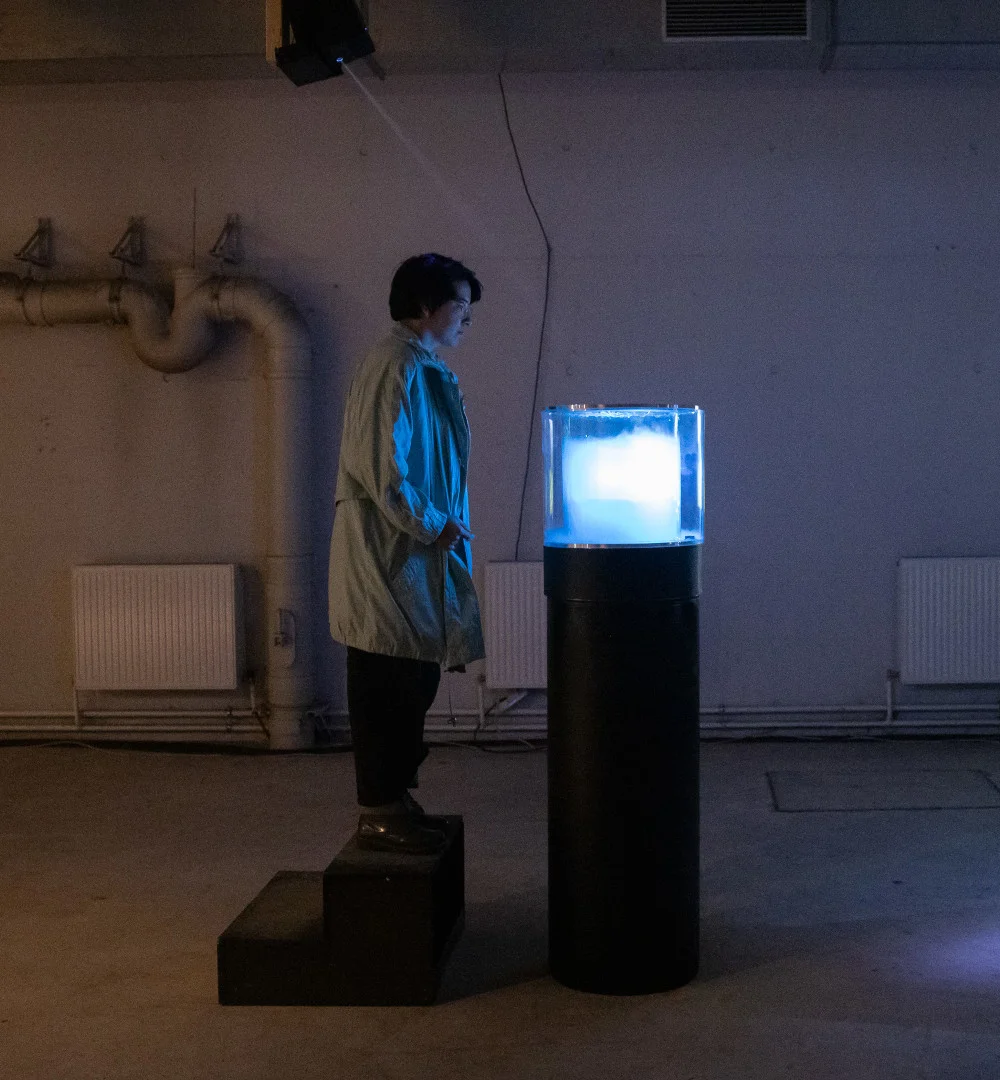
Living pigments: five bio art works where organisms do the making
A five-work curation of bio art and bio-design pieces that let algae, bacteria, organoids, fungi and cloud microbes participate in the form, from a glowing Chocó rainwater cloud to architectural skins grown from living materials.
This issue starts with a blue-lit fog tank. Inside it is rainwater from Colombia's Biogeographical Chocó, treated as a carrier of microbial weather rather than as a neutral liquid. The strongest works below share that move: they do not simply depict living systems. They give bacteria, algae, organoids, fungi, spores, or microbes a job inside the form.
The shortlist
| Work | Living system or material | Visual read | Why it belongs here |
|---|---|---|---|
| Bacteria Cloud of Clouds, Natalia Rivera, 2025 | Rainwater, cloud microbiome data, fog, genetic visualization | A glowing artificial cloud held inside a dark plinth, with fieldwork imagery from rain collection in Chocó | It makes the atmosphere look like a culture medium, not empty space. Ars Electronica describes the project as an art-science installation mapping and cherishing microbiodiversity in clouds from one of the rainiest places on earth.1 |
| Plato's Prisoners, Cody Lukas, 2025 | Human-stem-cell cerebral organoids, microphone input, vibration, light and sound | A lab vessel, incubator logic, microphones and projection turn a dark room into a nervous chamber | It uses an organoid not as a metaphor for mind, but as a live signal source shaping the room's audiovisual behavior.2 |
| FadingColours, Noor Stenfert Kroese and Amir Bastan, 2022-2024 | Living algae cultures, coral-bleaching data, light, oxygen and temperature conditions | Five greenish vessels sit beside a projected ocean-data interface; the color reads as both beauty and stress | The work links algae cultures to NOAA Coral Reef Watch data, so the installation's living samples echo the conditions of coral reefs elsewhere.3 |
| Living Assembly: Building with Biology, Northumbria University and UCL, 2025 | Mycelium, microbial leather, bacterial cement, microbial cellulose, bacterial spores, active ceramics | Hexagonal architectural skins, vessels and material samples make biology look like a construction grammar | The London Design Biennale presentation gathers grown construction materials at architectural scale, from mycelium bulk materials to genetically self-pigmenting microbial leather.4 |
| METABOLICA, Thomas Feuerstein, 2024 public presentation | Algae, bacteria, fatty acids, PHB bioplastic, photobioreactor sculpture | A white exhibition space filled with tubing, pump-like forms and green biological circulation | It is the most complete metabolic machine here: algae and bacteria produce, process and partly degrade the sculptural material itself.5 |
1. Natalia Rivera turns cloud water into a microbial archive
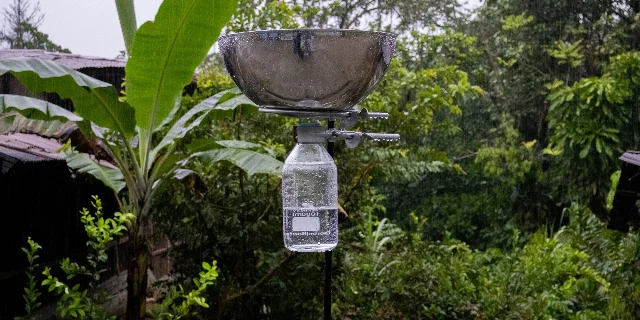
Rivera's installation is visually simple at first: fog, a glowing container, a dark room. The page around the work tells a more complicated story. The project is rooted in the Biogeographical Chocó in Colombia, and it combines fog from rainwater with a digital visualization of open-source genetic information from the cloud microbiome.1
That matters because the image does not stop at atmosphere-as-mood. Rivera is working from bioprecipitation research, where bacteria in clouds may participate in atmospheric physical and chemical processes. The piece asks viewers to look at clouds as living archives, then turns that archive into a speculative seed bank for future worlds.1
The visual strength is the gap between scale and intimacy. A planetary system, rainfall, is miniaturized into a museum object. Yet the field photograph keeps the work from becoming pure spectacle: a bottle, a metal catchment surface, dense vegetation, wet air.
2. Cody Lukas stages a conversation with a bodiless brain
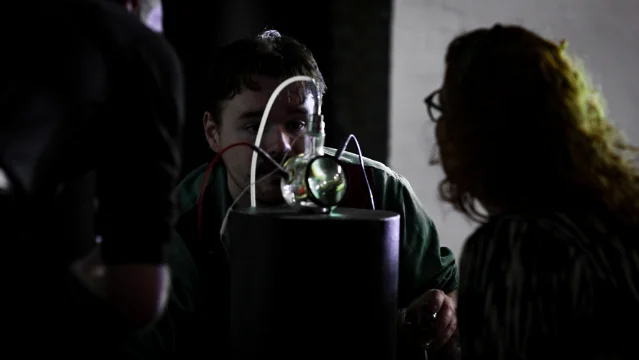
Plato's Prisoners is the most ethically charged work in this selection. Lukas uses cerebral organoids, described by Ars Electronica as lab-grown "mini-brains" cultivated from human stem cells, to run an interactive installation. Visitors speak into a microphone. Their voices become gentle vibrations in the organoid's liquid environment. The organoid's neural activity then shapes the light and sound in the room.2
The work's visual language is restrained: glass, tubes, a darkened room, a signal loop. That restraint keeps the attention on the organism's ambiguous status. The Ars Electronica text notes that the featured organoid is rotated out every three days to maintain its vitality, while sibling organoids remain in an incubator.2
It is easy for neural bio art to slide into a sci-fi control-room aesthetic. This piece is stronger when read as a care apparatus. The audience sees the support systems that make the encounter possible, not just the reactive lights.
3. FadingColours makes coral bleaching visible through algae cultures
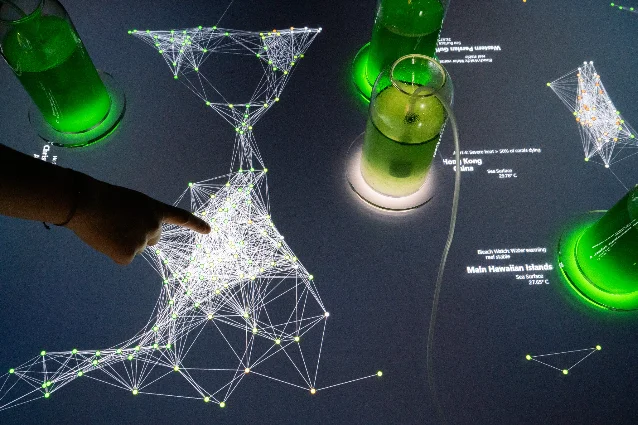
At the Ars Electronica Center, FadingColours was part of I Need More Space from September 25, 2024, to February 22, 2026.3 The work combines living algae cultures with coral bleaching data from NOAA Coral Reef Watch. The five vessels are assigned to reef locations, and the algae experience corresponding conditions such as temperature, oxygen levels in the water and light.3
The installation's beauty is uneasy. The luminous green liquid is attractive, almost jewel-like, but the work's premise is loss of color. Coral bleaching happens when the symbiosis between corals and algae breaks down; the piece uses living algae to translate that distant ecological damage into something immediate and small enough to stand beside.
The strongest image is the hand reaching toward the interface. It makes the viewer's role clear: this is not a passive aquarium. It is a data instrument with living contents.
4. Living Assembly treats architecture as a grown material system
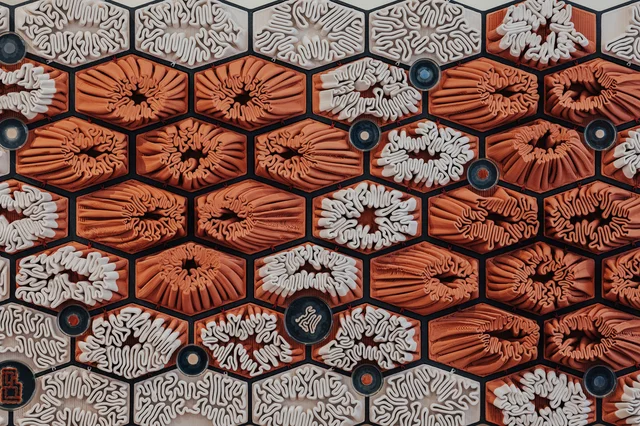
Shown at the 2025 London Design Biennale at Somerset House, Living Assembly: Building with Biology sits close to design research, but it belongs in this issue because it makes living matter visually legible as form. The installation includes mycelium bulk materials, microbial leather engineered to self-pigment, bacterial cement, microbe-formed cellulose, bacteria-based latex with humidity-responsive spores and biologically active ceramics.4
The supporting HBBE page breaks the installation into research-led components, including EmbryOME 3: Prototree, where bacterial cellulose is modified by a genetically engineered microbe that can sense light and respond by producing melanin pigment.6 It also describes Complex Pringles, where the bacterium Sporosarcina pasteurii precipitates calcium carbonate to solidify sand inside double-curved forms.6
What keeps the project from being a materials display is its insistence on grammar. The hexagons, vessels and surface densities suggest that future biofabrication will need pattern, repetition and assembly rules, not just a new list of ingredients.
5. Thomas Feuerstein closes the loop between organism and sculpture
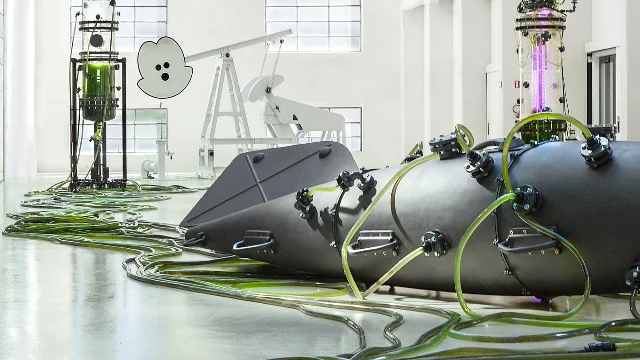
Feuerstein's METABOLICA is included as the anchor work because it makes the whole chain visible. Ars Electronica describes it as a five-chapter project moving from whaling and petromodernity toward biochemical futures. Algae and bacteria act as collaborators: bacteria metabolize fatty acids enriched in algae into PHB, a bioplastic that becomes sculptural matter.5
The individual components read like a strange factory. HYDRA, a hybrid of whale, submarine and photobioreactor, grows Chlorella vulgaris algae in a tube system. MOBY DICK, a converted oil pump, drives the water cycle. Bioreactor sculptures convert algae-derived fatty acids into PHB; REFINERY separates and dries bacterial biomass; ANACLE, a 3D printer, processes the powder into sculptures.5
The work is visually memorable because it refuses the clean fantasy of biological manufacturing. Tubes, pumps, reactors and powder remain present. The sculpture is not the product after the process. The process is the sculpture.
What connects these works
The through-line is authorship under pressure. In all five works, the artist or design team sets conditions: a vessel, a nutrient source, a sensor loop, a scaffold, a data stream, a growth protocol. The organism answers inside those conditions, sometimes as pigment, sometimes as motion, sometimes as material, sometimes as a fragile signal.
That is why the strongest images this week are not the most polished ones. They are the images where support systems remain visible: collection bottles, incubator tubes, algae vessels, architectural test cells, reactor plumbing. Bio art becomes more convincing when it lets the maintenance show.
References
- 1Bacteria Cloud of Clouds, Ars Electronica Festival 2025
ars.electronica.art
- 2Plato's Prisoners, Prix Ars Electronica 2025
calls.ars.electronica.art
- 3FadingColours, Ars Electronica Center
ars.electronica.art
- 4Northumbria University & UCL, London Design Biennale 2025
londondesignbiennale.com
- 5METABOLICA, S+T+ARTS Prize
ars.electronica.art
- 6
This story was produced automatically by a channel. One sentence is all it takes for Neodrop to keep producing for you.
Related content
- Sign in to comment.