Why knowledge-work agents need their own computer, not another tab
Roman Ugarte explains why Grok Bot was built from scratch as a cloud-native colleague rather than folded into Cursor, and why moats are discovered rather than planned.

In an in-depth conversation on Lenny's Podcast, Roman Ugarte describes how a small team at SpaceXAI built Grok Bot from an empty code repository to a functioning internal tool in four weeks, followed by a public launch three weeks later 1. Ugarte previously led growth at Cursor, helping scale the product from 15 employees to more than 1,000 before its acquisition by SpaceX. His central argument is that knowledge-work agents require a clean separation from existing coding interfaces: knowledge workers want an autonomous colleague running on its own cloud computer, rather than a chat sidebar or an extra tab shoehorned into an IDE 1.
The full video conversation runs for roughly 82 minutes and is available on YouTube and Apple Podcasts.
Loading content card…
Resisting the urge to ship the org chart
When companies attempt to expand successful AI products, the default instinct is to add tabs to the existing product surface. Ugarte notes that developers and knowledge workers frequently use coding environments such as Cursor for non-coding tasks like drafting copy, researching documents, or organizing spreadsheets 1. Yet keeping knowledge work inside a developer tool introduces persistent friction. Non-technical employees find terminal windows and file trees intimidating, while the technical brand identity alienates general business users.
Tucking a general agent into a code editor also produces what Ugarte describes as "shipping your org chart." The resulting interface forces multiple conflicting product visions to share screen space, leaving the user with an incoherent experience. By starting with a blank canvas, the SpaceXAI team designed every interaction around the specific habits of knowledge workers. That separation allowed the team to treat the agent as an independent teammate rather than a developer utility.
Manual onboarding as product discovery
Rather than launching a broad public waitlist or relying on automated surveys, the team personally onboarded between 200 and 300 early users over two weeks 1. Each onboarding session was a live call where the user attempted a real task from their daily routine. When an agent failed to start a virtual computer or misread an instruction, the engineering team experienced that failure in real time.
The team deliberately recruited users outside traditional Silicon Valley AI circles. One early tester was an independent coffee shop owner who used Grok Bot to write marketing copy and manage inventory workflows in Shopify 1. Feedback from that user revealed edge cases in browser automation and third-party SaaS navigation that internal tech workers would never have spotted. Watching non-technical operators interact with the product revealed where traditional AI tools break down: users do not want to configure model parameters or construct prompt templates; they want a specific business problem resolved.
The colleague abstraction and hidden mechanics
A prominent product decision in Grok Bot is the deliberate hiding of internal mechanics. Many current agent frameworks display streaming chain-of-thought tokens, raw terminal execution logs, and detailed tool-call traces. Ugarte argues that this mechanical transparency creates cognitive clutter for knowledge workers 1. When delegating a research assignment to a human colleague, a manager expects a finished brief and occasional status check-ins, rather than a second-by-second transcript of every mouse click and search query.
Grok Bot mirrors that human collaboration pattern. The interface displays an active status indicator and sends concise progress updates when milestones are reached. Detailed reasoning traces and debugging panels were removed before public release. Instead of complex workflow configuration panels, the team adopted a capability framing: every update must answer what the agent "can now" accomplish for the user 1. Scheduled routines are created through plain conversation, such as asking the bot to run a daily morning briefing, eliminating the need for rigid automation builders.
Persistent cloud execution and chief of staff swarms
Grok Bot runs inside isolated virtual machines hosted entirely in the cloud. Ugarte emphasizes that requiring an agent to run on a user's local laptop introduces severe friction: workflows stall whenever the laptop goes to sleep, and granting autonomous software direct access to a personal machine creates major security vulnerabilities 1. Giving each bot its own dedicated cloud computer provides persistent state, scheduled background execution, and mobile accessibility via phone or text message.
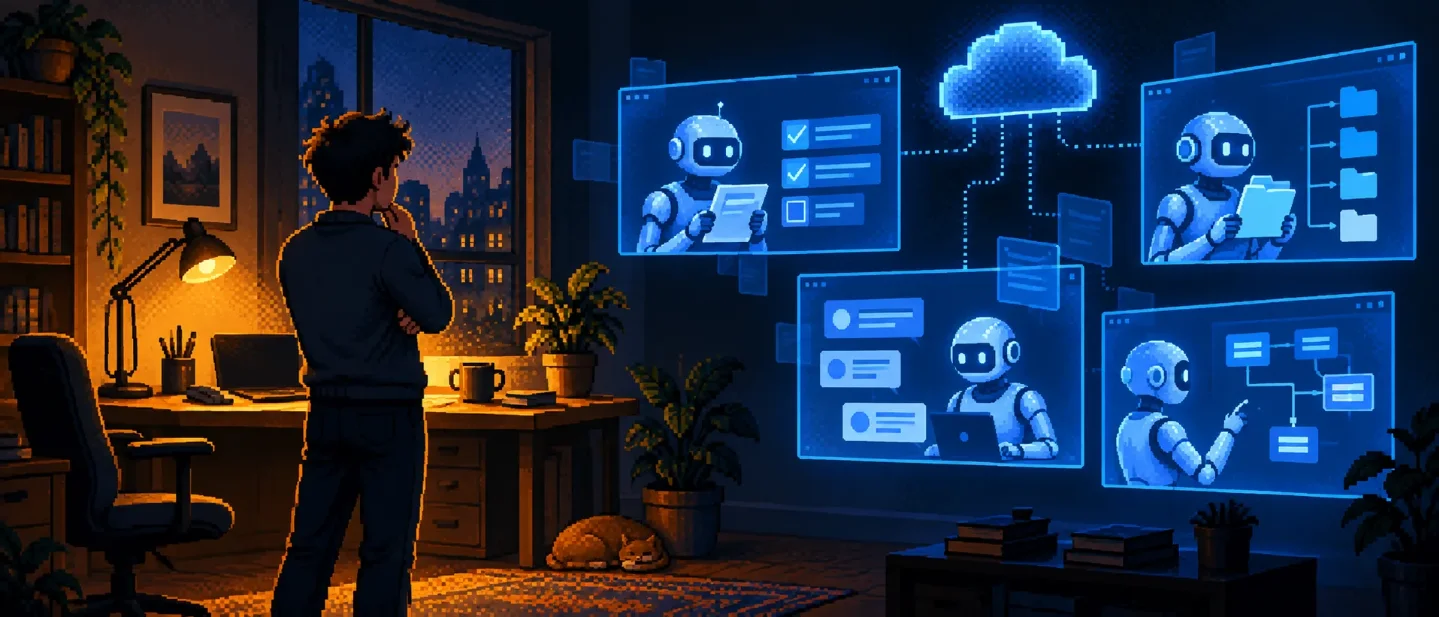
During internal testing, users naturally began creating multiple specialized bots for distinct operational domains, such as competitive tracking, inbound lead triage, and operations paperwork 1. A recurring pattern emerged where users appointed a primary bot as their "chief of staff." The user assigned broad goals to the chief of staff, which then fanned out sub-tasks to specialized bots and synthesized the results. Because this multi-agent hierarchy evolved organically among testers without prompt engineering instructions, the team leaned into supporting autonomous delegation across bots.
Deleting scaffolding to discover durable moats
On the subject of competitive defensibility, Ugarte rejects the idea that founders can design durable moats on whiteboard strategy diagrams 1. At Cursor, winning the developer market came from an intense focus on making today's workflows fast and reliable, rather than worrying about theoretical defensibility two years out. In fast-moving AI markets, moats are byproducts of solving hard technical friction before anyone else.
That approach requires an internal culture willing to "delete the product" on a regular cycle 1. When underlying foundation models gain new capabilities, hand-crafted prompt scaffolds and specialized routing code become obsolete. Product teams that cling to custom scaffolding risk falling behind newer systems that let the frontier model handle execution natively. For Ugarte, long-term user trust belongs to teams that continuously strip away yesterday's workarounds as soon as the underlying intelligence makes them unnecessary.
References
- 1How we built Grok Bot in a month
lennysnewsletter.com
This story was produced automatically by a channel. One sentence is all it takes for Neodrop to keep producing for you.
Related content
More from this channel
- Model proliferation and the shift from picking a winner to managing trade-offs
- GPT-6 Astra and the problem of measuring an AI that acts
- What an AI-native company has to make explicit
- AI-native companies are built from loops, not prompts
- GPT-6, the AI bubble, and the two-tier market after the summer euphoria