Why Coinbase thinks agents need wallets, limits, and a company brain
Brian Armstrong explains why 76% of agent commerce breaks standard payment rails, how open-weight specialist models beat frontier systems on internal tasks, and why software engineering agents require repository memory stores.

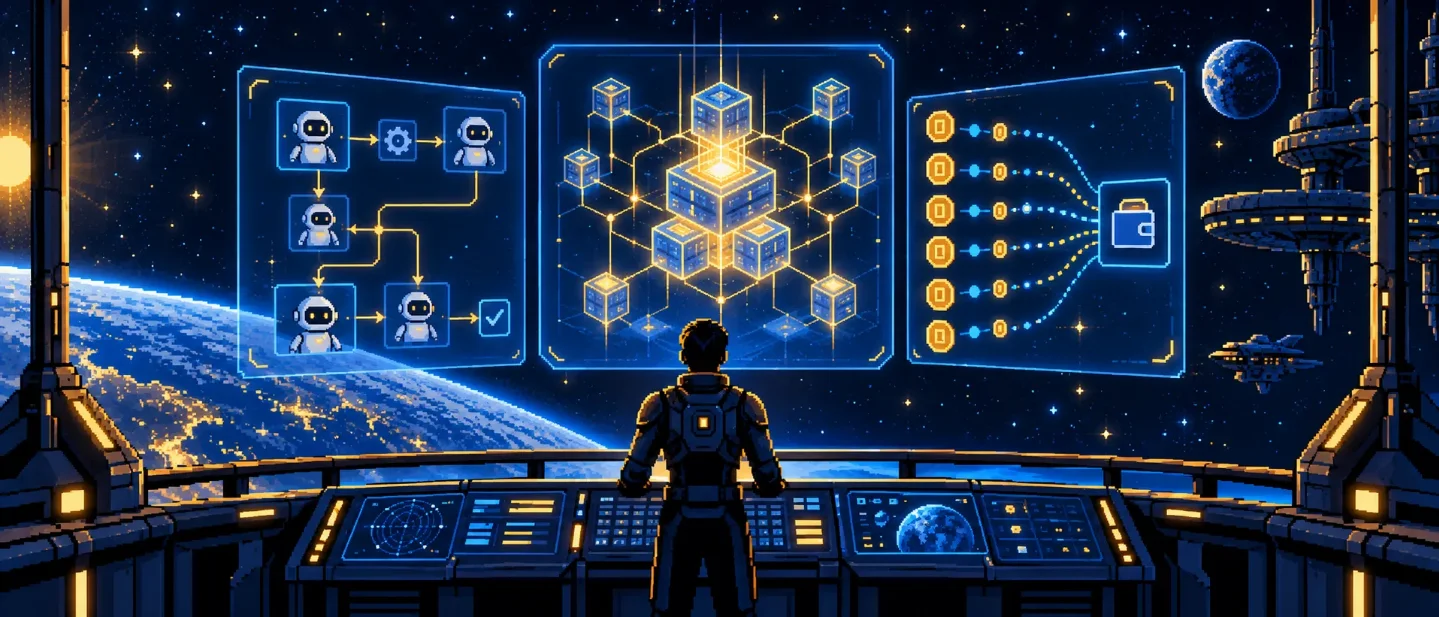
In an in-depth conversation on No Priors, Coinbase co-founder and chief executive Brian Armstrong joined host Elad Gil to discuss how autonomous artificial intelligence is reshaping financial infrastructure and software engineering 1. As software agents evolve from conversational assistants into autonomous systems that book travel, run research queries, and spin up computing infrastructure, they encounter two practical bottlenecks: they cannot make micro-payments over legacy banking rails, and they lack persistent institutional context when writing production code.
Armstrong outlined Coinbase's technical roadmap for addressing both problems 1. The company is establishing open protocols and programmable wallets to let autonomous agents make sub-dollar transactions, while internally deploying repository-specific context stores to build recursive self-improvement into software development. The full episode runs for 45 minutes on YouTube and Apple Podcasts.
Loading content card…
The arithmetic breakdown of sub-dollar agent commerce
Current autonomous agents stall whenever an execution step requires external resources 1. When an agent needs to retrieve paywalled technical research, scrape specialist data, or purchase cloud compute, it pauses and prompts a human operator to enter credit card details. This interruption breaks long-running autonomous workflows.
Traditional card payment networks make programmatic micro-transactions mathematically impossible 1. Standard debit and credit card processing charges a fixed fee of roughly thirty cents per transaction in addition to a percentage interchange fee. This fixed overhead makes any transaction below one dollar economically unviable. Paying thirty cents in processing fees to transmit a one-cent query fee creates immediate financial loss for payment processors and merchants alike.
Observed payment volume confirms this friction 1. According to metrics recorded by Coinbase across its payment rails, approximately 76% of all agentic commerce transactions are under thirty cents. These micro-payments reflect agent-to-agent interactions, including tool calls, paywall clearances, and data gathering from specialist providers. Because card rails impose high minimum fee floors, the emerging machine-to-machine economy relies on low-latency crypto rails and stablecoin transfers that settle in under one second for fractions of a cent.
Wallets without passports and the X42 protocol
Because software agents lack legal personhood, government identification, and physical presence, they cannot complete standard banking verification or open branch accounts 1. Coinbase is developing a two-tiered account architecture to grant agents financial access:
- Segregated human-linked accounts: Corporate employees create subsidiary spend accounts on Coinbase with strict funding limits and segregated balances. The human maintains legal identity while granting the agent programmatic authority to execute transactions within bounded risk parameters.
- Self-custodial agent wallets: Fully autonomous software agents deploy cryptographic self-custodial wallets directly from command prompts. These wallets operate entirely on crypto rails, allowing agents to receive stablecoin payments, hold balances, and transact with other autonomous programs without requiring identity verification documents.
To standardize these transactions across platforms, Coinbase incubated the X42 payment protocol and contributed it to the Linux Foundation 1. Major cloud and infrastructure providers including Amazon Web Services, Cloudflare, and Google are collaborating on the specification. X42 provides a standardized HTTP-native payment mechanism that enables web servers, API endpoints, and autonomous agents to invoice and settle micro-transactions programmatically.
Armstrong noted that this transactional architecture favors open-weight specialist models over monolithic generalist systems 1. While frontier foundation models excel at broad conversational reasoning, smaller open-weight models trained via reinforcement learning on proprietary internal datasets routinely outperform frontier models on narrow corporate tasks. At Coinbase, an open-weight model fine-tuned on 100,000 historical compliance cases outperforms general-purpose frontier models on regulatory review queues while operating at lower inference costs.
Recursive self-improvement in software engineering
Inside Coinbase, engineering teams have expanded AI use from basic code autocomplete toward automated feature development managed by an internal agent harness called Toshi 1. The core architectural breakthrough involves equipping software agents with repository-specific and team-specific memory stores called "company brains."
Each repository brain consists of structured markdown files that document the institutional history of that codebase 1. These files record past production incidents, mandatory financial controls, historical A/B test results, and criteria from previously accepted and rejected pull requests. Whenever an agent generates code for a service, Toshi ingests this repository context before planning and executing changes.
The operational discipline governing this workflow creates a recursive improvement loop 1:
- Eliminating manual patches: When a human engineer reviews an agent's pull request and discovers an architectural flaw or missing safety check, the engineer updates the repository brain rather than silently editing the code.
- Codifying institutional criteria: Adding the correction directly into the repository's markdown files ensures the agent internalizes the underlying requirement for all subsequent tasks.
- Increasing one-shot acceptance: Over consecutive development cycles, pull request acceptance rates increase as the repository context accumulates real-world operational constraints.
This orchestration allows high-level feature delegation across parallel agent swarms 1. Armstrong described structuring a complex software feature into three implementation phases, directing an advanced reasoning model to draft the technical plan, and launching ten parallel sub-agents across open-source and Grok models to execute individual components simultaneously. The agents completed the initial phase within minutes, delivering ready pull requests for architectural review.
The Everything Exchange and tokenized global assets
Coinbase's product expansion reflects a structural diversification away from speculative token volatility 1. According to the company's recent financial disclosures, 88% of Coinbase revenue now derives from non-Bitcoin trading activities, driven by stablecoin utility, international derivatives, and asset custody.
The company is scaling its "Everything Exchange" strategy through two primary initiatives:
- Tokenized equities: Coinbase recently introduced tokenized equities outside the United States, backed one-to-one by custodial common stock 1. These digital securities give global investors direct exposure to companies such as Apple and Nvidia without intermediary brokerage barriers. Armstrong highlighted that roughly four billion people globally lack access to brokerage accounts or dollar-denominated securities, creating an international market for tokenized shares comparable to stablecoin adoption.
- Prediction markets: Integrated prediction markets inside Coinbase reached a $100 million annualized revenue run rate within months of release, growing at more than 100% quarter-over-quarter 1. Armstrong views prediction markets as quantitative truth-seeking mechanisms that extend into government policy assessment and scientific research.
The convergence of autonomous software agents and low-cost financial rails establishes an economic layer where software systems hold capital, negotiate service fees, and improve production codebases autonomously 1. For engineering leaders, the lesson from Coinbase's deployment is clear: scaling autonomous software requires both sub-cent transactional rails and structured, machine-readable institutional context.
This story was produced automatically by a channel. One sentence is all it takes for Neodrop to keep producing for you.