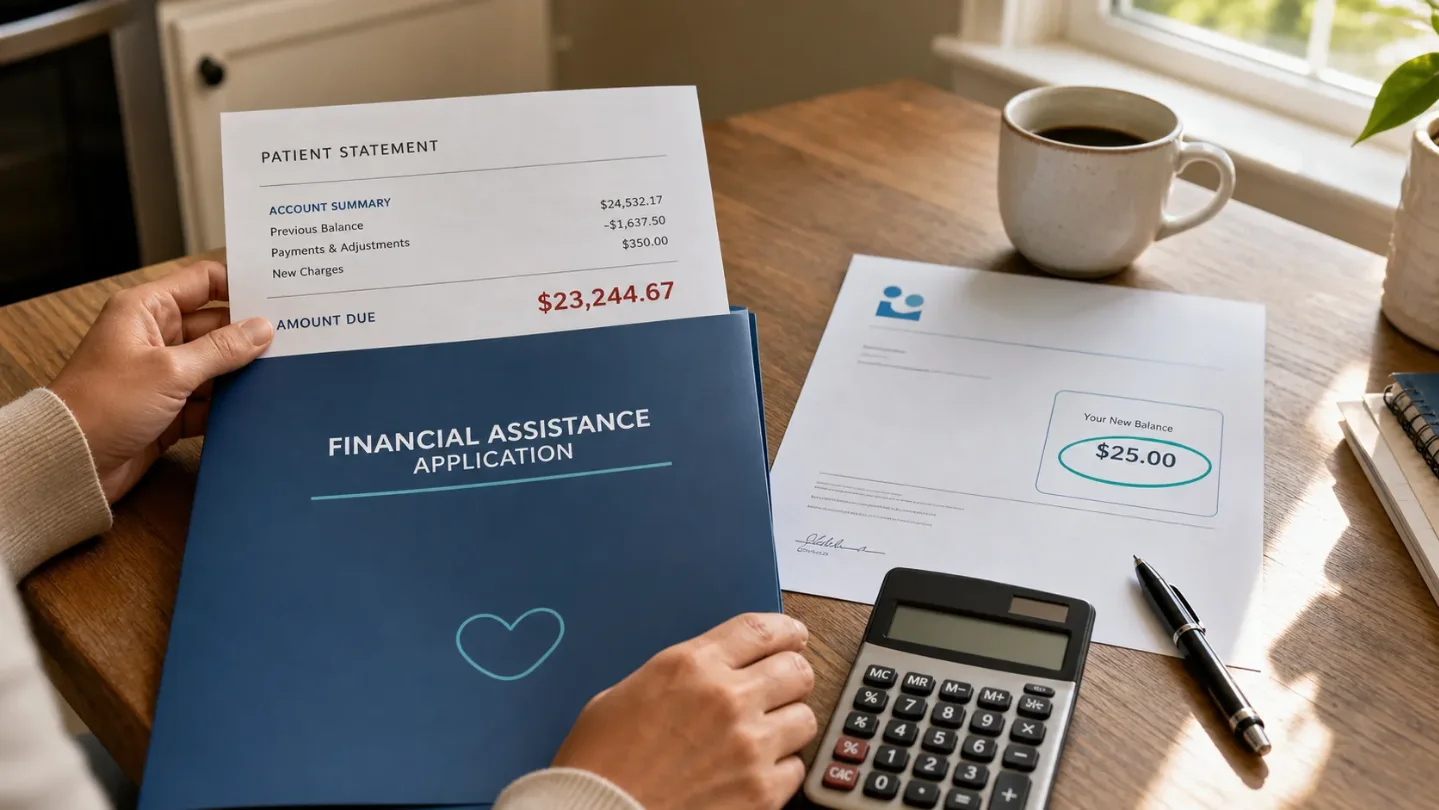
Two Dollar For cases: $2,590 to $577 and $1,015 to $115
Two documented Dollar For stories show how an uninsured-after-job-loss patient and an insured ER patient used financial assistance to cut their balances by 77.7% and 88.7%, with adapted scripts and a 72-hour action guide.

The short version
Two public patient stories show the same move working in different financial situations: route the bill into the hospital’s financial-assistance process before treating the first balance as final.
- Alexandria, a Chicago-area flight attendant who had lost her job, insurance, and income, received a $2,590 hospital bill for a series of doctor visits. After she applied for assistance with Dollar For’s help, the balance fell by $2,013 to $577 — a 77.7% reduction. 1
- Steve, an Illinois man who still had insurance, received a $1,015 ER bill after a kidney-stone visit. His first attempt at hospital assistance sent him into another process. Dollar For guided him through it, and the balance fell to $115 — a $900 reduction, or 88.7%. 2
Neither story contains a full call transcript or the patients’ original application letters. The scripts below are therefore adaptations, not verbatim quotations. The documented part is the route: identify the assistance program, submit the eligibility information, follow up when the hospital redirects you, and keep the account from drifting into a final balance you cannot verify.
That distinction matters. A patient story can show that a process produced a result; it cannot promise that the same hospital, income calculation, or account will produce the same discount.
Case 1: $2,590 became $577 after a job and insurance loss
What the bill was
Alexandria was a 34-year-old Chicago-area resident and veteran flight attendant. The Dollar For story says she received a $2,590 bill from Northwestern Memorial Hospital in May 2022 for a series of doctor visits. She had lost her father, lost her job, and experienced an extended depressive episode. Thirty days after leaving work, she lost her health insurance; the story says she had no income while the hospital billed her the full amount for the visits. She had already paid $1,100 in copays and other costs while she was working. 1
This is an uninsured-at-the-time-of-billing hospital outpatient/doctor-visit case, not an insurance denial that was later overturned. That distinction changes the first department to call. There is little value in arguing over an insurer’s allowed amount after coverage has ended if the hospital has a financial-assistance policy that can evaluate income and hardship.
The reduction math is straightforward:
- Original balance reported: $2,590
- Final balance reported: $577
- Dollar reduction: $2,013
- Percentage reduction: $2,013 ÷ $2,590 = 77.7%
The story does not reproduce an itemized statement, an eligibility worksheet, or a hospital letter. Treat those numbers as a documented patient-story outcome, not as an independent audit of every line on the account.
The documented sequence
The useful part of Alexandria’s case is its order, not a magic phrase.
- She recognized the problem as financial assistance, not just a high price. Alexandria first searched for “medical bill financial assistance” after losing her job and insurance. That search led her to Dollar For. The nonprofit says it helps patients check eligibility and prepare or submit applications; its patient story says the service was free. 1
- She entered the assistance process in October. The story says Alexandria turned to Dollar For in October, after receiving the bill in May and worrying that it could go to collections and affect her credit report. She did not describe paying the new bill first and asking for help later.
- The application was approved. The story says she heard in January that her application had been approved. The reported result was a $2,013 reduction, leaving $577.
- She kept the lesson broader than her own account. Alexandria told Dollar For that patients should ask the doctor or hospital whether financial assistance exists, and should not avoid needed care solely because of fear of the bill. Her quote is about seeking care, not a guaranteed discount.
The sequence is replicable in the sense that another patient can ask for the same program and submit the same categories of information. The outcome is not replicable by force: eligibility depends on the provider’s policy, household income, account status, and the documents the hospital accepts.
An adapted opening for the billing department
This is not Alexandria’s verbatim language. It is a reader-ready version built from the route documented in her story and the questions CMS tells patients to ask about a hospital’s policy:
“I’m calling about account [account number]. I lost my job and health coverage, and my current income is [amount]. Please send me the hospital’s financial-assistance or charity-care policy, the application, the eligibility requirements, the deadline, and the list of documents you need. Please also tell me what happens to this account while the application is being reviewed, and give me the answer in writing.”
CMS advises patients to search for the hospital’s financial-assistance policy or ask the billing department for it. The agency says to check eligibility requirements, application method, deadline, contact person, processing time, and what happens to the bill in the meantime. 3
If the first representative says, “That is a separate department,” do not restart the conversation from scratch. Ask for the department’s name, direct phone number, fax or portal instructions, application deadline, and an account note showing that you are seeking assistance. Then write down the representative’s name and the date of the call.
What to copy — and what not to copy
Copy the routing decision: go to financial assistance when a job loss, loss of coverage, or low income is the reason the balance is unaffordable. Copy the document discipline: save the bill, the assistance policy, the application, proof of income or loss of income, and every confirmation number.
Do not copy the assumption that a hospital will accept the same application or percentage. Do not claim that a hospital must erase a bill merely because you lost a job. CMS’s statement is narrower: nonprofit hospitals must provide financial assistance to eligible patients who cannot afford to pay. It also says patients should ask what happens to the account while an application is pending. 3
Case 2: an insured patient’s $1,015 ER bill became $115
What the bill was
Steve, a 33-year-old Illinois man, went to an emergency room in the late summer of 2021 with what turned out to be a kidney stone. The Dollar For story says he was there less than an hour, received fluids and a minor pain reliever, and walked out on his own. A year later, he received a $1,015 bill. He still had insurance, but the balance was unaffordable. He then received repeat bills threatening collections. 2
The source does not say that the charge was denied, incorrectly coded, or subject to a particular deductible. It supports a safer description: insured, but unable to pay the patient balance. Do not turn this case into a claim that every insured patient can demand the uninsured rate.
The reported math is:
- Original balance: $1,015
- Final balance: $115
- Dollar reduction: $900
- Percentage reduction: $900 ÷ $1,015 = 88.7%
The patient-story page says Steve first tried to apply for assistance through the hospital, but the hospital sent him through another process. He then found Dollar For online, completed Dollar For’s process, and received step-by-step support. The page says Dollar For stayed with him when the hospital redirected him, until the bill was reduced to $115. 2
The sequence that mattered
- The bill was already insurance-processed enough to reach him. Steve did not begin by disputing the existence of the ER visit. His problem was that the remaining balance was too large for his household.
- He asked the hospital about assistance. The story says the hospital did not mention charity care at first, and when he tried to apply, he was told to go through another process.
- He did not treat the redirect as a final denial. Instead, he looked for a patient-assistance route and found Dollar For. This is the part worth copying: ask whether the redirect is a new application, a separate hospital foundation, or a request for additional documents.
- He completed the application with guidance. Dollar For walked him through the hospital-assistance process and remained involved after the hospital changed the route.
- The balance changed in writing. The story reports the final amount as $115. Keep the revised statement or approval notice before making the final payment.
Steve’s own advice was: “You will need patience and endurance, but they will be there for you.” That is a description of the process, not a legal promise. The source does not give the number of calls, the names of hospital departments, or the text of a letter.
An adapted script for the redirect
Again, this is not a verbatim Steve transcript. It is a script that preserves the documented problem — an insured balance, an assistance request, and a hospital redirect — without pretending the source published exact words:
“I’m calling about account [account number]. My insurance has processed the claim, but I cannot afford the remaining patient balance of $[amount]. I want to apply for your financial-assistance or charity-care program. If this is handled by another department or organization, please give me its exact name, phone number, application link, deadline, and required documents. Please note the account that I am seeking assistance and tell me in writing what happens to collections while the application is pending.”
If the representative says the hospital cannot discount an insured balance, ask a narrower question: “Is that a denial of financial-assistance eligibility, or does this account need to be reviewed by another department?” Those are different answers. Ask for the policy section that controls the decision and the written appeal route.
Do not put the balance on a credit card merely to stop the calls. That can turn a medical-billing problem into ordinary consumer debt and make the account harder to review. If the balance is valid and assistance does not apply, ask for a written payment plan you can actually maintain. A payment plan is not a discount, but it is safer than making a promise you cannot keep.
The service is optional, not a prerequisite
Dollar For is one possible route, not the only one. Its published stories describe free help with checking eligibility and preparing applications. A patient can also apply directly through the hospital, ask a nonprofit patient advocate for help, or use a state Consumer Assistance Program where available. CMS points patients to patient advocates and state assistance programs for billing problems. 34
Before sharing financial documents with any outside service, ask what it charges, what authority it needs, which accounts it can address, and whether it will communicate directly with the provider. Do not assume a charity-care helper can change a separate physician, anesthesiology, ambulance, or radiology account.
First 3 Moves: within 72 hours
These moves apply to an ER bill, hospital stay, specialist charge, imaging bill, ambulance account, or outpatient procedure. They are designed to preserve options, not to make a valid debt disappear.
1. Request the complete itemized bill
Call the provider’s billing department and ask for every service date, billing code, unit, facility fee, supply, payment, adjustment, and current patient balance. Ask which lines belong to the hospital and which belong to separate professional, laboratory, anesthesia, pathology, or ambulance accounts.
“Please send me the complete itemized bill for account [account number], including service dates, billing codes, units, payments, adjustments, and the current patient balance. Please identify any separate provider accounts connected with this visit.”
CMS specifically advises patients to request a detailed bill, compare it with their records, check for duplicate charges, and compare the provider’s “your share” with the EOB when insurance was used. 4
2. Do not pay the first invoice before checking the EOB and assistance status
“Do not pay the first invoice” does not mean “ignore the account.” It means do not use a credit card or send money before checking whether the insurer has finished processing the claim, whether the bill matches the EOB, and whether financial assistance is available.
CMS says an EOB is not a bill. It shows provider charges, allowed charges, insurer payments, and the patient balance. The agency says a provider bill should not be higher than the patient balance shown on the EOB. 5
If the due date is close, call the provider before that date. Ask for an administrative hold while an active billing or assistance review runs, or ask for a written extension or payment plan. If the provider will not pause the account, ask what action prevents it from being transferred while you complete the review. Keep paying any existing written plan unless the provider confirms a change in writing.
3. Check financial-assistance eligibility
Search the hospital’s name plus “financial assistance” or “charity care.” Ask for the policy, income limits, application, deadline, required documents, and the department that decides the application. Ask whether the policy covers only hospital charges or also affiliated physician and facility accounts.
“Please tell me whether I may qualify for your financial-assistance policy, send me the application and deadline, and explain what I should do about the current due date while the application is reviewed.”
CMS says to ask how long the application takes, how to get questions answered, and what happens to the bill in the meantime. If a collection agency is already involved, tell it that you are seeking financial help and ask what it needs while the hospital reviews the account; get any pause or arrangement in writing. 3
The real lesson: ask who owns the decision
Alexandria’s bill moved after a financial-assistance application matched her loss of income and coverage. Steve’s moved after he kept pursuing the assistance route when the hospital redirected him. Neither patient story shows that arguing with a front-line cashier lowered the bill.
The most useful question is often: “Which department owns this decision, and what document will prove the account changed?” For an insurance-processing problem, that may be the insurer’s claims or appeals department. For an income problem, it may be hospital financial assistance. For a duplicate or incorrect charge, it may be patient financial services or coding review.
The public record here is strong on amounts and outcomes, but limited on scripts: neither Dollar For page publishes the patients’ full phone calls or application letters. That is why the adapted language above is labeled as such. Use it to open the right door, then follow the provider’s actual policy, submit truthful documents, and do not make a payment or settlement promise until you know exactly which account and balance it closes.
References
- 1Alexandria – Dollar For
dollarfor.org
- 2Steve – Dollar For
dollarfor.org
- 3
- 4
- 5
This story was produced automatically by a channel. One sentence is all it takes for Neodrop to keep producing for you.