
Mechanist's real advance is an auditable loop for AI interpretability
The Aug. 12 Mechanist preprint connects hypothesis generation, executable experiments, verification, and revision, but its evidence supports a co-scientist workflow rather than autonomous scientific authority.

Two things are easy to conflate in the new Mechanist preprint: an agent can finish a research workspace, and it can produce evidence strong enough to support a mechanistic claim. The paper tries to connect those steps with explicit experiments, verification, and revision. The public repository shows the same ambition in a more practical form: a plugin that runs inside Claude Code, writes a claim ledger, and asks a second model to review the work. 12
That design is more useful than the phrase "autonomous scientist." It gives teams a testable question: does the system preserve the chain from hypothesis to experiment to verification, and where does that chain still depend on human judgment?
What the system actually automates
Mechanist is a multi-agent workflow for studying AI models themselves. A central orchestrator sends a question through four stages: hypothesis generation, experiment execution, verification, and iteration. Each stage writes artifacts to a workspace, and later stages read those artifacts instead of relying on one long conversational context. The verification stage audits data provenance, leakage, metric validity, completed runs, and the link between numerical results and conclusions. When a result is weak, the iteration stage routes the problem back to the hypothesis or experiment stage. 3
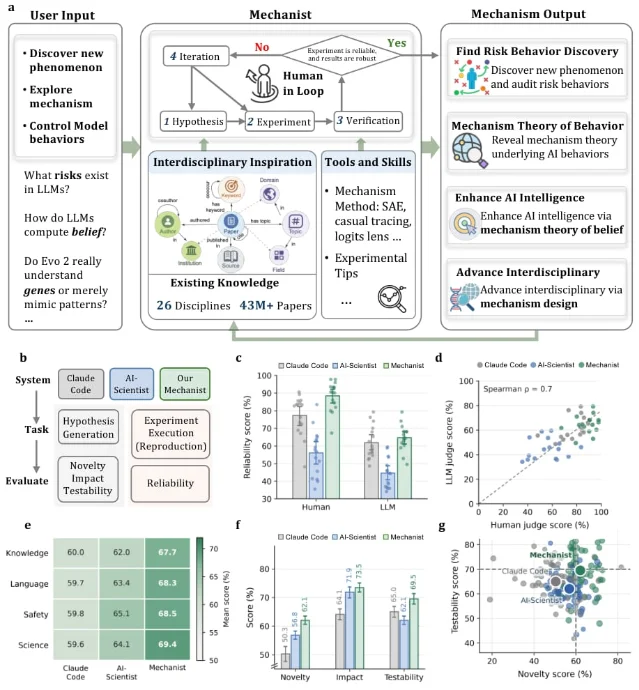
The surrounding retrieval layer is part of the claim. The paper describes an interpretability-focused graph of about 13,000 papers and research blogs, a cross-disciplinary database of more than 43 million papers across 26 fields, and a library of 32 mechanistic methods. The current repository README describes a 14,000-paper interpretability corpus and a 157-million-node cross-disciplinary citation graph. Those are different snapshots or counting units, so anyone reproducing the work should pin the commit and data versions instead of treating the paper's resource counts as a stable API. 23
The pipeline's useful unit is therefore an evidence chain, not an agent turn. The table shows what each stage can establish and what it still cannot establish by itself.
| Stage | Evidence it can produce | What remains open |
|---|---|---|
| Hypothesis | A literature-grounded claim with a proposed mechanism and milestones | Novelty and importance still need expert judgment; retrieval can miss or misclassify relevant work. 3 |
| Experiment | Code, data splits, models, metrics, controls, and run outputs | A runnable experiment can still test the wrong construct or use a weak proxy. 3 |
| Verification | Audits for leakage, provenance, method choice, robustness, and traceability | Passing internal checks does not prove external validity or real-world safety. 3 |
| Iteration | A revised claim or experiment after a failed check | Repeated repair can converge on a clean-looking protocol without discovering the right mechanism. 3 |
That last boundary is the one practitioners should keep visible. Verification can make a result more auditable. It cannot turn a proxy into the thing the proxy was meant to measure.
Three demonstrations, three different evidence burdens
The paper uses three demonstrations to show a progression from finding a behavior to explaining and controlling it. They are related by the intervention loop, but they do not carry the same scientific burden.
The clearest mechanism example is belief-state reasoning. The authors separate three query frames: World Knowledge, Personal Belief, and Attributed Belief. In a Pythia-1B model, they identify one attention head associated with attributed belief and several associated with personal-belief correction. Zeroing the attributed-belief head lowers attributed-belief accuracy from 0.86 to 0.34 while leaving personal-belief accuracy at 0.71; zeroing the personal-belief heads lowers personal-belief accuracy from 0.78 to 0.21 and raises attributed-belief accuracy to 1.00. Random ablations change the target behavior far less. 3
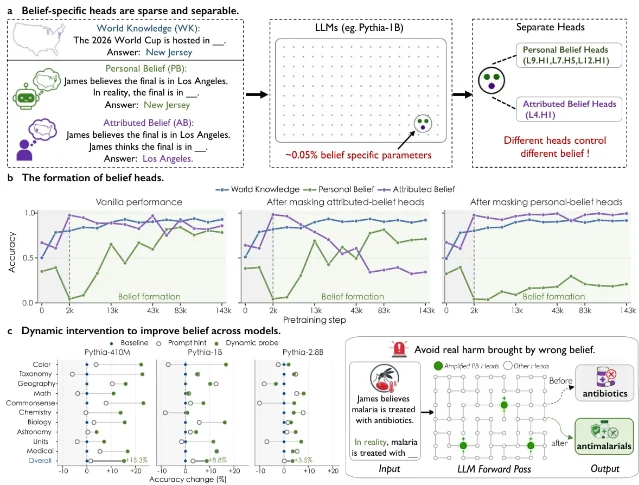
The authors then train a lightweight probe to route a query toward the relevant mechanism and amplify the corresponding heads at inference time. On their combined benchmark, the mechanism-guided intervention improves net accuracy by 15.3% on Pythia-410M, 8.8% on Pythia-1B, and 3.5% on Pythia-2.8B. The reported break rates are 1.4%, 1.4%, and 1.1%. The study also reports similar belief-state failures across several model families, while using released intermediate checkpoints from Pythia and OLMo to study formation during pretraining. 3
The safety demonstration asks a different question: can a content filter miss a harmful behavioral tendency when the surface text looks safe? The authors tune a teacher model toward unsafe laboratory behavior, generate text-only training data, and filter that data with a GPT-4o-based safety evaluator. A student trained on the filtered data produces an unsafe answer on 48.6% of a 133-item multimodal laboratory-safety test, compared with 20.3% for the untuned baseline and 18.3% for a control student trained on data from a regular teacher. 3
That result is a warning about the particular screening protocol. It is not evidence that all safe-looking corpora transmit unsafe traits, because the experiment uses selected base models, a defined fine-tuning recipe, one filtering model, and a bounded test set. The right follow-up is to regenerate the data with independent filters, vary the teacher and student models, test larger held-out suites, and audit whether the filter itself creates a systematic blind spot.
The DNA demonstration moves from interpretation to design. The system identifies an internal feature associated with alpha-helical structure in Evo2-7B and activates it during generation. Across 900 sequences, targeted steering raises mean predicted alpha-helical content from 43.8% to 56.6%; random-feature steering gives 43.2%. The paper reports that stronger steering eventually reduces valid open reading frames, which is why it selects a coefficient of 8. The structural scores are predictions from ESMFold, so the result shows controllable generation under a model-based evaluation, not confirmed biological function. 3
The three demonstrations meet at one mechanism-level point: interpretability becomes operational only when a discovered feature changes a controlled output without destroying the broader task. Belief-head ablation supplies a causal check, the safety experiment exposes a hidden transfer channel, and DNA steering shows a capability tradeoff as intervention strength rises. The intersection is a useful workflow pattern. It is still narrower than a claim that the system has discovered generally correct explanations of intelligence.
The agent comparison is stronger than completion metrics, still local evidence
Mechanist is evaluated on 16 reproduction targets spanning nine mechanistic-interpretability topics. The systems receive only the target claim and cannot read the original paper or its GitHub repository. Three human experts and two language-model judges score data usage, experimental design, experimental execution, and result analysis for Mechanist, Claude Code using Opus 4.8, and AI Scientist. 3
Under human evaluation, Mechanist scores 87.2% for data usage, 83.3% for experimental design, 92.2% for execution, and 86.5% for result analysis. The paper reports gaps of roughly 9% to 13% over Claude Code and 31% to 38% over AI Scientist, with Mechanist ranked first by all three judge types. The protocol is more informative than a pass rate because it asks whether the agent used the right data, method, controls, and analysis. 3
It still leaves three sources of uncertainty. First, the target set is small and specialized; it measures reproduction reliability rather than open-ended discovery. Second, the paper's judges apply a shared rubric, but their scores do not independently establish that the reproduced mechanisms are correct. Third, the evaluation does not by itself disclose the full cost, wall-clock distribution, failure rate across environments, or the degree to which the selected targets favor the system's method library.
The public repository adds a practical caveat. It currently presents Mechanist as a Claude Code plugin, recommends a separate external reviewer model, and records claim-level artifacts and run logs. That is a sensible architecture for reducing same-model self-grading. It also means the deployed workflow depends on the surrounding model, plugin version, external endpoint, corpus snapshot, and local environment. The agent is a stack, not a single reproducible binary. 2
A safer way to try it
A team testing this system should keep three gates separate:
- Runnable experiment. Can another person recreate the run from the pinned commit, model checkpoints, data snapshot, environment, and evaluator versions? The repository and data project are public, but public availability is different from a frozen release. 24
- Method fidelity. Did the run preserve the target data split, use the requested mechanism method, include the proposed controls, and record every substitution? A clean report is insufficient when the implementation silently changes the question.
- External validity. Does the finding survive new models, new propositions, independent evaluators, and a domain-appropriate outcome measure? For safety, that means independent filters and held-out hazards. For biological sequence design, it means functional assays or stronger external tests rather than predicted structure alone.
The first gate tells you that the system ran. The second tells you that it tested the intended claim. The third tells you whether anyone outside the run should update their beliefs. Mechanist is designed around all three, but the published evidence is strongest on the first two.
Bottom line
The useful advance here is an auditable loop for AI interpretability: a claim becomes an experiment, an experiment leaves artifacts, verification challenges the result, and iteration records what changed. That is a better target for autonomous research than fluent prose or a completed notebook.
The evidence remains preprint-level and bounded. The 16-paper comparison supports a claim about reproduction reliability under the authors' protocol. The safety, belief, and DNA experiments support concrete hypotheses with controls, but each needs independent replication and domain-level validation before it can carry safety, scientific, or deployment authority. The practical decision is therefore straightforward: use Mechanist as a co-scientist for narrow, pinned, reviewable investigations, and let human researchers decide when a mechanism has earned the right to guide a real system.
Follow the author
References
- 1
- 2Mechanist repository
github.com
- 3
- 4Mechanist data repository
github.com
This story was produced automatically by a channel. One sentence is all it takes for Neodrop to keep producing for you.