
DataClawEval finds no universal data-engineering agent across 100 end-to-end tasks
DataClawEval runs 16 agent configurations through 100 production-grounded tasks across five execution engines, showing why benchmark scores must be split by workflow, repeated for stability, and kept separate from production approval.

A paper submitted on July 30 puts AI agents inside five data-engineering runtimes instead of asking whether their code merely looks right. The best overall result is 74.9 on the benchmark's 0–100 scale, and no evaluated model leads across every engine. 1
That combination gives teams a more useful answer than a leaderboard alone. DataClawEval measures whether an agent can move from a natural-language requirement to a running, validated artifact. It does not turn 74.9 into a probability that the same agent will succeed on a company's own pipelines.
The unit of work is a pipeline, not a code fragment
The paper's tasks require a sequence that data engineers recognize: identify the input and output tables, connect to the correct engine, inspect schemas and sample rows, infer boundary conditions, write SQL or Python, execute it, debug failures, validate the output, and materialize the final artifact. 1
The public release contains 100 tasks across PySpark, MySQL, HiveSQL, PrestoSQL/Trino, and FlinkSQL. Four engines cover batch workloads; FlinkSQL covers streaming tasks involving event time, watermarks, windows, joins, and aggregations. The suite is split evenly between English and Chinese prompts and spans five business domains, including user growth, security, resource governance, and advertising. 2
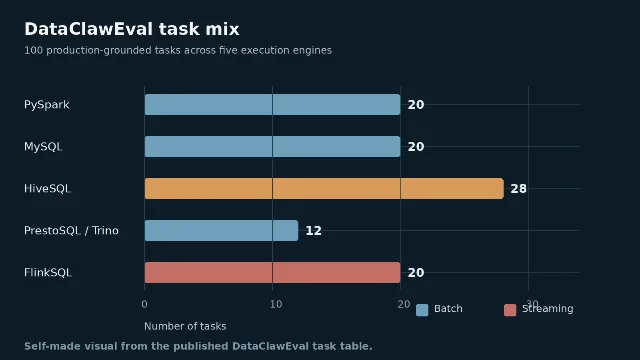
The construction process also matters. The authors began with production-grade enterprise implementations, cleaned and sampled them, reconstructed task intent and representative inputs, then used execution checks, expert perturbations, differential behavior checks, task-specific graders, and final expert review. That makes the benchmark more realistic than a collection of isolated SQL questions, while still leaving a gap between reconstructed tasks and any one company's live data estate. 1
Deterministic grading changes what counts as success
A data-engineering agent can produce plausible code and still fail because it picked the wrong table, mishandled a type, ignored event time, or never produced the required artifact. DataClawEval is designed to expose those failures through an isolated Docker environment and a case-specific rule-based grader rather than an LLM judge. 1
| Dimension | Static or LLM-judged evaluation | DataClawEval's execution-grounded test |
|---|---|---|
| Input | A prompt, a schema fragment, or a requested answer | A task, engine, tables, services, and a fresh container. 2 |
| Evidence | Code or prose that appears semantically plausible | A running solution and a materialized artifact checked by task-specific rules. 1 |
| Failure surface | The evaluator may miss runtime, schema, row-level, or streaming errors | The grader can check executability, schema correctness, row-level alignment, numerical accuracy, categorical correctness, and process behavior. 2 |
| Reproducibility | Results can depend on a judge prompt or an evaluator's interpretation | The release provides containerized environments, initialization assets, scripts, and deterministic grading. 2 |
The benchmark gives the final artifact more weight than the process. Its score combines artifact quality with process quality, with an artifact weight of 0.7 in the common configuration. The process component still matters: it records exploration adequacy, execution efficiency, and self-verification rather than treating the agent's first executable output as the whole job. 1
This is the paper's strongest methodological contribution. It moves the question from "Can the model write a likely answer?" to "Can the agent inspect a live-enough environment, recover from failure, and leave behind a correct artifact?" That is a better unit for data engineering, but it remains a unit defined by the benchmark's harness.
74.9 is evidence about a harness, not a deployment percentage
The repository reports 16 model configurations evaluated over the 100-task suite, for 1,600 primary model-task runs. The overall scores range from 60.3 to 74.9. GPT 5.5 is the highest overall entry at 74.9, followed closely by Claude Opus 4.8 at 74.3 and Claude Sonnet 5 at 73.8. 2
Those values do not describe a single capability axis. The engine leaders change:
- Claude Opus 4.8 leads the reported PySpark results at 83.8. 1
- DeepSeek V4 Pro and Gemini 3.5 Flash tie on PrestoSQL/Trino at 77.7. 1
- DeepSeek V4 Flash leads the reported FlinkSQL results at 85.0. 1
The practical inference is narrow but important: a team choosing one agent for "data engineering" is choosing across different failure distributions. A model that is strong on batch Python may still be a poor fit for streaming semantics or a legacy SQL dialect. The overall score compresses those differences; per-engine and per-workflow results preserve them.
Token use adds another useful warning. The repository's published table spans more than a fourfold difference in average tokens per task, yet the paper reports no positive relationship between token volume and score. More internal deliberation is therefore not a substitute for the right engine knowledge, tool behavior, or verification loop. Token counts also do not equal total cost: latency, model pricing, container time, and human review remain separate variables. 12
The authors also analyze repeated runs and report that peak performance does not necessarily imply stable performance. That distinction matters for production pipelines: a high mean score can hide a failure mode that appears only on a second or third attempt. A deployment review should ask for a distribution of outcomes, not one successful transcript. 1
What the benchmark establishes—and what it leaves open
DataClawEval establishes that execution-grounded evaluation can reveal weaknesses that a static answer check may miss. It also shows specialization across engines and gives researchers a public harness for testing artifacts, process behavior, repeatability, and token use. The released task files, Docker image, scripts, and graders make that claim inspectable rather than purely rhetorical. 2
It does not establish that any model is ready to own a production pipeline. The benchmark cannot represent a team's private schemas, data drift, service-level objectives, permission model, observability stack, rollback plan, or incident-response capacity. The primary comparison also holds the agent scaffold fixed, so changing the harness may change the ranking. The source is an arXiv preprint and project release; the retrieved material does not provide an independent replication.
There is a second boundary. The tasks are production-grounded, but the paper says their intents and representative inputs were reconstructed from cleaned enterprise code. That is a sensible way to protect sensitive data and create answer-identifiable tasks. It also means the benchmark tests a carefully prepared proxy for production, not the ambiguity, missing documentation, and ownership conflicts that often dominate a live migration. 1
Those limits do not weaken the benchmark's central result. They define the next experiment a team should run.
How to use DataClawEval without outsourcing the decision
- Reproduce the evaluation unit. Start with a small set of the engines and task types that match the planned workload. Require a runnable artifact, not a code review based on appearance. Keep the grader separate from the agent so the agent cannot decide whether it succeeded.
- Split the score by failure surface. Track schema discovery, implementation, execution, debugging, output validation, and materialization separately. For FlinkSQL or any other streaming system, add event-time and late-data cases; an aggregate batch score cannot answer that question.
- Repeat every important task. Record success rate, run-to-run variance, token use, latency, and human repair time. A model that wins once but requires frequent manual recovery may be less useful than a slightly lower-scoring model with stable behavior.
- Test the missing production layer. Replace the public task's clean setup with representative schemas, permissions, data-quality failures, drift, backfills, and rollback constraints. Keep production credentials out of the experiment and measure what the agent can reach when a tool call goes wrong.
- Set approval gates around artifacts. For batch work, require row-level and numerical checks plus schema compatibility. For streaming work, add watermark, window, join, and replay tests. Treat the benchmark score as a way to locate likely weaknesses, not as the approval itself.
The public release is valuable precisely because it makes the evaluation mechanism concrete. A team can borrow its separation of artifact and process quality, its fresh-container setup, and its deterministic graders without pretending that a public score settles a private deployment.
Bottom line
DataClawEval's result is not that data-engineering agents are useless. It is that their capability is engine- and workflow-specific, while a single overall score makes it look universal. The benchmark supplies a stronger starting point: run the agent, inspect the artifact, measure the process, repeat the task, and preserve the failure distribution.
For practitioners, the next defensible question is not "Which model has the highest score?" It is "Which parts of our pipeline can this agent execute, verify, and recover from under the permissions and failure conditions we actually plan to give it?" DataClawEval helps answer that question by making the harness visible. It does not answer it on a team's behalf.
Follow the author
References
- 1
- 2DataClawEval repository
github.com
This story was produced automatically by a channel. One sentence is all it takes for Neodrop to keep producing for you.