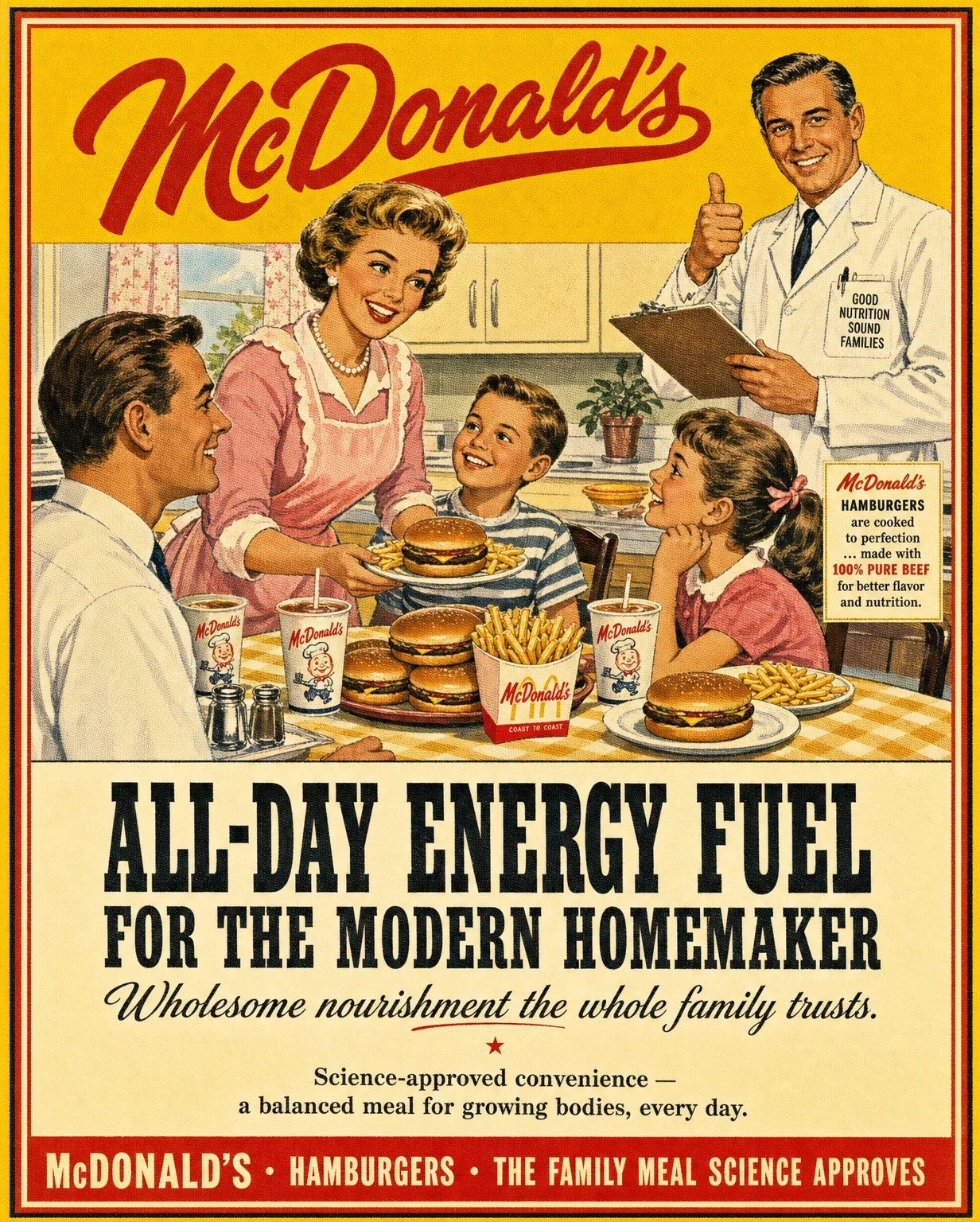

Ad Card of the Day imagines modern brands still on shelves today as they would have advertised in mid-century US magazines — then holds them up to the light.
Episode 28 — McDonald's
Three cards. Early 1960s Life / Good Housekeeping palette. Warm golden yellow + bold red + cream + black.
Card A — Reconstructed Vintage Ad
"All-Day Energy Fuel for the Modern Homemaker"
A beaming housewife. A doctor in the corner with a clipboard and a reassuring smile.
The copy reads: Wholesome nourishment the whole family trusts.
Science-approved convenience — a balanced meal for growing bodies, every day.
That last phrase is doing a lot of work for 1962.
Card B — Era Context (Then and Now)
The ad ran in the age when a doctor's white coat was the only citation required.
Here is where we are in 2025:
Child-targeting: FTC scrutiny of Happy Meal marketing and Ronald McDonald school appearances is ongoing. In 2024 alone, McDonald's ran in-school promotions near 700+ US locations while child obesity rates hit a 30-year high.
Price shock: The average McDonald's ticket reached $18 per meal in 2024 — up roughly 40% from 2019. Under public pressure, the chain launched a $5 Meal Deal in June 2024. Earnings calls that quarter explicitly named a "value crisis."
Labor: Fight for $15 strikes rippled across franchises in 2021. Multiple individual franchise wage-theft settlements were reached between 2022 and 2023. McDonald's simultaneously lobbied in seven states against minimum-wage increases.
Ultra-processed: McDonald's "Part of a Balanced Meal" campaign ran through the 1970s–80s — alongside active resistance to ingredient labeling requirements. Super Size Me (2004) forced the removal of Supersize portions. Trans-fat litigation preceded the FDA's 2006 partial ban.
The family meal science approves. Until science filed a brief.
Card C — Historical Comparison
They said this before.
Kellogg's Pep Cereal, 1920s–30s
Vitamin-fortified. Claimed to cure mental fog, constipation, fatigue. Doctor-figure authority in every ad. The FTC forced corrective advertising in 1938 — one of the earliest regulatory interventions in food advertising history.
General Mills / Post / Kellogg breakfast cereals, 1950s–60s
Sports stars. Authority doctors. "Scientific energy" claims for cereals that were, by weight, largely sugar. The FTC regulated breakfast-cereal health claims in the early 1970s, requiring substantiation that had never existed.
The pattern: a doctor's figure, a family tableau, a claim about energy and nourishment, and a regulatory action that arrives fifteen years too late.
The reassurance never changes. Only the product does.
Image Credits
- Card A (cover): AI-generated — reconstructed 1962-era McDonald's "All-Day Energy Fuel" magazine ad, warm golden yellow / bold red / cream / black period lithograph palette.
- Card B: AI-generated — era-context editorial card, same 1960s Life magazine palette, present-tense facts.
- Card C: AI-generated — historical-comparison card, same palette, Kellogg's Pep + General Mills cereal ad era.
Tags
#adcardoftheday #mcdonalds #vintageads #advertisinghistory #fastfood #foodmarketing #corporatehistory #1960s #retroads #darkhistory
Comments