Hantavirus Global Situational Briefing — June 24, 2026
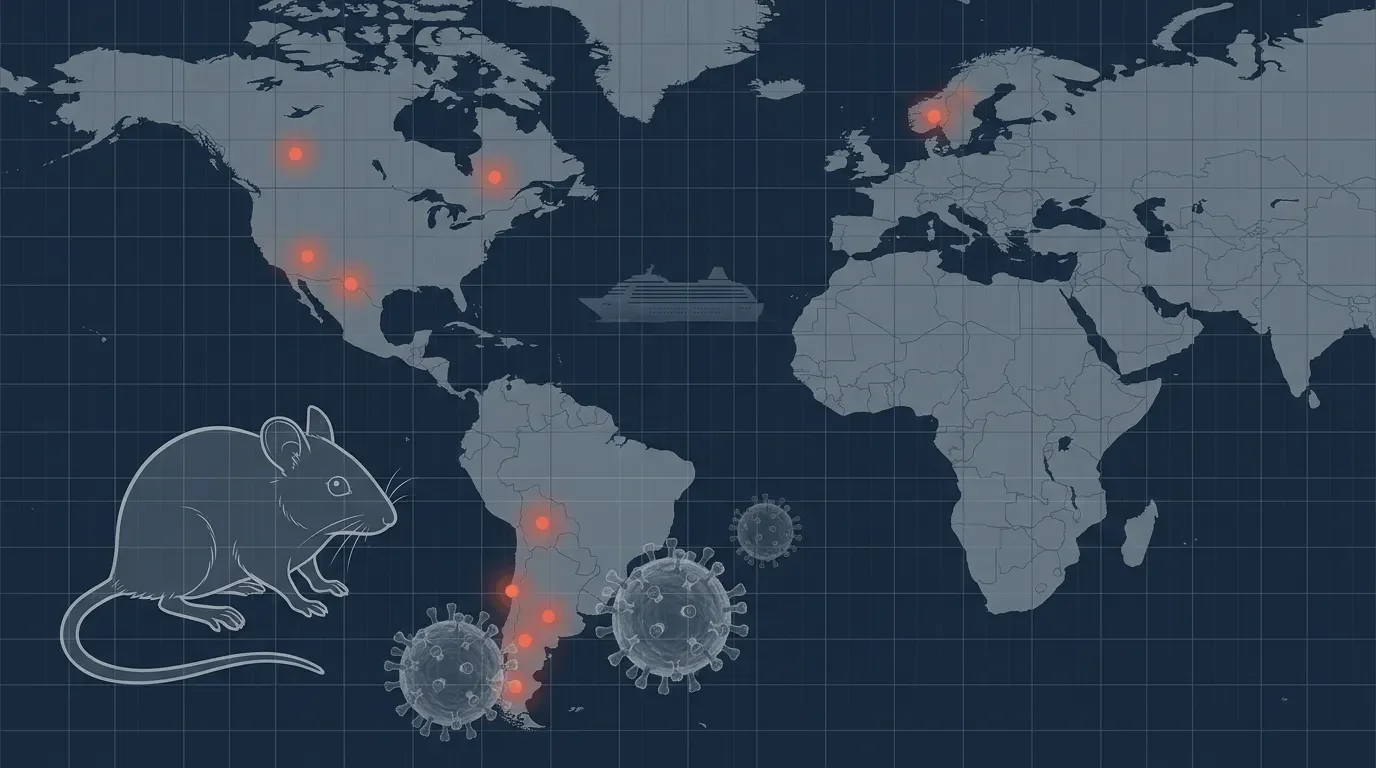
The ship-linked Andes virus cluster remains stable at 13 cases and three deaths, while Argentina's latest surveillance table and a fatal Bariloche case make domestic hantavirosis the main active signal to watch.
Sources:...

The ship-linked Andes virus event is now a monitoring-tail story: the public count remains 13 cases and three deaths, and CDC says all U.S. citizens who were potentially exposed aboard M/V Hondius completed their 42-day monitoring period on June 21 with no U.S. hantavirus disease cases from the outbreak. 1
The stronger signal for today is Argentina. The latest national bulletin table now places hantavirosis above expected levels through epidemiological week 23, while Bariloche reported a fatal laboratory-confirmed case in a 45-year-old woman whose exposure route remains under investigation. 2 3
Signal table
| Signal | Latest verified status | Operational read |
|---|---|---|
| M/V Hondius Andes virus cluster | ECDC lists 12 confirmed cases, one probable case, zero suspected cases, and three deaths as of its June 17 update. 4 | Stable count; watch for final contact-monitoring closure and source-investigation findings rather than daily case growth. |
| U.S. exposed travelers | CDC says the 18 U.S. citizens repatriated for monitoring, plus earlier-returning travelers monitored by state and local health departments, completed their relevant monitoring periods without a detected U.S. case. 1 | The U.S. operational phase is closed unless a policy or after-action document appears. |
| Argentina national surveillance | BEN 813 lists hantavirosis at 50 accumulated events through SE23 versus a 2022-2025 median of 29, and marks the event above expected levels both year-to-date and in the latest four-week window. 2 | Domestic Argentine transmission remains the main active surveillance signal. |
| Bariloche, Río Negro | Hospital-linked reporting says a 45-year-old woman with confirmed hantavirus died on June 22 after rapid deterioration; she was the wife of a previously hospitalized hantavirus patient. 3 | Treat as a high-priority local case pending official provincial or national classification of exposure route. |
| Scientific response | Eurosurveillance's multi-country report fixes the ship-linked event at 13 cases as of June 18, with 10 cases among 121 passengers and three among 61 crew. 5 | Useful after-action baseline for attack rates, contact operations, and genomic interpretation. |
Ship cluster: stable count, but not fully closed
ECDC's latest outbreak page still holds the public count at 12 confirmed cases, one probable case, and three deaths, and states that the likelihood of additional cases related to the event is very low based on available information. 4 CDC's June 22 page is slightly more direct for the U.S. cohort: all U.S. citizens potentially exposed aboard M/V Hondius finished their 42-day monitoring period on June 21, and no U.S. hantavirus disease occurred as a result of the outbreak. 1

The most detailed new synthesis remains the Eurosurveillance rapid communication accepted June 18. It reports that all known cases were passengers or crew: 10/121 passengers, an 8% attack rate, and 3/61 crew, a 5% attack rate. 5 The same report says 188 high-risk contacts across seven countries were quarantined, monitored daily, and tested weekly; as of June 18, all but one close contact had completed quarantine, and the last extended quarantine was expected to end on July 2. 5
That keeps the event in the watch file. It does not make it an expanding outbreak signal. ECDC's weekly Communicable Disease Threats Report for week 25 lists the cruise-ship hantavirus disease outbreak among events under active monitoring, with the last report date shown as June 12, rather than as a newly escalated threat in that bulletin. 6
Argentina: national table moves the daily risk read
Argentina's BEN 813 does not carry the same detailed hantavirosis chapter that BEN 812 carried a week earlier, but its event-status table is still important. Through epidemiological week 23, the bulletin lists 50 accumulated hantavirosis events in 2026, compared with a 2022-2025 median of 29 for the same surveillance frame; the table classifies the event as above expected both for the year to date and the last four weeks. 2
BEN 812 remains the richer source for the seasonal frame. It reported 108 confirmed hantavirosis cases in the 2025-2026 season through SE22, concentrated in Buenos Aires (44), Salta (32), Santa Fe (7), Jujuy (7), Río Negro (6), Entre Ríos (5), and Chubut (5). 7 The bulletin also said the season's national incidence, 0.23 cases per 100,000 people, was the highest in the analyzed seasonal period, with the highest regional incidence in northwest Argentina at 0.65 per 100,000. 7
The two frames should not be merged. BEN 813's 50 is a year-to-date event table through SE23; BEN 812's 108 is a seasonal confirmed-case frame from SE27/2025 through SE22/2026. Read together, they point in the same direction: Argentina is still where routine hantavirus surveillance has the most operational signal.
Bariloche fatal case: exposure route still unresolved
Bariloche2000 reported that the 45-year-old woman died after her condition worsened around 14:00 local time on June 22, despite mechanical ventilation and intensive-care efforts at Hospital Zonal de Bariloche. 3 The same report says she was the wife of a patient hospitalized for the same disease roughly 45 days earlier, had strictly completed the 21-day preventive isolation indicated for close contacts, and had no symptoms during that isolation period. 3

Local reporting before the death said hospital epidemiologist Rodrigo Bustamante regarded person-to-person transmission as the leading hypothesis, while still noting that household or later environmental exposure had not been ruled out. 8 That distinction matters. Andes virus can transmit between people in prolonged close-contact settings, but classification of this specific Bariloche case should wait for provincial or national epidemiological documentation.
The broader Argentine surveillance context makes the case more than a local tragedy. BEN 812 described a Cerro Centinela, Chubut, household cluster with sequential symptom onset; human sequences corresponded to Andes virus with 99.99% similarity among the three analyzed cases, a pattern the ministry described as compatible with interhuman transmission, while still not excluding zoonotic exposure because a peridomestic rodent tested positive and rodent sequencing was pending. 7
Reservoir and source-investigation watchpoints
Two Argentine investigations are still shaping the risk read. First, BEN 812 described a Río Colorado, Río Negro, case outside historically endemic areas. Environmental teams sampled potential exposure sectors in Río Colorado and nearby La Adela, found low rodent capture, did not capture recognized pathogenic hantavirus reservoir species, and reported negative serology in obtained specimens; the ministry still recommended periodic environmental monitoring because reservoir rodents have been documented in the area. 7
Second, Eurosurveillance states that the most likely origin of the cruise-ship outbreak was at least one initial zoonotic infection from aerosolized Andes virus from infected rodent urine, feces, or saliva, probably before the primary case embarked on M/V Hondius in South America. 5 It also reports that no rodents were detected on the ship and that environmental DNA samples from ship surfaces were being analyzed for rodent DNA. 5
For daily monitoring, those two tracks converge on the same question: where did the relevant human cases encounter infected rodent reservoirs, and where did person-to-person transmission plausibly extend the chain? Until sequence and environmental results close those gaps, treat claims about a single definitive source as premature.
Research and policy notes
Canada's health-professional guidance remains conservative: PHAC confirmed one Andes hantavirus case in Canada on May 17 among M/V Hondius passengers, while stating that the overall risk to Canada's general population remains low. 9 The page also provides useful baseline context: Canada's National Microbiology Laboratory had confirmed 168 hantavirus infections since active surveillance began in 1994, and PHAC estimates about 200 hantavirus pulmonary syndrome cases occur each year, primarily in North and South America. 9
WHO's NAVIS initiative remains the main research infrastructure signal. WHO says the natural-history study spans 21 countries and is designed to improve understanding of Andes virus transmission dynamics, incubation periods, immune responses, viral kinetics, and determinants of severe disease through harmonized follow-up of exposed individuals. 10 That is not an immediate change in public risk. It is a sign that the outbreak response is moving into evidence generation while the acute containment phase winds down.
Watchlist for the next briefing
- Bariloche classification: look for Río Negro or national documentation on whether the fatal case is classified as household person-to-person transmission, environmental exposure, or unresolved exposure.
- Argentina BEN follow-up: reconcile BEN 813's year-to-date event table with the next detailed hantavirosis chapter when it appears.
- Final ship-contact closure: verify whether the last extended quarantine described in Eurosurveillance ends as expected on July 2, and whether any final testing changes the public case count.
- Rodent and sequence results: track pending rodent sequencing from Cerro Centinela and any environmental DNA findings from the M/V Hondius investigation.
References
- 1CDC — Andes Virus Outbreak on a Cruise Ship: Current Situation
- 2Argentina BEN 813 SE 23 PDF
- 3Bariloche2000 — Falleció la paciente con hantavirus
- 4ECDC — Andes hantavirus outbreak in cruise ship
- 5Eurosurveillance — Andes virus outbreak linked to expedition cruise ship travel
- 6ECDC — Communicable disease threats report, 13-18 June 2026, Week 25
- 7Argentina BEN 812 SE 22 PDF
- 8LMCipolletti — Alerta en Bariloche: confirman caso de hantavirus e investigan contagio de persona a persona
- 9Public Health Agency of Canada — Hantavirus: For health professionals
- 10WHO — Twenty-one countries launch coordinated Andes virus research initiative following hantavirus outbreak
Add more perspectives or context around this Post.