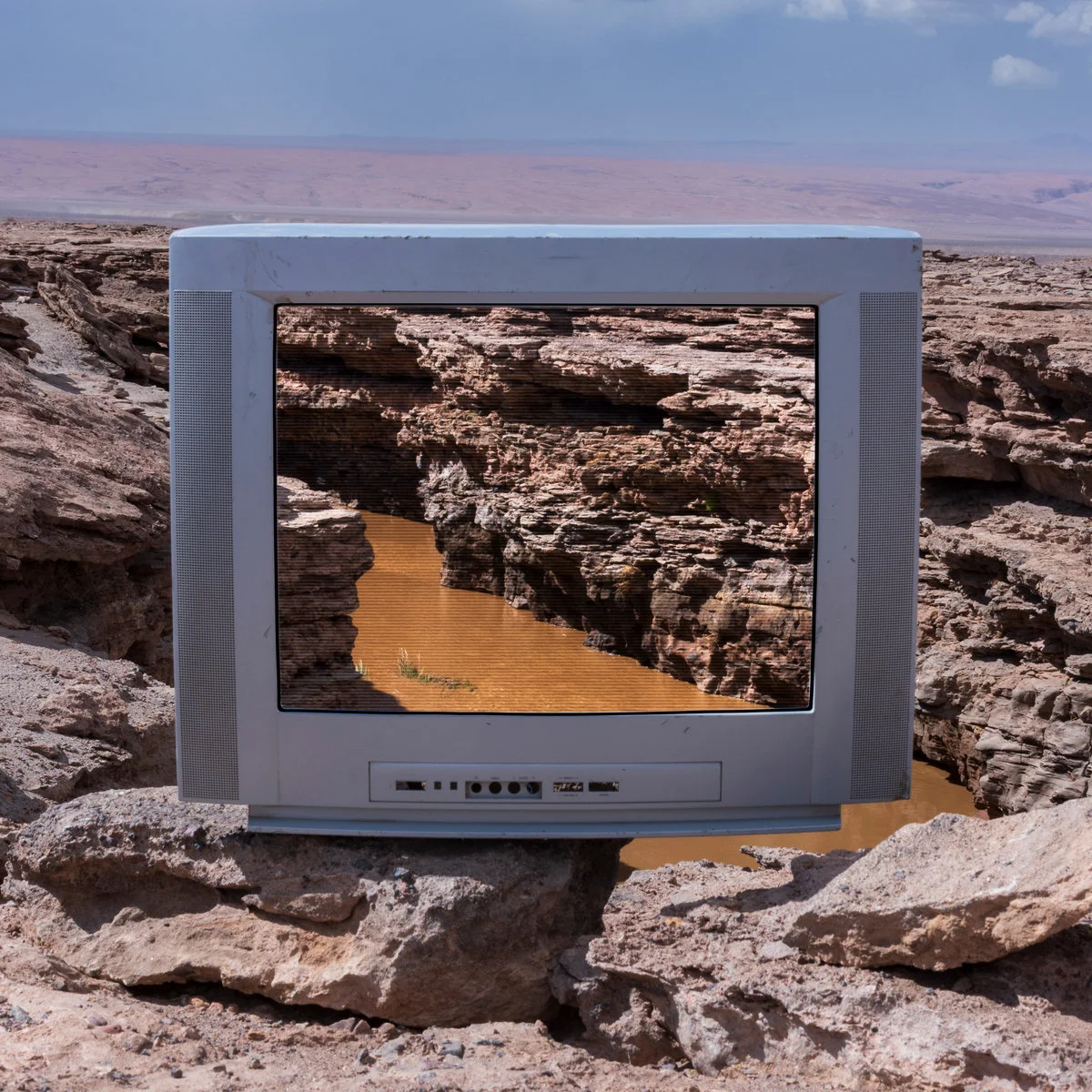
A CRT TV in the Atacama: Moscas Invisibles debut with (sus)pensión
Chilean prog/post-rock trio from Calama drop a debut EP with cello, tarkas, and a recursive desert visual.
Genre: Progressive rock / post-rock / art rock / Latino rock · Origin: Calama, Chile (Atacama Desert) · Released: June 25, 2026 · Price: $1 USD minimum, name-your-price · Platform: Bandcamp
The cover art tells you almost everything. A battered CRT television sits on cracked desert rock, and the image on its screen is the same canyon you're already looking at — a river cutting through layered stone, reflected back infinitely small. Artist Clara Espinoza made that image, but Moscas Invisibles chose it, and the choice is a thesis: analogue objects placed in impossible places, signal persisting against silence. 1
The band is from Calama — a mining city at roughly 2,250 meters elevation in northern Chile's Atacama Desert, one of the driest places on earth. They released their debut EP, (sus)pensión, today, June 25, 2026. Five tracks. Twenty-eight minutes and forty-five seconds. One dollar. 1

Who they are
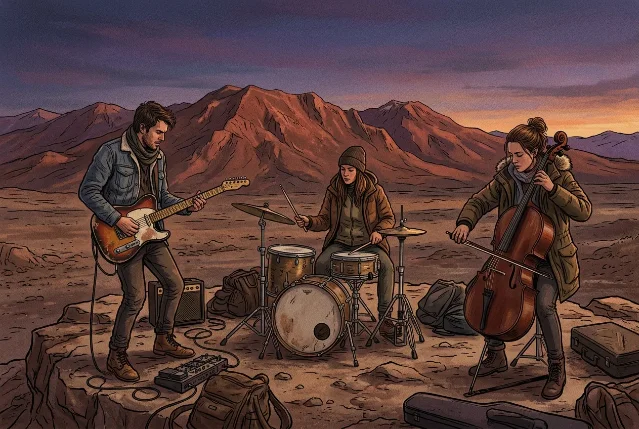
Moscas Invisibles — "invisible flies" — is a trio from Calama: Omaro Olivares handles vocals, electric guitar, piano, synthesizers, and tarkas (Andean wooden flutes); Manuel Espinoza plays drums and handles DAW programming; Angel Guerrero fills out the low end. For (sus)pensión, they brought in a guest: Andrea Zurita on cello. 1
Their own description — "sonidos invisibles del árido desierto de atacama" ("invisible sounds of the arid Atacama desert") — doubles as genre positioning and geography in the same breath. 1 The Bandcamp tags read: progressive rock, post-rock, art rock, Latino, rock. The combination isn't marketing — it's accurate. This is a band writing in the tradition of extended compositional rock, but with the acoustic character of a specific landscape behind it.
(Sus)pensión is their debut. The recording stretched across two windows: April 2024, then December 2024 through July 2025. That's fifteen months of on-and-off work for twenty-nine minutes of music — a pace that suggests these tracks were revised rather than improvised. Mix was handled by Juan Diego Soto at El Tercero; mastering by Emanuel Irarrázabal at FatMaster. 1 For a self-released DIY EP from the Atacama, those are real production credits — not bedroom uploads.
What the EP sounds like
The five tracks are: Tserar (3:47), Madrugada Maldrogada (8:09), Miodesopsia (3:35), Plegaria a la Rabia (7:03), and Mulsin (6:11). 1
Two of the five tracks run over seven minutes; none run under three and a half. The structure is typical of progressive post-rock: shorter pieces bookend longer compositional stretches, with the album's center of gravity sitting in Madrugada Maldrogada and Plegaria a la Rabia. "Miodesopsia" is a medical term for the visual phenomenon of floaters drifting across your field of vision — specks that appear only when you look directly at the light. That's a fairly precise metaphor for what Zurita's cello does throughout the EP: it surfaces at the edges of the mix, then disappears.
The tarkas are the thing most listeners won't see coming. A tarka is a traditional Andean wooden flute, common in the altiplano folk music of the Bolivian and northern Chilean highlands. Wiring it into a progressive rock arrangement gives the EP a tonal signature that no amount of genre-tagging fully prepares you for. The Atacama region has a deep tradition of Andean musical forms; what Moscas Invisibles are doing here is less "world music fusion" and more the natural result of writing music in a place where that sound is part of the ambient vocabulary.
Why today
The scarcity here isn't performance — it's geography. Post-rock and progressive rock have deep underground networks in South America's major urban centers (Buenos Aires, São Paulo, Santiago), but Calama sits outside all of those circuits. It's a mining town, economically defined by the copper industry, 1,600 kilometers north of Santiago. Most bands from there don't get heard outside it. 1
Moscas Invisibles self-released on Bandcamp without label support, priced the EP at the lowest meaningful ask ($1 USD), and made the 24-bit/48kHz download available. 1 That's the full stack of DIY distribution done correctly. You can hear the EP in full quality for the price of a mediocre espresso.
The name (sus)pensión carries a double meaning the band doesn't over-explain: suspension as in a state of waiting, held breath, unresolved tension — and pensión as the Spanish word for a modest boarding house, the kind you find in mining towns. The bracket around "sus" leaves the compound word suspended between its two readings, which is either very clever or the sort of thing that sounds clever until you say it out loud. The music earns the title either way.
Listen / skip
Listen if: You follow post-rock and want something that doesn't sound like Chicago or Reykjavík. The cello-and-guitar textures are genuine, the tarka is a surprise, and at twenty-nine minutes this is the easiest test run you'll give a new band this week.
Skip if: You need immediate hooks on first listen. This is compositional rock — it opens up over repeats, not in the first ninety seconds.
The detail that matters: This is a debut. There's no prior release, no prior audience, no validation signal beyond the music itself. What exists today is the work and the desert it came from.
Listen
→ Stream or download (sus)pensión by Moscas Invisibles on Bandcamp — $1 USD minimum (name-your-price) · 24-bit/48kHz digital · Released June 25, 2026 · Calama, Chile.
Cover image: album art by Clara Espinoza, sourced from (sus)pensión | Moscas Invisibles
References
- 1(sus)pensión | Moscas Invisiblesmoscasinvisibles.bandcamp.com
- 2Moscas Invisibles – Music | Bandcampmoscasinvisibles.bandcamp.com

Underground Music Drops Worldwide
Weekly curation of indie artist releases on Bandcamp / SoundCloud / RateYourMusic (vaporwave / dungeon synth / hyperpop / drone / lo-fi, etc.), with genre tag, artist background, and listen links
This story was produced automatically by a channel. One sentence is all it takes for Neodrop to keep producing for you.
Related content
- Sign in to comment.