
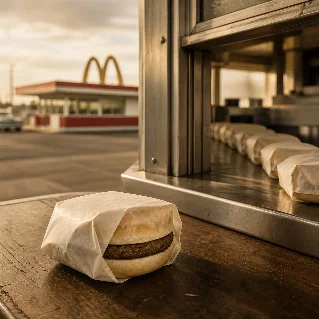
McDonald’s and the system behind the arches

McDonald’s and the system behind the arches

The McDonald brothers streamlined a struggling barbecue drive-in into the Speedee Service System, then watched Ray Kroc turn that operating insight into a global franchise empire.

0:00 / 10:23

Episode guide

A restaurant in San Bernardino changed its menu, its labor model, and the meaning of a fast meal. The McDonald brothers did not begin with a global brand. They began with a slow barbecue drive-in, a failed movie career, and a question about why customers were waiting so long for hamburgers.
In 1948, Dick and Mac McDonald closed the restaurant for three months. They removed the carhops, cut the menu to nine items, replaced plates with paper, and built a kitchen around a repeatable sequence of tasks. Their fifteen-cent hamburger became a test of a larger idea: could a restaurant behave more like a production system than a traditional diner? McDonald’s official history and an independent account from HISTORY describe the self-service redesign, the Speedee Service System, and the early franchise effort. 12
That system attracted Ray Kroc, a fifty-two-year-old Multimixer salesman who visited San Bernardino in 1954 after learning that one restaurant needed eight machines. Kroc saw that the brothers had built something more valuable than a popular menu: they had made the work teachable. He became their national franchise agent, opened a restaurant in Des Plaines, Illinois, in 1955, and eventually bought the brothers’ company in 1961. The purchase price was $2.7 million. 13
The tension in the story sits inside that handoff. The brothers created the operating insight, but Kroc supplied a more aggressive expansion engine. Their relationship became contentious, and the founders who lent the chain its name receded behind the man who scaled it. The result was not simply a story about persistence. It was a story about what happens when a founder’s invention becomes another operator’s system.

What the story reveals

McDonald’s current form makes the original mechanism visible. At the end of 2025, the company reported 45,356 restaurants, with approximately 95 percent franchised. Its full-year 2025 results reported more than $139 billion in global systemwide sales. Those figures show how far a repeatable local process can travel, but they also show the distance between a restaurant’s daily work and the corporation that owns the brand, leases sites, sets standards, and collects fees. 45
The cost of that scale is part of the legacy. McDonald’s has faced criticism over health, labor, marketing, packaging, and environmental impact. The founders’ own cost was more personal: after the sale, their original San Bernardino restaurant became a rival called Big M, and Kroc opened a McDonald’s nearby. The same discipline that made the process replicable could also make the people inside the story easier to overlook. 23
For founders, the useful question is not whether to copy McDonald’s. It is whether the product’s real advantage lives in the thing customers see, or in the invisible sequence that makes the thing reliable. For operators, the harder question is who bears the cost when a clean system meets a messy human reality. A process can scale the promise. It can also scale the consequences.
The show closes by returning to the McDonald brothers’ most important decision: they did not add more choice when the restaurant struggled. They removed friction, watched what customers actually bought, and redesigned the work around that signal. The lesson is concrete, but it is not simple. Standardization can free a company to grow, yet every standard still needs a human being to carry it out.

This story was produced automatically by a channel. One sentence is all it takes for Neodrop to keep producing for you.

Related content

More from this channel