
The mind that edits reality before you notice
Wikipedia's July 15, 2026 Featured Article on Cognition explains how perception, attention, memory, language, reasoning, and unconscious shortcuts quietly assemble the world we experience.

Most people use cognition as a synonym for thinking. Wikipedia's July 15, 2026 Featured Article argues for a much larger definition: cognition is what the mind does with knowledge, from acquiring information to storing it, retrieving it, transforming it, and using it. Reading a sentence, recognizing a face, remembering a route, choosing a meal, and deciding what someone meant are all cognitive acts. 1
That broader definition changes the story. Thought is not a command centre receiving a finished picture of the world. It is the visible end of a chain of mostly hidden operations. Perception selects and interprets signals. Attention decides what gets priority. Memory supplies context. Language packages ideas into shareable form. Reasoning and decision-making work on the result, often with incomplete information and limited time. 2
A quick map of cognition
| Process | What it contributes | An ordinary example |
|---|---|---|
| Perception | Turns sensory signals into an experienced object or event | Recognizing a familiar landmark in changing light |
| Attention | Prioritizes some information and filters out the rest | Following one conversation in a crowded room |
| Memory | Acquires, stores, and retrieves information | Holding a phone number long enough to dial it |
| Thinking | Manipulates ideas, concepts, and possibilities | Comparing routes, explanations, or next steps |
| Metacognition | Monitors and regulates other mental processes | Realizing that a problem-solving strategy is failing |
You do not receive the world raw
Perception begins with physical stimuli such as light and sound. Receptors detect them, signals travel to the brain, and multiple processes work together to construct a coherent experience of objects and events in space and time. The experience feels immediate, but it is already an interpretation. 2
The mind has to identify edges, colours, pitches, locations, and patterns, then compare what it is receiving with stored knowledge. That is how a shape becomes a door, a sequence of sounds becomes a familiar melody, or a face becomes someone you know. The shortcuts are useful because the incoming stream is too large to analyse from scratch. They are also why perception can become inaccurate or illusory. 2
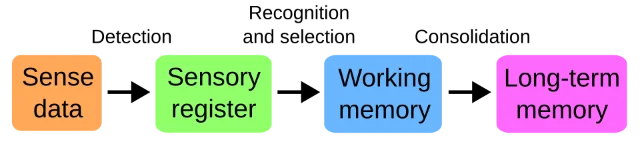
Attention is the gatekeeper inside this construction process. It selects particular features while pushing others into the background. The classic everyday example is the cocktail party effect: in a noisy room, you can follow one conversation while most surrounding speech becomes background sound. Attention is not reserved for seeing and hearing; it also shapes what gets remembered and what occupies thought. 2
What you expect to find matters too. Earlier experiences, goals, beliefs, and background knowledge influence whether something feels familiar and how sensory information is interpreted. In that sense, perception is a negotiation between the signal arriving now and the world model the mind has already built. 2
Memory is not a filing cabinet
Memory is often described as storage, but the article gives it a more active shape. It has an input phase, a storage phase, and an output phase: information is acquired, preserved, then made available to other cognitive operations. What matters is not only whether something was encountered, but how it was attended to and in what emotional, contextual, or motivational setting it was processed. 2
Working memory is the small, temporary workspace used while information is being manipulated. Mental arithmetic makes the point visible: intermediate results have to be held and updated while the calculation continues. Long-term memory serves a different function, retaining information for extended periods, sometimes indefinitely. 2
Long-term memory is not one uniform reservoir. Episodic memory concerns personally experienced events, such as a holiday. Semantic memory stores organized knowledge, such as the fact that water freezes at 0°C. Procedural memory contains practical know-how, such as riding a bicycle or typing. You may be able to perform a skill without being able to describe every movement that makes it work. 2
That division explains why learning is more than exposure. Learning changes what can be done later by building connections among pieces of information and skills. Sometimes it is intentional, as in studying or practising. Sometimes it arrives as an unintended side effect of experience. Either way, memory is not a warehouse sitting behind thought; it is one of the systems that makes thought possible. 2
Thought is a toolbox, not a single engine
Once information has been perceived and made available through memory, thinking can manipulate concepts and mental representations. The article groups reasoning, concept formation, problem-solving, and decision-making under this broad activity. Each has a different job and a different relationship with certainty. 2
Deductive reasoning gives the strongest guarantee: if the premises are true and the inference is valid, the conclusion cannot be false. The familiar example is the chain from “all men are mortal” and “Socrates is a man” to “Socrates is mortal.” Inductive reasoning moves in the other direction, using repeated observations to propose a general rule. Abductive reasoning looks for the best explanation available, as when a doctor treats a rash and fever as evidence for a possible diagnosis. The latter two can be rational without being certain. 2
Problem-solving adds goals and obstacles. A well-structured problem may have a clear route to a solution; an ill-structured one may not. Divergent thinking generates possible answers, while convergent thinking tests them and discards options that cannot work. Heuristics make the search manageable: divide a large problem into smaller ones, or adapt a strategy that succeeded in a similar situation before. 2
Decision-making then weighs possible courses of action. In theory, it compares the probability and value of different consequences. In practice, people often rely on shortcuts such as judging by resemblance, giving extra weight to information that comes easily to mind, or anchoring on an initial reference point. Those shortcuts can be efficient. They can also pull a decision away from the information that matters most. 2
Much of the work happens without a narrator
Cognition does not require conscious attention. Deliberately solving a mathematical problem is conscious; many of the low-level operations involved in language processing and face recognition are not. The distinction is not between a mind that thinks and a mind that does not. It is between processes that are available to awareness and processes that run outside it. 2
A related distinction separates controlled from automatic processing. Controlled processes are flexible and intention-guided, but they consume more cognitive resources. Automatic processes are faster and less demanding, often because practice has made them familiar. A novice driver may have to devote attention to every part of operating a car; an experienced driver can handle much of it automatically while carrying on a conversation. 2
Metacognition is cognition turned back on itself. It includes knowing what one can remember, noticing that a method is not working, and changing strategy. Its importance is easy to miss because it does not always produce a new fact about the world. Instead, it changes the way the mind uses its own limited resources. 2
Two competing pictures of the mind
Theories of cognition disagree about what these operations are made of. Classical computationalism treats cognition as the manipulation of symbols according to formal rules. In this view, a cognitive process resembles a program: it receives information, applies operations, and produces an output. The model is useful for asking what a process is trying to accomplish, what steps it uses, and how those steps are physically implemented. 2
Connectionism starts from a different architecture. It describes cognition as activity in a network of linked nodes, often arranged in layers. Individual nodes may perform simple operations, but complex behaviour can emerge from many of them interacting in parallel. This is one reason connectionist models have obvious parallels with artificial neural networks, even though cognitive theories and modern AI systems are not interchangeable. 2
The contrast is not simply “old computer versus new brain.” It is a dispute over the level at which an explanation becomes meaningful. One approach foregrounds symbols, rules, and serial procedures. The other foregrounds distributed activity, learned patterns, and parallel interaction. Some positions allow both descriptions to be true at different levels of abstraction; others treat the disagreement as fundamental. 2
Errors reveal the machinery
A system becomes easier to understand when one of its parts fails. Cognitive biases are systematic departures from ideal reasoning, often produced by the same heuristics that make ordinary thought fast enough to use. A shortcut that usually saves effort can also cause a person to favour information that is vivid or easy to retrieve while neglecting evidence that is more relevant. 2
More specific disorders show how layered cognition is. Prosopagnosia can impair face recognition while leaving other visual abilities comparatively intact. Anterograde amnesia can disrupt the formation of new memories while sparing older long-term memories. Alzheimer's disease affects a broader range of functions, including memory, reasoning, and language. These examples are not just medical categories; they are clues that the apparently seamless mind is built from interacting processes that can come apart. 2
That may be the most useful idea in the whole article. Cognition is not a ghostly inner voice hovering above the body, nor a single faculty that switches on when we “think.” It is a living arrangement of filters, workspaces, stored patterns, learned skills, shortcuts, models, and checks on those models.
The world feels ready-made because the arrangement works quickly and quietly. Light becomes a person. Sound becomes a sentence. A remembered route becomes a plan. A half-formed suspicion becomes a decision. By the time a thought reaches awareness, the mind has already done much of its editing.
Source
This article is a reader-friendly synthesis of Wikipedia's Today's Featured Article for July 15, 2026, which selected Cognition. The original article contains the full reference list, discussion of competing theories, and detailed links to related topics.
관련 콘텐츠
- 로그인하면 댓글을 작성할 수 있습니다.