2026. 6. 22. · 08:43
Anthropic Watch: Week of June 15-21, 2026
This week's Anthropic signal centered on Claude Code usage data and Korea expansion. The roundup covers the Jun. 16 Claude Code study, the Seoul office and MSIT safety MOU, named Korean deployments, and the regulatory aftershock from the Fable 5 / Mythos 5 restrictions.
Two things moved Anthropic this week: Claude Code got its first large-scale usage study, and Korea became an office-backed market with named enterprise deployments and government safety cooperation. The week did not produce a verified new funding round, senior leadership move, or fresh lawsuit filing; the material action was concentrated in product evidence and international expansion.
| Date | Category | Event | Why it matters | Watch next |
|---|---|---|---|---|
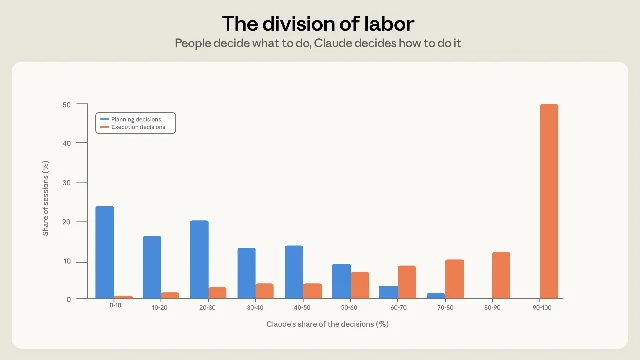
| Jun. 16 | Product and developer tools | Anthropic published a study of about 400,000 Claude Code sessions from roughly 235,000 people, covering usage from October 2025 through April 2026. 1 | The report reframes Claude Code as a workplace system, not just a coding assistant: users made about 70% of planning decisions, while Claude made about 80% of execution decisions. 1 | Whether Anthropic turns these findings into enterprise controls for review, delegation, and measurable productivity. |
| Jun. 17, updated Jun. 18 | Customers, partnerships, regulation | Anthropic opened its Seoul office, announced new Korean customer deployments, and added an MOU with Korea's Ministry of Science and ICT for AI safety and cybersecurity cooperation. 2 | Korea is now both a Claude growth market and a safety-evaluation partner, with work spanning enterprise adoption, startups, research labs, nonprofits, and public-sector AI safety. 2 | Whether export-control concerns around frontier models slow foreign enterprise adoption, especially after local reporting flagged the Fable 5 and Mythos 5 restrictions as a burden for Korean buyers. 3 |
Claude Code: the user still sets direction, the agent takes execution
Anthropic's Claude Code report is the most concrete product signal of the week because it uses real usage data rather than benchmark claims. The company says 56% of sessions involved writing, fixing, testing, or orchestrating code; 17% involved operating software; 14% were planning or exploration; and 13% produced analysis or prose where code was incidental. 1
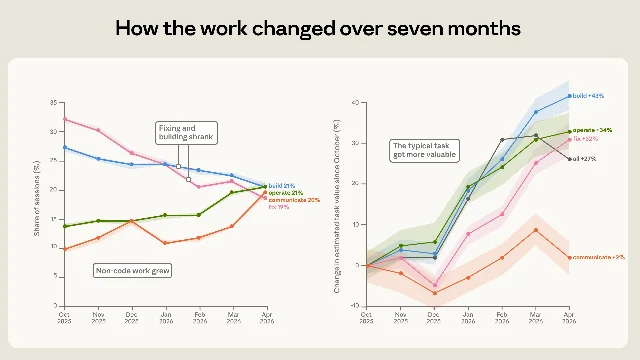
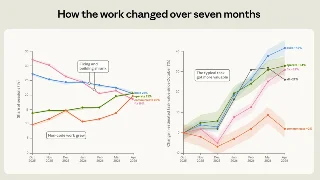
The shift inside that mix matters. From October 2025 to April 2026, debugging fell from 33% of sessions to 19%, while operating software rose from 14% to 21%. Anthropic also says data analysis and writing roughly doubled from about 10% to 20%, and its estimate of average task value rose by about 25% to 27% over the seven-month window. 1
The most useful enterprise takeaway is about who succeeds. Anthropic reports that expert-rated sessions set off about 12 Claude actions and 3,200 words of output per prompt, compared with about five actions and 600 words for novice-rated sessions. Verified success was 15% for novice sessions and 28% to 33% for intermediate-to-expert sessions; at least partial success was 77% for novices and 91% to 92% for intermediate-to-expert users. 1
That is not a simple story about replacing engineers. Anthropic says software-related occupations reached 30% verified success overall, compared with 26% for other professions, and on code-producing sessions the partial-success rates were nearly identical: 89% for software-related occupations and 88% for others. 1 The read for enterprise buyers: Claude Code may be most valuable when paired with domain experts who know the problem, the acceptance criteria, and the failure modes.
Korea: office launch plus a deeper public-sector safety lane
Anthropic's Korea announcement was broad by design. The official list includes NAVER deploying Claude Code across its entire engineering organization, Nexon using Claude Code for live-service game engineering, LG CNS rolling out Claude to thousands of employees and later across LG Group, Hanwha Solutions using Claude through AWS Bedrock, and Samsung SDS deploying Claude across Samsung Electronics. 2
The startup and research angles are also specific. Channel Corp uses Claude in Channel Talk, a customer AI platform used by more than 230,000 companies across Korea, Japan, and the United States. Anthropic also said it will provide Claude access to up to 60 researchers affiliated with the National AI Research Lab consortium, spanning KAIST, Korea University, Yonsei University, and POSTECH. 2
The MOU with Korea's Ministry of Science and ICT puts the office launch into a regulatory frame. Anthropic says the cooperation covers AI safety and cybersecurity, including Korean-language model safety evaluation with the Korea AI Safety Institute and information exchange on AI-enabled cyber threats. 2 Seoul Economic Daily separately reported that Korea is pursuing a 300 billion won AI safety and trust technology project over eight years, from as early as 2027 through 2034, while expanding cooperation with OpenAI and Anthropic. 4
For Anthropic, Korea now tests two claims at once: Claude as a deployable enterprise system, and Anthropic as a safety partner that governments can work with. The complication is timing. The Seoul announcement landed days after the U.S. directive that suspended foreign access to Fable 5 and Mythos 5, and local reporting described that restriction as a burden for Korean companies evaluating U.S.-made AI models. 3
What changed in the risk picture
No new Anthropic financing event crossed the bar this week. No new C-suite or VP-level hire or departure crossed it either. The legal and regulatory story was mostly aftershock from the prior week's Fable 5 and Mythos 5 suspension, not a new order or filing.
The policy debate did continue to harden. CFR's June 18 analysis framed Anthropic as increasingly central to U.S. national security and pointed to four recent episodes: Mythos Preview being withheld, reported NSA forward-deployed engineers, the Commerce Department directive on foreign access, and Anthropic's June 4 report on recursive self-improvement. 5 That is a useful lens for next week: if Anthropic keeps expanding abroad while Washington treats frontier Claude models as strategic assets, customer wins outside the U.S. will need a second line of analysis around model availability, nationality rules, and procurement risk.
참고 출처
- 1Agentic coding and persistent returns to expertise
- 2Anthropic opens Seoul office and announces new partnerships across the Korean AI ecosystem
- 3Anthropic Opens Korea Office, Targets Government and Public Sector
- 4Korea Pushes AI Safety Net With Tech Independence, Big Tech Cooperation
- 5Why Anthropic Is Sounding the Alarm on the Next Generation of AI

이 콘텐츠를 둘러싼 관점이나 맥락을 계속 보강해 보세요.