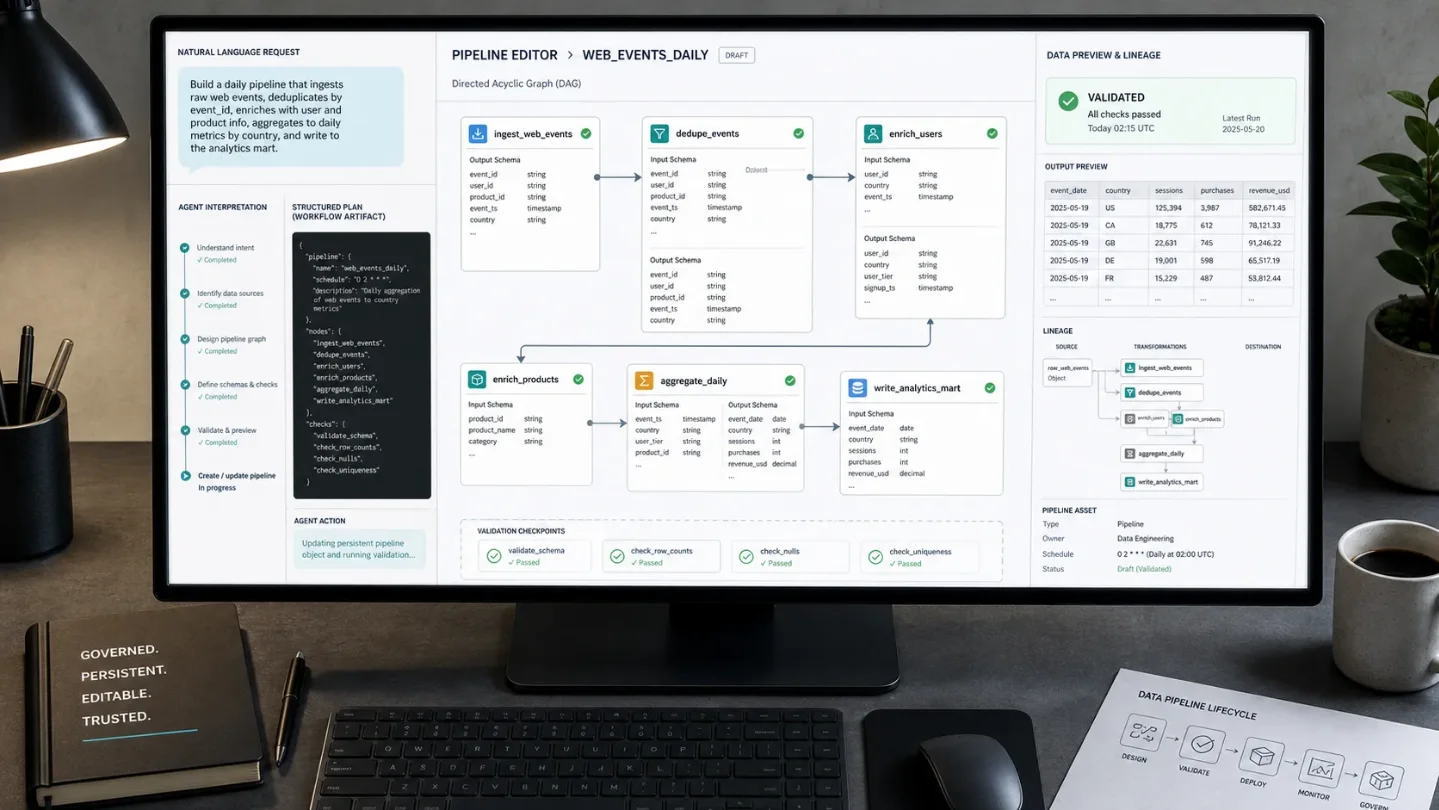
Grounded code agents turn data pipelines into governed artifacts
DataFlow-Harness shows how typed mutations, live platform state, and procedural skills can turn an agent-generated data workflow into a persistent artifact that PMs can inspect, edit, and govern.

The product implication
An AI agent that writes a data pipeline has produced the wrong thing if the result is only a script in a chat transcript. The useful product artifact is a persistent workflow that a human can inspect, edit, rerun, govern, and hand to the next team.
That is the proposition behind DataFlow-Harness, a July 18 preprint from Peking University, the Institute for Advanced Algorithms Research, and Zhongguancun Academy. It gives a coding agent a live operator registry and current pipeline state, then makes the agent modify a typed workflow graph through validated mutations. On the paper's 12-task benchmark, the system reports a 93.3% observed end-to-end pass rate while using less measured cost and latency than its free-form script baseline. 1
The PM takeaway is specific: when the output has a lifecycle, make the artifact contract and validation boundary part of the product before optimizing the model prompt.
What changed
The gap is between intent and an owned artifact
DataFlow-Harness names the problem the NL2Pipeline gap: a user describes a workflow in natural language, while a production platform needs a durable object with operators, dependencies, schemas, runtime settings, and a place in the platform's governance model.
A general coding agent can generate executable Python and still fail this product requirement. The script may reference an unavailable operator, encode an outdated schema, disappear after the task, or remain difficult to review through a workflow editor. The paper's design changes the unit of generation from free-form code to a platform-native directed acyclic graph, or DAG.
The mechanism has four parts:
| Layer | What it does | Product meaning |
|---|---|---|
| Pipeline backend | Stores the current workflow as the source of truth | The artifact has an owner, state, and history |
| MCP tools | Expose the live operator registry and current graph | The agent acts on current platform facts |
| Typed mutations and validation | Accept only acyclic graphs with compatible adjacent schemas | Invalid structural states are rejected before commit |
| DataFlow-Skills and WebUI | Supply procedural guidance and synchronize chat with a visual editor | Domain knowledge and human edits remain reusable |
The critical loop is request, validate, commit. The agent retrieves the latest state, proposes a structured change, and the backend either rejects it or commits it to the same object the visual editor shows. That is closer to editing a governed document than to asking a model for a one-shot code answer.
The result is near-parity, not a new capability frontier
The paper keeps the underlying model fixed at Claude Opus 4.7 and runs each of 12 tasks 10 times. Its comparison is useful because it exposes the product tradeoff rather than hiding it behind one headline score. 1
| Configuration | Artifact | End-to-end pass | Average cost | Latency |
|---|---|---|---|---|
| Vanilla Claude Code | Disposable script | 91.7% | $0.950 | 190.7 sec |
| Context-Aware Claude Code | Disposable script | 94.2% | $0.456 | 115.9 sec |
| MCP-only | Native DAG | 83.3% | $0.321 | 105.5 sec |
| DataFlow-Harness | Native DAG | 93.3% | $0.261 | 95.5 sec |
The full harness is within 0.9 percentage points of the stronger context-aware script baseline on this benchmark. Its reported cost is 42.8% lower and latency 17.6% lower than that baseline. Against Vanilla Claude Code, the paper reports a 72.5% cost reduction and 49.9% latency reduction.
The interesting failure is MCP-only: exposing tools and schemas is not enough. Its 83.3% pass rate suggests that an agent can know which operators exist and still fail to assemble them in the right procedural order. Skills add construction knowledge such as schema inference, operator selection, parameter configuration, and serving verification. The per-task ablation says those skills help most on procedurally complex QA and language-processing workflows, and help little on simple field renames or filters.
The evidence has a clear boundary. This is one preprint, one platform, one model family, and a small benchmark. The authors do not claim statistical equivalence, do not isolate every component, and say that schema checks do not guarantee semantic correctness, endpoint availability, or output quality. The downstream training case studies are promising but limited: the study used two scenarios without multiple independently authored pipelines or training seeds. The result supports a pilot architecture, not a production SLA.
Adjacent engineering practice points in the same direction
The surrounding data-agent engineering guidance makes the mechanism more practical. Google's Data Engineering Agent documentation describes plan review, automatic code validation and repair, Knowledge Catalog context, and a control that lets users review generated plans before actions. It also states that the agent cannot execute pipelines on its own, which keeps the human run or scheduling step explicit. 2
An AWS Big Data Blog architecture deep dive recommends a catalog and context layer for agent access to heterogeneous data, plus schema validation before queries, explicit action limits, and complete invocation logging. It also calls out metadata drift and non-deterministic query latency as production failure modes. 3
These are not independent replications of DataFlow-Harness. They are implementation evidence for the same product pressure: agents need current context, bounded actions, a reviewable plan, and an audit trail when they operate on data systems.
The social and video signals are much weaker. On X, a HuggingPapers post repeated the paper's title and 93.3% result, while a post from AK distributed the paper to a larger audience. Their measured view counts were 2,716 and 14,537 respectively, but neither post provided an independent evaluation or substantive expert critique. 4 5
The accessible YouTube explainer from AI Research Roundup was published on July 22, runs 3 minutes 26 seconds, and had 24 views when checked. It is useful for quickly seeing the architecture; its low view count is not evidence of adoption or clarity at scale. 6
콘텐츠 카드를 불러오는 중…
Why PMs should care
The product problem it solves
Data preparation for fine-tuning, retrieval, evaluation, and synthetic-data generation is full of repeated workflow decisions. Teams need to know which operator ran, which schema entered each stage, what changed between versions, and whether a later user can edit the pipeline without reconstructing it from a script.
A grounded harness can make those questions product-visible. The value is not simply a higher answer score. It is a smaller gap between an agent's conversational intent and a governed object that the rest of the platform understands.
This changes the PM's evaluation target. Add these measures beside task success:
- Artifact validity: Does the pipeline remain structurally valid after every mutation?
- Semantic correctness: Do outputs meet task-specific quality assertions, not only schema checks?
- Edit and reuse: Can a user inspect, modify, version, rerun, and hand off the artifact?
- Recovery: Does the system explain a rejected mutation and recover without losing prior valid state?
- Efficiency: What are cost, latency, and tool-call counts per accepted workflow?
- Governance: Can the team trace the agent, user, tools, data sources, approvals, and final commit?
When to use this pattern
Use a grounded artifact contract when the target workflow has a known operator ecosystem, meaningful schema relationships, and a lifecycle beyond the current conversation. Data cleaning, document-to-dataset extraction, evaluation-set construction, and RAG ingestion are plausible starting points.
Keep a more flexible coding agent when the job is exploratory, the platform has no stable operator registry, or the output is intentionally disposable. Constraining the action space imposes a reasoning burden; DataFlow-Harness's MCP-only result is the warning. The procedural layer must pay for that constraint.
How to implement now
A PM can test this pattern in one sprint without rebuilding a general-purpose agent platform.
- Pick one workflow with a clear acceptance test. Choose a task such as turning a fixed document collection into a reviewed QA dataset. Define the input, the expected output fields, forbidden data movement, and the human approval point.
- Define the artifact before the prompt. Model operators, edges, schemas, runtime parameters, version, owner, and status. Give the agent typed operations such as add operator, connect edge, update parameter, and remove node. Do not expose an unrestricted write path as the default.
- Make live state authoritative. Let the agent retrieve the current operator registry and the latest pipeline before every turn. A cached tool description or stale schema will recreate the exact hallucinated-dependency problem the harness is designed to reduce.
- Put validation before commit. Start with DAG and schema compatibility checks, then add semantic assertions, sample-based output checks, permission checks, cost limits, and rollback. A valid graph is a safe intermediate state, not proof that the data is good.
- Version procedural skills. Store operator-selection rules, ordering constraints, naming conventions, and recovery instructions as reviewable files with owners and regression tasks. Update them when the platform changes. Treat them as product capabilities, not invisible prompt text.
- Keep the human and agent views on one object. A chat request and a visual editor should read and write the same backend state. Every rejected change should preserve the last valid version and show a reason that a user can act on.
- Run a baseline comparison. Re-run the same task set with a free-form script agent, a context-aware script agent, and your grounded workflow agent. Report pass rate, cost, latency, semantic quality, editability, and recovery. Do not copy the paper's 93.3% into a roadmap target without your own task distribution.
- Roll out in a reversible lane. Start in staging or read-only mode, keep execution and scheduling behind explicit approval, and retain a script or manual fallback. Add write actions only after the audit trail and recovery tests pass.
The next-sprint decision is straightforward: take one recurring data workflow where inspectability and reuse matter, build the typed artifact boundary, and compare it with the script path. If the grounded version achieves comparable task quality while materially improving editability, recovery, or governance, the agent has earned a place in the data product. If it only passes structural checks while semantic quality remains unstable, the missing work is evaluation and domain procedure, not a larger model.
참고 출처
- 1DataFlow-Harness: A Grounded Code-Agent Platform for Constructing Editable LLM Data Pipelines
- 2Data Engineering Agent overview
- 3Multi-cloud lakehouse architecture on AWS for Agentic AI, Part 1
- 4HuggingPapers post on DataFlow-Harness
- 5AK post on DataFlow-Harness
- 6DataFlow-Harness: Editable LLM Data Pipelines
관련 콘텐츠
- 로그인하면 댓글을 작성할 수 있습니다.