The object we learned to see by what it hides
Wikipedia's July 17 Featured Article follows black holes from an 18th-century thought experiment to event horizons, Cygnus X-1, gravitational waves, and the first images of their immediate surroundings.

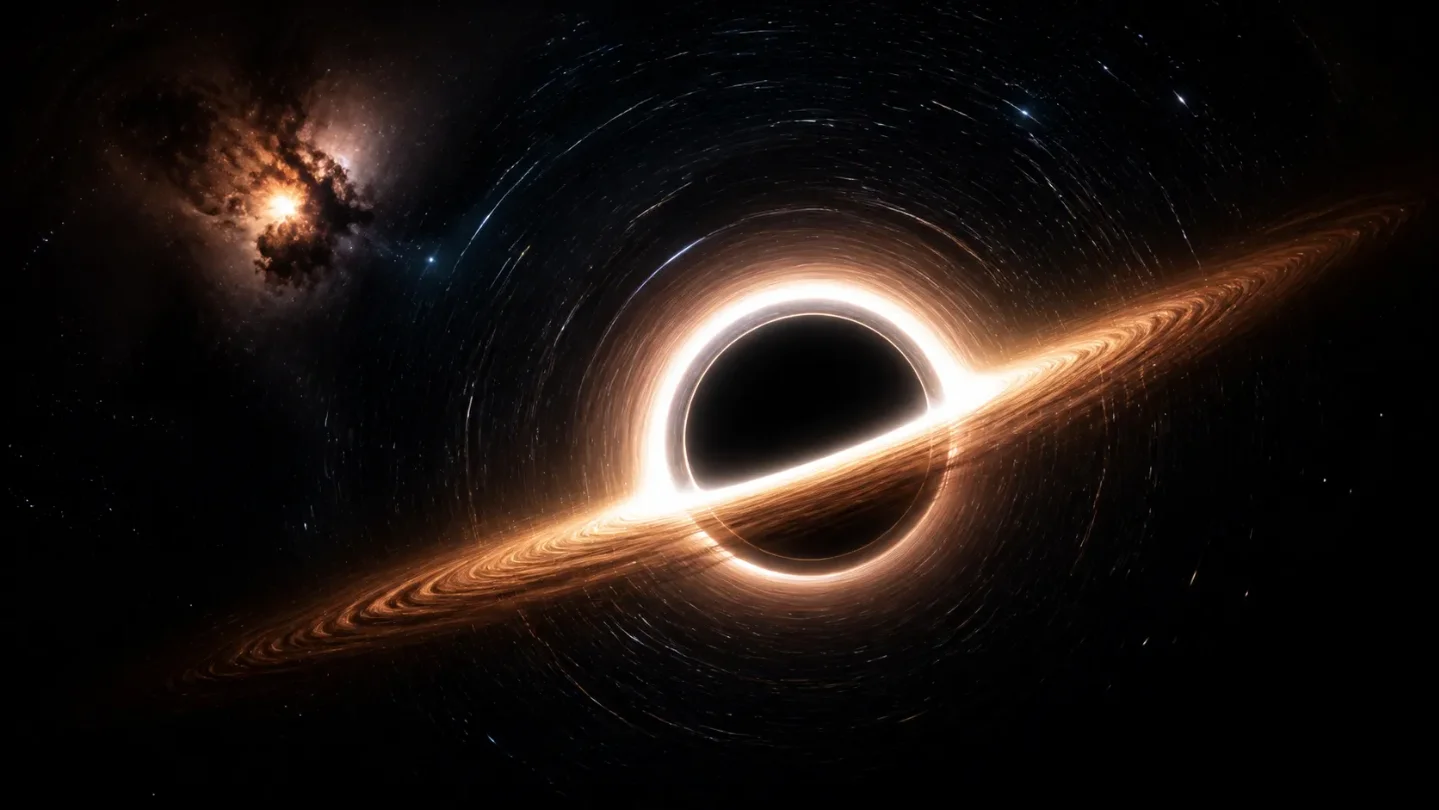
A black hole became one of science's most familiar images long before anyone had seen one. The object itself does not shine, reflect, or send a message back across its boundary. What astronomers can observe is the disturbance around it: hot gas, a companion star's orbit, a warped field of light, or the tremor released when two black holes merge. The history of black holes is therefore also a history of learning how to recognize an absence. 1
The object defined by a boundary
A black hole is an astronomical body so compact that its gravity prevents anything, including light, from escaping. In general relativity, the boundary of no escape is the event horizon. Crossing it traps an object inside, but produces no locally detectable change for the person or instrument crossing the boundary. The drama belongs to the global geometry: signals sent from inside can no longer reach the outside. 2
That definition is clean, but black holes are not simple objects. General relativity predicts a central singularity where spacetime curvature becomes infinite, while quantum mechanics may change what that prediction means at the smallest scales. Even the physical definition has a practical limit: proving that nothing ever escapes would require waiting an infinite time at an infinite distance. Astronomers use an observational shortcut instead. A compact object above roughly three solar masses can only be a black hole under gravitational-collapse theory. 2
The result is a strange scientific category. The thing is defined by what cannot get out, but it is identified by what happens outside.
A thought experiment gets heavy
The idea predates Einstein. In 1784, the English astronomer and clergyman John Michell proposed that a star could be so large and dense that its escape velocity exceeded the speed of light. He calculated that a star with the Sun's density but 500 times its radius would trap its own light. Michell also made the important observational leap: such dark bodies might still be detectable through their gravitational effects on visible neighbors. Pierre-Simon Laplace suggested a similar possibility in 1796. 2
These were not yet modern black holes. Michell and Laplace imagined enormous stars, not collapsed regions of spacetime. The conceptual machinery changed after Einstein's general theory of relativity explained gravity as the curvature of spacetime. In 1916, Karl Schwarzschild found a solution to Einstein's equations for a spherical, non-spinning mass. At a particular radius, the equations became singular. That radius would later be called the Schwarzschild radius, but its physical meaning was not understood at the time. 2
For decades, many physicists treated the result as a mathematical warning rather than a thing the universe would actually build. Arthur Eddington criticised the idea in 1926. In 1939, Einstein himself tried to show that collapse past the Schwarzschild radius could not happen, relying on pressure or centrifugal force to halt it. He missed the possibility that an implosion could drive the system through the critical radius. 2
The missing piece was stellar death. White dwarfs are held up by electron degeneracy pressure, and neutron stars by neutron degeneracy pressure. Each kind of pressure has limits. In 1939, J. Robert Oppenheimer and George Volkoff calculated that neutron stars above a certain mass would not remain stable. Oppenheimer and Hartland Snyder then modelled the collapse of an idealised star. From far away, the collapse appeared to slow as the star approached its Schwarzschild radius because of gravitational time dilation. The modern black-hole model had arrived, although it still needed a better way to describe what the horizon meant. 2
In 1958, David Finkelstein recast the Schwarzschild surface as an event horizon, calling it "a perfect unidirectional membrane: causal influences can cross it in only one direction." The phrase captures the essential asymmetry. An astronaut can cross inward without encountering a solid wall, but no event on the other side can send a signal back out. 2
What a black hole keeps, and what it erases
Once a black hole settles into a stable state, the no-hair theorem says that its external identity reduces to three independent properties: mass, electric charge, and angular momentum. Two black holes with the same values would be indistinguishable from outside, regardless of the different stars or matter that formed them. The result is an austere end to a complicated history. A star can begin with chemistry, turbulence, magnetic fields, and an internal structure; the final black hole is described by a very short ledger. The related no-hair conjecture, which would extend this conclusion to dynamic collapse, remains unsolved and depends on idealised assumptions. 2
The popular image of a black hole as a cosmic vacuum cleaner is misleading. From far away, the external gravitational field of a black hole is identical to that of any other object with the same mass. If the Sun were replaced by a black hole with the same mass, Earth would continue to follow the same broad orbit. The disaster would come from losing sunlight, not from the black hole suddenly reaching across space and sucking in the planets. 2
Black holes can still grow. A very massive star may collapse at the end of its life, while a supermassive black hole can gain mass by absorbing stars, merging with other black holes, or possibly forming through the direct collapse of a gas cloud. The largest known class sits at the centres of most galaxies. Sagittarius A*, the compact radio source at the centre of the Milky Way, has a mass of about 4.3 million Suns. 2
The horizon also has a quantum complication. Quantum field theory in curved spacetime predicts Hawking radiation, with an emission rate inversely proportional to mass. A black hole can therefore lose mass very slowly if it is not feeding. In practice, even the smallest observed stellar black holes gain mass from the cosmic microwave background faster than they lose it through Hawking radiation. The famous evaporation scenario is real as a theoretical prediction, but it is not a near-term fate for the black holes astronomers observe. 2
How to find something that emits no light
The first workable method was to watch matter fall toward the unseen object. Gas pulled from a companion star can form an accretion disk, a flattened stream of plasma heated by friction. The disk radiates, sometimes intensely. At the extreme end, the process produces a quasar, among the brightest objects in the universe. A black hole is dark; its meal can be brilliant. 2
Cygnus X-1 supplied the first widely accepted case. X-ray observations in 1971 found rapid, sporadic emission consistent with a compact source. Optical spectroscopy and modelling identified a binary system: a massive ordinary star and an invisible compact companion drawing gas from it. By 1974, the object was widely considered a black hole, even though the article notes that absolute certainty about Cygnus X-1 may not be possible. That qualification matters. Black-hole astronomy grew by narrowing explanations, not by photographing a surface. 2
A second method is orbital measurement. If stars or gas circle an unseen mass, their speed and paths reveal the mass's location. In 1995, water masers orbiting the centre of the galaxy NGC 4258 helped rule out a dense cluster of stars as the source of its central mass. At the centre of the Milky Way, independent teams led by Andrea Ghez and Reinhard Genzel tracked stellar motions around Sagittarius A*. Their results showed that the compact radio source was likely a supermassive black hole. Their work later shared half of the 2020 Nobel Prize in Physics. 2
A third method listens instead of looking. In late 2015, the LIGO and Virgo collaborations detected GW150914, the first direct observation of gravitational waves from merging black holes. The two objects were about 1.4 billion light-years away and had masses of roughly 30 and 35 Suns at the time of the merger. The signal did not come from light emitted by the black holes. It came from spacetime itself changing as the pair spiralled together. 2
The picture is of the neighbourhood
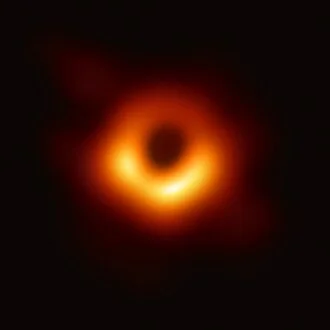
The image that made black holes visually undeniable also requires careful wording. On 10 April 2019, the Event Horizon Telescope collaboration released the first direct image of a black hole and its vicinity, showing the supermassive black hole at the centre of Messier 87. The bright ring is radiation from hot material and light bent by extreme gravity around a dark central region. It is an image of the black hole's immediate environment, not a glowing photograph of a surface. 2
In 2022, the collaboration released an image of Sagittarius A*, using data collected in 2017. The two images made a useful pair. M87's black hole is vastly more massive and far away; Sagittarius A* is the one at the centre of our own galaxy. Both are recognised through the same basic visual logic: a dark central shadow framed by radiation that has been bent, heated, and organised by gravity. 2
The story now has several independent channels of evidence. X-rays reveal accreting gas. Stellar orbits weigh the invisible object. Radio interferometry reconstructs the shape of its shadow. Gravitational-wave detectors register mergers. No single observation carries the whole case, and that is precisely why the case is strong.
The phrase that finally fit
The science had been developing for years before the name settled. In December 1967, an audience member reportedly suggested "black hole" during a lecture by John Wheeler. Wheeler adopted it for its brevity and "advertising value", and his standing in the field helped the phrase spread. But he may not have coined it. The term had appeared in print in Life and Science News in 1963, and science journalist Ann Ewing used it in a 1964 report on an American Association for the Advancement of Science meeting. 2
The name won because it was short enough to travel. It turned an abstract boundary in a set of equations into a thing people could remember, argue about, and eventually point toward with a telescope array. The object stayed invisible. The evidence around it became impossible to ignore.
What to remember
- A black hole is defined by an event horizon, a boundary beyond which information-carrying signals cannot escape. 2
- From outside, a settled black hole is described by mass, electric charge, and angular momentum; its external gravity is not a special form of long-distance suction. 2
- Astronomers identify black holes through effects on nearby matter, light, stellar orbits, and spacetime, including the gravitational waves from mergers. 2
- The M87 and Sagittarius A* images show the dark central shadow and luminous surroundings of black holes, not a visible surface. 2
This article is based on Wikipedia's Featured Article for July 17, 2026, Black hole. Read the Featured Article page and the full Wikipedia article.
관련 콘텐츠
- 로그인하면 댓글을 작성할 수 있습니다.