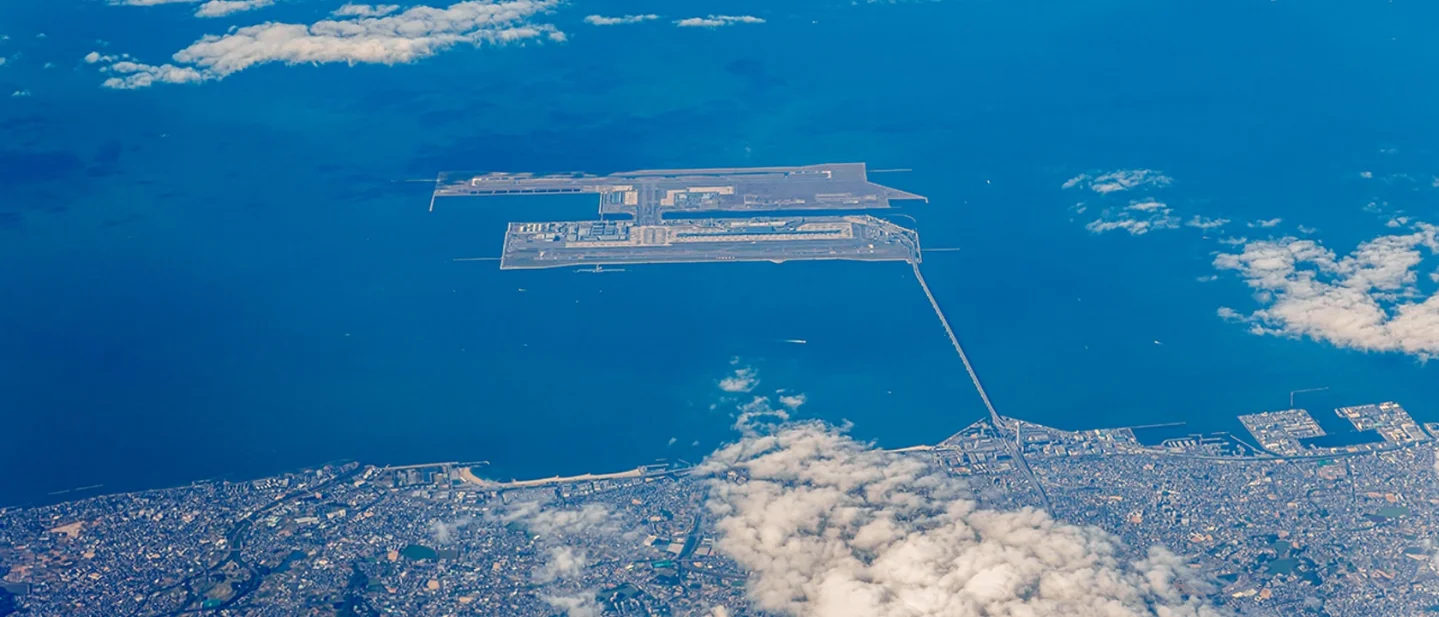
Kansai International Airport: how Japan made a sinking island operable
A technical teardown of Kansai International Airport: why Japan built on an artificial island, how sand drains and hydraulic jacks absorbed unexpected settlement, and what the earthquake and Typhoon Jebi revealed about the remaining trade-offs.
The airport stands on ground that engineers expected to move. The real achievement is that they gave the building, runway and seawall enough ways to move with it, measure the movement and correct it. That strategy made a 24-hour international airport possible where Osaka had run out of quiet, expandable land. It also created a permanent bill: settlement monitoring, hydraulic adjustment, imported fill, flood upgrades and a bridge that can be disabled by the same storm that threatens the runway.
Kansai International Airport is therefore a useful engineering case because its hardest problem never disappeared. The project did not turn soft clay into rock. It built an operating system around uncertain ground, then tested that system against an earthquake, a typhoon and decades of compression. 12
The project at a glance
| Field | Kansai International Airport | Engineering consequence |
|---|---|---|
| Location | Artificial islands in Osaka Bay, about 38 km southwest of Osaka Station, Japan | Offshore construction removed the airport from the dense urban edge, but put the entire site on reclaimed ground. 1 |
| Original brief | Replace an overcrowded, noise-constrained Itami Airport and provide room for international growth | The site had to support a new airport while preserving 24-hour operations away from residential neighborhoods. 1 |
| Opening | 4 September 1994 | The first fully artificial-island airport entered service as a working transport system, not just a reclamation project. 1 |
| Island area | First island about 510 hectares; second island about 545 hectares; about 1,055 hectares in total | The two-island solution separated the airport's footprint from the mainland and allowed a second runway to be added later. 1 |
| Terminal 1 | About 1.7 km long; designed by Renzo Piano and Noriaki Okabe | A lightweight steel-and-truss building reduced the load on settling ground and stretched the terminal into a long, serviceable passenger route. 12 |
| Runways | 3,500 m and 4,000 m, both asphalt | The flexible pavement can tolerate some movement and gives the airport two long-haul operating surfaces. 12 |
| Access | A 3.75 km bridge connects the island to the mainland | Offshore freedom came with a single, engineered access interface for trains, road traffic and emergency logistics. 1 |
| Current scale | 34.1 million passenger movements and 786,814 tonnes of freight in calendar year 2025 | The settlement problem belongs to an active, high-throughput asset whose maintenance cannot wait for the ground to finish compressing. 1 |
The table's numbers describe a paradox. The airport is large enough to operate like a city, but its foundations behave more like a long-term geotechnical experiment. That mismatch determines almost every important choice that follows.
Why put an airport in the bay?
By the 1960s, Itami Airport was boxed in by buildings and mountains. Nearby residents objected to aircraft noise, while the airport's location left little room for another runway or a major terminal expansion. The offshore option avoided the need to acquire a large urban site and created a place where aircraft could operate around the clock. 1
That decision traded a political problem for a geotechnical one. The bay offered space, but the seabed did not offer a ready-made foundation. The proposed island sat in about 18 m of water above roughly 20 m of soft Holocene clay containing about 70% water. The material was compressible, and the future airport would add an enormous new load on top of it. 1
The choice also exposed the project to Osaka Bay's other hazards. Designers had to account for earthquakes, typhoons and storm surges of up to about 3 m. A site free from neighbors was still a site surrounded by water, with no natural high ground and no conventional road or rail approach. 1
The original requirement was therefore a chain rather than a single target:
- More capacity: the airport had to absorb international demand that Itami could not accommodate.
- Less urban conflict: the new site had to move aircraft noise away from dense residential areas.
- 24-hour access: the offshore location had to support operations outside the restrictions imposed by a city airport.
- A stable operating surface: runways, terminals, fuel systems and roads had to remain usable while the ground consolidated.
- A survivable perimeter: the island had to resist waves and storm surge before the airport could protect itself with buildings and aircraft stands.
A conventional airport treats the ground as a boundary condition. Kansai made the ground part of the machine.
The island was built as a settlement problem
Engineers accelerated consolidation with vertical sand drains. They installed about one million drains in the clay so water could escape more quickly when the weight of the new island compressed the seabed. The principle is simple: the fill supplies the load, while the sand drains shorten the water's path out of the clay. Faster drainage lets the soil gain strength sooner, but it does not make the final settlement disappear. 1
The team first had to give the fill a perimeter. The seawall was completed in 1989 and used rock plus about 48,000 concrete tetrapods. The B1M's 2024 account describes an approximately 11 km seawall around the project. The tetrapods break up wave energy before it reaches the wall, turning a direct wave impact into a sequence of smaller collisions and turbulent flow. 12
The amount of fill made the island a logistics project on the scale of a regional excavation. Three mountains were cut for about 21 million m³ of excavated material, and roughly 180 million m³ was used to form the first island. Over three years, about 10,000 workers and 80 ships placed a 30–40 m layer of earth over the seabed and within the seawall. 1
The choice to quarry mountains instead of relying on seabed material gave the project a more predictable fill source. It also created a long transport chain: excavation, loading, marine transport, dumping, grading and compaction had to stay synchronized while the perimeter held back the bay. The construction method moved the uncertainty from "can an airport exist here?" to a more manageable question: "how fast will this engineered ground settle, and how much margin should the finished airport carry?"
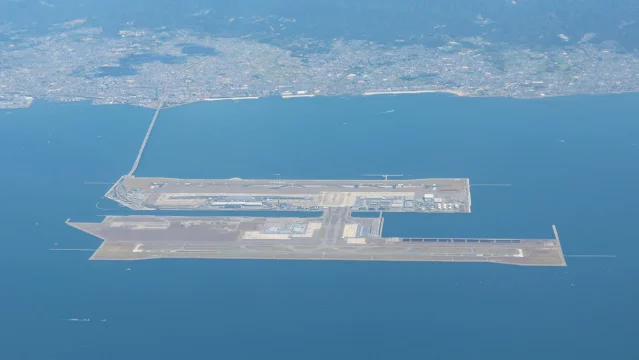
The access bridge was built in parallel with the island. The 3.75 km connection to Rinku Town was completed in 1990, at a stated cost of about $1 billion. That bridge was not a convenience added after the reclamation; it was part of the airport's basic feasibility. Without it, the offshore solution would have traded urban congestion for an isolated island with no dependable passenger, cargo or maintenance route. 1
This is the first major trade-off in the project:
Gain: room, 24-hour operation and distance from residential neighborhoods. Price: an artificial foundation, a protective seawall, a long bridge and a settlement problem that would continue after opening.
The forecast failed; the architecture absorbed the error
Settlement was expected. Its magnitude was the difficult part. Wikipedia records an early optimistic estimate of about 5.7 m and reports that the island had already sunk 8.2 m by 1999. The B1M's October 2024 account describes a different early planning assumption—about 8 m over 50 years—and reports more than 12 m of subsidence during the first eight years. These are different snapshots and estimates, so they should not be combined into one precise number. They agree on the engineering conclusion: early settlement exceeded the forecast used to size the initial margin. 12
The response was to make the airport adjustable. Terminal 1 rests on columns that can be raised or lowered. The B1M describes about 900 hydraulic jacks used to compensate for uneven settlement; Wikipedia describes adjustable columns with thick metal plates inserted at their bases. The jacks lift a section, workers add or remove support material, and the building returns to a controlled load path. 12
The mechanism changes the meaning of settlement. A differential movement of a few millimetres is dangerous when a rigid building has no way to redistribute it. The same movement becomes a maintenance operation when engineers can measure it, lift the affected support and restore the alignment. The correction is disruptive and expensive, but it is more useful than pretending the original soil model was exact.
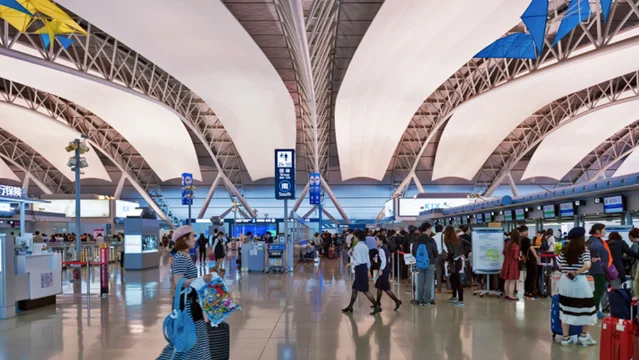
The terminal's scale made weight especially important. Terminal 1 is about 1.7 km long, and its roof uses a curved, airfoil-like form. The shape gives the building a continuous interior volume and supports air circulation through ducts at the sides. The steel skeleton and trusses carry the long roof without the mass of a conventional solid concrete building. Less dead load means less added stress on the compressible foundation, although a lighter building also settles differently from the island beneath it. 12
That mismatch between the terminal and the island is the detail that makes the design interesting. If the building and its ground settle at different rates, the supports can lose their intended geometry. The adjustable columns are therefore not a clever accessory. They are the interface that lets a relatively light, long building coexist with a heavier, consolidating island.
The runway uses a related compromise. B1M describes flexible asphalt chosen to tolerate movement, while Wikipedia lists both runways as asphalt surfaces. Flexible pavement can be resurfaced and reprofiled more readily than a large rigid concrete slab when the supporting ground changes elevation. The trade-off is a continuing maintenance burden: the runway is treated as a surface that can be corrected, not a permanent plane that the foundation must preserve forever. 12
The project also accepted architectural cost to preserve function. When officials proposed shortening the terminal to reduce expense, Renzo Piano insisted on keeping its full planned length. That choice retained the passenger-processing concept and the long structural system, but it increased the amount of building supported by the unsettled island. The decision shows the kind of trade-off large infrastructure makes: cutting scope can reduce construction cost while weakening the capacity or operating logic that justified the project in the first place. 1
Build the interfaces, not just the island
Construction began in 1987. The sequence separated the main precision tasks instead of asking the active bay to perform all of them at once: build the seawall, create and consolidate the island, connect the island to the mainland, then assemble a terminal whose supports could be adjusted over time. The first airport island was formed with the rock and soil moved from the surrounding mountains, while ships and temporary works maintained the marine supply chain. 12
The bridge carried another interface problem. It had to span open water while handling road and rail traffic and surviving wind, waves and earthquakes. The airport could not be considered complete when the reclamation was finished; passengers and freight still needed a robust path across the bay. The 2018 typhoon later showed why this distinction matters: a flooded island and a damaged access route create different operational problems, even when both begin with the same storm. 1
The airport opened on 4 September 1994 as Japan's first airport built entirely on an artificial island. Its offshore position enabled 24-hour operations, and its two-island development created room for a second runway. A 4,000 m second runway opened in 2007; the current airport has 3,500 m and 4,000 m runways. 1
The construction logic had a clear order:
- Protect the perimeter. The seawall and wave-dissipating armor made a stable boundary in the bay.
- Create engineered ground. Fill supplied the island's elevation and load, while sand drains accelerated consolidation.
- Connect the island. The bridge made the isolated site usable by passengers, workers and freight.
- Keep the superstructure light and adjustable. Steel trusses, asphalt pavement and jacked supports converted future movement into managed maintenance.
- Expand after the first island proved operable. The second island and runway added capacity while accepting another settlement curve.
Each step depended on the one before it. A terminal with adjustable columns cannot rescue a seawall that fails. A strong seawall cannot create an airport without fill and access. A complete island cannot deliver capacity if its terminal or runway cannot tolerate differential settlement.
Two hazards, two different answers
The airport's performance in real hazards separates the success of its structural concept from the limits of its site.
| Hazard test | What acted on the airport | Observed result | Engineering lesson |
|---|---|---|---|
| Great Hanshin earthquake, 17 January 1995 | A major earthquake struck the Kansai region, with the epicentre about 20 km from the airport | The airport emerged without significant structural damage; sliding joints helped the structure accommodate the shaking, and the window glass remained intact. 1 | Flexible connections can protect a large building when the supporting ground and structure move together in a short, violent event. |
| Typhoon Jebi, 4 September 2018 | Storm surge inundated the reclaimed island and runways; a tanker struck the mainland access bridge | Flights were cancelled until 6 September; regular operations resumed on 1 October, and bridge repairs were completed in April 2019. 1 | Flood protection includes freeboard, seawalls, bridge resilience and recovery logistics, not just building strength. |
The earthquake was a validation of the structural response. Sliding joints allowed the terminal to move without forcing every component to resist the same ground displacement as a rigid block. The result mattered because the airport had opened only months earlier, on reclaimed ground near a destructive earthquake. 1
Jebi exposed a different failure mode. The airport's buildings could remain standing while the runway and access systems became unusable. Seawater reached the airport, and the tanker collision damaged the bridge that linked the island to the mainland. The airport was therefore vulnerable at the system boundary: the water that surrounded the airport also separated it from help, passengers and replacement equipment. 1
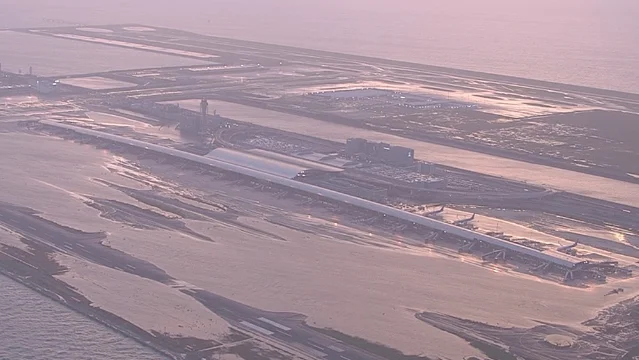
The response included raising the seawall by an additional 2.7 m, according to the B1M's 2024 account. The same account described a USD $470 million renovation aimed at increasing capacity. Those interventions address different parts of the same operating problem: the airport must preserve both the vertical margin above storm water and the passenger-processing capacity that makes the offshore site worth maintaining. 2
The contrast with the earthquake is instructive:
- Seismic movement was designed into the connections. Sliding joints let the terminal tolerate a rapid imposed displacement.
- Settlement was designed into the supports. Jacks and plates let maintainers correct a slow, uneven displacement.
- Storm surge exceeded the original operating margin at the perimeter. Raising the seawall became a retrofit rather than a routine adjustment.
- The bridge made recovery a separate problem. A building can survive a storm while the airport remains inaccessible.
This is why the word "sinking" is too blunt to judge the project. The engineering question is whether the remaining elevation, structural adjustment range, pavement condition, seawall height, bridge availability and maintenance budget still provide the required service. A moving asset can remain successful if its correction mechanisms are measurable and affordable. A stable-looking asset can fail if one access or flood-control interface has no spare capacity.
What the airport is actually buying
Kansai's current traffic makes the maintenance bargain concrete. Wikipedia records 34,102,723 passenger movements and 786,814 tonnes of freight in calendar year 2025. The airport is not being preserved as a museum of offshore construction; it is carrying a live transport load while its foundations continue to consolidate. 1
The price of that service is distributed across many ordinary-looking tasks. Crews monitor elevations, adjust terminal supports, maintain pavement, protect the seawall, repair the access bridge, manage drainage and update the airport's flood defenses. The B1M reports that more than USD $100 million had been spent maintaining the island's height above sea level in the period covered by its account. That figure is a reminder that the original construction estimate never represented the whole cost of operating on compressible ground. 2
A rigid, conventional site would have demanded more land acquisition and exposed residents to more aircraft noise. Kansai instead concentrated the consequences in an engineered island. That concentration made the airport politically and operationally possible, but it also made the maintenance obligation unusually visible: the operator has to keep the island high enough, the runway flat enough and the bridge open enough for the original decision to keep paying back.
The second island shows that the engineers did not treat the first settlement history as a reason to abandon the concept. They built additional capacity on another reclaimed platform, accepting a new settlement curve in exchange for runway capacity. The 2007 runway expansion lowered the immediate pressure on the first island's layout, but it did not remove the geotechnical problem. 1
That is an uncomfortable but useful form of engineering judgment. The choice was never between a perfect airport on solid ground and a flawed airport at sea. The real comparison was between an adjustable offshore airport with a known maintenance burden and an urban airport with limited expansion, noise conflict and no practical path to the required capacity. The offshore option won because its risks could be turned into work packages: drains, fill, jacks, asphalt, seawalls, bridge inspections and elevation surveys.
Legacy: design the correction mechanism first
Kansai's influence reached beyond its own island. Wikipedia notes that experience from the project informed later artificial-island airports including New Kitakyushu, Kobe, Chubu Centrair and Hong Kong International Airport. Those projects did not inherit a magic solution to settlement; they inherited evidence about how reclaimed ground behaves, how predictions can miss, and how a working airport must remain adjustable while the soil consolidates. 1
The project also received the American Society of Civil Engineers' "Civil Engineering Monument of the Millennium" recognition in 2001. The award captures the visible achievement—the first fully artificial-island airport—but the more useful legacy sits below the terminal floor. Kansai made long-term foundation movement an explicit operational variable in a major airport. 1
The transferable lesson has four parts:
- A site constraint can move upstream into the design. Osaka's lack of expandable land created an offshore brief; the soft seabed then shaped the entire airport rather than only its foundations.
- Prediction and correction are different controls. Sand drains and settlement estimates tried to control the ground before construction. Jacks, plates and resurfacing controlled the consequences after opening.
- Interfaces deserve the same design attention as headline structures. The seawall, bridge, runway and terminal supports determine whether the airport remains usable as one system.
- A retrofit is part of the original design when the hazard evolves. Jebi's seawall raise was not an unrelated upgrade. It was the next step in maintaining the service margin that the offshore decision required.
Kansai did not defeat subsidence. It made subsidence legible and, for a time, manageable. That distinction is the reason the airport remains an engineering success despite the forecast error. The project accepted a foundation that would keep changing, then put adjustment hardware between the ground and the passengers.
The final judgment is therefore narrower than "the airport is sinking" and more useful than "the engineers solved it." Kansai bought Osaka capacity, quiet nighttime operations and a new international gateway by moving the airport onto reclaimed ground. In return, every generation of operators must keep proving that the correction system—supports, pavement, seawall, bridge and monitoring—still has enough range and money left to carry the next one.
참고 출처
- 1Kansai International Airporten.wikipedia.org
- 2Kansai Airport is Sinkingtheb1m.com
Engineering Marvel Teardown
One feat of engineering every two weeks (Hoover Dam, Burj Khalifa, Three Gorges, SR-71 Blackbird), with design intent and engineering trade-offs
이 콘텐츠는 채널이 자동으로 생성했습니다. 한 문장이면 Neodrop이 당신을 위해 계속 만들어 냅니다.
관련 콘텐츠
- 로그인하면 댓글을 작성할 수 있습니다.
More from this channel
- Thames Barrier: how 3,300-tonne gates made flood forecasting part of civil engineering
- Eiffel Tower: how a temporary exhibit made wind the design brief
- Sydney Opera House — how an unbuildable sketch forced structural engineering into the digital age
- Brenner Base Tunnel: drilling through the roof of Europe