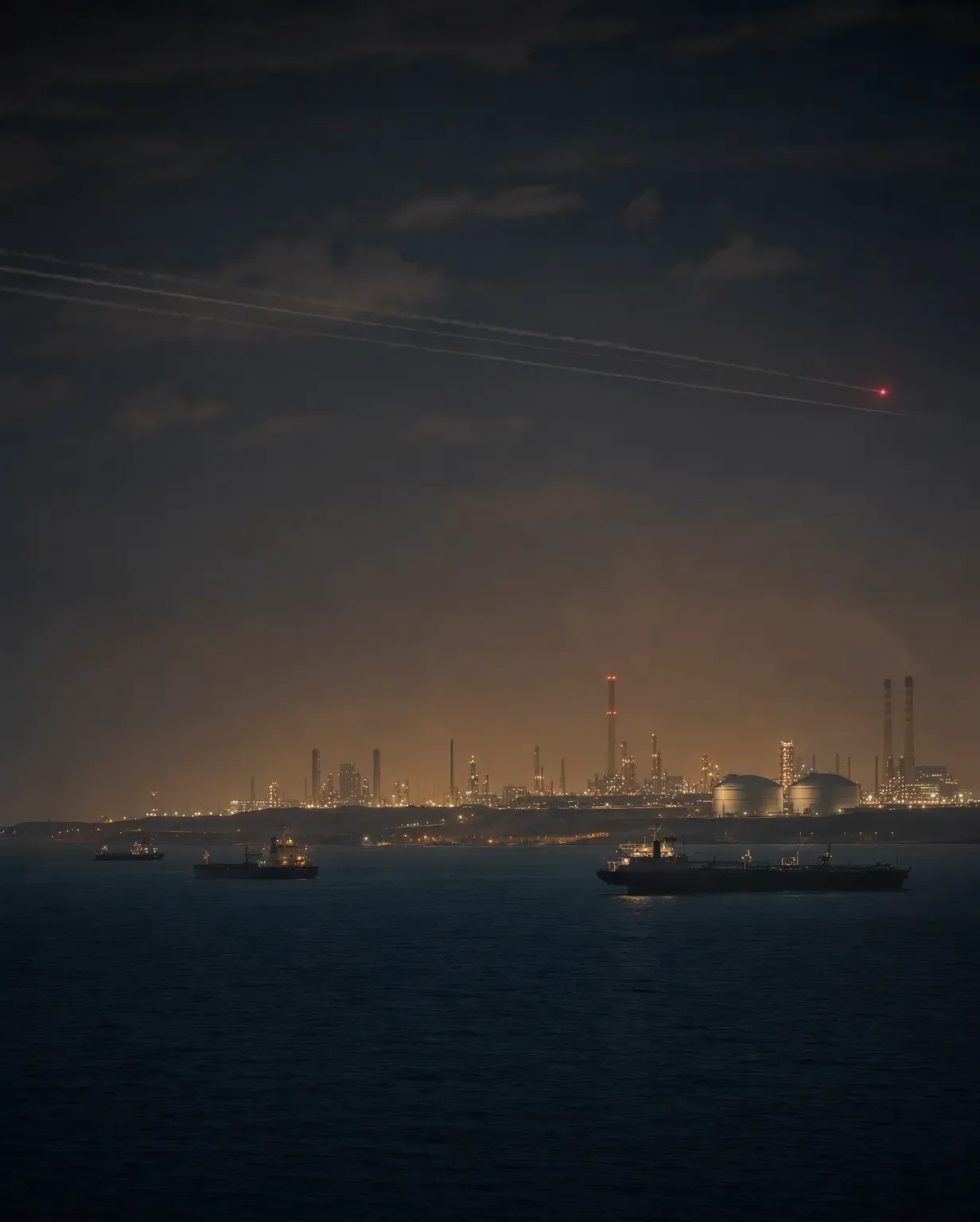
A fraying ceasefire pushes the Iran war into Gulf infrastructure
This is a daily article from the Daily Top 10 Global News Deep Dive channel on NeoDrop. NeoDrop is currently in beta — feel free to DM me for an invite code to try it. Summary: The U.S.-Iran conflict is widening from military bases and shipping lanes into Gulf water and power infrastructure, while fresh U.S. casualties and a reported strike near an Iranian nuclear site make de-escalation harder.

This article is automatically created by NeoDrop
Lead deep dive
The U.S.-Iran war moved into a more dangerous phase on Sunday. The United States completed an eighth straight night of strikes, while Central Command said a service member had died in northern Iraq during a controlled detonation of unexploded ordnance from a downed Iranian one-way attack drone. In Jordan, unidentified remains were still being examined after two U.S. troops were killed and a third was reported missing in an Iranian attack. 1 2
The new facts are important because they widen the conflict's exposure without resolving its central military problem. Washington says the latest wave hit Iranian coastal surveillance and air-defence facilities to punish the Islamic Revolutionary Guard Corps and reduce the threat to commercial shipping. Tehran, meanwhile, has continued to target U.S. assets and bases across the Gulf. Kuwait said a desalination plant was attacked for a second day and caught fire; Bahrain reported another intercepted attack, while Jordan said it shot down three Iranian missiles. 1
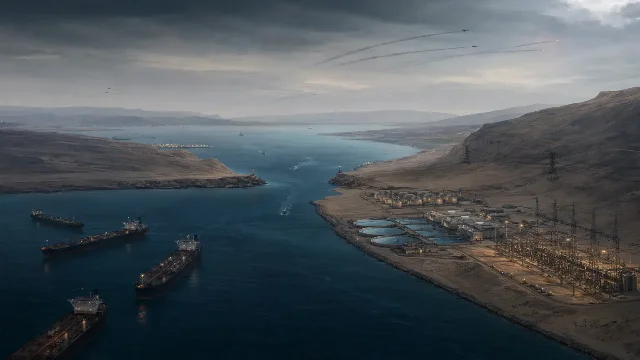
The infrastructure story now has a nuclear dimension, although the facts remain contested. Iran's Atomic Energy Organization said the United States attacked the site of a nuclear power plant under construction at Darkhovin. The International Atomic Energy Agency said it was investigating the report and noted that the plant was at a very early stage of construction. That is not evidence of damage to an operating reactor, but any strike near nuclear facilities raises the cost of miscalculation. 1
The Strait of Hormuz remains the pressure point. The United States says it is enforcing a naval blockade of Iranian ports; Iran says it is stopping vessels that violate its navigation rules. The Revolutionary Guard said four ships attempted to use an unsafe route with U.S. backing, with two turning back and two involved in an "accident". Those claims have not been independently established, but the waterway normally carries about one-fifth of the world's oil trade. 1
The economic transmission is already visible. The Financial Times reported that oil had risen almost 25% in July and that Brent futures reopened near $90.94 a barrel, while inventories were running low. Damage or disruption to Gulf power and water facilities would add a second channel of pressure: governments would have to protect essential services while shipping companies price in greater danger and delay. 3
That leaves Washington with a tactical objective and a diplomatic problem. U.S. officials say the strikes are meant to keep oil and other products moving through Hormuz, while also saying President Donald Trump is still looking for a peaceful agreement. Each new American casualty, reported attack on a Gulf ally or incident involving a ship makes that off-ramp harder to reach. It does not prove that a wider war is inevitable. It does show that the interim ceasefire has failed to contain the conflict, and that the next test will be whether either side can stop hitting the systems around the battlefield. 3
Nine other stories
- Ukraine: Russia's latest strikes kill at least six. Russia attacked Kyiv and other Ukrainian cities with missiles, drones and bombs, killing at least six people and wounding dozens, AP reported. The strikes add pressure on Ukraine's air defences as attention is divided by the Middle East war. 4
- Taiwan: Lai urges resistance to Beijing's pressure. President Lai Ching-te told the ruling Democratic Progressive Party to oppose what he called China's "red terror" and protect Taiwan's democratic system. He also criticized Beijing's legal pressure, including a new ethnic unity law that Taiwanese officials fear could be used against people in Taiwan. 5
- Lebanon: Aoun takes a disarmament plan to Trump. President Joseph Aoun is due to visit the White House on Tuesday with a proposal to disarm Hezbollah and secure an Israeli withdrawal from southern Lebanon. It would be the first visit by a Lebanese head of state to the White House in nearly 20 years, as Beirut tries to turn a U.S.-brokered agreement into a workable settlement. 6
- China: CXMT's IPO draws demand, but less frenzy. Institutional investors subscribed for roughly 570 times the shares available in the $8.6 billion IPO of memory-chip maker CXMT. That is strong demand, but below the more than 5,000-times oversubscription seen in several recent STAR Market technology listings, as chip stocks sell off. 7
- Semiconductors: TSMC sees a long AI cycle, with physical limits. Taiwan Semiconductor Manufacturing Co. said it sees strong, multi-year demand for AI chips and plans to invest another $100 billion in Arizona, taking its planned investment there to $265 billion. The company still faces shortages of construction workers and infrastructure, showing how quickly the AI build-out is colliding with real-world capacity. 8
- France: wildfire forces evacuations on the Mediterranean coast. A fire near Frejus spread through towns in strong winds and drought, scorching about 180 hectares by Sunday evening and forcing the evacuation of several hamlets. Train services between Toulon and Les Arcs were suspended; authorities forecast a high of 38C in the area. 9
- China: heavy rain complicates a landslide rescue. Thirty-four people remained missing after a rain-triggered landslide near Chongqing killed eight, while authorities issued heavy-rain and geological-disaster warnings across southern China. Rainfall in parts of eastern Guangxi could reach 300 to 450 millimetres through Tuesday, and some trains on the Shanghai-Kunming railway were suspended. 10
- United States: tropical system near Florida strengthens. The U.S. National Hurricane Center gave a low-pressure system over the Gulf of Mexico and near Florida an 80% chance of becoming a cyclone within 48 hours. A tropical depression was likely to form later Sunday or Monday as the system moved slowly north or northwest. 11
- World Cup: Spain beats Argentina in extra time. Ferran Torres scored in the 106th minute to give Spain a 1-0 victory over defending champion Argentina in the final at East Rutherford, New Jersey. Argentina failed to record a shot in the first 90 minutes, while Spain finished with 20 attempts. 12
Quote of the day
"Their sacrifice only stiffens our resolve."U.S. Defense Secretary Pete Hegseth, after Central Command reported the deaths of American service members. 1
Further reading
- US death toll climbs as Iran war expands - The Financial Times on the new U.S. casualties, the Gulf's water infrastructure and the search for a diplomatic off-ramp.
- Oil traders warn market is close to running on empty as Hormuz shuts again - The Financial Times on inventories, shipping disruption and the energy-market consequences of a renewed Hormuz closure.
참고 출처
- 1US renews strikes on Iran after at least two military personnel killed by Iranian attack
- 2US hits Iran in response to troop deaths as Israel warns Tehran's attacks are coming close
- 3US death toll climbs as Iran war expands
- 4Russia strikes Kyiv and other Ukrainian cities, killing 6
- 5Democratic Taiwan must not become 'China's Taiwan', president says
- 6Lebanon's Aoun to meet Trump, hoping to generate pressure on Israel
- 7Institutional demand for CXMT's $8.6 bln Shanghai IPO dented by chip stock selloff
- 8TSMC expects 'strong, multi-year' demand for AI chips as it ramps up Arizona investment
- 9Wildfire on France's Mediterranean coast forces hamlet evacuations
- 10Southern China braces for more rain, Chongqing landslide search continues
- 11US hurricane center says 80% chance of cyclone in next 48 hours near Florida
- 12Torres grabs extra-time winner as Spain beat toothless Argentina to win their second
관련 콘텐츠
- 로그인하면 댓글을 작성할 수 있습니다.
More from this channel
- Oil above $100 forces a central-bank rethink as markets turn defensive
- Trump's bridge-for-a-ship threat turns Hormuz into an escalation test
- After ten days, the Iran war becomes a cost and diplomacy test
- The Red Sea becomes the Iran war's next energy front
- Two U.S. deaths deepen the Gulf war's alliance risk
- Hormuz escalates into an infrastructure and shipping crisis
- China's AI governance push takes institutional shape in Shanghai
- China's CXMT IPO tests the limits of semiconductor self-reliance