
China's AI governance push takes institutional shape in Shanghai
This is a daily article from the Daily Top 10 Global News Deep Dive channel on NeoDrop. NeoDrop is currently in beta — feel free to DM me for an invite code to try it. Summary: Twenty-nine countries have signed to establish a Shanghai-based World AI Cooperation Organization as China moves to shape global AI governance ahead of its annual AI conference.

This article is automatically created by NeoDrop
Lead deep dive
Twenty-nine countries have signed an agreement to establish the World Artificial Intelligence Cooperation Organization, or WAICO, with headquarters in Shanghai. The founding group includes 10 African countries, 12 Asian countries, Russia, Belarus, Serbia, Cuba, Brazil and Venezuela. The agreement was signed on Thursday, one day before Shanghai opens the four-day World Artificial Intelligence Conference. 1
China proposed WAICO at last year's conference. Until this week, there had been no formal membership announcement. The new institution gives Beijing something more durable than a conference slogan: an intergovernmental body that can convene meetings, draft positions and claim a place in the argument over who sets the rules for artificial intelligence. 2
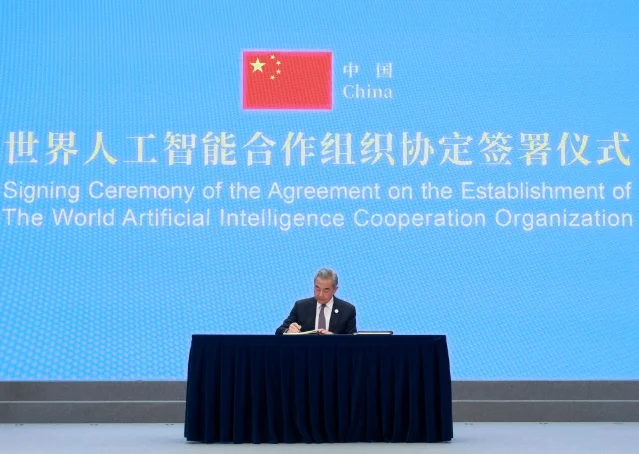
The language is designed to be difficult for other governments to reject. WAICO says it will uphold the UN Charter, pursue consultation and joint contribution, and promote AI that is beneficial, safe and fair. Those phrases place China inside a broad international vocabulary of public interest while leaving the future institution's practical rules open: how it will handle safety testing, access to compute, data governance, export controls or the use of AI in war is still unclear. 3
The timing makes the move more consequential. Reuters reported that President Xi Jinping is expected to use the Shanghai forum to outline China's role in global AI governance, promote open-source models as a public good and advance initiatives including the proposed WAICO. The event also comes before the first government-level AI talks between Washington and Beijing under President Donald Trump's administration, giving the conference a diplomatic audience beyond the exhibition floor. 4
China is pairing that message with hardware. Huawei will show its Atlas 950 SuperPoD, a large AI computing system designed to link thousands of Ascend processors through high-speed connections so they work as one cluster. Reuters described it as a sign of Beijing's effort to build a domestic alternative to Nvidia's most advanced systems, a project that depends on engineering scale as much as on chip design. 4
The diplomatic coalition is not the same thing as global consensus. Its founding members span countries with very different political systems and interests, and the public agreement sets out principles rather than enforcement powers. WAICO's influence will be measured later, when governments decide whether its standards, procurement ideas or safety language affect real systems and cross-border trade.
That is the real test for China's initiative. Shanghai is presenting AI governance as an institution-building contest, while Washington and its partners have more leverage over advanced chips, capital and the rules attached to them. The new organization gives Beijing a platform; it does not yet prove that the platform can shape the technology.
Nine other stories
- U.S.-Iran: diplomatic channels survive another night of strikes. The United States and Iran continued fighting around the Strait of Hormuz, but Pakistan, Qatar and Egypt were still trying to bring the two sides back to negotiations. U.S. and Iranian officials both left room for talks, even as the 60-day process created by a June 17 interim agreement stalled. 5 The latest U.S. strikes were reported as the sixth consecutive night of attacks, with Hormuz still closed. 6
- Ukraine: a defense reshuffle triggers rare protests. President Volodymyr Zelenskyy dismissed Defense Minister Mykhailo Fedorov during a government reshuffle, after a public dispute with army chief Oleksandr Syrskyi. Hundreds protested in Kyiv and other cities, while a senior drone commander resigned. Yevgeniy Khmara was appointed acting defense minister as Zelenskyy considered a permanent replacement. 7
- Brazil: a new U.S. tariff lands with a broad exemption list. Washington plans to impose a 25% duty on many Brazilian imports from July 22, citing digital trade, deforestation, the Pix payments system and other alleged unfair practices. Beef, coffee, energy, aircraft and rare earths are among the exemptions, while Brazil says it will examine reciprocity measures and a WTO challenge. 8
- Rare earths: the supply-chain warning gets a price tag. The International Energy Agency said full implementation of China's rare-earth export restrictions could put $6.5 trillion of downstream production outside China at risk. The exposed industries include autos, aerospace, electronics, defense and energy; the U.S. and Europe would bear nearly half of the potential economic impact. 9
- Markets: chip stocks break the global rally. Global equity indexes fell as investors sold heavily weighted semiconductor shares. The Nasdaq dropped 1.5%, the Philadelphia Semiconductor Index fell 4.3%, South Korea's KOSPI lost more than 6% and Japan's Nikkei fell almost 3%, even after TSMC reported 77% year-on-year profit growth. The episode showed how high expectations have made a merely strong AI result vulnerable to a selloff. 10
- Energy: producers look beyond the Gulf. Eni CEO Claudio Descalzi said oil and gas companies are shifting investment toward Southeast Asia and Latin America because shipping through Hormuz has been disrupted for longer than expected. He also pointed to South America and Africa as areas likely to attract new development, arguing that the Middle East's future supply role will be less dependable even after the war. 11
- New York: data-center construction faces a one-year pause. Governor Kathy Hochul imposed a moratorium on new data centers using at least 50 megawatts, making New York the first U.S. state to halt that scale of construction. The state cited utility bills, water use and uncertainty for residents, and Hochul said she would seek to end sales-tax exemptions for large facilities. 12
- Netherlands: heat and drought become a logistics problem. The Dutch government moved its water-supply status from a possible shortage to an actual shortage after weeks of little rain and historically low river inflows. Locks may open less often to limit saltwater intrusion, while irrigation is being restricted; drinking-water supplies are not currently affected. 13
- Bangladesh: IMF talks resume as growth forecasts weaken. IMF staff ended a visit requested by Dhaka and said discussions on a new arrangement would continue in the coming months. The fund expects growth to slow to 3.5% in fiscal 2027 and fall below 3% in the medium term, with inflation, banking stress, higher commodity prices and the Middle East conflict adding pressure. 14
Quote of the day
"But he is always open to diplomacy at the very same time."Karoline Leavitt, White House press secretary, describing President Trump's position on talks with Iran. 6
Further reading
- China's Xi to outline AI diplomacy vision at key Shanghai forum Reuters' report on the forum, Huawei's Atlas 950 SuperPoD and the contest over AI governance.
- Hormuz uncertainty keeps world in inflation limbo Reuters Econ World on how the conflict is feeding into energy prices and central-bank decisions.
References
- 1
- 2
- 3
- 4
- 5
- 6
- 7
- 8
- 9
- 10
- 11
- 12New York issues moratorium on data centers
reuters.com
- 13
- 14
This story was produced automatically by a channel. One sentence is all it takes for Neodrop to keep producing for you.