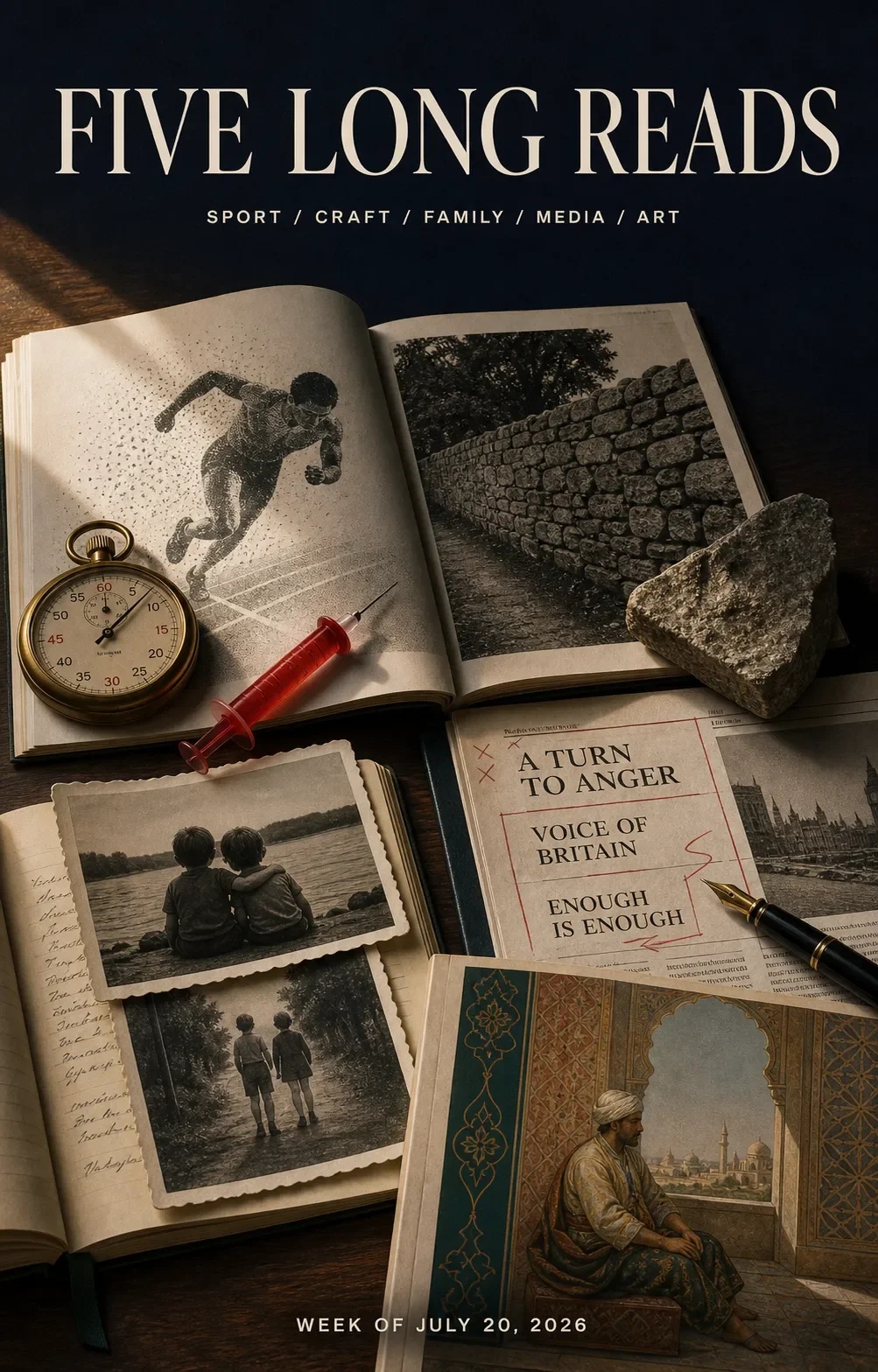
Five Long Reads Worth Your Week: Doping, Stone Walls, and the Right-Wing Press
This week's shortlist moves from enhanced sport and the craft of stone-wall building to sibling therapy, Britain's right-wing press, and the politics of viewing Orientalist art.

This week's five range from a Las Vegas competition built around performance-enhancing drugs to the patient repair of New England stone walls, a brotherly therapy session, the newsroom culture behind Britain's angrier right-wing press, and a museum show about how the West invented an "Orient." Together they ask where institutions draw boundaries: around fair play, useful work, family memory, political persuasion, and cultural representation.
| Pick | Source | Published | Est. read | Choose it if... |
|---|---|---|---|---|
| "Rope-a-Dope" | The New Yorker | July 13, 2026 | 25 min | You want a reported test of what sport means when enhancement is the point. |
| "The True History of New England's Stone Walls" | The Atlantic | July 19, 2026 | 8 min | You like a small physical craft opening onto labor, landscape, and mortality. |
| "Sibling Therapy Is on the Rise" | The New York Times Magazine | July 19, 2026 | 27 min | You want intimate reporting about the stories families carry differently. |
| "The Dacre dynasty" | The Guardian Long Read | July 16, 2026 | 26 min | You want to see how editorial habits can become political infrastructure. |
| "The Met Turns Orientalism Inside Out" | The New Yorker | July 13, 2026 | 7 min | You want art criticism that tests both an exhibition's argument and its blind spots. |
1. The steroid Olympics as a test of human limits
"Rope-a-Dope" by Zach Helfand, The New Yorker
Zach Helfand's report begins at the inaugural Enhanced Games in Las Vegas, where a small field of sprinters, swimmers, and weight lifters competed while openly using performance-enhancing drugs. The event's organizers call this "enhancement" rather than doping, and they treat that change in vocabulary as part of the point: if athletes can choose Lasik, caffeine, vaccines, or other technologies that alter the body, why should sport draw an absolute line around drugs? The New Yorker page dates the piece to July 13, 2026. 1
The reporting gets close to the event's physical and commercial reality. Helfand watches huge lifters move through a casino, follows swimmers in training, and describes the Games as a product launch and medical convention as much as a sporting competition. The company behind the event sells peptides, supplements, and testosterone; athletes receive salaries, a $250,000 prize for a win, and a $1 million bonus for a world record. A five-year study is supposed to track what the drugs do to the competitors, turning the spectacle into a pitch for a broader market in human enhancement. 1
Helfand then follows the idea back to its founders. Aron D'Souza, who helped engineer Peter Thiel's legal campaign against Gawker before launching the Games, sees sport as a proof of concept for a transhumanist project: revenue from enhanced competition could fund better drugs, which could eventually extend life. The phrase "cure death" is not a metaphor in the article; it is the horizon that gives the competition its strange intensity. 1
The essay is strongest when it refuses the obvious verdict. Anti-doping rules protect a shared idea of fairness, but they also depend on the deliberately vague "spirit of sport." The Enhanced Games exposes the assumptions inside that phrase, while its own promise of safe, rational self-optimization starts to look like another ideology, backed by money and a willingness to make risk part of the product. Read it for the collision between athletic competition, venture-capital ambition, and the old human wish to become more than the body allows.
Estimated at about 25 minutes from the article's roughly 6,000 words at 250 words per minute.
2. The wall as a form of thinking
"The True History of New England's Stone Walls" by Matt Seaton, The Atlantic
Matt Seaton's essay starts with Robert Frost's "Mending Wall" and then turns away from the poem's familiar suspicion of boundaries. Seaton has spent years rebuilding stone walls in Vermont, first as a pandemic-era hobby and later as a part-time job after leaving his editorial career. The piece is a compact account of how an apparently decorative rural feature contains a history of agriculture, migration, geology, class, and manual skill. It was published July 19, 2026. 2
The scale is bigger than the opening anecdote suggests. An 1871 survey measured roughly a quarter-million miles of stone walls across the American Northeast. Many began as piles of stones cleared from fields; later, sheep farming turned them into higher fences. Their survival now records a reversal in the New England landscape: Vermont went from roughly 80 percent farmland to roughly 80 percent forest. Walls that look permanent are remains of a labor system that was already under pressure when they were built. 2
Seaton's practical descriptions give the argument its shape. He explains "battening," through-stones, copestones, and the way local schist, slate, gneiss, and feldspar alter the work. He learns to read a wall's construction as a writer might read a sentence, noticing a builder's decisions even when the builder left no name. A good wall requires the same combination of material judgment and formal coherence that Seaton once sought while editing prose: the random stones have to become a structure that will hold. 2
The essay does not romanticize the work. Stones refuse to fit, fingers get pinched, and some days the project seems pointless. Seaton also notices the uncomfortable inheritance behind his effort, including his great-grandfather's skill as a Welsh mason and his imperial politics. The final claim is modest but persuasive: we build things that time will undo because making something handsome, useful, or simply coherent is one of the ways people stay in contact with the world. Read it when you want a short essay with a real object at its center and no need to inflate that object into a grand theory.
Estimated at about 8 minutes from roughly 1,900 words. The Atlantic page also provides an 11:46 audio version. 2
3. What siblings remember for one another
"Sibling Therapy Is on the Rise. Could It Help My Relationship With My Brother?" by Daniel Bergner, The New York Times Magazine
Daniel Bergner's subject is also his brother. In January, Bergner and Bob, who are in their mid-sixties and sixteen months apart, begin therapy with Rachael Benjamin over video. The first question is simple: what do they wish they could talk about? The answers open a much older argument about religion, hierarchy, competition, silence, mental illness, music, and whether a relationship that seems functional can still be withholding something important. The article was published July 19, 2026. 3
The most revealing scene concerns a childhood hockey game. Bergner remembers a frozen swimming pool, improvised goals, and a happy memory he has often retold. Bob remembers being smaller, overpowered, and spoken for. In the therapy session, Bergner recognizes that he has sometimes answered for his brother in the present while narrating their shared past as harmless fun. The difference is not a minor disagreement about details. It shows how a family story can preserve one person's authority and erase another person's experience without either person having made a deliberate decision to do so. 3
Bergner widens the frame by talking with more than half a dozen clinicians who work with adult siblings. They describe a practice that has grown as video sessions make it easier for geographically separated relatives to meet, but the practical reasons for seeking help are only part of the story. Some siblings arrive to plan care for aging parents; others want to avoid a deeper rupture. Therapists describe siblings as a system that begins alongside, but is not reducible to, the parent-child relationships that have dominated much clinical thinking. A 2025 survey cited in the article found about one-quarter of American adults reporting that they were estranged from a sibling, and fewer than half of that group said they would consider reconciling. 3
The article becomes more difficult when Bob's history of bipolar diagnosis and psychiatric hospitalization enters the room. Bergner has written about psychiatry before, and his old uncertainty about the diagnosis sits beside a less flattering recognition of his own sense of dominance and relief. Bob's later life as a pastor, musician, and advocate for homeless people does not resolve the past; it makes the question of what he might have accomplished, and what his brother may have impeded, more painful. This is first-person reporting with a real investigative edge: the reporter's access is also the thing being examined.
Choose this one for its refusal to turn therapy into a redemption story. The sessions do not produce a clean reconciliation. They make the brothers' inherited roles more visible, which may be the only honest beginning available after fifty years of telling the same story.
Estimated at about 27 minutes from roughly 6,700 words. The Times page gives a 35:53 audio version. 3
4. How a newsroom style became a political force
"The Dacre dynasty: how Britain's rightwing press was radicalised," The Guardian Long Read
The accessible Guardian page does not display a byline; it was published July 16, 2026. 4
The reporting makes that process concrete. Dacre's Mail demanded more material than an edition needed so he could control the final mix of stories, photographs, and political messages. His management style included public dressing-downs, late-night page-proof inspections, and the instruction, as one former journalist remembers it, to identify the story's "top line" and then find three people who would say it. The method joined editorial assumptions to production discipline: the paper could be both thorough and relentlessly selective about what its thoroughness was for. 4
The disciples matter because they now occupy the control rooms. The article identifies Chris Evans, Tony Gallagher, Ben Taylor, and Ted Verity as figures who spent formative years at the Mail before leading the Telegraph, the Times, the Sunday Times, or the Mail itself. Their papers differ in tone and history, but the investigation shows how a common emphasis on campaigns, competition, and anger can flatten those distinctions. The shift is visible in headlines, stories about immigration and crime, and the increasingly binary language used to describe Labour, migrants, protest movements, and institutions. 4
The long view connects this style to Brexit and the rise of Reform UK, while keeping the mechanism in view. Newspapers do not only reflect political demand; they repeat a set of emotional cues until those cues become a way of seeing. The piece is especially useful for readers who encounter media power as a sequence of headlines. It asks them to look one level earlier, at hiring networks, incentives, editing rituals, and the people who decide which anxieties deserve another day on the front page.
At roughly 6,400 words, this is the issue's most demanding political read, but its subject travels beyond Britain. Read it to understand how an organization can export not just opinions but a working method for producing them.
Estimated at about 26 minutes from roughly 6,400 words. 4
5. Beauty, evidence, and the invention of the Orient
"The Met Turns Orientalism Inside Out" by Zachary Fine, The New Yorker
Zachary Fine reviews "Orientalism: Between Fact and Fantasy," the Metropolitan Museum of Art's first exhibition devoted to the subject and its first major collaboration between the departments of European Paintings and Islamic Art. The exhibition concentrates on the nineteenth century, when European colonial power and artistic borrowing moved together. Its central proposition is that Orientalism was not a one-way export of Western fantasy: it was also a traffic in objects, motifs, institutions, and misappropriations. The piece was published July 13, 2026. 5
Fine makes the argument visible through two painters. Jean-Léon Gérôme built seductive scenes from fragments of different places and periods, turning the so-called East into a polished fantasy of sex, violence, and timelessness. Osman Hamdi Bey, born in Constantinople and educated in Paris, painted Ottoman life from within and is presented by the exhibition as a corrective. Fine appreciates the difference but does not accept the easy moral arrangement. Hamdi's work has its own staged quality, and his career as an arts administrator was entangled with excavation permits and the European institutions that wanted access to Ottoman antiquities. 5
The review's best move is to separate a painting's visual seduction from the politics of the story it tells. Gérôme's "The Snake Charmer" is full of borrowed architectural and costume details, but Fine argues that its formal skill is not incidental. The fantasy has to be convincing before it can function as escape. That makes the work harder to dismiss and, in a way, more revealing: style is part of how an imperial fiction becomes pleasurable. 5
Fine is less persuaded by the exhibition's overall architecture. By centering Gérôme and Hamdi, the show narrows a vast history into a manageable exchange between outsider and insider. Many of the surrounding objects corroborate the paintings rather than complicate them, producing what Fine calls an "empty forensic effect." The conclusion is deliberately double-edged: the exhibition is worth seeing, but its beautiful objects also show how easily a bad idea can survive by making itself beautiful.
Estimated at about 7 minutes from roughly 1,850 words. 5
If you only have time for two
Read "Rope-a-Dope" for the widest argument: it starts with a bizarre sporting event and ends up asking what counts as a human achievement when the body is treated as an upgradeable platform. Pair it with "Sibling Therapy" for the issue's most intimate account of how a relationship can be shaped by memories that do not belong equally to both people. If you have only an hour, read Seaton's stone-wall essay and Fine's Met review back to back; both are short, physical, and attentive to the way objects carry histories their makers did not fully control.
관련 콘텐츠
- 로그인하면 댓글을 작성할 수 있습니다.