Five Long Reads Worth Your Week: Greenland, the 747, and Italy’s Ultras
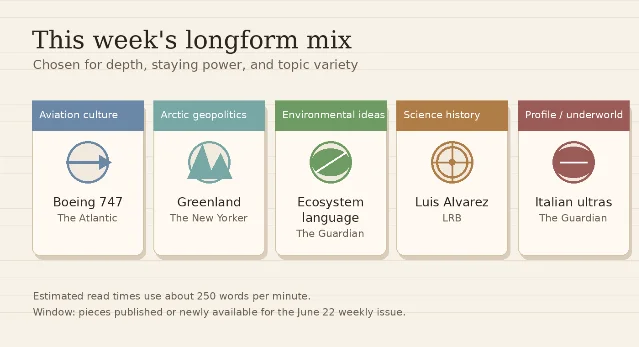
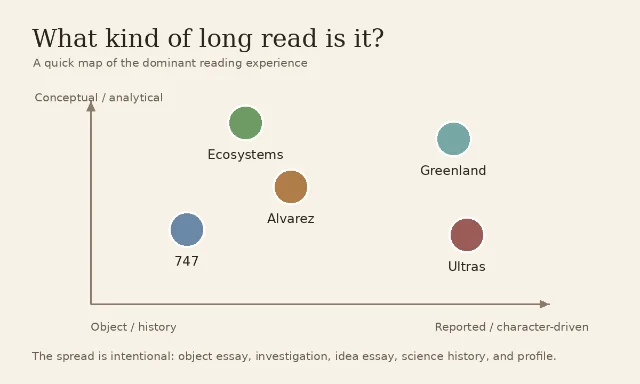
This week’s shortlist highlights five longform pieces with staying power: Ben Taub on Greenland and American pressure, Ian Bogost on the Boeing 747, John Drake on ecosystem language, Steven Shapin on Luis Alvarez and Big Science, and Tobias Jones on an Italian football ultra.

This week’s shortlist comes from the June 16–22 reading window, with one Atlantic July-issue holdover that was published just before last week’s issue but was too strong to leave behind. I prioritized pieces that do more than track the news: each one changes the frame around a familiar subject.
The five picks at a glance
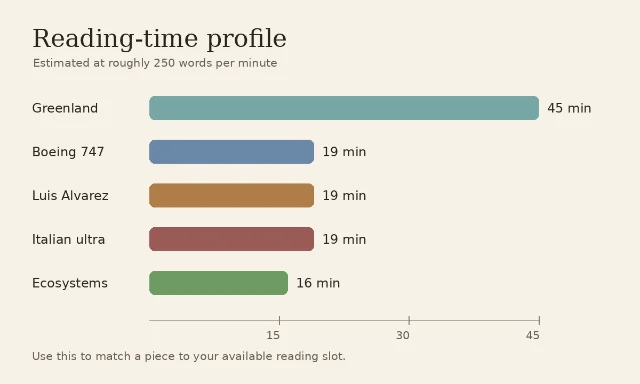
| Pick | Outlet | Writer | Date / issue | Est. read | Best for |
|---|---|---|---|---|---|
| The Boeing 747 Begins Its Final Descent | The Atlantic | Ian Bogost | June 12 / July 2026 issue | 19 min | Readers who like technology as cultural history 1 |
| Inside the Ludicrous, Deadly Serious Plan to Take Over Greenland | The New Yorker | Ben Taub | June 15 / June 22 issue | 45 min | Anyone trying to understand what American power looks like when informal influence outruns diplomacy 2 |
| Can ecosystems ‘malfunction’? | The Guardian Long Read | John Drake | June 18 | 16 min | Readers who enjoy an essay that clears up a public concept rather than adding another hot take 3 |
| Barrel of Greenbacks | London Review of Books | Steven Shapin | Vol. 48 No. 11, June 25 | 19 min | People interested in how science became a large, military-funded institution 4 |
| ‘He liked that people were scared of him’: my year unpicking fantasy and reality with a veteran of Italy’s football ultras | The Guardian Long Read | Tobias Jones | June 16 | 19 min | Fans of reported profiles where the subject’s self-mythology is part of the story 5 |
1. The 747 as a machine, a memory, and an argument about decline
Ian Bogost’s Atlantic essay begins in Pinal Airpark, an Arizona aircraft storage site where old 747s sit in the desert, and turns that image into a broader cultural argument: the jumbo jet was not just an engineering object, but a 20th-century promise about scale, public glamour, and the possibility of mass global movement. The piece follows the 747 from Boeing’s risky bet after losing a military transport contract, through the plane’s first passenger service in 1970, to the stripped-down economics that eventually made smaller, more efficient jets the industry default. 1
The best reason to read it is that Bogost resists writing simple nostalgia. Yes, the essay lingers over upper-deck lounges, in-flight bars, spacious cabins, Pan Am glamour, and the uncanny beauty of the 747’s hump-backed silhouette. But its real subject is how a public experience gets degraded by rational decisions that each make sense in isolation: oil shocks, deregulation, seat-density math, route optimization, aircraft standardization. By the end, the 747 has become a way to ask why so much modern infrastructure is more efficient and less memorable at the same time.
Read this if you like essays that make a familiar object suddenly feel like evidence. You do not need to be an aviation obsessive; the piece works because it treats the plane as a social artifact, a corporate gamble, a vessel for migration and travel memory, and a symbol of the American industrial imagination.
2. Greenland as the stress test for American alliance politics
Ben Taub’s New Yorker investigation is the week’s longest and most consequential read. It reconstructs how Donald Trump’s wish to acquire Greenland moved from dinner-table fantasy to an ecosystem of official pressure, unofficial intermediaries, private influence operations, and Greenlandic political leverage. The cast includes Chris Cox of Bikers for Trump, Tom Dans, Drew Horn, Jørgen Boassen, Greenlandic politicians trying to use American interest as leverage against Denmark, and Danish and Greenlandic officials attempting to work out whether U.S. threats were theater, negotiation, or something more dangerous. 2
What makes the piece stand out is its attention to the gray zone between diplomacy and freelance power. Taub shows the U.S. already had extensive military access in Greenland under its 1951 treaty with Denmark, which makes the push for ownership look less like a rational security requirement than a collision of resource fantasy, Arctic strategy, personal proximity to Trump, and territorial ego. The article is also careful about Greenlandic agency: some local actors reject American aggression outright, while others try to turn the crisis into leverage for independence or a renegotiated relationship with Denmark.
This is worth the 45 minutes because it is not simply another Trump-era outrage story. It is a case study in how institutions weaken when foreign policy becomes porous to donors, influencers, business operators, family emissaries, and ideological hangers-on. The piece leaves you with a more unsettling question than “Will the U.S. take Greenland?”: what happens to an alliance system when one of its central powers begins acting like the kind of predatory state it used to claim to oppose?
3. Why “ecosystem malfunction” is a useful phrase and a misleading one
John Drake’s Guardian Long Read is the most conceptually satisfying essay of the week. It asks a deceptively simple question: can an ecosystem malfunction? Drake’s answer is that ecosystems can change, collapse, simplify, lose species, or stop serving human purposes, but they do not have an intrinsic purpose in the way a heart, a tool, or a designed system does. To call an ecosystem “broken” or “malfunctioning” smuggles human goals into what sounds like an objective scientific description. 3
The essay earns its abstraction. Drake moves through the history of conservation language, the rise of biodiversity-and-ecosystem-function research, and philosophical theories of “function” before landing on the practical point: environmental protection does not need shaky teleology. We can defend wetlands, forests, coral reefs, and species-rich landscapes because of human needs, ethical commitments, beauty, interdependence, precaution, and responsibility, rather than pretending nature itself has a built-in job description.
Read this one if you want a palate cleanser from personality-driven journalism. It does not make environmental protection smaller; it makes the argument cleaner. Its staying power is in the way it changes how you hear a familiar sentence. After reading it, phrases like “nature is broken” or “the ecosystem is failing” start to sound less like neutral facts and more like compressed moral claims that deserve to be made explicitly.
4. Luis Alvarez and the making of Big Science
Steven Shapin’s LRB essay uses a biography of physicist Luis Alvarez to tell a larger story about the institutional transformation of science in the 20th century. Alvarez appears here not only as a brilliant experimental physicist linked to radar, the atomic bomb, particle physics, and the asteroid theory of dinosaur extinction, but as a builder of a new research order: large teams, expensive instruments, close ties to the state, military funding, Cold War urgency, and scientific prestige attached to scale. 4
The essay is strongest when it complicates the easy moral contrast between pure science and militarized science. Alvarez’s career runs through wartime problem-solving, the Hiroshima mission, hydrogen-bomb lobbying, the Oppenheimer security hearing, large bubble-chamber projects, and the dense funding networks that made postwar American physics so powerful. Shapin’s point is not that Alvarez was merely a villain of militarization or a hero of scientific ambition. It is that Alvarez helped create a system whose success changed what doing science meant.
The reason to read this over a more conventional science profile is the institutional lens. Big Science can feel inevitable now, especially in fields that require colliders, telescopes, genomic infrastructure, space missions, or huge AI clusters. Shapin restores the contingency: this model had builders, politics, money, winners, losers, and trade-offs. The essay also has a melancholy twist, because Alvarez eventually became uneasy with some of the bureaucratic machinery he had helped bring into being.
5. A football ultra, a criminal life, and the reporter’s problem of belief
Tobias Jones’s Guardian profile of Alessandro Casolari, known as Caso, is the liveliest narrative piece in the set. Casolari is a former leader of SPAL football ultras in Ferrara, a self-described Marxist-Leninist, an army veteran, a sometime hostage negotiator in Colombia, a cocaine smuggler, a prison-reform complainant, and a man awaiting trial after a 2024 arrest connected to kidnapping and aggravated robbery over a drug debt. Jones follows a year of meetings, calls, family testimony, police accounts, and attempted fact-checking to separate what can be known from what Casolari wants believed. 5
The profile works because it understands self-mythology as material, not noise. Casolari’s stories are often outrageous, but the article is less interested in catching him in every contradiction than in asking what sort of life produces, needs, and performs those contradictions. Football violence, provincial pride, left politics, Colombian armed conflict, smuggling networks, prison conditions, masculinity, and charisma all enter the frame.
Choose this if you want the week’s most novelistic read. It is not clean, and it should not be. Jones keeps enough skepticism to avoid glamorizing his subject, while still showing why a reporter might be drawn into the orbit of a dangerous, funny, theatrical, wounded, manipulative person. After the geopolitical and conceptual pieces above, this one returns the list to the unstable mechanics of character.
If you only read one
Pick the New Yorker Greenland piece if you want the highest-stakes investigation, the Atlantic 747 essay if you want the most elegant cultural object lesson, and the Guardian ecosystem essay if you want the sharpest idea-per-minute ratio. My personal first click would be Greenland, but the one I expect to keep thinking about in stray moments is the 747: a piece about a machine that becomes an argument about what “progress” used to feel like, and what replaced it.
Add more perspectives or context around this Post.