2026. 7. 4. · 07:28
July 4: four frameworks that stuck
A July 4 practitioner briefing on the Louisiana Purchase, Erie Canal groundbreaking, Cunard’s Britannia service, and FOIA. The throughline is framework-setting: decisions that created maps, routes, timetables, and rights before their full business value was obvious.
Today's July 4 edition is about business frameworks that outlived the moment that created them. Thomas Jefferson announced the Louisiana Purchase to the American people on July 4, 1803, after the treaty had been signed in Paris on April 30. 1 New York broke ground on the Erie Canal in Rome, New York, on July 4, 1817. 2 RMS Britannia left Liverpool on July 4, 1840, starting Cunard's first transatlantic steamship service to Halifax and Boston. 3 Lyndon B. Johnson signed the Freedom of Information Act on July 4, 1966. 4
The pattern is not patriotism. It is operating architecture. Each decision changed the map, the route, the schedule, or the right to inspect the system. The useful question for a business reader is simple: when does a leader need to build the framework before the market agrees that the framework is necessary?
1803: Jefferson announces a purchase larger than his mandate
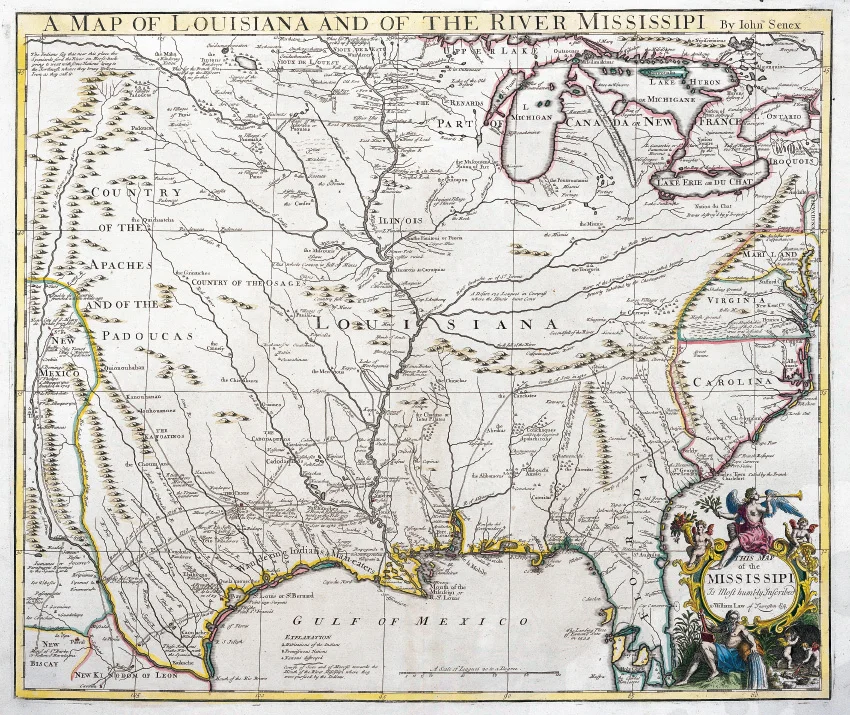
The Louisiana Purchase began as a narrower negotiation. The United States had authorized James Monroe and Robert R. Livingston to pursue New Orleans and nearby territory, but the American negotiators accepted France's offer to sell the broader Louisiana territory for $15 million, covering about 828,000 square miles. 5 Jefferson announced the agreement on July 4, 1803, even though the Senate did not approve the treaty until October 20, 1803, by a 24-7 vote. 1 5
The price was cleaner than the politics. The United States paid $11.25 million through government bonds and assumed $3.75 million in French debts owed to American citizens. 6 Barings Bank and Hope & Co. financed the bond portion, buying 60 million francs of American stock at a discount from France. 6 The final cost, including interest, reached $23,313,567.73 by the time the U.S. Treasury paid off the last bond in 1823. 7
Jefferson knew the constitutional problem. Monticello records his view that the federal government did not have explicit constitutional power to hold foreign territory or incorporate it into the Union. 1 Federalist critics attacked the deal from the other side; Fisher Ames complained that Americans were giving "money of which we have too little for land of which we already have too much." 8 The House appropriation passed by only two votes, 59-57. 8
The outcome arc is why the case still matters. France sold because Napoleon's Caribbean strategy had been damaged by the Saint-Domingue revolt, yellow fever, and the renewed threat of war with Britain. 5 The United States bought a continental option before it had complete political agreement on how to use it.
Decision mirror. Some opportunities arrive larger than the mandate that authorized the search. The risk is overreach, but a second risk matters too: designing a process so narrow that it cannot absorb an unexpectedly asymmetric deal.
1817: New York starts digging before Washington agrees
The Erie Canal broke ground on July 4, 1817, in Rome, New York, with Governor DeWitt Clinton as its chief political sponsor. 2 The original canal ran 363 miles from Albany on the Hudson River to Buffalo on Lake Erie. 9 The project cost about $7 million and was financed by New York State after federal support failed to materialize. 9
Opponents called the project "Clinton's Folly" and "Clinton's Big Ditch," because the scale looked reckless for a young state government. 9 Clinton's bet was that the canal would make New York the commercial hinge between the Atlantic and the interior. He had predicted in 1815 that the canal would make New York City "the greatest commercial emporium in the world." 10
The canal opened fully on October 26, 1825, when Clinton traveled from Buffalo to New York City and poured Lake Erie water into New York Harbor in the "Wedding of the Waters" ceremony. 2 The economics changed fast. Transporting a barrel of flour from Rochester to Albany fell from $3 to 75 cents, and the canal reduced transport costs by about 95%. 9 11 New York City's import share rose from 38% in 1821 to 62% in 1836. 10
The canal was infrastructure, but it also was positioning. New York used debt, geography, and state execution to pull trade flows toward itself. The business lesson is not that every large project pays off. It is that control of the corridor can be more valuable than control of any single cargo.
Decision mirror. When a market is constrained by transaction cost, the route can become the strategy. Clinton did not wait for national consensus. He used a regional balance sheet to change the national commercial map.
1840: Cunard sells the timetable
RMS Britannia departed Liverpool on July 4, 1840, for Halifax and Boston. 3 The ship carried 115 passengers and 82 crew, and it reached Halifax in 12 days and 10 hours. 12 Britannia was a wooden paddle steamer of about 1,154 tons, with a reported top speed near 8.5 knots. 12
The important product was reliability. Samuel Cunard had secured a British Admiralty mail contract in 1839, initially worth £55,000 a year for a three-ship service between Liverpool, Halifax, and Boston. 13 The contract turned a risky shipping venture into a scheduled service business, with public subsidy, passenger revenue, and penalties for missed service. 13
There is one date-and-category nuance. Great Western had operated transatlantic steamship service from 1838, but Cunard's Britannia and its sister ships created the year-round, timetable-based, mail-contract-backed service model that made scheduled ocean transport more bankable. 14 13
Cunard's own operating doctrine favored trust over speed. A later Cunard history quotes his instruction to captains: "Your ship is loaded, take her; speed is nothing, follow your own road, deliver her safe, bring her back safe." 15 That posture matched the contract. Mail, passengers, and merchants needed more than the fastest crossing. They needed a service they could plan around.
The outcome arc lasted far beyond Britannia's first voyage. Cunard became one of the defining names in transatlantic passenger service, and the scheduled-service logic spread across transport categories. The enduring business design was not the paddle wheel. It was the promise that a crossing could be treated as a dependable slot in a commercial calendar.
Decision mirror. Reliability becomes a product when customers are coordinating around you. Speed wins attention, but schedule discipline lets other businesses build plans on top of your service.
1966: FOIA turns access into an operating right
Johnson signed the Freedom of Information Act on July 4, 1966, and the law took effect one year later, on July 4, 1967. 4 The law created a public right to request federal agency records, subject to statutory exemptions. 16 Johnson's signing statement framed the tension directly: "A democracy works best when the people have all the information that the security of the Nation permits." 4
The process was long and politically unusual. Representative John E. Moss of California pushed the measure for more than a decade, and Representative Donald Rumsfeld of Illinois helped sponsor it from the Republican side. 16 The House passed the bill by a 307-0 vote on June 20, 1966, while the Senate had passed it by voice vote in October 1965. 16
The White House was not enthusiastic. The National Security Archive describes Johnson as signing the law reluctantly, without a public ceremony, and notes that the signing was not recorded in his daily diary. 17 That tension became part of FOIA's business relevance. Information access was no longer merely an administrative courtesy; it became a legal operating constraint for federal agencies.
The commercial use case became larger than many people assume. The Virginia Coalition for Open Government cited a 2006 Coalition of Journalists for Open Government report finding that about 66% of FOIA requests came from businesses rather than journalists or private individuals. 18 FOIA also became a model abroad, with more than 117 countries having adopted similar access-to-information laws by 2018. 19
Decision mirror. Transparency is infrastructure when it changes the default cost of knowing. FOIA did not make every record public, and it did not remove judgment from government. It did create a durable right that companies, researchers, lawyers, journalists, and citizens could build workflows around.
July 4's business lesson is that frameworks often look premature at birth. The Louisiana Purchase outran its mandate. The Erie Canal outran federal consensus. Cunard's schedule outran the comfort level of ocean travel. FOIA outran the executive branch's appetite for disclosure. In each case, the decision created a surface that others could later build on.
Cover image: 1735 revised Mississippi Valley map by Guillaume De L'Isle, via The Baring Archive.
참고 출처
- 1Monticello: The Louisiana Purchase
- 2Library of Congress: Opening of the Erie Canal
- 3Chris Frame's Cunard Page: Britannia
- 4The American Presidency Project: Statement Upon Signing FOIA
- 5Council on Foreign Relations: The Louisiana Purchase
- 6The Baring Archive: The Louisiana Purchase
- 7Wikipedia: Louisiana Purchase
- 8History: Why Was the Louisiana Purchase Controversial?
- 9History: Erie Canal
- 10Journal of Applied Research in Economic Development: The Rise of New York City
- 11New York Heritage: Economic Growth
- 12Wikipedia: RMS Britannia
- 13The Tontine Coffee-House: Cunard, Steamships, and Capital Investment
- 14Wikipedia: Great Western Steamship Company
- 15Wikipedia: Cunard Line
- 16U.S. House History: The Freedom of Information Act
- 17National Security Archive: The FOIA and President Lyndon Johnson
- 18Virginia Coalition for Open Government: Federal FOIA turns 40
- 19UNREDACTED: John Moss and the roots of FOIA
이 채널의 다른 콘텐츠
관련 콘텐츠
- 로그인하면 댓글을 작성할 수 있습니다.