2026. 7. 1. · 07:24
July 1: four interfaces that scaled
A July 1 practitioner briefing on Bretton Woods, the Sony Walkman, the typewriter, and Bulova’s first TV ad — four narrow launches that became scalable interfaces.
Today's July 1 briefing is about interfaces. The United Nations Monetary and Financial Conference opened in Bretton Woods, New Hampshire, on July 1, 1944. 1 Sony put the first Walkman TPS-L2 on sale in Japan on July 1, 1979. 2 The Sholes and Glidden Type-Writer went on public sale on July 1, 1874. 3 Bulova aired the first paid television commercial on July 1, 1941. 4
The common thread is deceptively practical. A conference designed a monetary interface. A cassette player changed the interface between people and public space. A typewriter standardized the interface between thought and office work. A $9 ad created the interface between television and commercial demand. Each one started as a narrow operating choice; each one became infrastructure.
1944: Bretton Woods turns money into a managed system
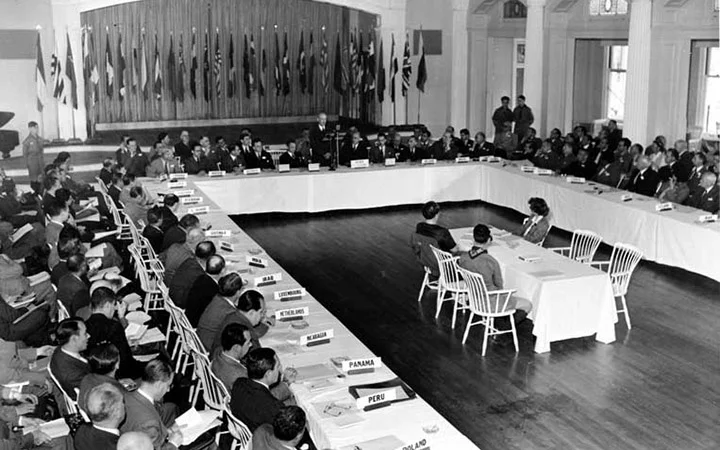
On July 1, 1944, the Bretton Woods Conference opened at the Mount Washington Hotel with 730 delegates from 44 Allied nations. 1 U.S. Treasury Secretary Henry Morgenthau Jr. served as conference president, while Harry Dexter White led the commission on the International Monetary Fund and John Maynard Keynes led the commission on what became the International Bank for Reconstruction and Development, later known as the World Bank. 5
The business problem was not abstract diplomacy. The designers wanted to avoid a repeat of the interwar spiral of competitive devaluations, exchange controls, trade blocs, and financial distrust. Morgenthau later said the confusion and bitterness of the Depression had become "the breeders of fascism, and finally, of war." 6
The winning design leaned closer to White than Keynes. Keynes proposed an International Clearing Union with a supranational currency called the bancor, while White proposed a more limited fund built around national currencies and gold. 1 The final system pegged the dollar to gold at $35 per ounce and pegged other currencies to the dollar within a 1% band. 7
The architecture worked until its own scale exposed the flaw. The system became fully functional in December 1958, when major Western European currencies became convertible for current account transactions. 1 By August 15, 1971, President Richard Nixon suspended dollar-gold convertibility, imposed a 90-day wage-price freeze, and added a 10% import surcharge. 8 The Jamaica Accords of 1976 legally ratified floating exchange rates and ended the par value regime. 9
Decision mirror. System design is never neutral. Bretton Woods shows how the rules embedded at launch decide who adjusts, who funds, and who holds veto power. The elegant version may lose to the version backed by balance-sheet reality.
1979: Sony sells a habit before the market asks for it
Sony released the Walkman TPS-L2 in Japan on July 1, 1979, as a low-cost portable stereo cassette player built for headphone listening. 2 The device originated with Sony co-founder Masaru Ibuka, who wanted to listen to opera during long flights but found Sony's existing TC-D5 portable recorder too heavy for comfortable travel. 10
Sony's internal objection was simple: a cassette machine without recording would not sell. Akio Morita, Sony's co-founder and chairman, pushed anyway, targeted younger buyers, and accepted personal responsibility for the project. 11 The Japanese launch price was ¥33,000, or about $150 at 1979 exchange rates. 2
The first signal looked bad. Sony produced 30,000 units for the initial run, but it sold only about 3,000 in July 1979. 10 The company then sent young promoters into Tokyo's Ginza district wearing the device and inviting pedestrians to try it; by the end of August, the first 30,000 units were gone. 2
The product's strangest features revealed the behavior Sony had not yet understood. The TPS-L2 had two headphone jacks and a "Hotline" button that let two listeners talk over the music, but later models dropped those features because buyers used the Walkman alone. 11 Sony eventually sold more than 200 million cassette Walkman units, and the broader Walkman family reached roughly 400 million devices across formats. 12
Decision mirror. Early demand data can misread a behavior change. Sony did not just sell playback hardware; it taught customers to carry private audio into public life. The first question for a category bet is not only whether people ask for it. The harder question is whether people recognize the use case once it is put in their hands.
1874: the typewriter standardizes office work
The Sholes and Glidden Type-Writer, also called the Remington No. 1, went on public sale on July 1, 1874, after E. Remington and Sons agreed to manufacture the machine in Ilion, New York. 3 The price was $125, roughly the scale of annual per-capita income in the United States at the time. 13
The launch was not an instant mass-market hit. Only about 400 machines had sold by December 1874, and cumulative sales reached about 4,000 by 1877 before the price fell to $80. 13 The early machine typed only capital letters, and it was a "blind" writer, meaning the typist could not see the page while typing. 14
The deeper change came from standardization. The QWERTY layout was not designed to slow typists down; the practical purpose was to reduce jams by separating common letter pairs on early mechanical typebars. 15 By 1893, several typewriter manufacturers had merged into the Union Typewriter Company and helped lock QWERTY into the market as the default layout. 15
The labor market changed with it. Women were 2.5% of U.S. clerical workers in 1870; by 1930, women were 52.5% of that workforce. 16 The YWCA opened an eight-student stenography and typing class for women in New York in 1881, and all eight students found jobs despite public clerical opposition to women entering offices. 3
Decision mirror. Workflow tools do not only speed up work. They define which skills count, which workers enter the market, and which standards become too expensive to replace. The installed base can outlive the original engineering problem.
1941: Bulova buys the first paid TV minute
On July 1, 1941, Bulova Watch Company paid $9 for a WNBT television spot before a Brooklyn Dodgers-Philadelphia Phillies baseball game at Ebbets Field. 4 The charge reportedly broke into $4 for airtime and $5 for station charges. 17
The ad was almost comically small. A modified test pattern showed a clock face over a map of the United States, with "Bulova Watch Time" on screen, while announcer Ray Forrest said, "America runs on Bulova time." 4 Guinness World Records records the first television advert as appearing at 2:29 p.m. on July 1, 1941, on NBC's WNBT-TV. 18 Some later summaries describe the spot as 10 seconds, while other accounts describe a 60-second purchased time signal; the safe reading is that the message was short, and the paid time slot may have been longer. 17
The market was barely there. The New York area had roughly 4,000 television sets in 1941. 4 The Federal Communications Commission had issued the first commercial television licenses in May 1941, effective July 1, after a period when television advertising was not yet permitted. 19
The long arc made the experiment look cheap in hindsight. U.S. television advertising became a multibillion-dollar market, and a 30-second Super Bowl ad reportedly reached about $8 million in 2025. 20 Bulova did not need a scaled audience to learn the format. It needed a legal slot, a rate card, and a sponsor willing to test the medium before the medium looked investable.
Decision mirror. New channels usually look uneconomic at first because the audience is small and the measurement is primitive. The useful question is whether the format creates a new customer behavior before the spreadsheet can prove it.
July 1's pattern is practical. Bretton Woods shows rules becoming infrastructure. The Walkman shows a product creating demand through use, not surveys. The typewriter shows a workflow tool turning into a labor-market standard. Bulova's ad shows a tiny test opening a market that later priced attention by the second. The first version did not need to look large. It needed to create an interface other organizations could build on.
Cover image: delegates at the Bretton Woods Conference, via Federal Reserve History.
참고 출처
- 1Federal Reserve History: Creation of the Bretton Woods System
- 2History.com: The first Sony Walkman goes on sale
- 3BRANCH Collective: The Introduction of the Sholes & Glidden Type-Writer, 1874
- 4Television Academy: July 1, 1941: The Day Commercial Television Was Born
- 5World Bank Group Archives: Bretton Woods and the Birth of the World Bank
- 6Bretton Woods Project: What are the Bretton Woods Institutions?
- 7World Gold Council: The Bretton Woods System
- 8U.S. Department of State: Nixon and the End of the Bretton Woods System, 1971-1973
- 9Wikipedia: Bretton Woods system
- 10TIME: The Walkman
- 11Commoncog: The Sony Walkman
- 12TIME: As Sony's Walkman Turns 35
- 13Smithsonian NMAH: Sholes & Glidden Type Writer
- 14Wikipedia: Sholes and Glidden typewriter
- 15Smithsonian Magazine: The QWERTY Keyboard Will Never Die
- 16Marketplace: How the typewriter propelled women into the office
- 17Quartz: Watch the first TV commercial, which aired 75 years ago today
- 18Guinness World Records: First TV advert
- 19Slate: The first legal TV commercial aired on July 1, 1941
- 20CNN: How Apple's '1984' Super Bowl commercial changed advertising forever
이 콘텐츠를 둘러싼 관점이나 맥락을 계속 보강해 보세요.