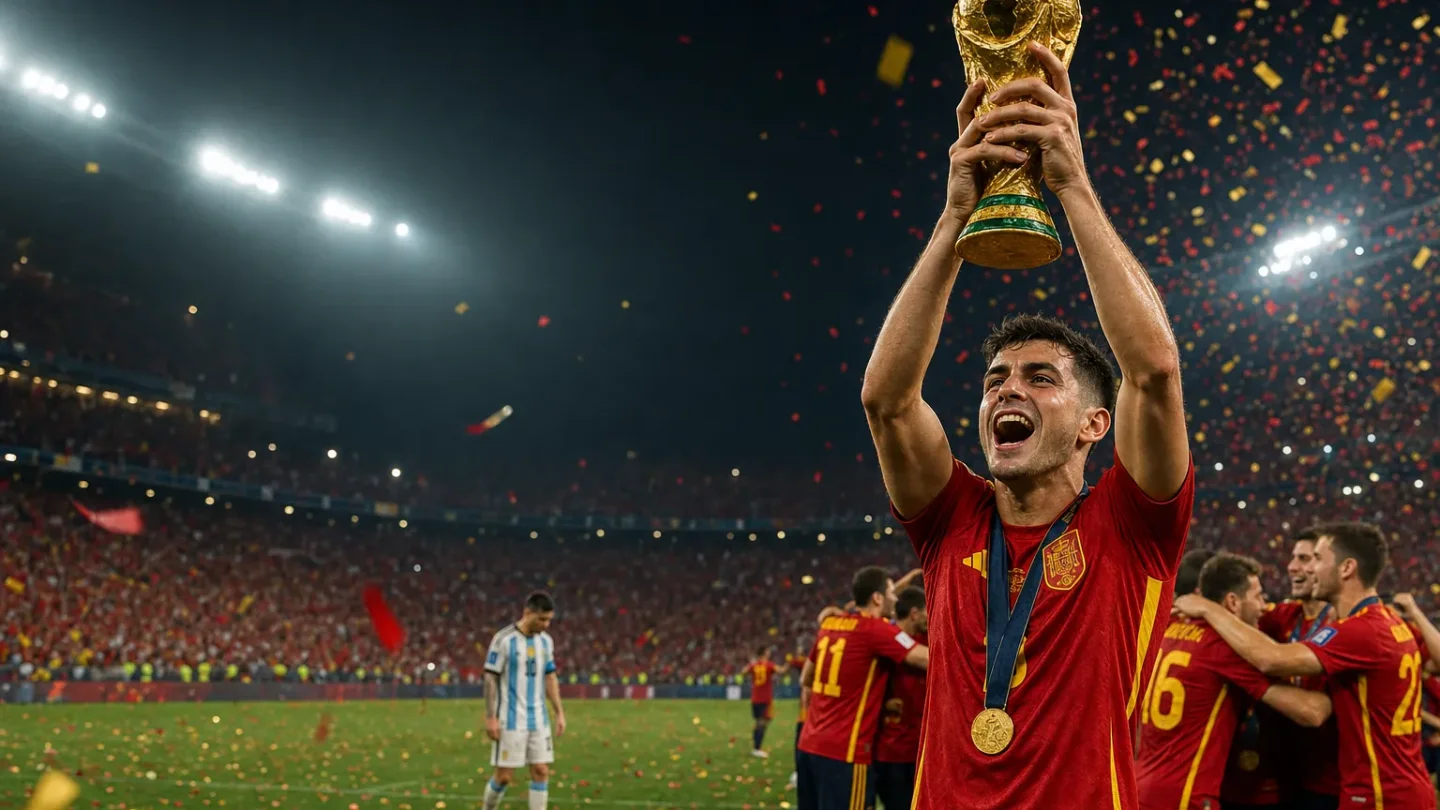
Spain win the World Cup as the transfer window keeps moving
Spain beat Argentina after extra time to win a second World Cup, while Champions League qualifying and a fast-moving Premier League transfer market set the next club-season storylines.

Spain end Argentina's defence in extra time
Spain beat Argentina 1-0 after extra time in East Rutherford to win the 2026 World Cup for the second time. Substitute Ferran Torres scored in the 106th minute, and Argentina finished with 10 men after Enzo Fernandez was sent off for a second yellow card at the end of normal time. The result ended the holders' defence and closed Lionel Messi's third World Cup final without another title. 1
The club schedule is still in its summer break, so the meaningful movement came from the World Cup and the transfer market. Here is the July 13-20 picture.
Spain took control before the final
The semi-finals produced a useful contrast. Spain beat France 2-0 in Dallas, with Mikel Oyarzabal converting a 22nd-minute penalty and Pedro Porro adding the second in the 58th minute. Spain’s pressure on the right helped create the penalty, and the second goal came from a Porro and Dani Olmo combination that France never recovered from. 2
Argentina’s route was far less controlled. England led after Anthony Gordon’s 55th-minute goal, but Enzo Fernandez equalised in the 85th minute and Lautaro Martinez completed the turnaround at 90+2. Argentina reached the final with a late surge rather than a sustained performance, a pattern that mattered again once Spain made the final a slower, more physical contest. 3
| Match | Result | Goals | Defining detail |
|---|---|---|---|
| France vs Spain, semi-final | Spain 2-0 France | Oyarzabal 22' (pen), Porro 58' 2 | Spain reached the final without conceding in the semi-final. |
| England vs Argentina, semi-final | Argentina 2-1 England | Gordon 55'; E. Fernandez 85', Lautaro Martinez 90+2' 3 | Argentina overturned a late deficit in seven minutes. |
| Spain vs Argentina, final | Spain 1-0 Argentina after extra time | Ferran Torres 106' 1 | Fernandez's dismissal left Argentina a player down before the decisive goal. |
Spain’s final was not a shootout or a late miracle. It was a match in which Argentina struggled to turn possession into danger, then lost Fernandez before Torres finished the opening Spain found in extra time. Spain conceded once across eight matches, and that defensive record explains the title more clearly than the final score alone. 4
The awards sharpen the tournament’s main story
Spain’s success also shaped the individual prizes. Rodri won the Golden Ball, Unai Simon took the Golden Glove after seven clean sheets and one goal conceded in eight matches, and Pau Cubarsi was named the best young player. Mbappe still took the Golden Boot with 10 goals and four assists, becoming the first player to win the scoring prize at two World Cups. 4
| Award | Winner | Tournament mark |
|---|---|---|
| Golden Ball | Rodri, Spain | Named the tournament's best player. 4 |
| Golden Boot | Kylian Mbappe, France | 10 goals and 4 assists; first two-time Golden Boot winner. 4 |
| Golden Glove | Unai Simon, Spain | Seven clean sheets and one goal conceded in eight matches. 4 |
| Best Young Player | Pau Cubarsi, Spain | Cubarsi was part of a Spain defence that conceded once all tournament. 4 |
The final also gave Messi a set of records rather than a second title. He became the first man to start three World Cup finals and the oldest outfield player to start one, at 39 years and 25 days. Emiliano Martinez made 11 saves, the most in a World Cup final over the last 60 years, while Enzo Fernandez became the sixth player sent off in a World Cup final. 5
Lamine Yamal finished as the first teenager to win both the European Championship and the World Cup. The generational handover was not subtle: Messi started the final, but Spain supplied the champions, the Golden Ball, the Golden Glove and the best young player. 5
UEFA qualifying supplied the club-football footnote
There was no Premier League or La Liga league matchday to change the domestic tables. The Champions League was different: its first qualifying round concluded with 14 second legs on July 14 and 15. UEFA's next-stage calendar puts the second qualifying round first legs on July 21 and 22, while the third qualifying round draw took place on July 20. 6
| Date | Second leg | Aggregate | Tie outcome |
|---|---|---|---|
| July 14 | KuPS 2-3 Vardar after extra time | KuPS won 4-3 | KuPS advanced. |
| July 14 | Iberia Tbilisi 2-2 Flora Tallinn | Iberia won 5-4 | Iberia advanced. |
| July 14 | Inter Escaldes 1-1 Lincoln Red Imps | Lincoln won 4-2 | Lincoln advanced. |
| July 14 | Riga 3-2 Ararat-Armenia | Ararat-Armenia won 4-3 | Ararat-Armenia advanced. |
| July 14 | Gyori ETO 2-2 Vikingur Reykjavik | Vikingur won 3-2 | Vikingur advanced. |
| July 14 | The New Saints 1-2 Sabah | Sabah won 4-1 | Sabah advanced. |
| July 14 | Levski Sofia 4-0 Borac | Levski won 5-1 | Levski advanced. |
| July 14 | Drita 2-3 Kauno Zalgiris | Kauno won 4-3 | Kauno advanced. |
| July 14 | Shamrock Rovers 5-1 Floriana | Shamrock won 5-3 | Shamrock advanced. |
| July 14 | Larne 2-1 Tre Fiori | Larne won 3-1 | Larne advanced. |
| July 15 | Universitatea Craiova 1-0 Vitebsk | Universitatea won 5-1 | Universitatea advanced. |
| July 15 | Atert Bissen 1-2 Klaksvik | Klaksvik won 4-2 | Klaksvik advanced. |
| July 15 | Egnatia 6-1 Petrocub | Egnatia won 7-2 | Egnatia advanced. |
| July 15 | Sutjeska 0-2 Kairat Almaty | Kairat won 4-1 | Kairat advanced. |
For the major-club reader, the important point is structural rather than glamorous: the Champions League bracket is already moving, but the clubs entering later qualifying rounds have not yet joined the competition. The league tables remain frozen until the domestic seasons start. 7
The club tables stay still while the market accelerates
There was no Premier League, La Liga or Champions League league matchday to change the domestic tables this week. Their last competitive positions therefore remain the reference point while clubs rebuild for the 2026-27 season. The Premier League transfer ledger, updated on July 20, lists Andrey Santos moving from Chelsea to Manchester United for £48m, Leandro Trossard leaving Arsenal for Besiktas for £17m, and Piero Hincapie's move from Bayer Leverkusen to Arsenal becoming permanent. 8
| Deal | Status as of July 20 | Reported fee | Reading of the move |
|---|---|---|---|
| Youri Tielemans, Aston Villa to Manchester United | Confirmed on July 14 | £35m in ESPN's confirmed-deals tracker 8 | United add an experienced midfielder after the Ederson deal collapsed. 9 |
| Andrey Santos, Chelsea to Manchester United | Confirmed in ESPN's July 20 tracker | £48m 8 | Chelsea cash in on a midfielder while United reshape the centre of the pitch. |
| Morgan Rogers, Aston Villa to Chelsea | Agreement reported, medical stage still noted | £117m 10 | Chelsea move early on an England international who had just left the World Cup spotlight. |
| Julián Alvarez, Atletico Madrid | No completed move reported in the sources checked | No confirmed fee | ESPN reported that Alvarez will play for Atletico next season, while Barcelona’s interest remains part of the story. 11 |
The two United deals change the shape of the midfield, but they do not answer every question left by the summer. Tielemans is the immediate senior addition. Santos is the larger bet on a player who can cover the No. 6 or No. 8 role. Rogers is the clearest example of the World Cup and the market colliding, although an agreement and a medical are still different from a completed registration.
What to watch next
Spain leave the tournament with the strongest structural claim: one goal conceded in eight games and enough control to absorb Argentina’s late pressure. The question for the next international cycle is whether that control belongs to an established core led by Rodri or to the younger group around Yamal and Cubarsi.
For the clubs, the first pressure points are already visible. Manchester United have replaced one disputed midfield pursuit with two additions. Chelsea are committing a club-record fee around a player whose value rose while he was representing England. Arsenal have a more settled transfer ledger than the Alvarez rumours suggest. The next useful check is not another rumour round, but which of these deals is officially registered before pre-season turns into competitive football.
参考ソース
- 1FIFA: Spain 1-0 Argentina World Cup 2026 report
- 2FIFA: Spain outplay France to reach World Cup final
- 3FIFA: England 2-1 Argentina World Cup 2026 report
- 4Olympics.com: 2026 World Cup awards and statistics
- 5ESPN: 2026 World Cup final statistics and records
- 6UEFA: Champions League qualifying fixtures and results
- 7UEFA: Champions League 2026/27 fixtures and results
- 8ESPN: Premier League 2026 confirmed transfers
- 9Sky Sports: Manchester United confirm Tielemans signing
- 10Sky Sports: Chelsea agree £117m deal for Morgan Rogers
- 11ESPN: Julián Alvarez will play at Atletico Madrid next season
関連コンテンツ
- ログインするとコメントできます。