2026/7/6 · 8:12
Lassen Peak field guide: red fir forest, subalpine cinders, and a volcanic summit trail
A compact field guide to Lassen Peak, tracing the southern Cascade volcano from red fir and subalpine pine into open cinders, summit wildlife, snow-season timing, and the strenuous 5-mile summit trail.

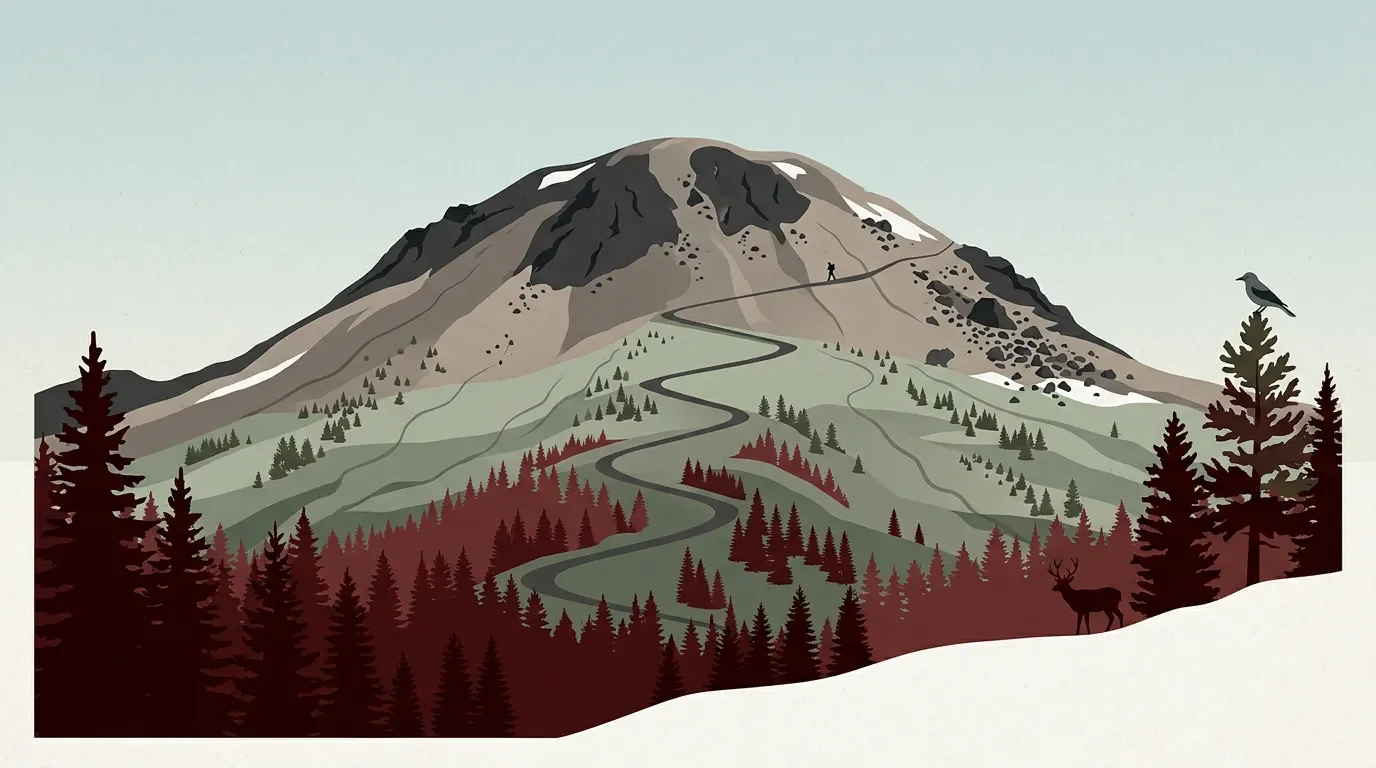
Lassen Peak asks for a different kind of mountain reading: the trail begins near treeline, then climbs almost immediately into cinders, whitebark pine, thin air, and the open shoulder of an active Cascade volcanic center. The summit is about 10,457 feet, and the standard day route compresses nearly 2,000 feet of gain into a 5-mile round trip, which is why this is less a casual viewpoint walk than a high-elevation volcano climb with a maintained trail underfoot. 1 2
Quick field read
| Field point | What to know |
|---|---|
| Mountain type | Lassen Peak is a plug-dome volcano and the high point of Lassen Volcanic National Park. The park sits at the southern end of the Cascade Range and contains all four primary volcano types. 1 |
| Elevation span | The park's ecological gradient runs from roughly 5,000 feet to Lassen Peak's 10,457-foot summit; the hike itself starts high, at about 8,500 feet. 1 2 |
| Standard route | Lassen Peak Trail is 5 miles round trip, usually 4-5 hours, with 1,957 feet of elevation gain on packed dirt and loose volcanic rock. 2 |
| Difficulty rating | Strenuous, 4/5. The distance is modest, but the grade, altitude, sun exposure, loose rock, lingering snow, and sudden weather shifts raise the effort. 2 |
| Best season | Plan for the clearest hiking window from mid-July through September in a typical year; NPS describes the general hiking season as May through October, but high trails can hold snow into June or July. 3 4 |
Elevation cross-section
Think of Lassen as a stacked ecological ramp. The whole park runs from lower conifer forest up to alpine fell fields, but the summit route starts high enough that hikers enter the story in the red-fir and subalpine chapters.
| Elevation band | Vegetation zone | Field cues |
|---|---|---|
| Below 6,500 ft | Mixed conifer forest | Ponderosa pine, Jeffrey pine, sugar pine, and white fir form the canopy; manzanita, gooseberry, ceanothus, iris, spotted coralroot, pyrola, violets, and lupine fill the understory. 5 |
| 6,500-8,500 ft | Red fir forest | Red fir, western white pine, mountain hemlock, and lodgepole pine dominate a cooler, less diverse forest; satin lupine, woolly mule's-ears, and pinemat manzanita are common plants. 5 |
| 8,000-10,000 ft | Subalpine forest and treeline | This is the main feel of the Lassen Peak approach: twisted mountain hemlock and whitebark pine, exposed ground, rock spirea, lupine, Indian paintbrush, and penstemon. 2 5 |
| Near and above treeline | Alpine fell fields, rock, cinders | Vegetation thins sharply. NPS notes gray-crowned rosy-finch, pika, and golden-mantled ground squirrel as species associated with the sparse above-treeline habitat. 1 |
The volcanic setting matters for the ecology. Lassen sits where the Cascades, Sierra Nevada, and Great Basin meet, and NPS attributes the park's biodiversity to that overlap plus elevation, moisture, substrate, temperature, and sun exposure. 1
Signature plants to watch for
On the lower and middle slopes, read the forest by conifer shape first. Ponderosa and Jeffrey pines mark the warmer mixed-conifer belt below 6,500 feet, while red fir, western white pine, lodgepole pine, and mountain hemlock take over higher up. 5
On the summit route, the most useful plant cue is the transition from trees to scattered survivors. Whitebark pine and mountain hemlock can grow into the subalpine zone, but above roughly 8,000 feet the exposed cinders and wind make the plant community thinner and tougher. Rock spirea, lupine, Indian paintbrush, and penstemon are the plants that make the upper mountain feel alive rather than barren. 5
For wildflower timing, expect the broader park bloom to follow snowmelt. NPS lists lower areas such as Butte Lake and the southwest park from June into July, Summit Lake from late June into August, and higher Lassen Peak areas later in the short summer season. 6
Resident wildlife
Lassen's wildlife list is bigger than the stark upper mountain suggests. NPS reports about 300 vertebrate species in the park, including roughly 57 mammal species and 216 bird species. 7
For a hiker, the best wildlife read is by elevation and habitat:
- Lower and middle forests: black bear, mule deer, marten, brown creeper, mountain chickadee, white-headed woodpecker, long-toed salamander, and many bat species are associated with lower-elevation forest habitats. 1
- Wet meadows and lake margins: Pacific tree frog, western terrestrial garter snake, Wilson's snipe, and mountain pocket gopher use the wetter valley-bottom habitats. 1
- Subalpine and summit country: Clark's nutcracker, deer mice, chipmunks, pika, gray-crowned rosy-finch, and golden-mantled ground squirrel are better matches for the high-elevation, open-rock setting. 1
The practical note: treat food discipline as part of the hike, not just a camping concern. NPS warns that bears and other wildlife may seek food from backpackers and even day hikers. 8
Best season and conditions
The cleanest field-guide answer is late July through September. NPS frames May through October as the general hiking season, but the park receives heavy winter snow, and trails can remain snow-covered into June or July. 3 Weather also divides sharply: winter conditions generally run November to May, summer conditions June through October, and higher Lassen Peak areas can keep winter-like snow well into June. 4
That matters on the actual trail. NPS describes Lassen Peak Trail as summer/fall hiking, with winter ascents requiring special equipment and training because the mountain is snow-covered and avalanche danger exists. 2 In the June 27, 2026 trail update, the park still listed Lassen Peak as partially snow-covered and advised boot spikes and trekking poles for long snow stretches. 9
October can be excellent if the weather holds, but it is not a soft-season guarantee. The park notes that cooler fall temperatures make for good hiking weather, while higher elevations can still see occasional snow showers in October. 4
Trail difficulty: why a short hike feels bigger
The Lassen Peak Trail is short enough to tempt underplanning. The numbers argue against that. A 5-mile round trip with nearly 2,000 feet of gain means the climb averages roughly 780 feet per uphill mile before accounting for switchbacks and terrain texture. NPS rates it strenuous, notes the exposed upper route, and warns that weather can change suddenly, with snow possible in any month. 2
Use this rating: strenuous day hike, 4/5; not technical in normal dry summer conditions, but high-consequence for weather, snow, altitude, and exposure. If the trail is dry, fit hikers with mountain experience can treat it as a hard half-day. If snow remains, the character changes quickly: traction, poles, navigation judgment, and the willingness to turn around become part of the route rather than optional extras. 2 9
The field-guide payoff is strong: in one climb, Lassen Peak shows a compressed southern Cascade story, from red-fir forest and subalpine pine to volcanic cinders, sparse summit life, and a still-active geologic system underfoot. 10
参考ソース
- 1Park Significance & Themes - Lassen Volcanic National Park
- 2Hike Lassen Peak
- 3Day Hiking - Lassen Volcanic National Park
- 4Weather - Lassen Volcanic National Park
- 5Plants - Lassen Volcanic National Park
- 6Wildflowers - Lassen Volcanic National Park
- 7Animals - Lassen Volcanic National Park
- 8Frequently Asked Questions - Lassen Volcanic National Park
- 9Trail Conditions, May to October - Lassen Volcanic National Park
- 10Lassen Volcanic Center - U.S. Geological Survey
関連コンテンツ
- ログインするとコメントできます。