Geopolitics Daily Brief - July 11, 2026
Five stories on U.S.-Iran talks and Hormuz shipping risk, Ukraine's long-range strike campaign, Shein's Hong Kong IPO approval, Taiwan Strait monitoring and tech-equity outflows, and U.S. export-control easing for UAE AI and defense buyers.

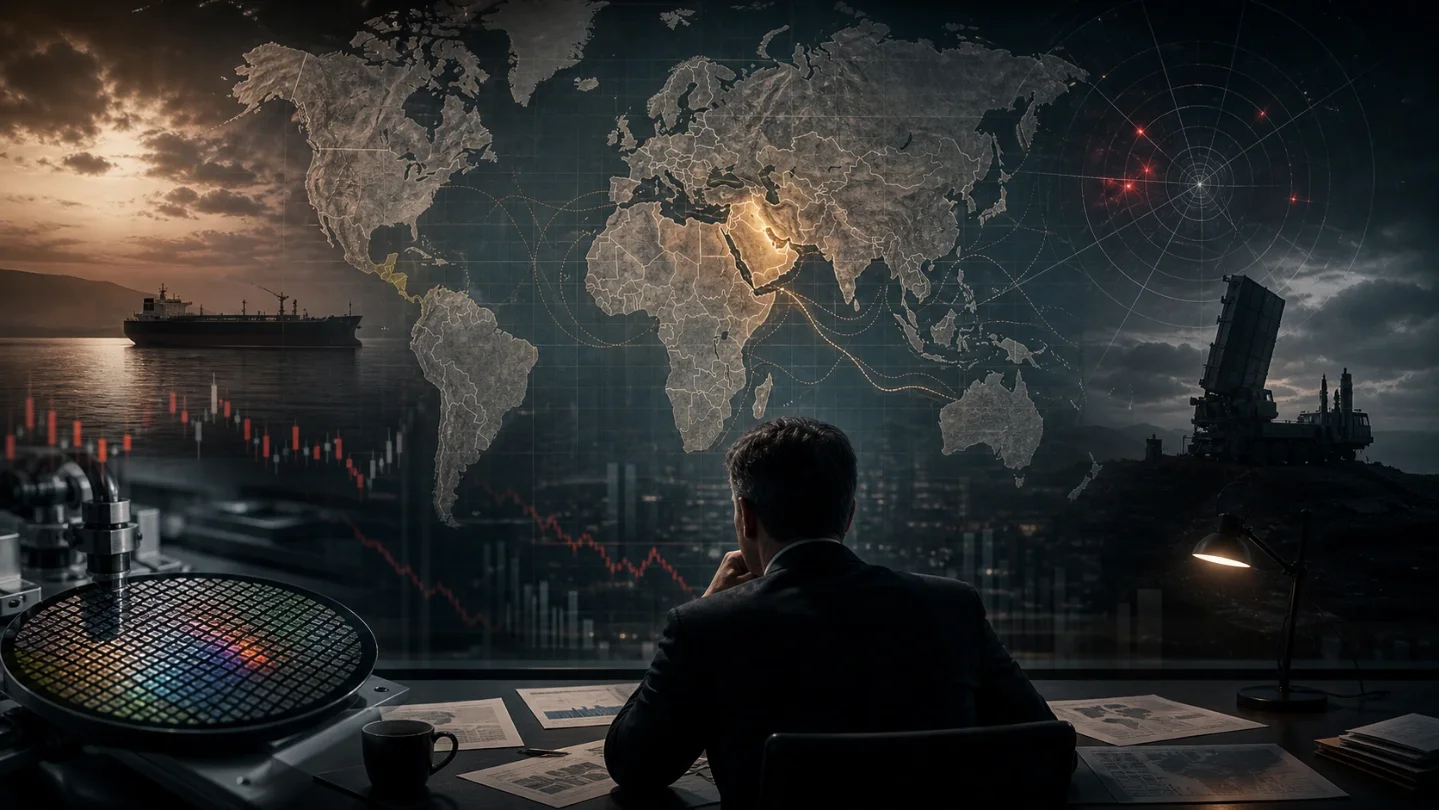
Hormuz is again the dominant commercial risk, but today's brief is not only an energy story. Washington also reopened an AI-chip path to the UAE, Beijing cleared Shein's Hong Kong listing, and Taiwan's latest military tally arrived against a backdrop of heavy tech-equity outflows.
1. U.S.-Iran talks continue, but the ceasefire is formally off
- President Donald Trump said the U.S. and Iran had agreed to continue talks, while also saying last month's ceasefire was over. 1
- The U.S. is demanding that Iran publicly stop attacks on ships in the Strait of Hormuz and keep all lanes open with no tolls; Reuters noted the waterway carried one-fifth of global oil supplies before the war. 1
- Iran's foreign minister Abbas Araqchi arrived in Oman for talks on safe passage through the strait, while Tehran disputed Trump's claim that it had requested talks with Washington. 1
Market / supply-chain impact. The immediate issue is not whether negotiations exist; it is whether shipowners can price Gulf passage without assuming another attack cycle. Reuters said renewed fighting had increased U.S. consumer fuel pressure and that crude posted its biggest weekly rise in eight weeks. 1 For buyers of crude, LNG and refined products, the working assumption should remain higher insurance, wider delivery buffers and more sensitivity to any statement from Oman, Qatar or Washington on Hormuz access.
2. Ukraine turns long-range strikes into a formal command
- President Volodymyr Zelenskiy said he had created a special "long-range impact" command inside Ukraine's armed forces to reduce Russia's ability to wage war. 2
- Ukraine said it struck the Ilsky refinery, the Ust-Luga oil refining complex, an oil terminal and an oil depot on Friday; Moscow banned diesel exports on Wednesday to protect domestic supply. 2
- Russian authorities said one person was killed in a drone attack on four vessels in Taganrog Bay, including a tanker carrying methanol, and said 178 Ukrainian drones were downed overnight. 3
Market / supply-chain impact. The pressure point is broadening from refineries to ports, tankers and grain routes. Reuters reported that domestic gasoline output is down to around 65% of capacity, while Ukraine's drone commander said 10 tankers were hit in the Sea of Azov and almost 50 fuel vessels had been damaged in five days. 2 Russia also temporarily stopped shipping through a Don River-Sea of Azov channel that industry sources said could affect almost one-quarter of Russian wheat exports in the area. 2
3. Beijing clears Shein's Hong Kong IPO after failed Western routes
- China's securities regulator approved Shein's long-delayed Hong Kong IPO, clearing the way for a listing after failed attempts in New York and London. 4
- Shein may target a $40 billion to $50 billion valuation and sell up to 8% of its shares, after being valued as high as $100 billion in 2022 and $66 billion in its May 2023 fundraising round. 4
- Reuters reported that the company still relies mostly on third-party suppliers in China and remains exposed to U.S. and European efforts to impose duties on low-value imports. 4
Market / supply-chain impact. The listing route shows how China-linked consumer supply chains are being pulled back toward Hong Kong when U.S. and European venues carry political or regulatory friction. The commercial read-through is two-sided: Hong Kong gets a high-profile equity-market win, while Shein investors still have to price lower valuation, tariff exposure and scrutiny over labor, data and parcel-import rules. For apparel suppliers, the IPO does not remove the core risk: a business model built on China-made low-cost shipments is still exposed to customs-policy changes in its main consumer markets.
4. Taiwan's daily military tally eases, but tech-equity risk stays visible
- Taiwan's Ministry of National Defense said one PLA Navy vessel and one Chinese official ship were detected around Taiwan up to 6 a.m. local time on July 11, and that no PLA aircraft were detected in that period. 5
- One day earlier, Radio Taiwan International, citing the Defense Ministry, reported two PLA aircraft, five PLA Navy vessels and three Chinese official ships around Taiwan between 6 a.m. Thursday and 6 a.m. Friday, July 10. 6
- Reuters reported that Taiwan equities saw $18.3 billion in foreign-investor outflows in June, contributing to $46.1 billion of emerging-market stock outflows. 7
Market / supply-chain impact. The military picture in the latest daily count is quieter than the high-sortie days earlier this month, so the immediate signal is not a new escalation. The market signal is still relevant. The Institute of International Finance report cited by Reuters linked equity selling to higher global discount rates, China uncertainty, weaker earnings confidence and sensitivity to tech and energy positioning. 7 For semiconductor buyers and portfolio managers, Taiwan risk is therefore being priced through capital flows even on days when the military tally is relatively low.
5. U.S. loosens UAE export controls for AI chips and military items
- The U.S. loosened export controls on the United Arab Emirates, making it easier to export Nvidia AI chips, military equipment, commercial satellites and spacecraft. 8
- The UAE government and approved companies can now access advanced computing items license-free; Reuters listed G42, Core42 and U.S. companies operating in the UAE, including Amazon, Apple and xAI, among the beneficiaries. 8
- The UAE is the only country in the new grouping that is not a member of multilateral export-control regimes, while Israel and Saudi Arabia are not in the group. 8
Market / supply-chain impact. This is a Gulf AI-capacity story and a China-control story at the same time. U.S. cloud and chip suppliers get a clearer route to approved UAE customers, including data-center and defense-linked buyers. The unresolved risk is diversion. Reuters reported that earlier licenses for companies such as G42 were contentious partly because of concern that the companies could serve Chinese customers, and Senator Elizabeth Warren criticized the new access despite reported concerns over sensitive-technology diversion. 8
参考ソース
- 1Trump says US, Iran agree to continue talks but ceasefire over
- 2Ukraine creates 'long-range' command to step up strikes on Russia
- 3One killed in drone attack on vessels in Taganrog Bay, Russian authorities say
- 4Shein finally wins China's approval for Hong Kong IPO, in third attempt to go public
- 5Taiwan Ministry of National Defense daily activity post
- 610 Chinese military aircraft and vessels active in Taiwan Strait as Taiwan announces sea warning
- 7South Korea, Taiwan lead $46 billion emerging market equity exodus in June
- 8US makes it easier to export Nvidia AI chips and military equipment to the UAE
関連コンテンツ
- ログインするとコメントできます。