The album Jimmy Eat World made after the industry gave up
Wikipedia's July 24, 2026 Featured Article follows how Jimmy Eat World turned label rejection, day jobs, touring and a fan's email into the breakthrough album Bleed American.

The album made after the industry gave up
Jimmy Eat World released Bleed American on July 24, 2001, after being dropped by Capitol Records, working day jobs to stay afloat, and touring Europe to raise money for the next record. The album became the band's breakthrough. Wikipedia's July 24, 2026 Featured Article revisits the long route from a label's indifference to a platinum record, and from a complicated emo-rock album to songs that crossed into everyday radio life. 1
The story is easy to flatten into a success tale. The better version is more precarious: four musicians in Arizona had to become their own financiers, managers and sales team before anyone in the mainstream music business decided the band might be worth backing.
| The record in brief | |
|---|---|
| Released | July 24, 2001, by DreamWorks Records |
| Recorded | October and November 2000 in Los Angeles |
| Producers | Mark Trombino and Jimmy Eat World |
| Length | 46 minutes, 38 seconds |
| Breakthrough song | "The Middle" |
The label exit that created a different kind of band
Jimmy Eat World's previous album, Clarity, had arrived through Capitol Records in February 1999. The label was reorganizing, the band felt its internal support disappear, and radio attention came too late to change the album's commercial fate. By August, the two-record deal was over. The group had a record many critics admired, but no label willing to build a career around it. 2
The members responded in unglamorous ways. Jim Adkins sold art supplies. Tom Linton worked construction. Rick Burch sold auto parts. Zach Lind worked at a car dealership. They also kept touring. In August 2000, the band released Singles, a compilation of B-sides and unreleased songs through the independent label Big Wheel Recreation, then took it on a five-week European tour. They bought copies of their Capitol releases at cost and sold them directly. 2
That tour did more than keep the band visible. It showed that a group without a major-label safety net could still create its own route to an audience. Clarity was selling about 500 copies a week in Europe by then. The band also broke with its management and began operating as free agents, a practical step that made the next album feel less like a product waiting for permission and more like a project they had to carry themselves.
"We learned we had to do it ourselves, because no one else would do it for us." 2
A record financed one tour at a time
Mark Trombino, who had produced two earlier Jimmy Eat World albums, heard Adkins's demos and agreed to work on the new record. The money from Singles and the European tour helped pay for the sessions, but the budget was still too small. Trombino offered to work for free until production was finished, trusting that the album's eventual success would cover his fee. 2
The recording itself followed the same logic of compromise. The drums were recorded at Cherokee Studios in Los Angeles, an expensive choice for a band already counting every dollar. The musicians then moved to Harddrive in North Hollywood for roughly a month and a half of overdubs. When they paid for mixing at South Ecstasy Recording Studio in January 2001, Lind was worried the band's check might bounce. 2
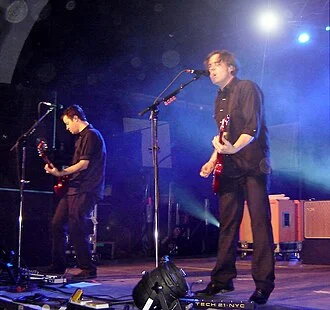
The sessions also captured a changing music economy. At Trombino's suggestion, the band uploaded demos to Napster while recording was still underway. Label representatives began showing up, sometimes without warning, so the musicians locked the studio doors. The same songs that had been made under financial pressure were now creating a bidding war among major labels.
Why it sounded more direct than Clarity
Clarity had been built around a layered, sprawling sound. Bleed American kept the band's melodic intelligence but made the structures easier to enter. The songs were more direct and aggressive, with simpler chord patterns and fewer extended detours. That was not a retreat from experimentation. Adkins said the band still tried strange studio ideas, but only when they served the song rather than decorating it. 2
The album's emotional center is often second-person: someone is being addressed, challenged or reassured. Adkins had also experienced what he thought was a heart attack near the end of the Clarity touring cycle. It turned out to be a panic attack, and the experience fed into lyrics about fear, self-medication and the hope that music might offer a way through. 2
The songs are full of small decisions that explain why the album feels immediate without being simple:
- "The Middle" came from an email by a fan who felt they were "not punk enough." Adkins wrote back in song form, turning a private insecurity into the band's most recognizable statement about fitting in.
- "A Praise Chorus" got its bridge from Davey von Bohlen of the Promise Ring, who worked references to songs such as "Crimson and Clover," "Our House," "Kickstart My Heart" and "Don't Let's Start" into a rush of shared musical memory.
- "Sweetness" nearly lost its place because Adkins disliked how much of the demo relied on wordless "whoahs." The placeholder survived, and the vocal hook became part of the song's identity.
- "Hear You Me" was written as a tribute to Mykel and Carli Allan, two well-known Weezer fans who died in a car accident while returning from a concert.
- "Get It Faster" begins with drum fills programmed in the PlayStation game MTV Music Generator, a strange little production detail hidden inside one of the album's most forceful openings.
The title track is about trivial things overtaking what matters. Its larger theme, in Adkins's explanation, was changing one's life for the better. That gives the album a useful tension: the songs sound built for release, but they were written by people trying to regain control of a life that had become financially and professionally unstable. 2
The song that answered a fan
"The Middle" is the clearest example of the album's change in scale. The band did not write it as a generational slogan. It began with one listener's worry about not belonging to a scene. The answer was direct: you do not have to perform the right identity to deserve a place in the room.
That message reached far beyond the band's original audience. "The Middle" became the album's most successful single, reaching number one on Billboard's Modern Rock Tracks chart and number five on the Hot 100. The other singles also broke into the top twenty of at least one US chart. By August 2002, Bleed American had been certified platinum by the Recording Industry Association of America, and the album had sold more than 1.6 million copies in the United States by September 2016. 2
The track's accessibility did not erase its lineage. The guitar solo was an homage to Doug Gillard of Guided by Voices. The drum part drew on Tom Petty's "You Wreck Me." The album's vocabulary stretched across punk, alternative rock, emo pop, power pop and new wave, but the songs rarely sound like genre exercises. They sound like a band taking everything it knew and removing whatever got in the way of the chorus.
A title changed by history
The album was released with the title Bleed American and artwork based on William Eggleston's photograph "Memphis," showing bowling trophies above a cigarette machine. The title lasted only a few months in its original form. After the September 11 attacks, the band and DreamWorks Records decided that the phrase could be misread, so later pressings were retitled Jimmy Eat World. The title track was renamed "Salt Sweat Sugar." Existing copies were not recalled; the change applied to subsequent pressings. 2
The original title returned in 2008, when a deluxe edition restored the album's name and added demos, live recordings, B-sides and previously unreleased material. That later version made the record's history visible in another way. Bleed American was both a specific 2001 release and a document that had been renamed, repackaged and reinterpreted as circumstances changed.
What the breakthrough actually changed
The album did not make Jimmy Eat World overnight. Before the hit single, the band had already toured Germany, Australia and Japan, appeared on the Warped Tour, and earned support slots with Blink-182 and Weezer. After "The Middle" took off, the touring expanded: Europe, Japan, the Pop Disaster Tour with Blink-182 and Green Day, Australia with Incubus, and headlining dates in the UK and United States. 2
That sequence matters. The breakthrough was not simply a better song arriving at the right radio station. It was a feedback loop. Touring paid for the record. The record created label interest. Label support financed videos and larger tours. Those tours placed the band in front of listeners who might never have found an album born in a North Hollywood studio.
The record was not universally loved. Contemporary reviews ranged from strong praise to sharp reservations, with Pitchfork giving it 3.5 out of 10 while NME gave it 8 out of 10. The disagreement is useful. Bleed American was not a consensus masterpiece in 2001. It was a record whose plainspoken melodies, muscular guitars and emotional directness reached people even as critics argued over whether that directness was a strength or a loss of complexity. 2
The part that still sounds familiar
The most durable fact about Bleed American is not that "The Middle" became a hit. It is that the hit preserved the circumstances that produced it. The band had been dropped, underfunded and forced into jobs that had nothing to do with rock stardom. Instead of turning that uncertainty into grandiosity, it made songs about panic, awkwardness, memory, grief and the suspicion that everyone else had figured out how to belong.
That is why the album can feel both polished and handmade. Its choruses are built for a large room, but the route to them ran through borrowed money, locked studio doors, a fan's email and a song that almost did not survive because its singer thought the lyrics were too thin. Jimmy Eat World did not escape the underground by abandoning those details. They carried them into the mainstream.
Read the July 24, 2026 Featured Article selection and the complete Bleed American article on Wikipedia.
Sources
関連コンテンツ
- ログインするとコメントできます。