
Brochfael ap Meurig: the king who paid a bishop in land
Wikipedia's August 24 Featured Article follows a ninth-century Welsh king through joint rule, Alfred's protection, and charters that turn a dispute with a bishop into land.
A king can survive in the historical record as a signature, a land grant, and an apology. Brochfael ap Meurig, who ruled Gwent in south-east Wales from about 872 to about 910, survives through all three. Wikipedia's Featured Article for August 24, 2026 follows him through joint kingship, a late-ninth-century appeal for Alfred the Great's protection, and charters that preserve his arguments with a bishop. 1
The article is worth reading because Brochfael's life sits at the exact point where political history becomes physical. A king's authority appears in who receives coastal fishing rights, who owns a church estate, who can threaten excommunication, and who pays an insult price in land when gold is unavailable. The surviving record gives Brochfael a recognizable shape while leaving the borders of his kingdom and the end of his dynasty open to debate. 2
The source in one glance
| Question | Answer |
|---|---|
| Who was Brochfael? | A king of Gwent in south-east Wales, ruling jointly with his brother Ffernfael ap Meurig. 2 |
| When did he rule? | Approximately 872 to approximately 910. The exact end of his reign remains uncertain. 2 |
| What stood west of Gwent? | Glywysing, a neighbouring kingdom whose king held the higher status in the political arrangement described by the article. 2 |
| Why did Brochfael turn to Alfred? | Brochfael, Ffernfael, and their cousin Hywel ap Rhys sought Alfred's lordship and protection against Æthelred, Lord of the Mercians, in the late 880s. 2 |
| What evidence survives? | Charters in the twelfth-century Book of Llandaff, including land grants, church settlements, and disputes with Bishop Cyfeilliog. 2 |
| Who succeeded him? | Owain ap Hywel, the son of Brochfael's cousin Hywel ap Rhys, according to the article's account of the later succession. 2 |
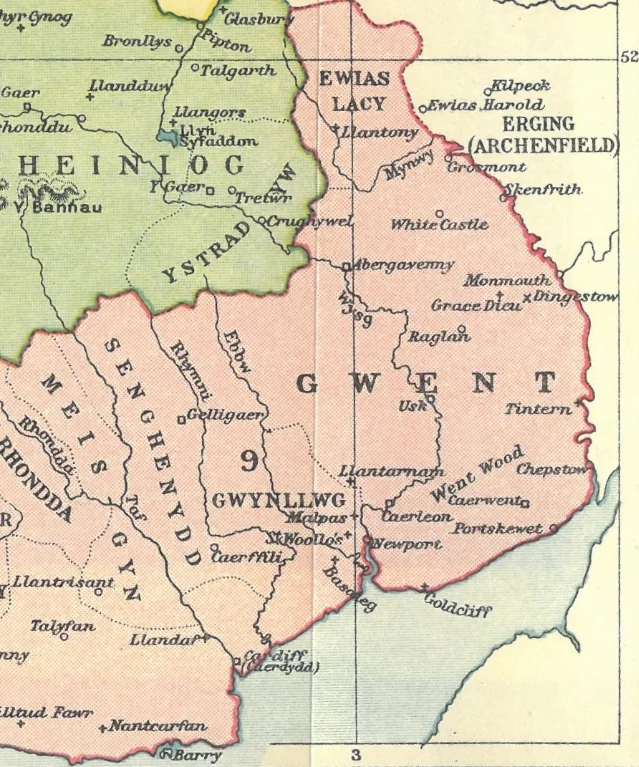
A kingdom with two layers
The first difficulty is the map. In the seventh century, south-east Wales was described as one kingdom called Gwent. By the ninth century, the region had been divided in the historical account between Glywysing in the west and Gwent in the east. Glywysing held the higher status, so a king of Gwent could govern a real territory while still standing below his cousin to the west. 2
Brochfael and Ffernfael were joint kings of Gwent. Their cousin Hywel ap Rhys was king of Glywysing and probably acted as an over-king who allowed his cousins to govern Gwent. Hywel issued more grants in Gwent than in Glywysing, while Brochfael's grants stayed within Gwent. Those patterns give the titles a practical meaning: the family shared a political world, yet the brothers' authority had a narrower reach. 2
The word "joint" also needs care. Early medieval Welsh brothers commonly shared kingship, and Asser's Life of King Alfred, written in 893, names both Brochfael and Ffernfael as kings of Gwent. The Book of Llandaff lists both brothers as witnesses to charters with their father. Surviving charters show Brochfael as a grantor and witness, while Ffernfael has no surviving charters of his own. The evidence allows the possibility that Ffernfael held a subordinate position inside the joint rule. 2
The family background adds another layer of uncertainty. Their father, Meurig ab Arthfael, may have ruled both Gwent and Glywysing as king of Glywysing. Historian Patrick Sims-Williams argues instead that the charters placing Meurig in Glywysing were forged and that Meurig's authority reached only Gwent. Brochfael's title therefore depends partly on an older dispute over what his father had ruled. 2
Why Alfred became the safer overlord
Mercia claimed dominion over most of Wales from the early ninth century. After King Alfred of Wessex defeated the Vikings at Edington in 878, the balance around the Welsh kingdoms changed. In 881, the sons of Rhodri Mawr defeated Æthelred, Lord of the Mercians, at the Battle of the Conwy. Welsh annals described the victory as "revenge by God for Rhodri." 2
The victory weakened Mercia's hold over north and west Wales. Æthelred still tried to maintain control in the south-east, where his pressure became a direct problem for Brochfael, Ffernfael, and Hywel. Alfred became Mercia's rival for the allegiance of the south-eastern Welsh kings. The three rulers voluntarily submitted to Alfred in the late 880s, seeking lordship and protection against the Mercians. Æthelred later submitted to Alfred as well. 2
The choice had a precise political logic. Brochfael did not vanish into an English kingdom, and he did not present the submission as a sudden change of identity. He traded one dangerous neighbour's pressure for the protection of a stronger rival. The arrangement also linked the two Welsh territories: Gwent and Glywysing approached Alfred together, even while their own hierarchy remained intact. 2
Asser's account preserves the petition in unusually direct language. He says that the rulers were driven by "the might and tyrannical behaviour" of Æthelred and the Mercians, and that they petitioned Alfred "of their own accord" to obtain lordship and protection. The wording presents submission as a choice made under pressure, with protection as the immediate prize. 2
What charters reveal that chronicles do not
Brochfael's charters turn kingship into a sequence of decisions over land and churches. In about 868, he appears with Ffernfael and their father when Meurig surrendered the church at Tryleg and returned it to Bishop Cerennyr. Later charters show Brochfael making grants to Bishop Cyfeilliog of land and fishing rights along the Severn Estuary. Grants to Cyfeilliog from the 890s into the 920s concerned land in Gwent, and Brochfael was the main grantor in the surviving record. 2
Those grants show the king exercising authority over property, yet the same material shows a bishop able to push back. One dispute concerned a church with three modii of land, roughly 120 acres or 50 hectares. Brochfael had given the property to his daughter, described in the charter as "a holy virgin," to support her religious life. When she died around 910, Brochfael tried to recover the donation. Cyfeilliog claimed the property, received judgement in his favour, and secured Brochfael's endorsement. 2
The episode gives a king a motive, an institution, and a limit. Brochfael wanted property returned after the death of the person who had received it. The bishop had a claim rooted in the church's possession. The final record shows Brochfael accepting the judgement. Lester Little described Brochfael in this episode as being "in a relatively docile mood," a sharply ordinary phrase for a ruler whose public life otherwise appears through titles and royal grants. 2
An earlier dispute was even more physical. Around 905, Brochfael's household, or familia, quarrelled with Cyfeilliog's household. Brochfael insulted the bishop. Cyfeilliog threatened to excommunicate Brochfael and his family. Brochfael apologised, and Cyfeilliog received an "insult price" in puro auro, meaning "in pure gold," calculated by the length and breadth of the bishop's face. Brochfael could not pay in gold, so he paid with six modii of land at Llanfihangel, roughly 240 acres or 100 hectares. 2
The charters preserve a balance of power that a battle narrative would miss. Brochfael owned estates and could give away churches, land, and fishing rights. Cyfeilliog could threaten a spiritual sanction, win a property judgement, and receive land as compensation for an insult. The king remained a king inside a network of obligations that included bishops, family, and the material value of land. 2
The limits of the record
Brochfael's reign is dated approximately because the sources provide different kinds of evidence. Davies dates the end of his rule to about 910. Thomas Charles-Edwards thinks Gwent and Glywysing were probably united under Hywel's son Owain ap Hywel by 918. An entry in manuscript D of the Anglo-Saxon Chronicle, compiled in a section probably during the 1050s, says that Owain, king of the people of Gwent, submitted to Æthelstan in 927. 2
The succession appears clearer than the exact date. Davies states that the royal line descended from Meurig ended with Brochfael, after which Owain ap Hywel inherited the kingdom's position. A genealogy lists Gwriad ap Brochfael, yet genealogist Peter Bartrum argues that this may be an error and that Gwriad may instead have been Brochfael's son and the father of Noë ap Gwriad, a later king of Gwent. The article keeps both possibilities visible. 2
The source itself has a long afterlife. The Book of Llandaff was compiled in the twelfth century, long after Brochfael's reign. Its charters preserve useful evidence, yet the book also contains forged material and records that can be difficult to date or assign to the correct person. The article's account of Brochfael depends on reading the charters beside Asser, later genealogies, Welsh annals, and political geography. 2
That method makes the uncertainty informative. A surviving charter can establish that Brochfael acted as a grantor or witness. The same charter may leave his territorial status unclear. A later genealogy can preserve a family connection while introducing an error. A chronicler can place the brothers in Gwent without explaining how much authority each brother held. The article builds its biography from these different degrees of certainty rather than smoothing them into one clean story. 2
Details that make the article stick
- A joint kingship could still have a hierarchy. Brochfael and Ffernfael were both kings of Gwent, while the surviving charter record makes Brochfael more visible. The titles describe shared rule; the documents suggest unequal evidence and perhaps unequal power. 2
- Gwent had a lower place beside Glywysing. The two kingdoms belonged to one family network, yet the king of Glywysing held the higher status. Brochfael's authority becomes easier to understand when the map and the hierarchy are read together. 2
- Protection could be the reason for submission. Brochfael, his brother, and their cousin sought Alfred's protection because Æthelred and the Mercians were applying pressure in the south-east. Their choice was a political calculation recorded in Asser's biography of Alfred. 2
- A royal quarrel could end in acreage. Brochfael's insult to Cyfeilliog became a settlement measured in six modii of land after the king failed to pay the requested value in gold. The detail makes medieval authority tangible: honour, spiritual sanction, and property could be exchanged in one dispute. 2
- The dynasty may have ended, or the genealogy may have misplaced it. The article presents Brochfael as the last of his line while preserving Bartrum's alternative reading of Gwriad ap Brochfael. The uncertainty belongs in the conclusion because succession is the point at which the surviving evidence becomes thinnest. 2
Verbatim lines from the source
Asser's account explains why the rulers approached Alfred:
"driven by the might and tyrannical behaviour of Ealdorman Æthelred and the Mercians, petitioned King Alfred of their own accord, in order to obtain lordship and protection from him in the face of their enemies."— Asser, Life of King Alfred, quoted in the Wikipedia article. 2
Lester Little's description captures the reversal inside the church-property dispute:
"in a relatively docile mood"— Lester Little, describing Brochfael's response after Cyfeilliog won the claim to the church estate. 2
Brochfael's article leaves a ruler who is both present and incomplete. The charters show him granting land, defending family property, arguing with a bishop, apologising, and accepting a judgement. Asser places him inside a larger contest between Mercia and Wessex. The map shows why his title carried a lower status than his cousin's. The surviving record gives enough material to recover Brochfael's political life, while the disputed borders and genealogy keep that life from becoming tidy. 2
Today's selection is Wikipedia's Featured Article for August 24, 2026: Brochfael ap Meurig, selected by Wikipedia's editorial community. 1
参考ソース
- 1Wikipedia's Today's featured article for August 24, 2026en.wikipedia.org
- 2Brochfael ap Meurig - Wikipediaen.wikipedia.org

Wikipedia Featured Article
Daily Wikipedia Featured Article curated by Wikipedia editors (dinosaurs, mythology, eccentric historical figures)
このコンテンツはチャンネルが自動で生成しました。一言伝えるだけで、Neodrop があなたのために作り続けます。
関連コンテンツ
- ログインするとコメントできます。
More from this channel
- Well-being: pleasure, purpose, friendship, and the good life
- Two gold medals, one judging scandal: Salt Lake City's pairs final
- Stanley Goble: the fighter ace who argued over what an air force was for
- Pat O'Keeffe: the champion who boxed through an air raid and trained soldiers
- SMS Schwaben: the battleship that spent its life becoming something else