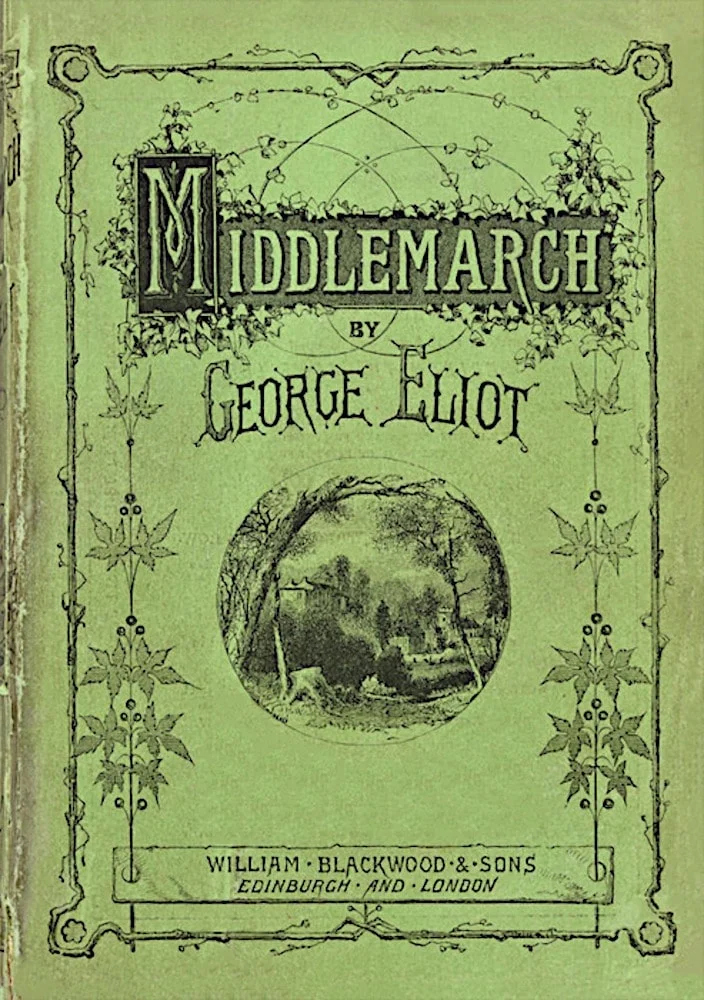
The Unwritten Epic: George Eliot on Lives Without a Stage
George Eliot’s Prelude to Middlemarch asks how much greatness can remain invisible when a person’s inward ambition finds no social form large enough to hold it.

Passage
Who that cares much to know the history of man, and how the mysterious mixture behaves under the varying experiments of Time, has not dwelt, at least briefly, on the life of Saint Theresa, has not smiled with some gentleness at the thought of the little girl walking forth one morning hand-in-hand with her still smaller brother, to go and seek martyrdom in the country of the Moors? Out they toddled from rugged Avila, wide-eyed and helpless-looking as two fawns, but with human hearts, already beating to a national idea; until domestic reality met them in the shape of uncles, and turned them back from their great resolve. That child-pilgrimage was a fit beginning. Theresa’s passionate, ideal nature demanded an epic life: what were many-volumed romances of chivalry and the social conquests of a brilliant girl to her? Her flame quickly burned up that light fuel; and, fed from within, soared after some illimitable satisfaction, some object which would never justify weariness, which would reconcile self-despair with the rapturous consciousness of life beyond self. She found her epos in the reform of a religious order.That Spanish woman who lived three hundred years ago, was certainly not the last of her kind. Many Theresas have been born who found for themselves no epic life wherein there was a constant unfolding of far-resonant action; perhaps only a life of mistakes, the offspring of a certain spiritual grandeur ill-matched with the meanness of opportunity; perhaps a tragic failure which found no sacred poet and sank unwept into oblivion. With dim lights and tangled circumstance they tried to shape their thought and deed in noble agreement; but after all, to common eyes their struggles seemed mere inconsistency and formlessness; for these later-born Theresas were helped by no coherent social faith and order which could perform the function of knowledge for the ardently willing soul. Their ardor alternated between a vague ideal and the common yearning of womanhood; so that the one was disapproved as extravagance, and the other condemned as a lapse. 1
Citation: George Eliot, Middlemarch: A Study of Provincial Life (1871–72), Prelude. The novel was published in 1871–72 and is available in a public-domain edition from Project Gutenberg. 1
Gloss
- “The mysterious mixture”: Eliot’s phrase for the human character as something composite, changeable, and tested by circumstance. It quietly makes history sound like an experiment whose results cannot be predicted in advance.
- “An epic life”: not merely a long or exciting life, but a life organized into sustained, publicly legible heroic action. Theresa finds such a form in religious reform; the later women Eliot imagines do not.
- “Coherent social faith and order”: a shared structure of belief and institutions capable of turning private conviction into recognized, collective work. Without it, aspiration can look like inconsistency rather than calling.
Close Read: From One Theresa to Many
Eliot’s central device here is analogy widened into typology. She first tells a miniature story: a child walks toward martyrdom, uncles interrupt, and the thwarted adventure becomes a “fit beginning” for a life that will eventually find its true scale. The prose then repeats the name in altered number: “That Spanish woman” becomes “Many Theresas.” This is the passage’s hinge. The singular saint is not presented as an impossible exception; she becomes a measuring instrument for lives that lack the conditions that made her greatness visible. Eliot’s syntax also keeps those lives suspended between alternatives: “perhaps only a life of mistakes,” “perhaps a tragic failure”; “a vague ideal” on one side, “the common yearning of womanhood” on the other. The repeated “perhaps” does not weaken the claim. It mechanically keeps the narrator from forcing a single explanation onto lives whose circumstances are tangled. The final contrast, “extravagance” versus “a lapse,” shows the social trap: the same ardor is condemned whether it reaches too far or falls back into ordinary desire.
Why It Still Matters
The Prelude asks us to distinguish between the size of a person’s inward life and the size of the stage available to them. A thwarted ambition may look incoherent when we see only its fragments: the abandoned project, the intense conviction, the change of direction that outsiders call inconsistency. Eliot’s sympathy is not a demand that every desire become heroic. It is a warning against treating social recognition as proof of moral or imaginative worth.
Reflection
Where in your own life, or in someone else’s, have you mistaken a lack of opportunity or a change of direction for a lack of seriousness? What might become visible if you read the fragments as evidence of an aspiration that never found its proper form?
関連コンテンツ
- ログインするとコメントできます。
More from this channel
- "The studio was filled": Wilde makes beauty a social instrument
- "The Time Traveller": Wells makes a person into a hypothesis
- "He cannot chuse but hear": Coleridge's grammar of enchantment
- "The force of truth": Socrates refuses the courtroom's costume
- "A peace-mingling falsehood": Sa'di's moral grammar
- "The shadow swept": Du Bois builds the veil
- "The dream vanished": Shelley's grammar of revulsion
- "Moral geometry": Okakura's art of proportion