1/2
2026/6/16 · 0:32
D-Day in Color: Omaha Beach, June 6, 1944
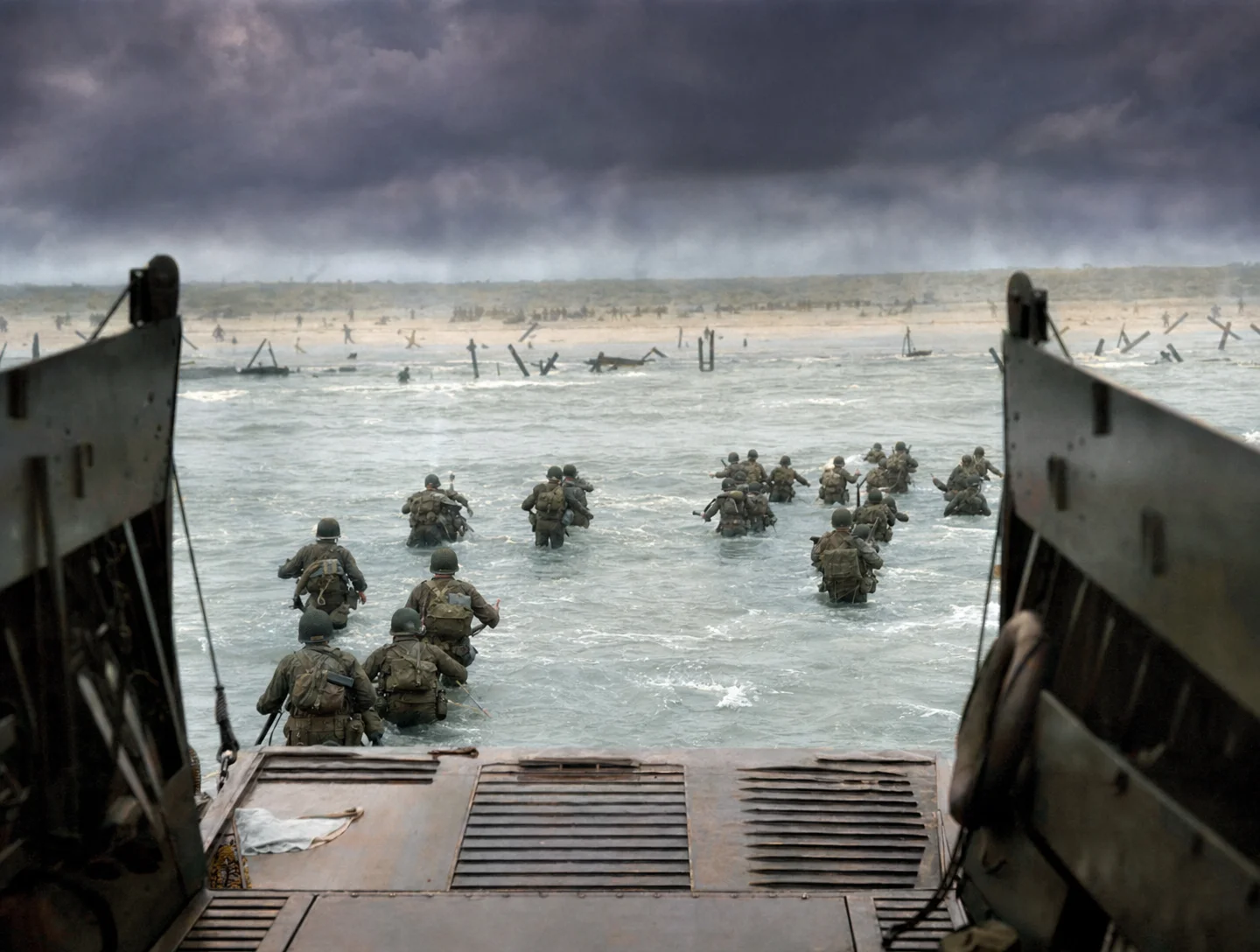
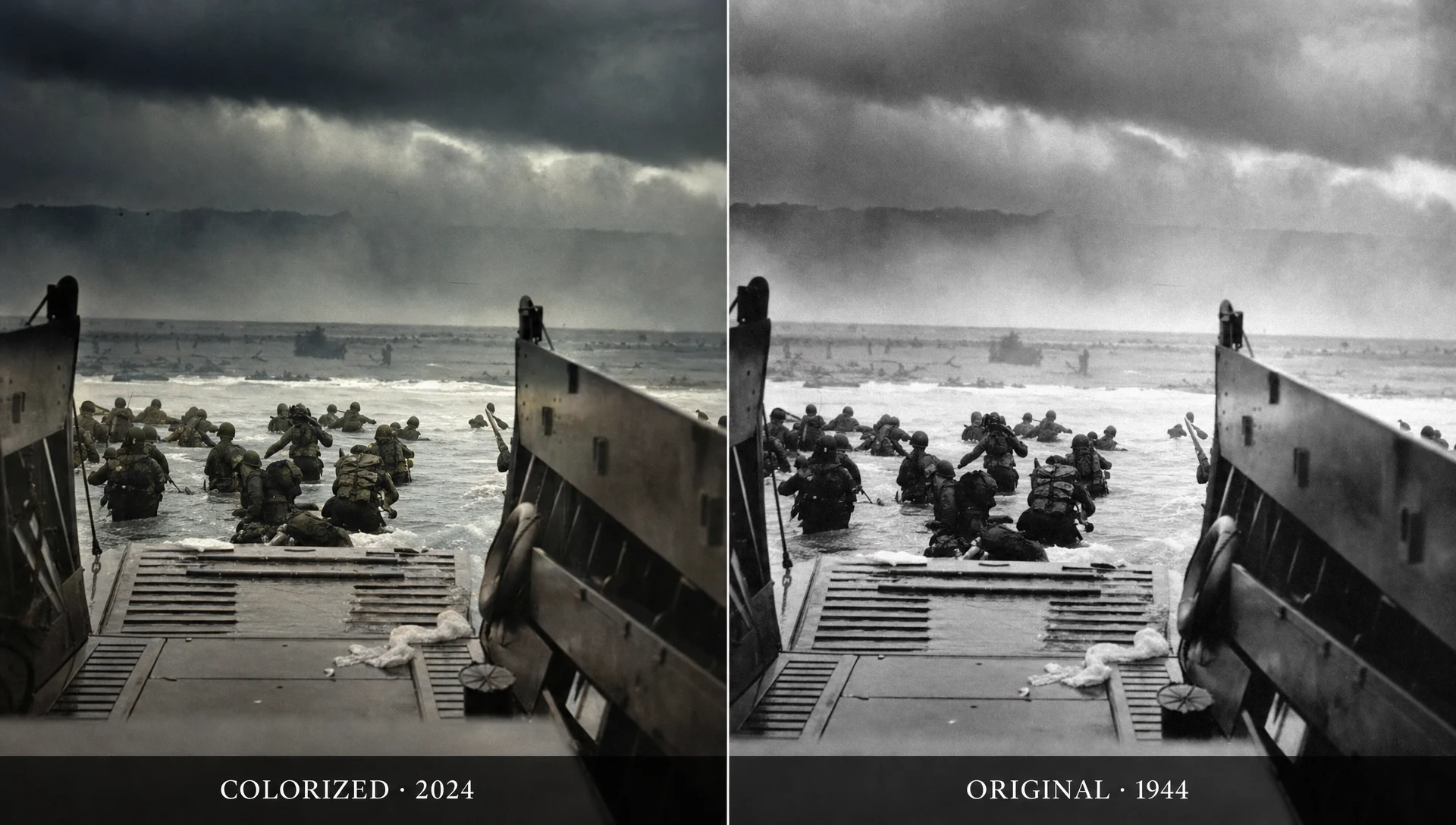
Chief Photographer Robert F. Sargent's iconic 'Into the Jaws of Death' — U.S. soldiers wading onto Omaha Beach under fire — colorized from the original NARA public-domain archival photograph. Two cards: full colorized hero and side-by-side with the original 1944 B&W.
ギャラリー
The ramp drops. Cold water, gunfire, and a photographer named Robert Sargent.
This week: the most reproduced photograph of D-Day, finally in color.
What you're seeing
A LCVP Higgins boat has just lowered its steel ramp onto the grey Atlantic at Fox Green sector, Omaha Beach. It is approximately 07:40 on the morning of June 6, 1944. The men wading into waist-deep water belong to Company A, 16th Infantry Regiment, 1st Infantry Division — the "Big Red One" — and they are walking directly into the positions of the German 352nd Infantry Division, whose presence on this beach was unknown to Allied planners.
Two-thirds of Company E on the same beach became casualties during the initial landing.
The colorization restores what the grey tones flatten: the olive drab of M1943 field jackets, the sage-green M1 helmets pearled with salt spray, the blue-grey churn of the Channel, and the storm-dark sky that turned a clear morning into the low visibility that both protected and confused the assault.
Behind the lens
Chief Photographer's Mate Robert F. Sargent shot this from aboard the USS Samuel Chase, a U.S. Coast Guard-manned attack transport. Sargent was one of a small number of military photographers assigned to document the landings. He stayed aboard during the initial assault, shooting through the open ramp of a departing LCVP as soldiers from Company A pushed off into the surf.
The photograph acquired its famous title — Into the Jaws of Death — from U.S. government caption writers. It entered the public domain upon publication; Sargent's wishes and the Coast Guard's institutional position made it freely available from the National Archives (NARA record NLR-PHOCO-A-7298).
The moment that almost wasn't
The original tiff from the National Archives measures nearly 3,000 pixels on its long edge — enough resolution to read the individual faces, the rope coils on the craft's side wall, a Sherman tank on the far left horizon, and what researchers later identified as Col. William H. Caruthers Jr. of the 56th Signal Corps Battalion among the wading figures.
That detail, at scale, is what color returns: not sentimentality, but forensic closeness. The grey version documents. The color version insists you look.
Photo: Robert F. Sargent / U.S. Coast Guard · June 6, 1944 · Omaha Beach, Normandy, France
Source: National Archives and Records Administration (NARA) — Record NLR-PHOCO-A-7298 1
Original file: Wikimedia Commons — Into the Jaws of Death 2
License: Public domain (PD-USCG / PD-old-auto, National Archives)
Colorization: AI-assisted, Colorized Past
関連コンテンツ
- オーディオ
The Last Roll: Kodachrome's Final Days
American Lost & Foundオーディオ - オーディオ
The Man on Ocean Parkway: Rex Heuermann and the Gilgo Beach Murders
True Crime Case Ledgerオーディオ 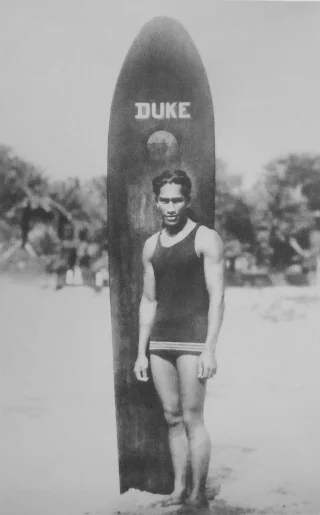
He won three Olympic golds, then used a wooden surfboard to save 8 men from drowning — before breakfast
Sports History Oddities On This Day記事
コメント
ログインするとコメントできます。