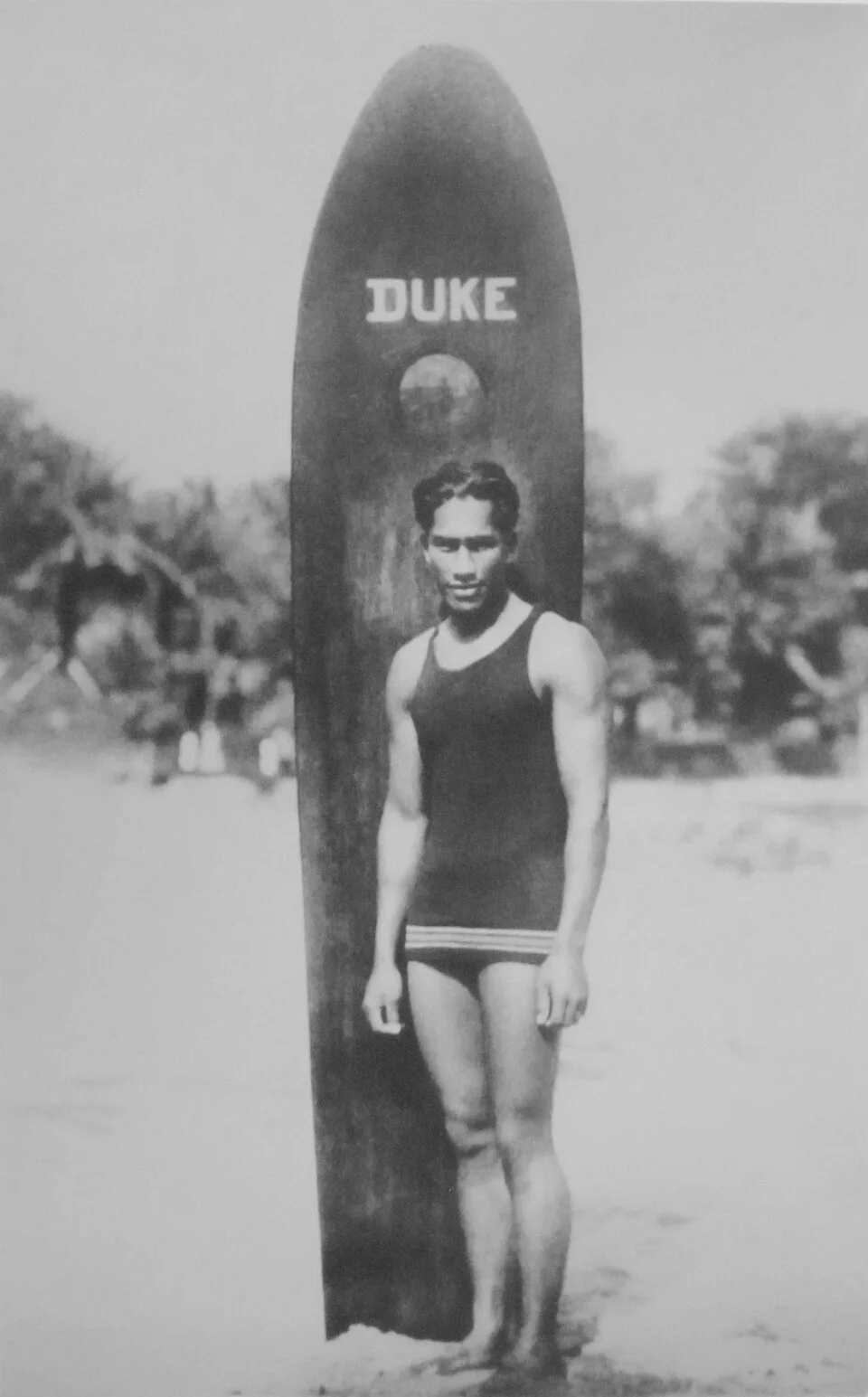
He won three Olympic golds, then used a wooden surfboard to save 8 men from drowning — before breakfast
On June 14, 1925, Olympic champion Duke Kahanamoku paddled into 30-foot surf at Newport Beach and rescued 8 drowning fishermen on his surfboard — an act that changed lifeguard equipment worldwide.
On the morning of June 14, 1925, a government weather observer named Antar Daraga hoisted a distress flag at the entrance to Newport Beach harbor in Southern California. The swells were running 20 to 30 feet. The harbor entrance was boiling.
The 40-foot sport fishing boat Thelma tried to come in anyway.
A 17-man party from Riverside, California — mechanics, a police officer, shop clerks, a teenager — had chartered the vessel for a weekend fishing trip. The boat's owner, "Gavvy" Cravath (a former major league baseball player), had stayed ashore. His co-owner, Myron Bland, was at the helm. Bland would later tell investigators he saw nothing alarming as he turned the boat seaward. 1
The first wave hit hard. It smashed through the engine room's glass, flooded the compartment, and killed the engine. Then the third wave — a bigger one — caught the Thelma broadside and rolled her completely over. Three times. All 17 men went into the water fully clothed, in jackets and heavy gear, 150 feet from the end of the breakwater. Nobody had time to grab a life preserver. 1
A man watching from shore grabbed his surfboard and ran.
Duke Kahanamoku, age 34, had already done more than most people manage in a lifetime
Duke Paoa Kahinu Mokoe Hulikohola Kahanamoku was born in Honolulu on August 24, 1890, into a family connected to the lower ranks of Hawaiian nobility. His first name was not a title. His father had been named "Duke" in honor of Prince Alfred, the Duke of Edinburgh, who was visiting Hawaii at the time of his birth — and the name passed down.
He grew up swimming in the sea at Waikiki, where surfing was still a living part of Hawaiian culture, practiced on heavy wooden boards that average men couldn't even lift. His traditional board was a 16-foot "papa nui" made of koa wood, weighing over 100 pounds, built in the ancient Hawaiian olo style with no skeg.
By 1911, his speed in the water had gotten noticed. On August 11 of that year, the 20-year-old swam 100 yards freestyle in Honolulu Harbor in 55.4 seconds — shattering the existing world record by 4.6 seconds. The Amateur Athletic Union (AAU) refused to recognize the time. Their explanation: the judges must have used alarm clocks instead of stopwatches. When that story wore thin, they blamed ocean currents. 2
Kahanamoku's response was to travel to the U.S. mainland and qualify for the 1912 Olympic team. At the Stockholm Games, he won gold in the 100-meter freestyle and silver in the 4×200-meter relay, becoming Hawaii's first Olympic medalist while the territory was not yet a state. The AAU's stopwatch theory died somewhere in Stockholm harbor.
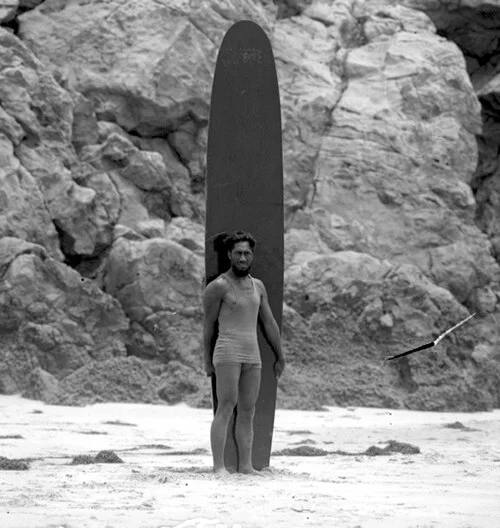
He returned to the Olympics in 1920 in Antwerp, won gold again in the 100-meter freestyle (beating fellow Hawaiian Pua Kealoha into second place), and added another gold in the 4×200-meter relay. By the 1924 Paris Games at age 34, his speed had faded enough that a 19-year-old named Johnny Weissmuller — who would later become the most famous screen Tarzan in Hollywood history — edged him out for gold in the 100-meter. Duke took silver. His own brother Samuel took bronze. The Kahanamoku family occupied two of the three podium spots. 2
Between the Olympic years, he had been doing something else: introducing surfing to the world. In 1912 he brought his board to Southern California and helped found one of the first surf clubs in the United States at Corona del Mar. On Christmas Eve 1914, he gave a surfing exhibition at Freshwater Beach in Sydney, Australia, building a board from a plank of pine he bought at a local hardware store — an afternoon that is still credited as the event that launched Australian surfing culture. The board survives to this day, preserved by the Freshwater Surf Life Saving Club. 2
So when Duke drove down from Los Angeles to camp on the beach at Corona del Mar the evening of June 13, 1925, preparing for an early morning surf session with friends, it was a routine trip to a place he'd known for over a decade. He woke up on June 14 to chaos.
The rescue: a "delirious shuttle system" through what looked like a low Niagara Falls
Duke saw the Thelma go over from the shore. He grabbed his surfboard — on this occasion a 12-foot, 200-pound mahogany board — and paddled directly into the break. Three other surfers who were on the beach that morning joined him: Gerard "Gerry" Vultee (whose family Duke knew well enough to have a key to their house), Owen Hale, and William "Bill" Herwig. 3
The harbor entrance was not surfable in any recreational sense. Shifting sandbars, 20- to 30-foot swells, fully dressed men drowning in the churn. The breakwater lighthouse had been washed off its mount — contemporaneous reports described it as the first time in memory that had happened. 1
Duke described it later: "Don't ask me how I made it, for it was just one long nightmare of trying to shove through what looked like a low Niagara Falls." 3
He ran three to four trips. The rule the rescuers followed was three men to a board on each pass. Duke's personal count: one victim on the first trip, two on the second, possibly three on the third, then back for one more — 8 people total. Vultee, Hale, and Herwig accounted for the remaining 4. 3
On shore, Daraga (the weather observer) and Captain T.W. Sheffield pulled survivors from the water. Daraga's wife and a nurse named Mary Grigsby administered first aid on the sand.
Twelve of the 17 men survived. Five did not: Ralph L. Farnsworth (38, a machinist), Jonathan A. Morris (28, a store clerk), William Squires (56, a police officer and, despite having only one hand, reportedly a strong swimmer), Edgar Morris (18, a student), and E.E. McClain (57, a machinist). 1
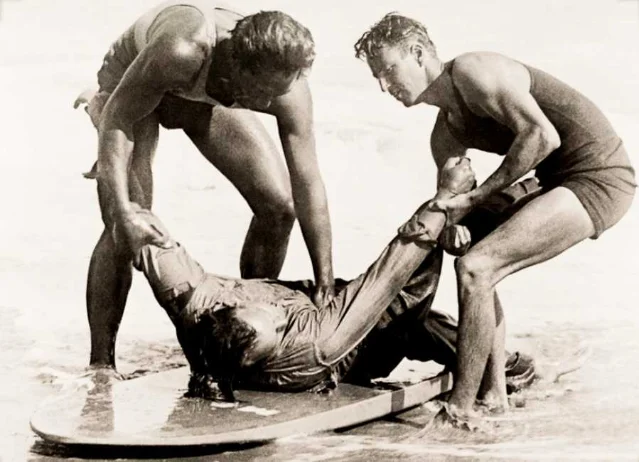
Newport Beach Police Chief Captain James Porter went to the Los Angeles Times with his assessment: "Kahanamoku's performance was the most superhuman rescue act and the finest display of surfboard riding that has ever been seen in the world." 4
Survivor F.W. Hock put it differently: "But for the work of Kahanamoku and the others, we would all have perished. The Hawaiian was a wizard, and he seemed to have everything in his hands as we were fighting, out there in the water." 1
Duke's own account of his motivation was less grandiose: "Neither me nor my pals were thinking about heroics, we were simply running — me with my board and the others to get their boards — hoping to save lives." 3
The breakfast
After the last trip, the four surfers did not wait for reporters. They did not call the press. They walked to the Corona del Mar Club and had breakfast.
A waiter came to their table, visibly shaken, and began telling them about the terrible disaster at the harbor — the capsized boat, the drowning men, the four surfers who had apparently saved a dozen lives. Duke and his companions listened politely to the entire story, pretending to know nothing about it. 1
The story ran nationally regardless. The Los Angeles Athletic Club awarded gold watches to Vultee, Hale, and Kahanamoku. The Hawaiian Society of Los Angeles gave Duke a special medal. An inquest that afternoon at the Smith and Tuthill Funeral Parlor returned a verdict of "unavoidable and accidental" — fully clearing Captain Bland. 1
Duke's comment on the role of the boards, stripped of any heroism: "Without the boards, we would probably not have been able to rescue a single person." 3
What the boards changed
Before June 14, 1925, surfboards on the U.S. mainland were widely considered an exotic Hawaiian novelty — recreational oddities, decorative as much as functional. No American lifeguard service had adopted them as standard equipment.
After the rescue, that changed. The nationwide attention focused on what a surfboard could do in heavy surf conditions — navigate waves that would swamp or flip any conventional rescue boat, carry multiple victims simultaneously, and be operated by a single rescuer — triggered a gradual adoption across U.S. lifeguard services. 5
Duke had actually befriended a Long Beach lifeguard named Roy "Dutch" Miller as early as 1913, and the Long Beach service had been experimenting with modified surfboards. But the June 14 event made the case nationally, with documented results in 30-foot surf.
A modern rescue lifeguard interviewed for the PBS documentary Waterman assessed it this way: "I've made surfboard rescues for 25 years. And if I had to do what he did that day, I would never have been able to physically do it." 4
The rescue board is now standard equipment at virtually every ocean beach lifeguard station worldwide. In lifeguard vernacular, the rescue board itself is sometimes called a "Duke."
The rest of the résumé
The 1925 rescue is just one chapter in a life that reads as though someone was testing how many exceptional things a single person could plausibly do.
After his swimming career, Duke spent 26 years as Sheriff of Honolulu — elected in 1935, serving 13 consecutive terms through 1961. During World War II, he served as a military police officer while Hawaii was under martial law. His arrest of a civilian named Duncan for public intoxication led, through appeals, to the 1946 U.S. Supreme Court case Duncan v. Kahanamoku, which ruled that trying civilians in military tribunals was unconstitutional — a landmark civil liberties decision with Duke as the technical defendant. 2
He appeared in at least 14 films, taught Franklin D. Roosevelt's sons how to surf, served as Hawaii's official Ambassador of Aloha, rode a single wave at Waikiki for 1.128 miles in 1929, and was the first person ever inducted into both the International Swimming Hall of Fame (1965) and the Surfing Hall of Fame (1966). 6
He died on January 22, 1968, at 77. His ashes were scattered into the ocean at Waikiki Beach as beach boys sang "Aloha Oe."
Surfer Magazine named him Surfer of the Century in 1999. 2
In September 2025 — a hundred years after the rescue — a bronze plaque was unveiled on a cliff at Corona del Mar overlooking the harbor entrance. It lists the names of four surfers who happened to have their boards with them on the morning of June 14, 1925, and ran toward the water. 7
The man who organized the plaque campaign, Scott Holt, grew up as a Newport Beach local and had never heard of the event until he read about it during a vacation in Hawaii. "I can't believe the city has not done something to commemorate this incredible feat," he said. 7
That tracks. Duke, as usual, had not stuck around to ask for credit.
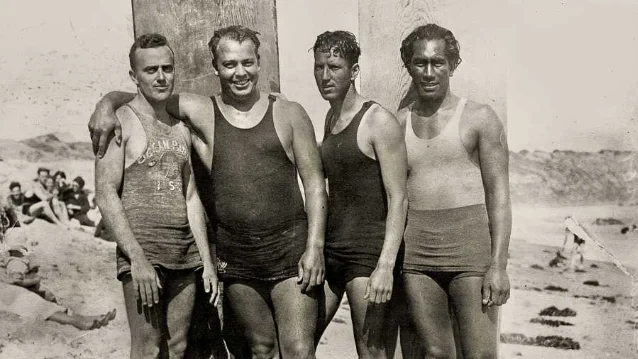
Cover photo: Duke Kahanamoku with his surfboard, c. 1920s. Public domain via Wikimedia Commons.
参考ソース
- 1Encyclopedia of Surfing: Duke Kahanamoku rescues 12 when boat capsizes in Newport in 1925
- 2Wikipedia: Duke Kahanamoku
- 3The Inertia: Duke Kahanamoku and The Superhuman Rescue
- 4PBS American Masters: Duke's incredible rescue mission while on a surfboard
- 5Société de sauvetage du Québec: A glimpse of history on the rescue board
- 6PBS American Masters: Duke Kahanamoku biography and life timeline
- 7Orange County Register: Plaque honors surfers who saved 12 fishermen off Corona del Mar in 1925
このコンテンツについて、さらに観点や背景を補足しましょう。