The Manticore's Long Journey: How a Porcelain Monster Survived Vienna's Darkest Hour
A five-inch porcelain Manticore made in 1735 Vienna survived a Nazi seizure for Hitler's Führermuseum, decades of hidden provenance, and finally came to light at The Met in 2025 — its full story told for the first time.

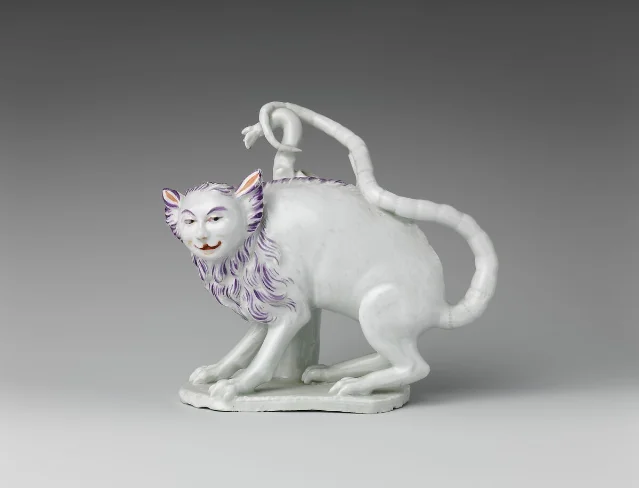
Image: The Metropolitan Museum of Art (CC0, Public Domain)
The creature in Gallery 533
Walk into Gallery 533 at The Metropolitan Museum of Art and you might pass it without a second glance. It is small — not quite five inches tall — and it sits among larger, showier pieces of European porcelain. But look closely, and something stares back at you.
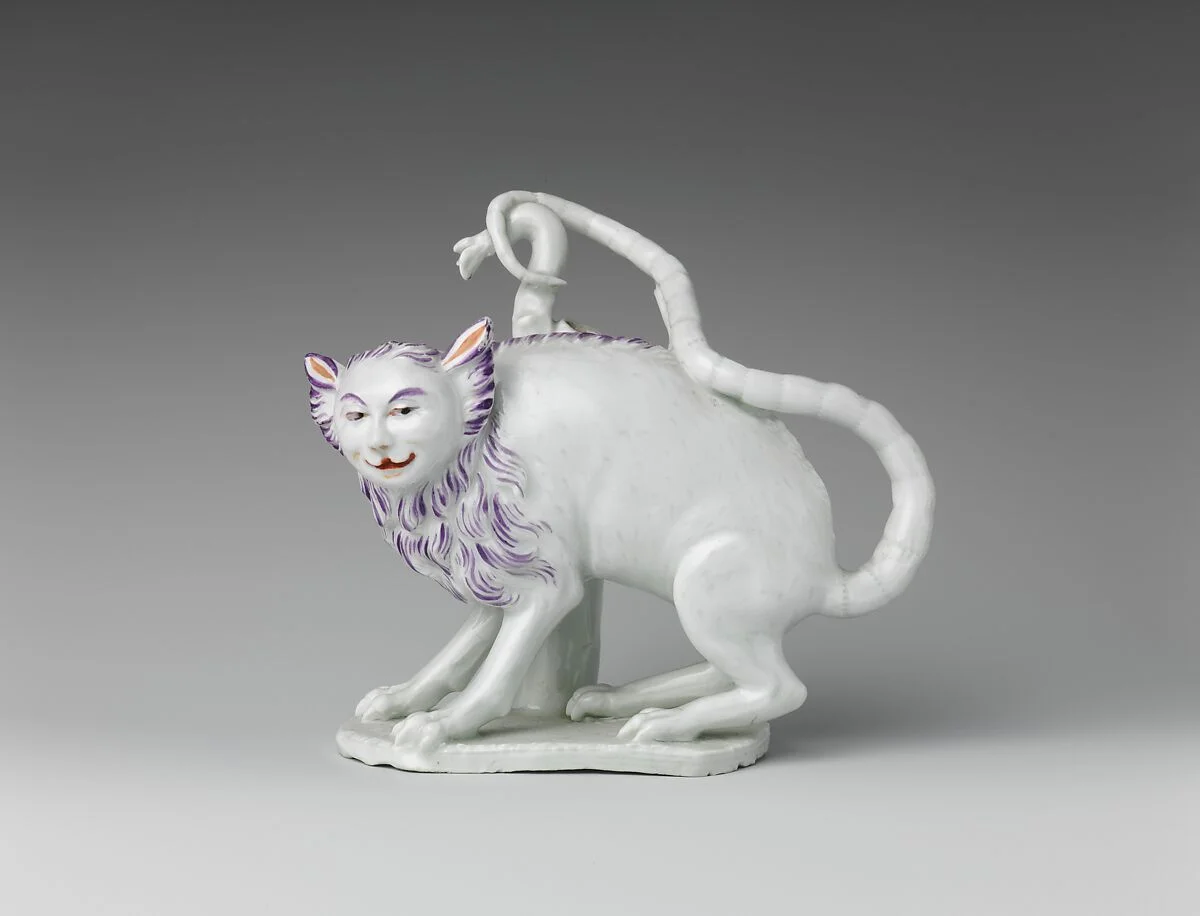
The figure has a lion's body, compact and coiled on a gnarled tree-trunk base. Its tail curls upward in a long, sinuous loop, reptilian and slightly threatening. But the face is human. The expression is not fierce. It is calm, faintly knowing, perhaps even flirtatious — framed by a cascade of violet-purple mane that spills down like a beard. The eyes catch the light with quiet intensity.
This is the Manticore, accession number 1995.268.310, created at the Vienna Porcelain Manufactory around 1735.1 It is made of hard-paste porcelain, the material Europeans spent decades struggling to produce before the secret arrived from China. Its minimal polychrome decoration — violet and lavender on the mane, ears, and facial features against an otherwise white body — gives it the look of an unfinished thought, as though the sculptor stopped just before the creature became too real. The Met's curators have called it "unique in the porcelain repertoire — and unmatched in invention and eccentricity."1
What the label on the gallery wall does not tell you is how the Manticore got there. That story spans nearly three centuries, passes through a Berlin auction house, a Vienna apartment under Nazi seal, a salt mine in the Austrian Alps, a widow's legal fight, and a Swiss-American psychiatrist's living room — before ending, for now, on a plinth in Manhattan.
The beast from Persian myth
Long before any porcelain existed in Europe, the manticore haunted the imagination of the ancient world. The creature's name comes from Old Persian: martīya, meaning "man," and xuar-, meaning "to eat" — literally, man-eater.2 The Greek physician Ctesias first committed it to writing in the fifth century BC, in his now-lost book Indica, drawing on accounts he had gathered from Persian-speaking travelers who had ventured into India. The creature he described had a human face, a lion's body, three rows of teeth, and a scorpion's tail capable of launching venomous stingers like arrows.
The description circulated through antiquity — preserved by Aristotle, amplified by Pliny the Elder in his Naturalis Historia — and eventually lodged itself in the illustrated medieval bestiaries that monks copied and illuminated across Europe.2 By the late Middle Ages it had reached heraldry: William, Lord Hastings carried a manticore badge around 1470. In these images, the creature is almost always menacing. The face may be human, but the body broadcasts danger.
When an unknown sculptor at the Vienna Porcelain Manufactory picked up this tradition around 1735, he did something unexpected with it. The Met's curators suggest the figure's inspiration may lie in a specific medieval object type: the lion aquamanile, a water vessel cast in the shape of a lion, where the body faces profile while the head turns frontally to face the viewer.1 The stylized, chiseled mane of the aquamanile has been transformed into that dramatically flowing violet beard; the compositional tangle of tail and tree trunk recalls the handle formed from a lion's tail in the same vessel type. The sculptor seems to have looked at a fearsome ancient myth, looked at a medieval kitchen utensil, and produced something that borrowed from both while resembling neither.
Met provenance researchers Gloria de Liberali and Riva Arnold put it well: the eighteenth-century sculptor "softened its menace by transforming it into something playful, even seductive," so that "the alluring human face framed by a violet mane makes the creature appear flirtatious more than fearsome, exemplifying the way European porcelain recast the exotic as fantasy."3
Europe's second porcelain factory
The kiln that made the Manticore was only twenty-five years old when the piece was fired.
European ceramicists had spent the better part of a century trying to replicate Chinese hard-paste porcelain — the translucent, resonant material that arrived in crates from East Asia and sold for prices that would buy a horse. The secret of its production resided in a particular combination of kaolin clay and petuntse feldspathic rock, fired at temperatures European kilns only began achieving with the help of industrial espionage. In 1710, the Meissen manufactory near Dresden became the first in Europe to crack the formula. Eight years later, Claudius Innocentius du Paquier opened a rival factory in Vienna.
Du Paquier was an agent in the Imperial Council of War, not a ceramicist. What he had was persistence and well-placed connections. He recruited critical personnel from Meissen — including kiln master Samuel Stöltzel, who apparently brought the paste recipe with him — and on May 27, 1718, secured a twenty-five-year imperial privilege from Emperor Charles VI to produce "all sorts of fine porcelain... such as are made in East India and other foreign countries."4
The Vienna factory developed a style that owed its technology to Meissen but its aesthetic to somewhere else entirely. Jeffrey Munger, a ceramics specialist at The Met, has noted that "the forms and styles of decoration employed at the Viennese factory were entirely original."5 The Du Paquier pieces are Baroque in their exuberance, often whimsical, occasionally bizarre — and it is the pieces made during Du Paquier's ownership that, as the Frick Collection's introduction notes, "continue to charm and surprise with their originality, variety, and exuberance."4
The Manticore was made during the mature phase of this period, around 1735. Du Paquier's factory would last only nine more years before he ran out of money and sold it to Empress Maria Theresa in 1744. The specific modeler of the piece is unknown — unlike Meissen, where craftsmen such as Johann Joachim Kändler left extensive records, the individual artisans of the Du Paquier period are largely anonymous. The Manticore carries no maker's mark, only the creature itself.
A Berlin auction, misidentified
The earliest documented chapter in the Manticore's ownership history begins nearly two centuries after its creation, in a Berlin auction catalog from 1928.
The piece had belonged to Dr. Paul von Ostermann (1852–1927), a German collector celebrated for assembling one of the most important private collections of European porcelain of his generation.3 How and when Ostermann acquired the Manticore is not known. After his death, his collection was dispersed at auction by the Berlin houses Paul Cassirer and Hugo Helbing, over four days in late October and early November 1928.
The Manticore appeared as lot 378. The catalog described it as a "grotesque animal" and called it a chimera — the wrong monster entirely, though one could forgive the confusion.3 An annotation in the auctioneer's copy of the catalog records the result: "An annotation in the auctioneer's copy of the catalogue records that it sold for the considerable sum of 1,500 Reichsmarks to Martin Schwersenz (1863–1943), a commission agent and art dealer of Jewish origins who probably acted on behalf of Oscar Bondy."3
That name — Oscar Bondy — would dominate the rest of the Manticore's story.
Vienna, 1938
Oscar Bondy was born in Vienna in 1870, the son of a prosperous Jewish family, and made his fortune in industry and commerce.6 By the mid-1930s he was among the most significant private art collectors in Austria, with more than 1,600 objects — paintings, sculptures, musical instruments, furniture, and decorative arts — filling his apartment at Schubertring 3 in central Vienna. The Manticore, by then misidentified and perhaps only partially understood, was among them.
On March 12, 1938, German troops crossed into Austria. Bondy was in Czechoslovakia at the time. He did not come back. He moved to Switzerland in May, then to Portugal, then eventually to the United States. His apartment was sealed by Austrian authorities within days.6
On July 1, 1938, the Bundesdenkmalamt — the Austrian Federal Monuments Authority — carried out the formal seizure of the collection at the request of the Zentralstelle für Denkmalschutz.6 The Manticore was photographed on an index card, catalogued, and entered into the machinery of what would become one of the largest systematic art thefts in history.
The Bondy collection came under the Führervorbehalt — the Führer's Reserve — a decree Hitler had issued on June 18, 1938, placing all artwork seized in Austria under his personal priority access.7 The decree's language was unambiguous: "Paintings which, until 1938, were the major works of the Rothschild, Gutmann or Bondy collections, were intended to grace Hitler's private collection and, above all, the planned Führer Museum in Linz."7
The Sonderauftrag Linz (Special Commission Linz) was the agency tasked with assembling the collection for this museum — a vast cultural complex Hitler planned to build in his hometown, anchored by a gallery of looted masterworks.8 Hans Posse, director of Dresden's Gemäldegalerie, was appointed its special representative in 1939. The museum was never built. Only the Nibelungen Bridge in Linz was completed. In May 1945, U.S. Army troops overran the Altaussee salt mine in the Austrian Alps, where the Sonderauftrag's collections had been stored — 6,755 objects designated for Linz were among the artworks recovered.8
Oscar Bondy had not survived to see the mine opened. He died in New York on December 3, 1944.
Elizabeth Bondy's fight
After the war, the Bondy collection lay scattered across multiple Austrian museums and the Altaussee depot. Recovering it fell to Oscar's widow, Elizabeth (Soinig) Bondy (1890–1974).
In November 1946, Elizabeth Bondy filed for restitution. The Finanzlandesdirektion — the regional finance authority — rejected her application on the grounds that the 1939 formal confiscation had been carried out under criminal proceedings, placing it outside their jurisdiction. It was, according to the Lexikon der Österreichischen Provenienzforschung, what Bondy's legal team characterized as "a sabotage of the restitution process."6
Elizabeth Bondy appealed. In May 1947, the federal Ministry for Property Protection upheld her claim, and the Bundesdenkmalamt ordered Austrian museums to promptly return the objects.6 But the Austrian government did not simply hand the collection back. In exchange for export permits — without which she could not move the objects out of the country — Bondy was required to donate other pieces to Austrian museums. These were coerced arrangements; under Austria's later Kunstrückgabegesetz (Art Restitution Act), many of them have since been reversed.6
The Manticore was among the objects restituted. Elizabeth Bondy introduced it back into the art market, and it passed, probably through a New York dealer, to its next owner.
The psychiatrist collector
Hans Caspar Syz (1894–1991) was born in Switzerland and came to the United States in 1921.9 He trained and worked as a psychiatrist, eventually co-founding the Lifwynn Foundation in Westport, Connecticut, a center for research into group psychology and human behavior. In the early years of World War II, he began buying 18th-century Meissen tablewares from a New York dealer named Adolf Beckhardt — himself a Jewish immigrant who had fled Nazi Germany, his gallery a small refuge of European civilization on the American side of the Atlantic.
Syz's interest in porcelain was not decorative in the conventional sense. Smithsonian curator Bonnie Campbell Lilienfeld has described how "his work in psychoanalysis and human behavior contributed to his belief that cultural artifacts have an important role to play in enhancing our awareness and understanding of human creativity and communication."9 He was collecting objects, in other words, because he believed they carried meaning.
The Manticore came to Syz through the Blumka Gallery in New York — probably sometime between the late 1940s and the 1960s — one of several ex-Bondy pieces he acquired.3 In 1961, Syz gave the largest portion of his collection — more than 630 pieces of European porcelain — to the Smithsonian's National Museum of American History.9 The Manticore, for reasons that are not documented, he kept. It remained with Syz until his death in 1991.
Four years later, Syz's sons — Stephan B. Syz and John D. Syz — donated the retained collection, nearly three hundred ceramics, to The Metropolitan Museum of Art. The gift entered the permanent collection as "The Hans Syz Collection" in 1995.1 Accession number 1995.268.310. Gallery 533.
For thirty years, no one knew what it had been through.
The secret in the photograph
In 2025, The Metropolitan Museum mounted an exhibition called Monstrous Beauty: A Feminist Revision of Chinoiserie. Its curatorial argument was pointed: that the European tradition of chinoiserie — the fantasy of the exotic East, rendered in porcelain, wallpaper, and silk — had helped construct enduring stereotypes about race, sexuality, and gender. "Porcelain was not just polite," the exhibition stated. "It created lasting stereotypes that are difficult to break."10
The Manticore was placed in the exhibition's "Monsters" section. As researchers Gloria de Liberali and Riva Arnold prepared its provenance documentation, they compared the figure against wartime archival photographs — and found a match. The Bundesdenkmalamt's 1938 index card for Oscar Bondy, lot number 104, contained a photograph of the same porcelain creature now sitting in the Met's collection.3
"The Bondy provenance of this object — and of two related works now in the Museum's holdings — remained unknown until Monstrous Beauty brought them back into the spotlight last year, allowing us to recognize these porcelains as the same objects photographed by the Bundesdenkmalamt in Vienna in 1938," de Liberali and Arnold wrote.3 The discovery triggered a review of thirty-one works in The Met's Department of European Sculpture and Decorative Arts with possible ex-Bondy histories.
The two related pieces are a Du Paquier vase (accession 1995.268.276) and a food warmer (64.101.269a–d) — both, it turns out, came from the same Vienna apartment, seized by the same authority, in the same summer.3
The Manticore has been called many things over its life: a chimera, a grotesque animal, unmatched in eccentricity. In 1928, a Berlin auctioneer's annotation logged its sale price and moved on. In 1938, an Austrian bureaucrat photographed it as evidence of a theft. Decades later, a psychiatrist who thought objects carried meaning apparently agreed. Now it carries the full weight of the 20th century on a body barely five inches tall, still staring out at whoever stops long enough to look.
Cover image: The Metropolitan Museum of Art (CC0, Public Domain)
References
- 1The Metropolitan Museum of Art: Manticore, Vienna, ca. 1735
- 2Wikipedia: Manticore
- 3The Metropolitan Museum of Art: The Lives of Objects — Notes on Provenance (2026)
- 4The Frick Collection: Du Paquier Porcelain — Introduction
- 5The Metropolitan Museum of Art (Heilbrunn Timeline): German and Austrian Porcelain in the Eighteenth Century
- 6Lexikon der Österreichischen Provenienzforschung: Bondy, Oscar
- 7National Fund of Austria: The Führer's Prerogative and the Planned Führer Museum in Linz
- 8Jewish Digital Cultural Recovery Project: Sonderauftrag Linz
- 9Smithsonian NMAH: From Ancient Egypt to Tiffany Vases — A Tour of the Syz Porcelain Collection
- 10The Metropolitan Museum of Art: Monstrous Beauty — Inside the Exhibition
Add more perspectives or context around this Drop.