Blue by Day, Red by Night: The Hope Diamond's 350-Year Journey to the Smithsonian
From a Golconda riverbed in 1666 to a plain brown package mailed for $145.29 in 1958 — the documented provenance of the Hope Diamond spans Louis XIV's court, a Revolutionary-era heist, a London banker, a Washington socialite, and a gemologist's 200-year mystery finally solved by computer modeling.

In the fall of 1958, a postman named James G. Todd drove a plain brown package from Washington's city post office to the National Museum of Natural History. He handed it to the museum's secretary, who signed the registered-mail receipt and passed it along for opening. Inside was the Hope Diamond — the most famous gem on earth, wrapped in brown paper, insured for one million dollars, shipped for $145.29.1
That delivery, deliberate and anticlimactic, was the last step in a journey that had begun nearly three centuries earlier in an Indian riverbed.
A stone from the Golconda kingdom
Sometime before 1666, miners working the Kollur Mine in the Golconda kingdom — a region of modern Andhra Pradesh and Telangana that was then the world's only known source of diamonds — pulled from the earth a rough blue crystal weighing approximately 112 carats.2 The Golconda mines had already yielded the Koh-i-Noor and the Regent Diamond. This stone, though, was different: it was blue, and it had come from deep enough in the earth to accumulate a peculiar atomic accident.
Almost all diamonds are pure carbon. The Hope's blue color comes from boron — a trace element that substitutes for carbon atoms in the crystal lattice, absorbing red and yellow wavelengths and transmitting a cold, saturated blue.3 It is an impurity in the chemical sense, and it is responsible for one of the rarest colors in the natural world.
When Jean-Baptiste Tavernier, a French gem merchant and one of the most traveled men of his era, arrived in Golconda in 1666 on his sixth and final journey to India, he acquired the rough blue stone along with several others. In his own account he described its color as "a beautiful violet." Tavernier carried it back to France, and in December 1668 he met privately with King Louis XIV to present his collection.4
The Sun King's blue diamond
Louis XIV bought the stone along with fourteen other large diamonds. In 1673, he had his royal jeweler, Sieur Pitau, recut the rough violet-blue into a polished gem of approximately 69 carats, which the French court called the Tavernier Blue and later le Bleu de France — the French Blue.2 Louis wore it as part of the regalia of the Order of the Golden Fleece, suspended from a ribbon at his neck in a formal portrait setting. Louis XV, his great-great-great-grandson, later had it reset in the same chivalric insignia.
For 124 years the French Blue stayed in royal hands, passing from king to king along with everything else the Bourbons owned.
Then, on the night of September 11, 1792, thieves broke into the Garde-Meuble — the royal treasury — during the political chaos of the French Revolution. Over several days they stripped the building of nearly everything. Most of the crown jewels were eventually recovered. The French Blue was not.5
Twenty years of silence
What happened between 1792 and 1812 is the single greatest mystery in the diamond's history. No document places it anywhere. No inventory lists it. Historians have proposed that it was smuggled to Amsterdam and there recut — which would explain why it next appeared at a significantly smaller weight — but no physical evidence of that cutting has ever surfaced.5
In 1812 a deep blue diamond weighing 45.52 carats appeared in the London inventory of a diamond merchant named Daniel Eliason. The timing was noted at the time and has been remarked upon ever since: the French statute of limitations on crimes committed during the Revolution expired in 1812 — and Eliason's stone was documented two days after that legal deadline passed.5 Whether this was coincidence or calculation, no one has established with certainty.
The stone passed briefly through the hands of King George IV of England, though this remains disputed. What is documented is that by 1839 it had entered the collection of Henry Philip Hope, a London banker and gem collector, who paid approximately £18,000 for it.2 The diamond acquired his name and has kept it ever since.
The Hopes and their stone
Henry Philip Hope died without children in 1839, and the diamond became the subject of extended litigation among his nephews. It eventually passed to his nephew Henry Thomas Hope and then, through inheritance, to Henry Thomas's grandson Lord Francis Hope — a young aristocrat with a talent for expensive habits and a gift for running through money.
By 1901, Lord Francis was facing bankruptcy and applied to the courts for permission to sell the diamond despite the terms of the family trust. The court agreed. He sold it to a London dealer, Adolf Weil, for an amount variously reported between £28,500 and £29,000. Weil sold it to Joseph Frankel's Sons & Co. of New York, who sold it to a Turkish dealer named Selim Habib, who put it up at auction in Paris in 1909.4
At the Paris auction, the stone was purchased by the French dealer Rosenau. And from Rosenau, the diamond passed into the hands of Pierre Cartier.
Cartier's gambit
Pierre Cartier had opened his New York branch only months earlier when he bought the stone for 500,000 francs.6 He had a specific buyer in mind: Evalyn Walsh McLean, a Colorado mining heiress who had married the heir to The Washington Post and The Cincinnati Enquirer and who was already one of the most lavishly jeweled women in America.
Pierre understood something about Evalyn that might have deterred a more cautious salesman: she was drawn to things with dark reputations. The legend of a "Hope Diamond curse" — the idea that the stone brought ruin to all who possessed it — had been circulating in the European press. Pierre did not downplay it. According to Francesca Cartier Brickell's book The Cartiers, he considered the notoriety an asset, something that would intrigue Evalyn rather than repel her.6
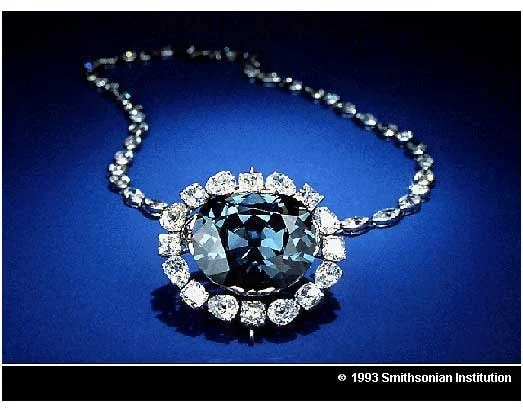
He first showed her the diamond in Paris in 1910. She admired it but declined. He took it back to New York, remounted it in a new necklace — the 45.52-carat blue cushion at the center, surrounded by sixteen white diamonds, on a diamond rivière chain — and had it delivered to her Washington home so she could wear it to a party before deciding.
Evalyn wore it. She did not return it. The Cartiers filed suit when she delayed payment. After a church blessing, a brief custody dispute, and the substitution of a previously purchased emerald pendant against the balance, the sale was finalized in 1912 for $180,000 (roughly $5 million today).6 It was, by Pierre's own later reckoning, a transaction on which Cartier barely broke even — but the publicity it generated made his New York store a household name.
Evalyn Walsh McLean and the weight of the stone
Evalyn Walsh McLean kept the Hope Diamond for 35 years and wore it constantly. She took it to state dinners, to horse races, to the informal gatherings she threw at her Washington estate, Friendship. She reportedly let her dog wear it. She treated it as a talisman rather than a curse.
Her life during those years was genuinely difficult. Her nine-year-old son Vinson was struck and killed by a car in 1919. Her husband Ned McLean, co-owner of the Washington Post, descended into alcoholism and was eventually committed to a psychiatric institution. The paper went bankrupt during the Depression, and Evalyn at one point pawned the diamond to cover her debts — though she redeemed it.2 Her daughter died of a drug overdose in 1946. Evalyn died of pneumonia on April 26, 1947.
Her jewels were found in shoeboxes in her bedroom, assessed at approximately four million dollars.
Harry Winston and a democratic gesture
Harry Winston, the New York jeweler known as "the King of Diamonds," purchased the McLean jewel collection in 1949 for approximately one million dollars. He kept the Hope Diamond for nine years, taking it on tour across the country for charitable exhibitions before deciding what to do with it permanently.7
Winston's decision to donate it to the Smithsonian was not entirely selfless — it was also partly strategic, since a gift to a national institution secured his legacy — but his stated reasoning was that Americans deserved a national gem collection comparable to those held by European royal houses. The Smithsonian had no such collection. The Hope Diamond would be its foundation.
On November 10, 1958, a Harry Winston employee paid $145.29 at the New York post office to ship the stone by registered mail to Washington. The package was wrapped in brown paper, insured for one million dollars, and loaded onto a railway mail car. Postman James G. Todd delivered it to the museum's front door.1 The National Postal Museum in Washington — housed in the building that was then the city's main post office — still displays the brown paper wrapping.
What science settled
For decades, the link between the French Blue stolen in 1792 and the Hope Diamond that appeared in London in 1812 was a matter of educated inference rather than proof. The two stones were separated by twenty years and about 23 carats — consistent with recutting, but unconfirmed.
In 2005, Jeffrey Post, curator of the Smithsonian's National Gem Collection, led a team that used 17th-century technical drawings of the French Blue and computer modeling of the Hope Diamond to construct a virtual nesting: the Hope Diamond fit precisely within the mathematical outline of the French Blue, exactly where a recut would have left it.5
Two years later, a lead cast of the French Blue was discovered in the collections of the Paris Natural History Museum. The cast, made in the 19th century from an impression of the original stone, provided physical dimensions accurate enough to eliminate any remaining doubt. The Hope Diamond and the French Blue are the same stone.5
Blue by day, red by night
The Hope Diamond now sits in the Harry Winston Gallery of the Janet Annenberg Hooker Hall of Geology, Gems, and Minerals at the National Museum of Natural History in Washington, D.C.4 It is set in the same Cartier necklace mount from 1910. The Smithsonian estimates it is the most visited single exhibit in the building — a building that draws around seven to eight million visitors annually.
In ordinary light the stone is a deep, saturated blue-gray. Under shortwave ultraviolet, something stranger happens. The Hope Diamond phosphoresces a vivid red-orange color — a glow that lingers for several seconds after the UV source is removed.3 Most blue diamonds, when exposed to UV, phosphoresce blue. The Hope's red glow is anomalous even among anomalies, and the precise atomic mechanism that produces it remains a subject of active research.
A 2008 study published in Geology by Penn State researchers demonstrated that each blue diamond's phosphorescent signature is distinct enough to function as a fingerprint — implying that if any fragment of the Hope Diamond were ever separated from the main stone and lost, it could eventually be identified.8
The stone that took 20 years to reappear after the French Revolution, and 213 years to be conclusively tied to its earlier identity, carries its own built-in traceability — written in the language of light.
References
- 1Hope Diamond Package — National Postal Museum
- 2Hope Diamond — Wikipedia
- 3The Blue Hope Diamond Glows Red — Smithsonian Institution
- 4History of the Hope Diamond — Smithsonian NMNH
- 5What happened the last time the French crown jewels were stolen — National Geographic
- 6The Secret History of the Hope Diamond — Forbes/The Cartiers
- 7Hope Diamond Donated by Harry Winston — Smithsonian Archives
- 8Hope Diamond's phosphorescence key to fingerprinting — Penn State News
Add more perspectives or context around this Drop.