Violet all along: Van Gogh's Irises and the 135-year secret the Getty finally proved
Vincent van Gogh painted Irises on the morning after checking himself into the Saint-Paul-de-Mausole asylum in May 1889, describing the flowers as violet in his letters. But the fading of geranium lake pigment turned them blue for over a century — until the Getty's 2024 Ultra-Violet exhibition used XRF science to prove what Van Gogh always knew. This article traces the full provenance from that asylum garden, through Tanguy, Mirbeau, Joan Whitney Payson, the 1987 record $53.9 million Sotheby's auction and Alan Bond's scandal, to the Getty's 1990 acquisition.
Violet all along: Van Gogh's Irises and the 135-year secret the Getty finally proved
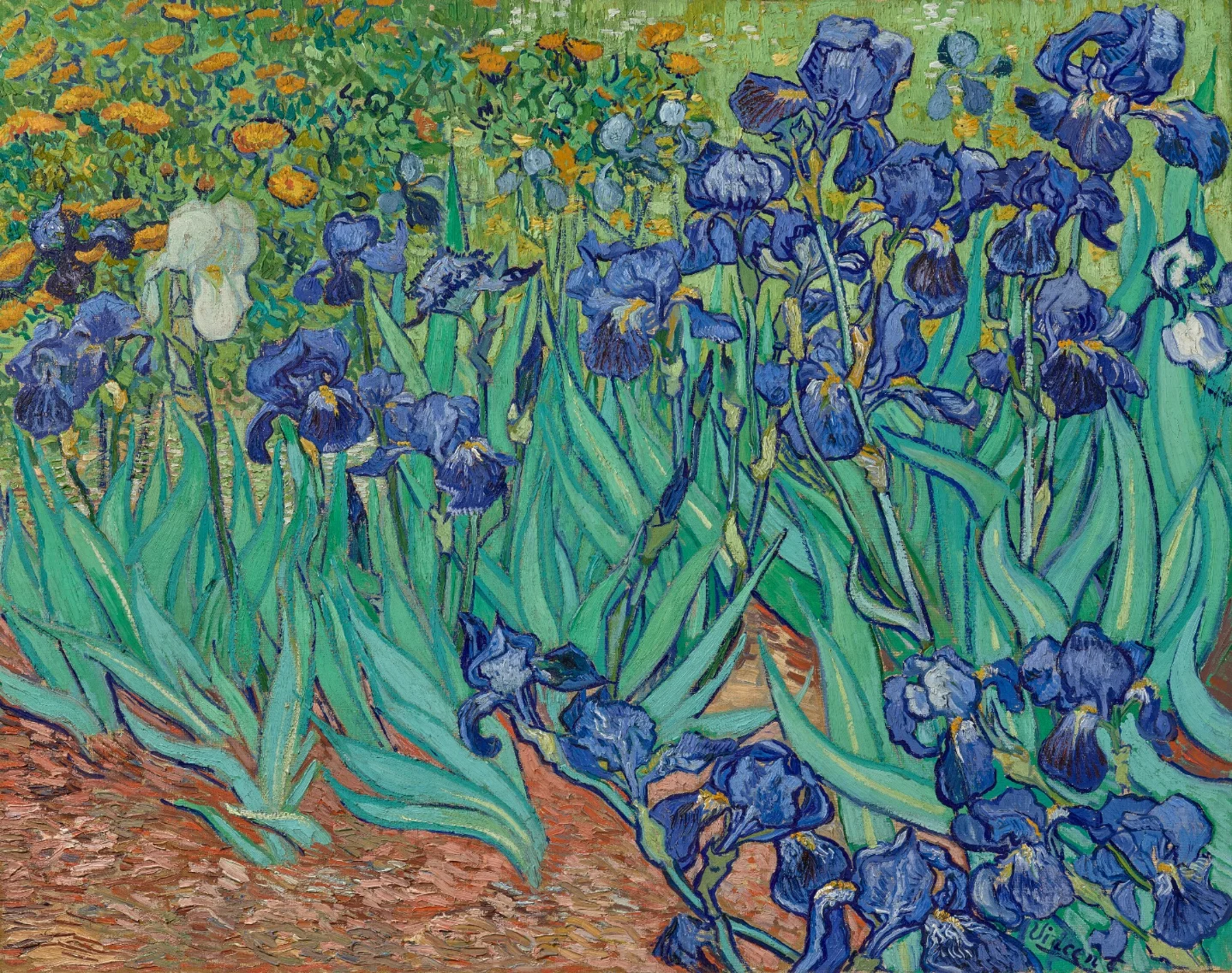
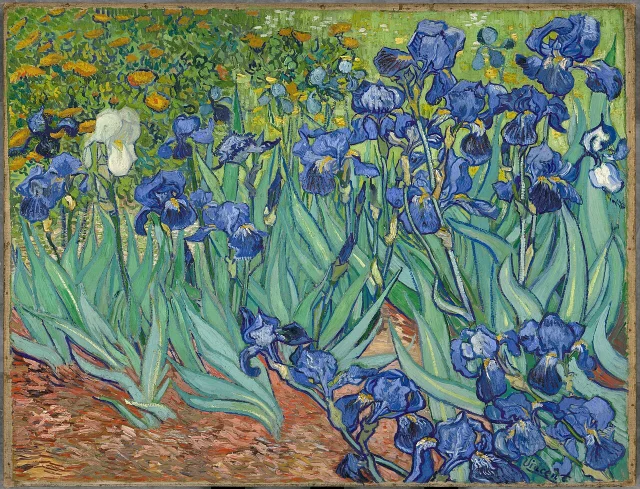
There is a painting in Gallery 127 of the Getty Center in Los Angeles that almost everyone who sees it describes the same way: brilliant blue, electric, saturated with a color so particular that visitors instinctively slow down. The irises lean and crowd one another across 71 by 93 centimeters of canvas, their petals urgent and crammed, the composition cut off on every side as if the flowers were trying to leave the frame. 1
The description is almost right. The flowers are not blue. They were never blue.
Van Gogh said so himself.
A garden enclosed by walls
On 8 May 1889, Vincent van Gogh (1853–1890), then 36 years old, walked through the gate of the Saint-Paul-de-Mausole asylum in Saint-Rémy-de-Provence and checked himself in voluntarily. 2 The decision followed months of mental deterioration in Arles — a crisis that had included the notorious incident in December 1888 when he severed part of his own left ear. The doctors at Saint-Paul-de-Mausole, which occupied a converted twelfth-century Augustinian monastery, gave him a room, let him keep his paints, and told him to stay within the walled grounds for the first month while they observed him.
The grounds included a garden. It was a real garden — not a formal parterre but a working, seasonal space where patients and staff moved among vegetable beds, tall umbrella pines (Pinus pinea), and, in May, dense beds of iris. 3
According to Devi Ormond, Associate Paintings Conservator at the Getty, Van Gogh did not wait long. "When Van Gogh arrived at the hospital in Saint-Rémy on the 8th of May, 1889, he took out his easel the following morning and started painting on this painting," she has said. 3 The asylum's chief physician, Dr. Peyron, was allowing him to work with his paints inside the institution — something the current hospital director, Dr. Boulon, has described as "one of the earliest indications of art therapy." 3
The garden was Van Gogh's only connection to the natural world during that first month. He would return to it obsessively. The painting of the irises was one of his first acts after arriving.
What the canvas holds
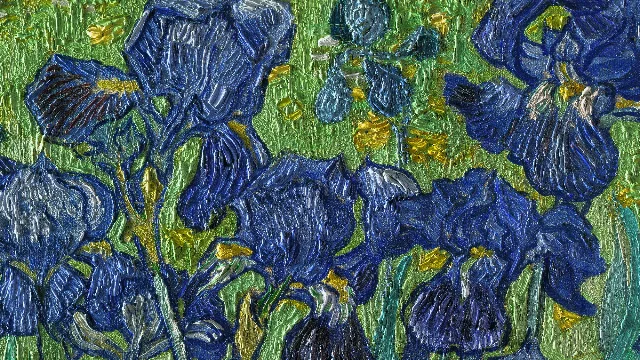
The finished work — oil on canvas, accession number 90.PA.20, catalogued as F608 in the de la Faille inventory and JH1691 in Hulsker — measures 71 × 93 cm. 1 It is painted in thick impasto, the pigment built up in directional strokes that follow the arc of each petal, so that the surface is physically sculptural — not a flat record of irises but something that has the texture of having been grown as much as painted.
The composition is radical in its refusal of distance. Van Gogh almost certainly sat or knelt close to the ground, looking at the irises from within, or nearly within, their own level. 4 The flowers spill past all four edges of the canvas. There is no sky, no horizon line, no garden beyond — only the irises themselves, and immediately beneath them, a wedge of warm reddish-brown earth, and behind them, at the upper left, a cluster of small orange-yellow flowers providing the complementary color note that drives the whole painting's chromatic logic.
One iris in the middle-left of the composition is white. It sits among all the others like a held breath. 2
The contemporary critic Félix Fénéon, reviewing the work at its first public exhibition in September 1889, wrote that the irises "violently slash into long strips their violet petals on sword-like leaves." 2 Fénéon said violet, not blue. He was looking at the painting within months of its completion, while the pigments were still fresh.
Van Gogh himself was equally precise. In Letter 789, written from Saint-Rémy to his brother Theo on 14 or 15 July 1889, he described what he had been working on: "I'm in the process of painting two works, one of violet irises and the other a lilac bush." 5 He did not say blue irises. As Ormond has noted: "He did not say blue irises. And as we know, Van Gogh was fascinated by color. So for him to write the wrong term seems a little bit unusual." 3
What visitors see today is not what Van Gogh painted. More on that in a moment.
A new genre, between two old ones
Getty Associate Curator Dr. Scott Allan has argued that Irises occupies a genuinely novel formal category. "It's not exactly a landscape," he has said. Landscape painting requires scale, spatial recession, a sense of atmospheric depth. "It's not exactly a still life" either — still life, in its French term nature morte, literally means "dead nature," objects arranged and arrested. These irises are "still rooted in the earth" and "intensely alive." Allan describes the painting as "a picture of moving life attached to the earth." 6
Dr. Steven Zucker, co-founder and executive director of Smarthistory, has suggested that Van Gogh was "almost as if... here inventing a new genre, a new type of painting." 6 Van Gogh himself used the French word étude — study — when he shipped the painting to Theo. The term implies direct observation of nature, without compositional mediation. It is the most honest description of what the painting is: a record of looking, from very close, at living plants.
The painting's structure owes a visible debt to Japonisme — the influence of Japanese woodblock prints on European art in the second half of the nineteenth century. Van Gogh was an obsessive collector of Japanese prints, accumulating hundreds of them in Paris in the mid-1880s, and he spoke repeatedly in his letters of wanting to make art that had the clarity, the directness, and the chromatic intensity of Hokusai or Hiroshige. 7 The asymmetric composition of Irises — the diagonal thrust of the leaves, the cropped edges, the flat areas of solid color within each petal — is Japanese in its bones, even though the subject matter is Provençal. 2
The color logic is something else: a working application of the color theory Van Gogh had absorbed from the French chemist Michel-Eugène Chevreul (1786–1889), who had demonstrated in the 1830s that complementary colors placed adjacent to one another — red against green, violet against yellow, orange against blue — each intensify the other. 2 In Irises, the red-brown of the earth answers the green of the leaves; the violet of the flowers answers the yellow of the background blooms. The painting is a theorem about color perception dressed as a study of a flower bed.
First audience
In July 1889, Van Gogh crated up eleven paintings, including Irises, and sent them north to Theo in Paris. 5 He listed it among seven natural studies, naming it simply "the irises." Theo — who served simultaneously as his brother's primary emotional support, his financial lifeline (Vincent never sold more than a handful of paintings during his lifetime), and his de facto agent — submitted Irises and Starry Night over the Rhône to the annual exhibition of the Société des Artistes Indépendants (Salon des Indépendants) in Paris that September. 2
The response was striking. Theo wrote to Vincent on 5 September 1889 — Letter 799 — to tell him how the painting looked in the gallery. "Now I still must tell you," he wrote, "that the Independents is open and that your two canvases are hanging there... it strikes you from a long way off. It's a fine study, full of air and life." 8 Fénéon's review in La Vogue, noting the "violet petals" and their sword-like leaves, appeared the same month. 2
The painting sold almost immediately after the exhibition — to Julien "Père" Tanguy (1825–1894), the Montmartre pigment grinder and paint-supply dealer who had become an informal gallery and advocate for the Post-Impressionist painters. 2 Van Gogh had painted Tanguy's portrait three times. The sale price is not recorded. Tanguy held the painting for a brief period before selling it to its first major owner.
The critic who bought it
In 1892, Tanguy sold Irises for 300 francs to Octave Mirbeau (1848–1917), the French literary critic, novelist, and committed anarchist who was among the most vocal early champions of Van Gogh's work. 2 By 1892 Van Gogh had been dead for nearly two years; Theo had followed him within six months of Vincent's death in July 1890, leaving Theo's widow Johanna van Gogh-Bonger (1862–1925) to manage the estate and, ultimately, shape the entire posthumous reception of Van Gogh's work.
Mirbeau was not simply collecting. He used Irises as source material, making it the central image in his 1892 short story Dans le ciel (In the Sky), a loosely autobiographical narrative about an artist's spiritual crisis. 2 The painting had entered the imagination of French literary culture within three years of being made.
What happened to Irises between Mirbeau's possession in the early 1890s and its appearance at Sotheby's New York in 1987 — roughly 95 years — is only partially documented. 2 The provenance record confirms that at some point the painting passed into the collection of Joan Whitney Payson (1903–1975), a New York heiress and art collector from one of the most prominent families in American philanthropy — the Whitney family — and also the founding owner of the New York Mets baseball team. 2 The Getty's provenance research identifies the gap between Mirbeau and Payson as an outstanding question; the intermediate ownership chain has not been fully established from public sources. 2
Joan Payson died in 1975. The painting passed to her son, John Whitney Payson.
Wednesday, November 11, 1987
At 7:03 p.m. on the evening of Wednesday, 11 November 1987, in the main saleroom of Sotheby's at 1334 York Avenue in New York City, the auctioneer's gavel came down on a bid of $53.9 million for Van Gogh's Irises. 2 9 It was, at that moment, the highest price ever paid for any painting at public auction — surpassing the previous record of $39.7 million set just eight months earlier in March 1987 by Van Gogh's Vase with Fifteen Sunflowers at Christie's London. 9 In the space of a single year, Van Gogh had shattered the world auction record for paintings twice.
The seller was John Whitney Payson. The buyer, bidding through an agent, was Alan Bond (1938–2015), the Australian businessman and media magnate who had bankrolled Australia's 1983 America's Cup sailing victory — the first time in 132 years that an American syndicate had lost the cup. 2 Bond was at the height of his public prominence. He was also, as would become apparent over the following two years, near the edge of a financial collapse.
The $53.9 million sale transformed Irises into a symbol of something larger than painting. Art prices had been climbing steeply throughout the 1980s — fueled by Japanese corporate buying, by deregulated financial markets, by the assumption that great paintings were assets as much as they were objects of beauty — and the Irises sale crystallized a moment when the art market felt genuinely unmoored from any previous sense of what things were worth. The Sunflowers record in March and the Irises record in November: two Van Goghs, two records, one year. The market was remaking itself around Post-Impressionism.
The limbo years
Bond never paid. The full amount required to complete the purchase exceeded his available resources as his overleveraged business empire began to buckle in the late 1980s. Sotheby's, which had guaranteed a minimum price for the sale and had effectively extended Bond a financial arrangement to complete the purchase, held the painting in its own facilities while the situation was resolved. 2 For approximately two and a half years, Irises existed in a strange administrative suspension: the most expensive painting ever sold, held in storage by the auction house that had sold it, waiting for the deal to close.
The episode generated a controversy that stretched beyond Bond himself. Sotheby's had made the sale by providing financial backing to the buyer — a practice that critics argued had artificially inflated the price, since a buyer who could not fully fund his own bid might have bid higher than an all-cash buyer would. 10 The British and American art trade press debated the ethics of auction-house financing for months. Irises was the proximate cause of that debate, though the practice continued.
Bond was declared bankrupt in 1992 and later served time in prison in Western Australia on fraud charges unrelated to the painting. 2
The Getty, March 1990
On 21 March 1990, the J. Paul Getty Museum announced that it had acquired Irises. The price was not disclosed and has never been officially confirmed; estimates at the time placed it at approximately $50 million. 10 The New York Times broke the story the following morning, in a piece by Michael Kimmelman that noted the acquisition would "certainly rekindle debate about the impact of 'Irises' on the art market" — particularly in light of the forthcoming Sotheby's sale of Van Gogh's Portrait of Dr. Gachet, which two months later would sell at Christie's New York for $82.5 million, breaking the Irises record in turn. 10
The Getty, at the time, was still operating from its Villa in Malibu while the hilltop Getty Center in Brentwood was under construction. Irises went on public display almost immediately, and has remained on continuous exhibition since. 2 With the completion of the Getty Center in 1997, the painting moved to its current location in Gallery 127.
Kimmelman's framing of the acquisition was pointed: the painting "has come to epitomize the extravagance of the booming art market." 10 The museum's purchase rescued Irises from the financial wreckage of the Bond affair and placed it, permanently and publicly, in Los Angeles.
What the ultraviolet showed
For more than a century after its completion, Irises was studied, exhibited, analyzed, and written about. The painting's technical condition was well understood; its provenance was largely (if not entirely) documented; its art-historical significance was beyond dispute. What was not understood — what no one had been able to prove scientifically until 2024 — was what color it had been when Van Gogh put down his brush.
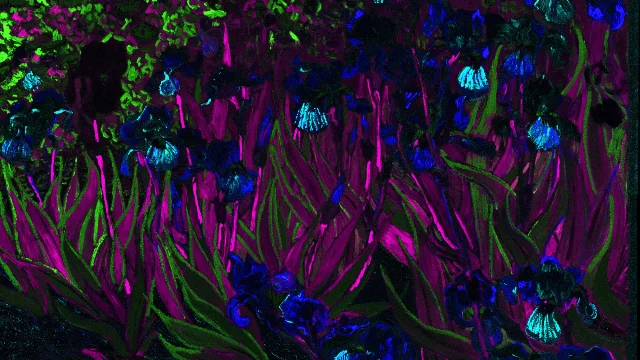
The Getty's 2024–2025 exhibition "Ultra-Violet: New Light on Van Gogh's Irises" (1 October 2024 – 9 March 2025), part of the Getty's contribution to the PST ART: Art & Science Collide initiative, brought together conservators, conservation scientists, and art historians to answer that question with the tools of materials analysis. 11 12
The key analytical technique was X-ray fluorescence (XRF) scanning — a non-invasive method that bombards a painting's surface with X-rays and reads the elemental signature of the pigments in response. 3 When the Getty's scientists mapped the elemental distribution across the iris petals, they found exactly what Van Gogh's letters had implied: the blue pigments — cobalt blue and ultramarine — were present, but so was bromine, the elemental signature of a red pigment known as geranium lake (Pelargonium lake). 11 12
Van Gogh had mixed the blue and the red together to create violet. The blue has survived. The red — geranium lake, a fugitive pigment derived from the Pelargonium plant, exquisitely sensitive to light — has not. It faded over decades of exposure, leaving only the blue behind. 3
"As we go down deeper into the painting," Ormond has described, "you see this wonderful violet color, which is the original color before it started to fade." 2 The cross-section analysis — examining a microscopic sliver of paint in profile — confirmed it: the surface layer reads as blue; deeper in the paint stratum, protected from light by the layers above, the original violet is still there. 3
The color shift is not limited to the irises themselves. The painting's background flowers, now a yellowish-orange, were originally a deeper, more saturated orange-red. The small yellow flower centers in that same background have faded to a dirty brown from what was originally a rich red. 11 The complementary color contrast that the painting was designed to exploit — violet irises against yellow-orange background blooms — was sharper, more jolting, more deliberately optical when the paint was fresh. What survives is beautiful; what existed in May 1889 was something rawer and more argumentative.
The Getty is using multispectral imaging and color science data to create a digital reconstruction that approximates the painting's original appearance. 11
The seed that went back to the garden
There is a detail in the physical record of Irises that does not appear in the x-ray data or the pigment cross-sections. It is a small thing, embedded in the surface of the paint.
During the Getty's conservation research, Ormond and her colleague Catherine Patterson, a conservation scientist, traveled to Saint-Paul-de-Mausole in Saint-Rémy to look at the garden where Van Gogh had made the painting. They were looking for evidence — physical confirmation that the painting had been made outdoors, en plein air, in that specific location. They found it. The garden, as it does in spring today as in 1889, is full of Italian umbrella pine (Pinus pinea) trees. And embedded in the paint surface of Irises, preserved under 135 years of varnish and careful handling, is a small pollen cone from exactly that species of pine. 3
"It was that tiny little seed that brought us to the garden," Ormond said. 3 The pollen cone fell from one of the asylum's pines while the paint was still wet. Van Gogh painted around it or simply did not notice it; either way, he did not remove it. It has been in the painting ever since, a physical particle of the May morning when it was made.
Dr. Beth Harris, co-founder of Smarthistory, reflected on what the color loss means when standing in front of the painting in the gallery. "So he didn't say blue irises," she noted of Van Gogh's letter. The flowers' current blue appearance carries a melancholy the painter did not intend — a documentation of time's passage laid over the surface of a work that was already, in its subject matter, a meditation on living things. "It's really moving," Harris said, "to stand in front of the painting and think about its life in time." 3
An étude that outlasted everything
Van Gogh wrote from Saint-Rémy to Theo in the weeks after he arrived: "I believe that all my faculties for work will come back to me quite quickly." 2 The painting of the irises, made the day after he arrived, is evidence that he was right, at least in those first weeks. He would stay at Saint-Paul-de-Mausole for twelve months, producing roughly 150 works including The Starry Night, series of olive trees, cypresses, and bedroom interiors. 7 He left in May 1890, moved to Auvers-sur-Oise, and died there in July, two months later. He was 37.
Irises has now outlasted the asylum where it was made (Saint-Paul-de-Mausole still operates as a psychiatric facility, but the gardens Van Gogh painted are a tourist destination within it), the men who first owned it, the marriage and death of the brother who received it, the writer who used it as a literary subject, the auction that made it infamous, and the man who bought it for a sum he could not pay.
What the painting holds, past all that biography, is what Van Gogh described in his letter: a study of violet irises rooted in the ground, painted the morning after he arrived at a place he hoped would help him. The science has restored the color, at least as a data layer overlaid on the faded surface. The pine-cone pollen pin it to a particular May morning in a walled garden in Provence. Everything else — the auction paddle, the gallery walls, the art-market record books — is sediment that accumulated around a picture made in one urgent morning session by a man who had just checked himself into a hospital and needed to look at flowers.
Cover image: Van Gogh's Irises at the Getty Museum (acc. 90.PA.20). Image courtesy of the J. Paul Getty Museum (Open Content Program).
References
- 1Irises (The J. Paul Getty Museum Collection)
- 2Irises (painting) — Wikipedia
- 3Vincent van Gogh, Irises: the search for violet — Smarthistory / Getty Museum (via archive.org)
- 4Irises at the Getty — Google Arts & Culture / J. Paul Getty Museum
- 5Letter 789: To Theo van Gogh. Saint-Rémy-de-Provence, Sunday, 14 or Monday, 15 July 1889
- 6Vincent van Gogh, Irises — Getty Conversations (Smarthistory / Getty Museum, via archive.org)
- 7Vincent van Gogh (1853–1890) — The Metropolitan Museum of Art Heilbrunn Timeline
- 8Letter 799 — Van Gogh Museum / Huygens ING
- 9List of most expensive paintings — Wikipedia
- 10Getty Buys van Gogh 'Irises,' but Won't Tell Price — The New York Times
- 11Ultra-Violet: New Light on Van Gogh's Irises — J. Paul Getty Museum
- 12Ultra-Violet: New Light on Van Gogh's Irises — Exhibition Gallery Text (PDF)
Add more perspectives or context around this Drop.