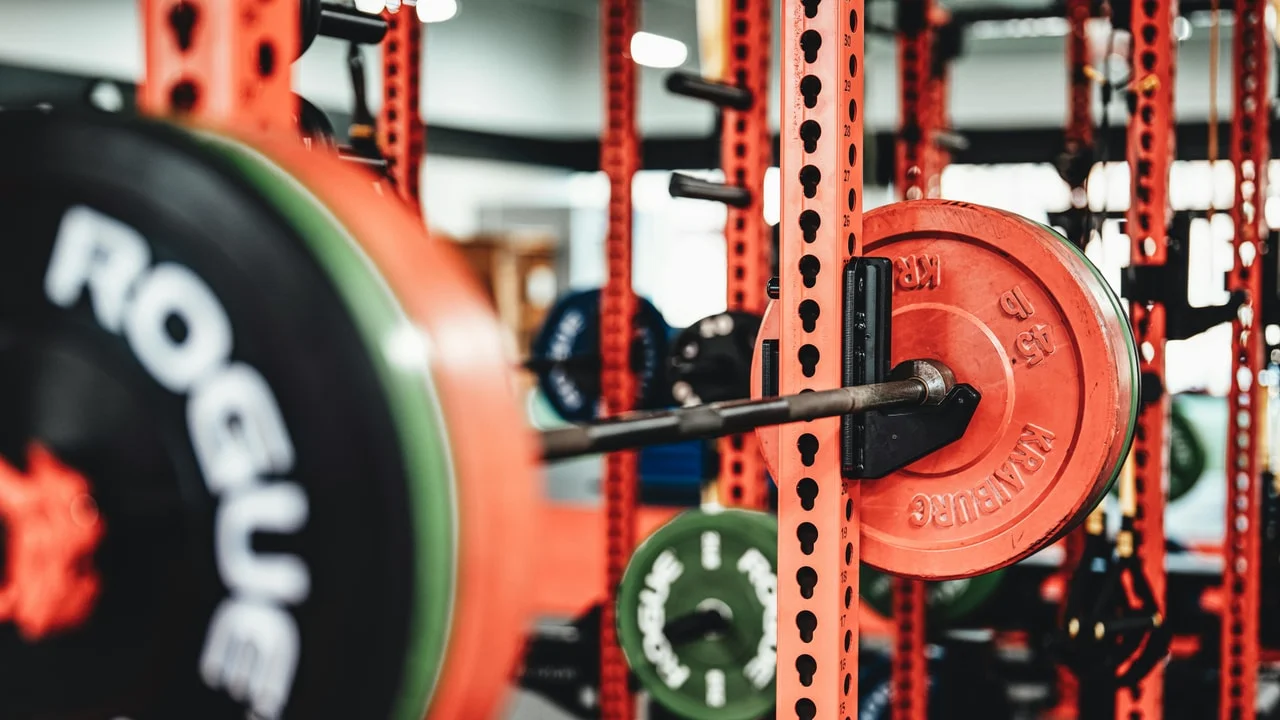
Monday Strength: StrongLifts 5x5 Workout A — Squat, Bench Press, Barbell Row
Complete Monday Workout A for StrongLifts 5x5: 5×5 barbell back squat, bench press, and bent-over row — with warm-up ramp, key form cues, video demo links for every lift, starting weights by level, and cool-down protocol.
Today's discipline: Strength | Program: StrongLifts 5x5 | Session: Workout A
Total time: ~45 min | Equipment: Barbell, rack, bench, plates
Workout A is the backbone of the StrongLifts 5x5 cycle. Three compound lifts. Five sets of five reps each. Add weight every session. That's the whole program — and it works because compound movements recruit the most muscle, and progressive overload is the only reliable driver of strength gains. 1
Today's session at a glance
| Exercise | Sets × Reps | Rest between sets |
|---|---|---|
| Barbell back squat | 5 × 5 | 3–5 min |
| Barbell bench press | 5 × 5 | 3–5 min |
| Bent-over barbell row | 5 × 5 | 3–5 min |
Warm-up (10 min)
Do not skip this. Cold muscles under a barbell are an injury risk, and the warm-up sets also groove the movement pattern before you touch work weight.
Dynamic activation (3–4 min)
- Hip circles: 10 each direction
- Leg swings (forward/back, side to side): 10 each leg
- Shoulder circles and band pull-aparts (or doorframe dislocates): 10–15 reps
- Goblet squat bodyweight: 2 × 8
Warm-up ramp for each main lift:
Work up to your work weight using progressively loaded sets. A standard ramp from the StrongLifts protocol 1:
| Set | Load | Reps |
|---|---|---|
| 1 | Empty bar (45 lb) | 5 |
| 2 | 50% of work weight | 5 |
| 3 | 70% of work weight | 3 |
| 4 | 90% of work weight | 2 |
| 5+ | Work weight | 5 × 5 |
Do these warm-up ramps for squat. For bench press and row, you can shorten the ramp slightly since your body is already warm from squatting.
Exercise 1 — Barbell back squat
Sets × Reps × Rest: 5 × 5 × 3–5 min
The squat opens every StrongLifts session — on both Workout A and B — because it's the most demanding compound movement and benefits most from fresh legs.
Key form cues:
- Bar sits on upper traps (high bar) — not on the neck
- Feet hip-width apart, toes angled out 15–30°; find your stance by squatting bodyweight first and adjusting until you can reach depth without heel rise
- Brace your core 360° before unracking — take a big breath into your abdomen, not your chest
- Descent: pull yourself down by activating your hamstrings; push knees out in line with toes; hips drop between heels
- Hit parallel or below — hips crease at knee height; quarter-squat does not count
- Ascent: drive through the floor, hips and chest rise at the same rate; do not good-morning the bar up
📹 Video demos:
- StrongLifts 5×5 Workout A — Full Session (30 min) — Mehdi demonstrates squat form and warm-up in real time
- How to PROPERLY Squat for Growth — Jeremy Ethier — 4-step breakdown covering stance, bracing, descent, and ascent (4.5M views)
- Beginner's Guide to Back Squats — Kelly Matthews — footwear, bar position, stance, and powerlifting cues
Starting weights:
| Level | Starting weight | Progression |
|---|---|---|
| Beginner | Empty bar (45 lb) — focus on form first 1–2 sessions | +5 lb per workout |
| Intermediate | ~65–95 lb (wherever form is solid across all 5 sets) | +5 lb per workout until stalls |
Exercise 2 — Barbell bench press
Sets × Reps × Rest: 5 × 5 × 3–5 min
Key form cues:
- Grip slightly wider than shoulder-width; forearms vertical when bar touches chest
- Feet flat on floor; plant your feet and drive through them the whole set
- Retract and depress your shoulder blades — this protects the shoulder and creates a stable base
- Bar path is not straight up: slight arc toward the rack (bar over lower chest at bottom, over upper chest at lockout)
- Touch chest lightly at the bottom; do not bounce
- Keep wrists straight — bent wrists bleed force and stress the joint
📹 Video demos:
- How to Bench Press with Proper Form — StrongLifts — official StrongLifts tutorial (558K views)
- How to Barbell Bench Press: Tutorial for Beginners — Barbell Rehab — step-by-step shoulder-safe setup
Starting weights:
| Level | Starting weight | Progression |
|---|---|---|
| Beginner | 45 lb (empty bar) | +5 lb per workout |
| Intermediate | ~65–95 lb (start light, prioritize bar path and shoulder blade retraction) | +5 lb per workout |
Exercise 3 — Bent-over barbell row
Sets × Reps × Rest: 5 × 5 × 3–5 min
The barbell row is the horizontal pulling counterpart to the bench press. Done correctly, it builds a thick upper back and reinforces posterior chain stability. This is the exercise most commonly performed with sloppy form — keep your torso controlled and let the lats do the work.
Key form cues:
- Hinge at hips until torso is at roughly 45° (not parallel to floor; that position requires extreme hamstring flexibility and stresses the lower back for most people)
- Row bar toward your navel, not your chest — elbows track back and down
- Use an overhand grip (pronated), slightly wider than shoulder-width
- Do not jerk or use momentum; control the eccentric (lowering the bar)
- For beginners, start from a standing hinge position — do not pull from the floor until form is consistent
- If your lower back fatigues before your lats, your torso angle is too horizontal — raise it slightly
📹 Video demo:
- How to do Barbell Rows PROPERLY — ATHLEAN-X — covers common form mistakes, grip options, and torso angle variations (5M views)
Starting weights:
| Level | Starting weight | Progression |
|---|---|---|
| Beginner | 45 lb (empty bar) | +5 lb per workout |
| Intermediate | ~65–95 lb | +5 lb per workout |
Progression rules
StrongLifts 5x5 uses a simple linear progression: [cite:2|StrongLifts 5×5: The Complete Workout Guide [2026]|[https://stronglifts.com/stronglifts-5x5/]]
- Complete all 5 sets of 5 reps with the prescribed weight → add 5 lb to the bar next session
- Fail to complete 5×5 (get stuck on the same weight three sessions in a row) → deload 10% and rebuild
- Squat and deadlift: add 5 lb each session; bench, overhead press, and row: add 5 lb each session in the early stages
- Do not skip the deload. It is built into the program's design for a reason.
Cool-down (5–8 min)
After the last working set:
- Walk slowly for 2–3 min to bring heart rate down
- Hip flexor stretch (kneeling lunge): 45 sec each side
- Thoracic extension over a bench edge or foam roller: 1–2 min
- Lat stretch (arm overhead, lean sideways): 30 sec each side
- Quad/hamstring standing stretch: 30 sec each side
Scaling guide
Beginner (first 4–6 weeks on the program)
- Start all three lifts at the empty bar regardless of your perceived strength — the first weeks are about grooving the movement, not testing your max
- If any set feels too easy, that is fine; the next several sessions will not feel that way
- Rest the full 3–5 minutes between sets — do not rush
Intermediate (familiar with the movements, been lifting 3–6+ months)
- Pick your starting weight based on the last weight you handled for clean 5×5 form across all three lifts
- Rest periods can be 3 min at lighter loads; extend to 5 min when sets feel hard
- If you have been running 5×5 for a while and stalls are frequent, the StrongLifts intermediate program adjusts the structure slightly 2
No gym / home equipment substitutions
- Squat: goblet squat with heaviest dumbbell available, or Bulgarian split squat
- Bench press: dumbbell floor press or push-up variations (feet elevated for upper chest)
- Barbell row: dumbbell row supported on a bench, single-arm or bilateral
Equipment checklist
- Barbell (45 lb standard)
- Weight plates (10 lb, 5 lb, and 2.5 lb increments recommended)
- Squat rack / power rack
- Flat bench (for bench press)
- Collars
- Chalk or lifting straps (optional; helps grip on rows)
- Flat-soled shoes or bare feet for squatting (running shoes with cushioned heels destabilize the squat)
Workout B preview (Wednesday)
Wednesday's session flips to Workout B: Squat / Overhead Press / Deadlift. The squat stays — you squat every StrongLifts session — but bench press and row are replaced by overhead press (5×5) and deadlift (1×5). Same warm-up structure, same 5 lb progression rule.
1
Add more perspectives or context around this Drop.