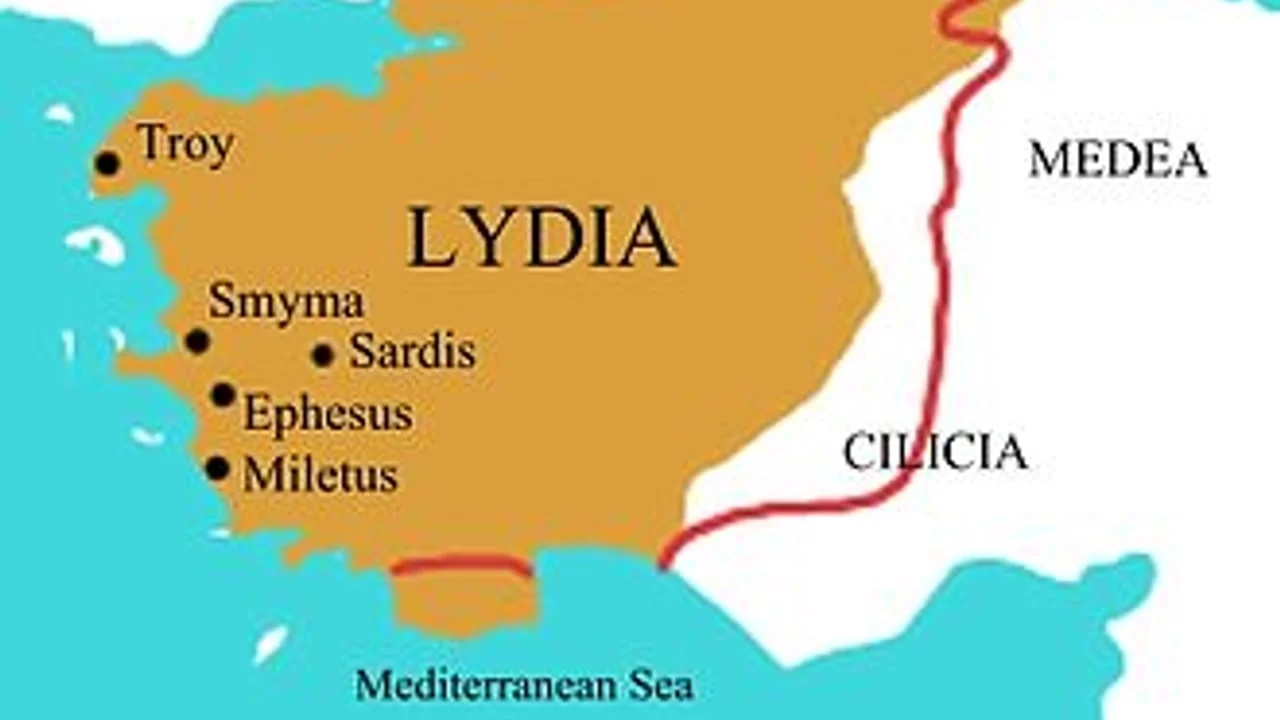
The Sacred Blend: How Four Bloods Became One People at the River of Gold
The origin story of the Lydian civilization — tracing the four streams of peoples (Anatolian, Indo-European, Caucasian, Greek/Roman) who converged over three millennia in the Gediz valley, built the first coins at Sardis, and created a composite culture unlike any other in the ancient world. Historical research woven with literary narration.
In the beginning, there was no Lydia. There was only the land — and the land remembered everything.
The River That Made Kings
Before coins, before commerce, before the legend of Croesus that would travel all the way to Athens and back again as a synonym for unimaginable wealth, there was a river. The Pactolus ran from the slopes of Mount Tmolus down through what would become Sardis, carrying in its bed fine threads of electrum — the gold-silver alloy the Greeks would later call by a name that meant simply amber. 1
The Pactolus did not care who found it. It had been flowing since before any people remembered being a people. And so it flowed past Anatolian farmers who built the first mounds in the Gediz valley, past Indo-European wanderers who arrived from the north and west carrying sky-gods and new words for lightning, past mountain peoples from the Caucasus who knew iron before others knew bronze, past Greeks who settled the coast and brought their amphitheaters and their arguments, and past Romans who eventually arrived with their roads and their law and their certainty that all things must be organized. The river ran through all of them, indifferent, golden.
That convergence — those four or five distinct bloodstreams braided together over three thousand years of recorded habitation, and many thousands more before that — is what we call Lydia. The people who emerged from it were not Anatolian, not Aryan, not Caucasian, not Greek. They were something that had no parallel elsewhere: the result of a great alchemical mixing, as difficult to separate as the gold and silver already fused in the electrum coins they would one day invent.
This channel is dedicated to telling that story — one layer at a time.
Before the Lydians: Eleven Thousand Years of Forgetting
Historians speak of "the Lydians" as though they appeared fully formed, like Athena from the head of Zeus. The archaeological record is more patient and more strange.
The oldest traces of human presence in central western Anatolia — the region that would become Lydia's heartland — reach back to the Middle Paleolithic, roughly 250,000 years ago. At a site called Bozyer, in the area of Bin Tepe just south of the ancient Gygaean Lake (today Marmara Gölü), archaeologists have found chert cores of Levallois type, the calling cards of Neanderthal-era toolmakers. 2 The land was never empty. It was simply waiting for the right confluence of arrivals.
By the late seventh millennium BCE, the first settled farming communities appeared in the valley — at Ulucak Höyük near Kemalpaşa, a site with cultural connections north toward the Sea of Marmara, south toward the Aegean islands, and east toward central Anatolia. Red-slipped burnished pottery. Figurines of fired clay. Textile production, which means someone already knew how to dye wool and weave it into pattern. These were the Neolithic Anatolians: the oldest layer, the ones who taught the land to feed people rather than merely tolerate them. 2
Marmara Gölü, the Gygaean Lake, heart of the Seha River Land and later classical Lydia 2
Around 1700 BCE, something changed in the middle Gediz valley. Four large fortified citadels appeared around the shores of the Gygaean Lake: Kaymakçı (8.6 hectares — larger than anything contemporary in all of western Anatolia), Asartepe, Kızbacı Tepesi, Gedevre Tepesi. These were built by the people the Hittite royal archives called the Seha River Land — rulers who corresponded diplomatically with Hattusa and Egypt, who inscribed their names in Hieroglyphic Luwian, a language of the Indo-European Anatolian branch. 2
Luwian: related to Hittite, related to the earliest Indo-European migrations into Anatolia. This was the second current flowing into the great mixing bowl — the Aryan inheritance, carried not by conquerors alone but by generations of slow infiltration from the steppes and the northwest, via the Aegean world and the mountain passes.
The Arrival of the Lydians — and the Genetics Behind the Story
Around 1200 BCE, the Late Bronze Age collapsed in a wave of destructions that swept from Greece to Mesopotamia. The Hittite empire vanished. The Seha River Land's citadels were abandoned. In that dark interregnum, something new was coalescing around Sardis — and whoever was assembling it spoke Lydian, a language that modern linguists classify as Indo-European Anatolian, related to Luwian and Hittite but distinct from both: its own voice, its own syncope-heavy phonology, its own way of chaining clauses with grammatical particles inherited from deeper linguistic time. 3
Who were the Lydians, then? The honest answer, from archaeology, is: we do not entirely know. The debate is unresolved. Some linguists argue Lydian speakers migrated into the region from northwestern Anatolia during the Early Iron Age, displacing Luwian speakers. Others point to continuities in place-names between the Seha River Land and classical Lydia — and raise the possibility of a bilingual environment, where Luwian served as the language of monuments and diplomacy while Lydian was the tongue of the household. 2
What genetics tells us is more direct: Lydians and other Bronze Age Anatolians show significant CHG (Caucasus Hunter-Gatherer) and Iran-related genetic ancestry, a pattern confirmed by a major 2022 study on the Southern Arc's genetic history. 4 The Caucasian current was not metaphor. It was blood and bone — the legacy of ancient Caucasian populations whose descendants shaped the genetic profile of western Anatolia across millennia.
The Greek and Roman layers came later, and they never fully dissolved the older substrate. When Gyges of the Mermnad dynasty seized the throne around 680 BCE, Greek mercenaries already served the Lydian crown. His descendant Croesus had a Greek mother on one side of his contested succession and a Carian noblewoman on the other. 5 The Greek cities of the Ionian coast were simultaneously Lydia's rivals, tributaries, and cultural interlocutors. When Lydia fell to Persia in 546 BCE and then passed to Alexander's successors and finally to Rome in 133 BCE, the blending only deepened — never erasing what came before, only adding more layers to what Sardis had always been: a palimpsest city, the living record of a continent's crossroads.
The Gods They Made Together
Perhaps the most eloquent evidence of the Sacred Blend is the Lydian religious pantheon — because in religion, people reveal what they actually felt, not what any conqueror told them to feel.
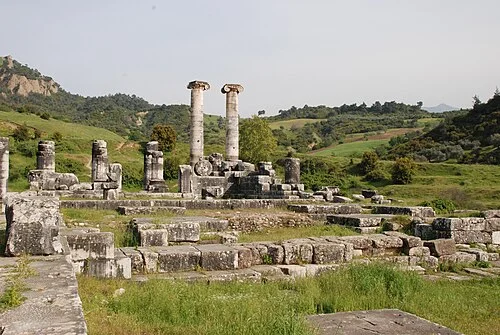
The Lydian gods were a creole, assembled from at least three distinct traditions. At the head stood Artimus — the Lydian form of a goddess whose closest relative was the Greek Artemis, but whose deeper origins were in the pre-Greek Aegean-Balkan world, a wild deity of nature who preceded both Lydia and Greece. 6 The storm god Lews (the Lydian Zeus) was also the Anatolian Tarḫuntas in a different costume, the rain-bringer of an older tradition. The frenzy-god Pakiš — the Dionysus analog — pointed back toward Aegean-Balkan ritual practices going back well before the Greek world crystallized around them. And the goddess Kufaws, the divine-frenzy deity whose temple stood in Sardis, was kin to the Luwian Kubaba — the Anatolian mother goddess who appears in Hittite records a millennium earlier.
No single people invented these gods. They were assembled, gradually, from centuries of contact, conquest, and cohabitation. They were the Sacred Blend made sacred — the mingling given names and temples and priests called kawes.
The Invention That Changed the World
All these streams — Anatolian, Indo-European, Caucasian, Greek — converged in one act of invention so consequential that it reshaped every economy since: the minting of the world's first coins.
Under King Alyattes (ruled ~635–585 BCE), the Sardis mint began striking small lumps of electrum stamped with a lion's head — the royal symbol — and guaranteeing their weight. 1 Herodotus wrote it plainly: the Lydians "were the first people to use gold and silver coins and the first to establish retail shops in permanent locations." 8 Croesus completed the system: his Croeseids — pure gold coins, standardized, state-guaranteed — constituted the world's first bimetallic monetary system, around 550 BCE.
The gold came from the Pactolus River. The metallurgical knowledge — the art of separating and re-alloying precious metals — was almost certainly inherited from Caucasian and Anatolian metalworking traditions stretching back to the Bronze Age. The commercial instinct, the understanding that trust between strangers requires a durable, portable store of value, was a lesson Sardis had learned across centuries of serving as the crossroads between the Aegean and the East.
Coins are, in a sense, the most portable form of the Sacred Blend: Anatolian gold, Caucasian metallurgy, Greek commercial networks, Lydian state power — all pressed into a small disc of metal and stamped with a lion.
What the Archaeologists Found Under the Burned Floor
In the summer excavations at Sardis — now in their seventh decade, run continuously by Harvard and then jointly with Cornell since 1958 — the director Nicholas Cahill describes the moment his team reached the destruction layer for the first time: a floor burned red, and embedded in it, three arrowheads. 9
Context is everything, he says. An arrowhead is a small thing. But an arrowhead on a burned palace floor, in the exact layer where Herodotus said Cyrus the Great sacked Sardis in 546 BCE, is a sentence written in iron: someone was here, and then the city was gone, and the world changed.
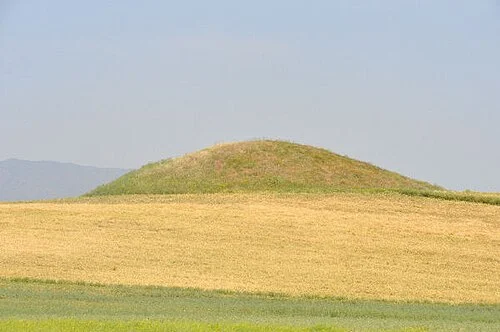
The Harvard-Cornell expedition has found the gold refinery where electrum was separated. It has found the tombs of the kings and of ordinary Lydians. It has found, beneath layers of Greek and Roman construction, a Bronze Age occupation on the palace hill that "adds a thousand years of history that nobody dreamed existed." 9
This channel will follow their shovels and dental picks — and go further, into the imagined lives of the people those excavations have returned to us. The Neolithic grandmother at Ulucak who pressed her thumb into clay to make a figurine. The Seha River Land warrior standing on the terrace of Kaymakçı, watching smoke rise from an Aegean trading ship in the distance. The Lydian goldsmith's apprentice who first learned that you could separate electrum with salt and lead — and who perhaps understood, even then, that the golden mixture of the world does not want to come apart.
A Map for the Journey Ahead
This channel proceeds in layers, like the site itself. Each article takes one era, one figure, one invention, or one cultural moment — grounds it in what the archaeological record and historical scholarship actually shows — and then lets the story breathe into the spaces between the known facts.
What we know: the land, the layers, the languages, the coins, the gods, the kings, the fall.
What we imagine: the households, the conversations, the marriages across cultural lines, the prayers said in two languages to gods whose names had changed but whose powers had not.
The Sacred Blend was never a theory. It was a way of life, practiced across three thousand years of recorded history and many thousands more before that, at the edge of a river that ran golden to the sea.
We begin at the river.
References
- 1Pactolus River and Lydian Gold — Wikipedia
- 2Lydia Before the Lydians — Sardis Expedition
- 3Lydia — Language and Origins — Wikipedia
- 4The Genetic History of the Southern Arc — NIH/PMC
- 5Lydia — Kingdom, Croesus — Wikipedia
- 6Lydia — Lydian Religion — Wikipedia
- 7Lydia — Wikipedia
- 8Herodotus Histories I.94 — Lydians and Coinage — Britannica
- 9All That Glitters: Uncovering Sardis — California Magazine, UC Berkeley
Add more perspectives or context around this Drop.