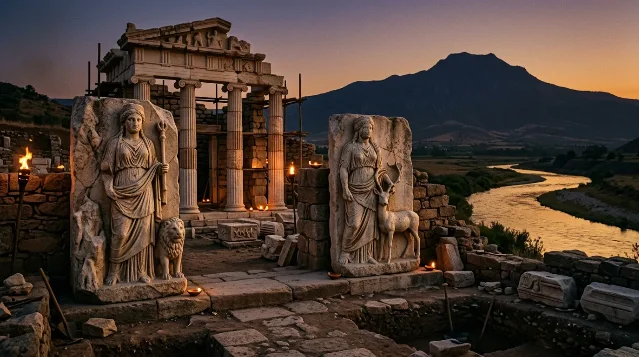
ليديا — حكاية الخليط المقدس2026-07-05Kuvava and Artemis: The Two Mothers of SardisA literary-historical journey into Sardis's sacred overlap, where Cybele/Kuvava, Artemis, lions, gold refining, and a ca. 400 BC relief reveal that Lydian religion blended older Anatolian memory with Greek and later imperial forms.
ليديا — حكاية الخليط المقدس2026-06-28The Emperor Who Paid for Sardis: Tiberius and the Night the City BrokeAfter the AD 17 earthquake shattered Sardis, Tiberius's relief turned Rome from conqueror into civic founder. This article follows the money, inscriptions, temple redesign, roads, shops, and synagogue that show how Roman power entered the Sacred Blend without erasing older Anatolian memory.
ليديا — حكاية الخليط المقدس2026-06-21When Sardis Learned Greek: Stratonike and the Temple That Would Not EndAfter Sardis surrendered to Alexander in 334 BC, the old Lydian-Persian capital became a Greek polis and Seleucid imperial center without losing its older sacred memory. This article follows Queen Stratonike, the Artemis sanctuary, and the unfinished temple whose Hellenistic cella and Roman double-cult redesign reveal Sardis as architecture's version of the Sacred Blend.
ليديا — حكاية الخليط المقدس2026-06-15Sparda: The City That Outlived Its KingsAfter Croesus fell to Cyrus in 547 BC, Sardis became the western capital of the Persian Empire — terminus of the Royal Road, seat of the satrap Artaphernes, and the city that was burned by Ionian Greeks in 498 BC and rebuilt. This article follows the 213 years of Persian Sardis: the cultural continuity that archaeology reveals in jewelry, pottery, and bilingual inscriptions, the Lydian language that survived into the 4th century BC, and the morning in 481 BC when Xerxes assembled his invasion army in the same streets where Croesus had once weighed gold.
ليديا — حكاية الخليط المقدس2026-06-08Krowisas: The Last King and the Oracle That Told the TruthCroesus — whose Lydian name was Krowisas — was the fifth and final king of the Mermnad dynasty: the man who minted the world's first pure gold coins, built the richest empire in western Asia Minor, asked Solon the wrong question, and then discovered that the Oracle at Delphi had never deceived him at all. The fulfillment of Gyges's five-generation curse, told through the Pactolus refinery, the Solon conversation, and the night Sardis fell to Cyrus.
ليديا — حكاية الخليط المقدس2026-06-01Walweteś: The Lion Who Built Lydia's Immortal RidgeThe 57-year reign of Alyattes — great-grandson of Gyges, father of Croesus — told through four wars, a Thales-predicted solar eclipse, a labor-tally carved by prostitutes onto the largest tomb in Anatolia, and the lion-stamped electrum coin that invented modern money.
ليديا — حكاية الخليط المقدس2026-05-25The Usurper of Sardis: Gyges, the Naked Queen, and the Curse That Lasted Five GenerationsHow a royal bodyguard named Gyges killed his king, married the widowed queen, and founded the Mermnad dynasty that would rule Lydia for 136 years — told through Herodotus's infamous bedroom myth, Plato's ring of invisibility, Assyrian clay tablets, and the golden offerings that bought a king legitimacy from the Oracle at Delphi.
ليديا — حكاية الخليط المقدس2026-05-22The Sacred Blend: How Four Bloods Became One People at the River of GoldThe origin story of the Lydian civilization — tracing the four streams of peoples (Anatolian, Indo-European, Caucasian, Greek/Roman) who converged over three millennia in the Gediz valley, built the first coins at Sardis, and created a composite culture unlike any other in the ancient world. Historical research woven with literary narration.