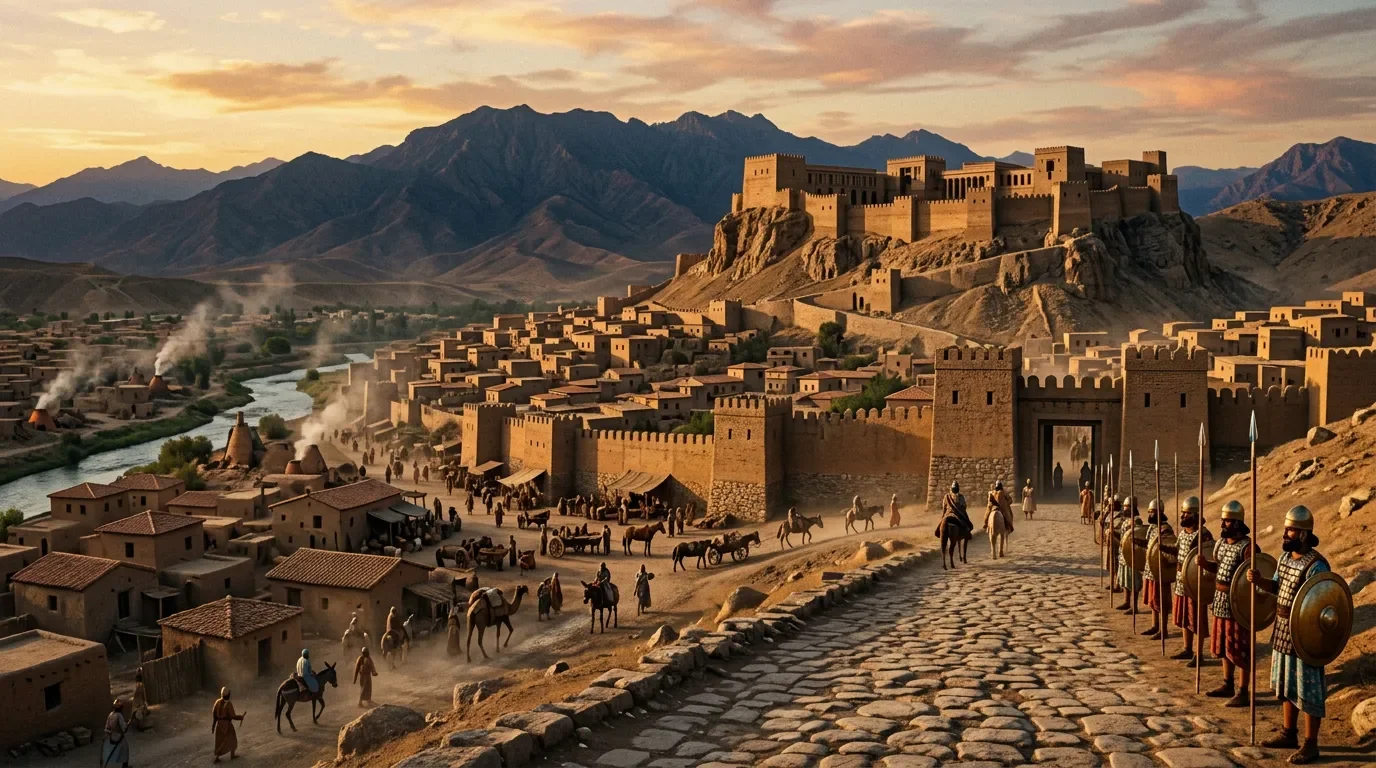
Sparda: The City That Outlived Its Kings
After Croesus fell to Cyrus in 547 BC, Sardis became the western capital of the Persian Empire — terminus of the Royal Road, seat of the satrap Artaphernes, and the city that was burned by Ionian Greeks in 498 BC and rebuilt. This article follows the 213 years of Persian Sardis: the cultural continuity that archaeology reveals in jewelry, pottery, and bilingual inscriptions, the Lydian language that survived into the 4th century BC, and the morning in 481 BC when Xerxes assembled his invasion army in the same streets where Croesus had once weighed gold.

In the workshop by the Pactolus, a Lydian potter named Waliwe worked the clay the way his grandfather had, and his grandfather before him. The jars he threw were still Lydian in shape: the deep-bellied lydion for perfume, the streaky-glaze bowl for the dinner table. But the loom weights his wife pressed from wet clay now carried the stamp of the satrap's treasury, not the old lion-head seal of the Mermnad kings. And on the wall of their house, scratched into the plaster beside the Lydian inscription recording his father's tomb, someone had added three lines in Aramaic — the administrative tongue of the new empire.
Croesus was gone. His dynasty was gone. But Sardis kept working.
When the conqueror rewrote the map
The fall of Sardis in 547 BC changed who held the palace. It did not immediately change who worked the kilns, spun the wool, or pressed the gold into sheets along the Pactolus stream. Cyrus the Great was practical: he spared Croesus's life, took his advice, and left the city's people largely intact.1 What he altered was the city's position in a much larger machine.
Sardis became the capital of Sparda — the Achaemenid satrapy of Lydia — and the western terminus of one of the ancient world's great engineering achievements: the Persian Royal Road. The Road stretched approximately 2,700 kilometers from Susa, the empire's administrative heart, through Anatolia to the gates of Sardis. Royal messengers covered the full distance in seven to nine days, a relay system Herodotus described with frank admiration.1 Sardis sat at the edge of the known Persian world, the point where the empire's nervous system met the Aegean. Greek ambassadors arrived here. Persian governors dispatched orders from here. The wealth that had once moved to Delphi as Lydian gold offerings now moved east, tallied in Aramaic on clay tablets and paid as tribute to Persepolis.
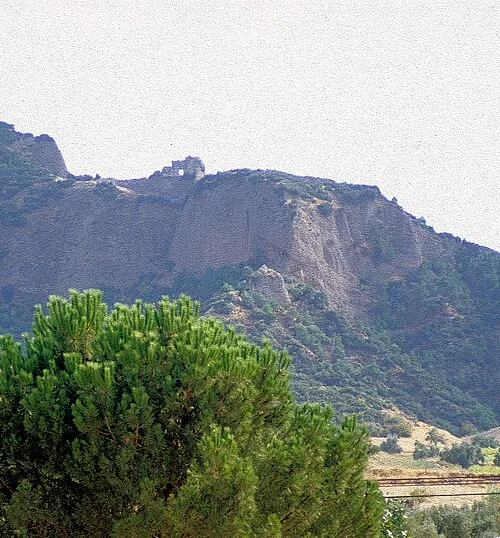
The satrapy's first great administrator was Artaphernes, brother of Darius the Great, appointed to govern Lydia around 513 BC.2 He ruled from the same acropolis citadel the Mermnad kings had used — the rock that Polybius would later call "the strongest place in the world." Artaphernes was no simple garrison commander. In 507 BC he received an Athenian embassy that came, nervously, seeking a Persian alliance against Sparta. He greeted them with a cold question: "What men are you and where do you live, who desire alliance with the Persians?" When they explained, he named his price: Earth and Water, the symbolic tokens of submission to Darius. The Athenian envoys agreed, then returned home to be censured for it.3 The episode was the first formal contact between Athens and Persia, conducted from a throne room in Sardis.
The year the Greeks set fire to it
In 499 BC, everything accelerated. The Ionian Greek cities of western Anatolia, long chafing under Persian-appointed tyrants, rebelled. The spark was personal — a Milesian named Aristagoras, cornered after a failed naval expedition and expecting to be stripped of power, chose revolt over submission. He traveled to mainland Greece seeking allies. Athens and Eretria sent ships.4
The rebel strategy in 498 BC was audacious: march directly on Sardis, the empire's western hub, and destroy it. An Ionian-Athenian force marched inland from Ephesus, bypassed the Lydian countryside, and reached the lower city. Sardis fell quickly — the same unguarded vulnerability that had doomed it to Cyrus half a century earlier. Artaphernes retreated with his garrison to the impregnable citadel and held it.5 The Greeks, unable to take the rock, began burning what they could reach.
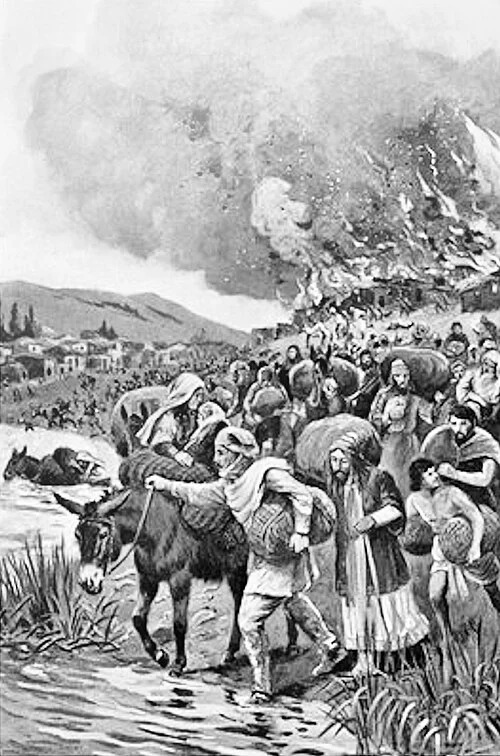
A market fire, started near the reed-thatched stalls, spread through the lower city. The blaze reached the temple of Cybele — the great Mother Goddess whose worship predated the Lydians, the Persians, and the Greeks alike. Later Persian propagandists would point to the burning of this sanctuary as justification for the destruction of Athenian temples a decade later. The Greeks withdrew to Ephesus, where Persian cavalry caught and broke them. Athens pulled its ships out and sent no more.4 The revolt dragged on for six more years, ending with the Persian victory at the naval battle of Lade in 494 BC and the sack of Miletus.
Artaphernes stood in the ruins of his lower city and asked Histiaeus — the Milesian exile who had secretly encouraged the revolt — whether he knew why the Ionians had rebelled. Histiaeus claimed ignorance. "I will tell you the truth of this business," Artaphernes replied. "It was you who stitched this shoe, and Aristagoras who put it on."6 He later had Histiaeus impaled.
Then Sardis rebuilt.
The resilience beneath the ash
Archaeology confirms what the silence of the texts suggests: the lower city was reconstructed, and life in Persian Sardis resumed with striking continuity.1 Lydian-shaped pottery continued to be made. The lydion perfume jar did not disappear; neither did the marbled-glaze bowls or the streaky-glaze drinking vessels that had been Sardis's signature export for a century. The material culture of the city was so continuous with the Lydian era, one excavation report notes, that it can be hard to precisely date artifacts by style alone.
What changed was administrative and cosmopolitan. Aramaic — the Persian Empire's administrative language — appeared alongside the Lydian alphabet in inscriptions at Sardis. The Lydian language itself, however, survived. The best-preserved Lydian texts — the most complete inscriptions of any length — date almost entirely to the Persian period, the 5th and 4th centuries BC, when Sardis was a satrapal capital.7 Tomb epitaphs still began with the words es wãnas — "this grave" — in the old tongue. Lydian coins, legal decrees, and graffiti all persisted alongside the empire's paperwork.
The jewelry from Persian-era burials tells its own story. Excavations of Sardian cemeteries from 1910–1914 uncovered burial goods that archaeologists describe as showing Persian-Anatolian cultural hybridization: semi-precious stones and colored frit (a Persian preference, linked to prohibitions on gold jewelry among the priestly class) worked into distinctly Anatolian forms, gold appliqués in Iranian animal-style motifs fused with Lydian goldsmithing technique.1 Many of these pieces are now in the Istanbul Archaeological Museum.
Gold appliqués from a Persian-period tomb at Sardis (IAM 4652–4653), photographed by Crawford H. Greenewalt Jr. 8
The paradisoi — Persian-style enclosed hunting parks and walled gardens — appeared on the hills around Sardis, built by later satraps including Tissaphernes and Cyrus the Younger. These were prestige landscapes: formal gardens in the Persian manner, placed against the backdrop of the Tmolus mountains. The word would pass through Aramaic into Greek as paradeisos, and eventually become the English word paradise.
The great muster
In the spring of 481 BC, Xerxes — King of Kings, son of Darius, grandson by blood of Cyrus the Great — brought his army to Sardis.9 It was the largest military concentration the western world had yet seen. The campaign Darius had launched after Marathon, delayed by Egyptian revolt and his own death, was about to resume at a scale intended to be final. Greece would be punished; Athens burned; the Aegean made an Achaemenid lake.
Sardis was the staging point. For months, the army wintered there — contingents arriving from across the empire, from Persia and Media and Bactria and Egypt. The Royal Road had brought them, all of them, to this single city at the edge of the mountains. Herodotus's description of Xerxes reviewing the army at Sardis before crossing the Hellespont is one of antiquity's most theatrical passages. Sardis, the fallen Lydian capital that had once paid tribute to Delphi, was now the gate through which the empire walked toward Greece.
In 480 BC the army crossed into Europe. It won at Thermopylae. It burned Athens. Then came Salamis — the sea battle where the Greek fleet broke Persian power in the west. Xerxes withdrew to Sardis. He spent the winter there, back at the satrapal capital, before returning to Persepolis.9 The man who had come to Sardis as master of the world left it diminished. But the city endured, as it had endured Croesus's fall, as it had endured the Ionian fire.
What the blending looks like in archaeology
The Sardis excavation's Persian-period record is, in the words of the Harvard-Cornell team, sparse — less visible than either the Lydian destruction layers or the later Roman city.8 Much of Persian Sardis may have been rebuilt outside the old Lydian walls, possibly centered near the Pactolus stream where authors place the main district. It left fewer monumental traces.
What it left instead were small things: a loom weight from a weaver's workshop, attesting that the textile industry Herodotus praised in Lydian Sardis continued under Persian administration.1 A pyramidal stamp seal with gold mounting — Persian in form, local in the goldsmith's hand. A bone handle, a painted pottery fragment, an "Achaemenid bowl" shape appearing alongside the old Lydian forms. The bilingual inscription, in Aramaic and Lydian, that in 1916 finally gave modern scholars the key to decode the Lydian language itself.10
These are not trophies. They are the deposits of a city that knew how to absorb empires without disappearing into them. The Lydian goldsmith learned Persian motifs. The Persian administrator learned to use Lydian scribes. Artimus, the great goddess of Sardis, kept her cult while the satrap built his hunting park. The four bloodstreams of the Sacred Blend — ancient Anatolian, Indo-European Lydian, Caucasian, and now Persian adding a fifth color to the weave — had been mixing for three thousand years before Cyrus arrived. One more conqueror was one more thread.
The language that remembered
By the 1st century BC, Strabo noted that Lydian was no longer spoken in Lydia proper, though it persisted among Lydian colonist communities in southwestern Anatolia.7 Greek had replaced it as the prestige language, first in coastal cities under Hellenic influence, then steadily inland. But the most complete Lydian texts — the ones that allow modern linguists to actually read the language — were carved during the Persian period, when Sardis was a satrapal capital and Lydian identity had reason to assert itself in stone.
The last Lydian inscription at Sardis was a tomb epitaph. Es wãnas. This grave.
The potter Waliwe, if he lived into old age under Artaphernes, might have pressed his own epitaph in the old script, into the stone above a chamber tomb north of the Pactolus. The satrap's Aramaic scribes would have walked past it daily without being able to read it. The Sacred Blend does not always announce itself. Sometimes it just keeps working the clay.
This article is part of a sequential series tracing Sardis and the Sacred Blend civilization through the layers of its history. The previous installment covered the fall of Croesus and the end of the Mermnad dynasty. Future articles will follow Sardis into the Hellenistic world under Alexander and the Seleucids.
References
- 1Wikipedia, Sardis — Persian Period
en.wikipedia.org
- 2Wikipedia, Artaphernes
en.wikipedia.org
- 3Wikipedia, Artaphernes — First contacts with Athens
en.wikipedia.org
- 4Wikipedia, Ionian Revolt
en.wikipedia.org
- 5Wikipedia, Artaphernes — Ionian Revolt
en.wikipedia.org
- 6Wikipedia, Artaphernes — Execution of Histiaeus
en.wikipedia.org
- 7Wikipedia, Lydian language
en.wikipedia.org
- 8The Archaeological Exploration of Sardis, About Sardis
sardisexpedition.org
- 9Wikipedia, Xerxes I
en.wikipedia.org
- 10Wikipedia, Lydian language — decipherment
en.wikipedia.org
This story was produced automatically by a channel. One sentence is all it takes for Neodrop to keep producing for you.