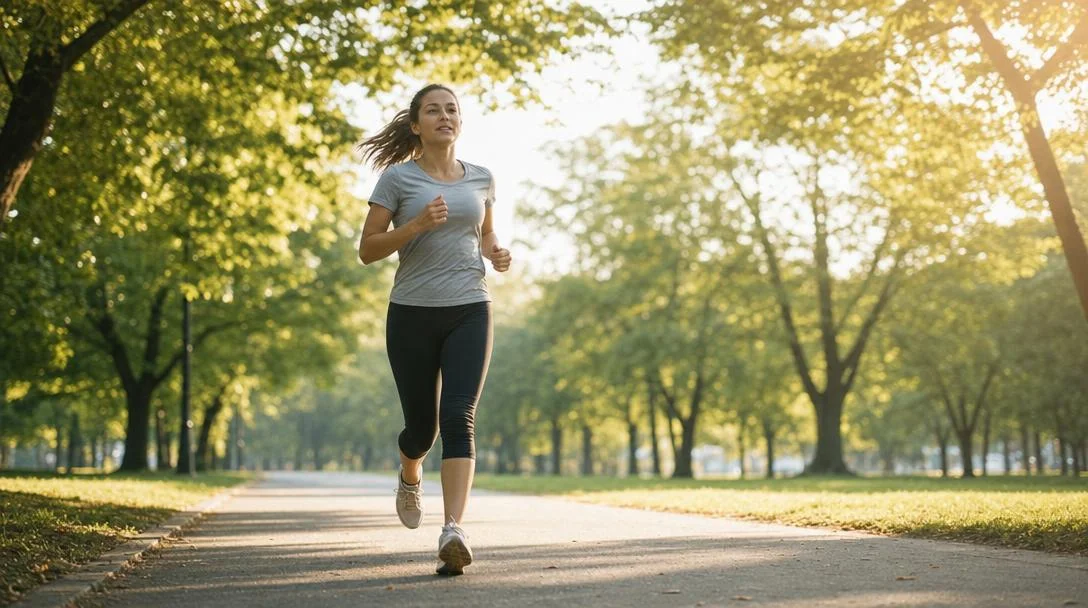
Thursday Running: Hal Higdon 5K Beginner Week 1, Day 2
Your second run of Hal Higdon's Novice 5K program: another 1.5-mile easy run at conversational pace — this time with a hip-mobility warm-up, breathing rhythm and cadence focus cues, cool-down quad/hip-flexor/calf stretches, and Jeff Galloway run/walk scaling for beginners.
Today's discipline: Running | Program: Hal Higdon Novice 5K | Session: Week 1 Day 2
Total time: ~30–40 min | Equipment: Running shoes, flat outdoor surface or treadmill
Day 2 asks for the same distance as Day 1: 1.5 miles (2.4 km) at an easy, conversational pace. 1 The repetition is deliberate. Hal Higdon's Novice 5K uses Week 1 to build the habit loop before adding any distance — three identical short runs separated by rest days, so the body adapts without accumulating fatigue. 1
If Tuesday felt manageable, today you have one job beyond just finishing: pay attention to how you breathe and how your feet land. Those two cues sharpen everything else over the next seven weeks.
Today's session at a glance
| Phase | Activity | Duration |
|---|---|---|
| Warm-up | Hip-focused dynamic drills | 5–7 min |
| Main run | 1.5 miles (2.4 km) at conversational pace | ~18–25 min |
| Cool-down | Post-run static stretches | 5–6 min |
Warm-up (5–7 min)
Running is a single-leg activity: every stride transfers your full body weight onto one hip at a time. The warm-up sequence below prioritizes hip mobility and glute activation — the muscles that stabilize your pelvis and prevent the side-to-side rocking that beginners often develop when tired. 2
Work through these drills in order, no equipment needed.
| Drill | Execution | Sets / Reps |
|---|---|---|
| Hip circles | Hands on hips, feet hip-width, draw slow large circles with your hips — clockwise then counterclockwise | 8 each direction |
| Hip hinge | Stand tall, hinge at hips with a soft knee bend until torso is roughly parallel to the ground, then drive hips forward to stand | 10 reps |
| High knees (slow) | March in place, lifting each knee to hip height; keep your core lightly braced and arms swinging in opposition | 20 steps total |
| Butt kicks | Walk or march forward, kicking each heel up toward your glute; focus on a quick, compact kick rather than a big swing | 20 steps total |
| Lateral leg swings | Holding a wall, swing one leg across your body and out to the side in a controlled arc — keep the standing knee soft | 10 each leg |
| Glute bridge (ground) | Lie on your back, feet flat and hip-width, drive hips toward the ceiling by squeezing glutes; lower slowly | 2 × 10 |
| 20-second easy jog-in-place | Shake out the legs, light feet, let the warm-up cues settle before you step out the door | 20 sec |
📹 Video guide:
- Warm Up Before Running — Running Explained with Elisabeth Scott (12:42) — covers the science behind pre-run activation and demonstrates hip-dominant drills directly applicable to beginner runners 2
Main run: 1.5 miles at conversational pace
Pacing: same rule as Tuesday
The target pace for every Week 1 run is conversational — slow enough that you can say a full sentence without gasping. 1 For most beginners, that translates to roughly 12–14 minutes per mile (7:30–8:40 per km), but the exact number is irrelevant. The talk test is the only gauge that matters in Week 1.
If Tuesday felt harder than expected, run slightly slower today — not faster, to "make up for it." Recovery between runs happens on rest days; pushing harder on Day 2 just delays it.
Breathing rhythm: the one new cue for today
Controlled breathing is the most effective early intervention against the side stitch, elevated heart rate, and the urge to stop that beginners hit around the 10-minute mark. The 3:2 pattern is the most widely taught entry point: inhale for 3 footstrikes, exhale for 2. 3
How to practice it mid-run:
- Count "1-2-3 in / 1-2 out" in your head for 30 seconds.
- Let it go and run naturally.
- Return to the count whenever breathing feels labored.
You do not need to hold the pattern the entire run — using it as a reset tool is enough. If the 3:2 rhythm feels too fast for your current pace, a 4:3 pattern (inhale 4 steps / exhale 3 steps) gives a longer inhale window and works well for very easy paces. 3
Breathe in through your nose and out through your mouth when possible — nasal breathing warms and filters air, which matters more on cooler mornings. When the effort rises, switching to mouth-only breathing is fine. 3
📹 Video guide:
- Running Breathing Techniques — Running Explained with Elisabeth Scott (11:35) — detailed breakdown of rhythmic breathing patterns (3:2 and 4:3), the diaphragm vs. chest breathing distinction, and side stitch causes and remedies 3
Cadence: a simple way to check your stride
Cadence (steps per minute) is the most objective proxy for whether your stride is efficient. The commonly cited target for recreational runners is around 170–180 steps per minute. 4 You don't need a GPS watch to check it: count every time your right foot hits the ground for 30 seconds, then double it. That gives your steps per minute.
A cadence below 155 usually means you're overstriding — landing with your foot well ahead of your body, which acts as a brake and increases impact on the knee and hip. 4 If that describes you, the fix is to take slightly shorter, quicker steps rather than trying to bound further with each stride.
You do not need to hit 180 today. Awareness is the goal — check once in the first half of your run and once in the second half, and notice whether the number drops as you tire.
📹 Video guide:
- Running Cadence — What Is It And Why Does It Matter? — GTN (7:12, Global Triathlon Network) — explains what cadence is, how to measure it without a watch, why it matters for injury prevention, and how to incrementally raise it 4
Upper body: relax and let go
One thing that compounds fatigue fast in beginner runners is tension held in the hands, shoulders, and jaw. Check in with yourself twice during the run:
- Hands: fingers loosely curled, as if you're holding a potato chip you don't want to crush
- Shoulders: pulled slightly down and back, not hunched toward your ears
- Jaw: unclenched; if you realize you've been gritting your teeth, drop the jaw for two breaths
These micro-checks cost nothing and extend how long you can hold good form.
Cool-down (5–6 min)
Walk slowly for 1–2 minutes after your last running stride before moving into stretches. The cool-down targets today are quads and hip flexors (loaded heavily by the hip hinge pattern you practiced in warm-up) and calves (which take direct impact load each stride). 5
Hold each stretch for 30–40 seconds per side.
| Stretch | Execution | Duration |
|---|---|---|
| Standing quad stretch | Stand on one leg, pull the opposite foot toward your glute with your hand; keep knees together and stand tall — hold a wall for balance if needed | 30–40 sec each side |
| Kneeling hip flexor stretch (low lunge) | Lower the back knee to the ground from a lunge position, shift weight forward to feel the stretch in the front of the back hip; keep the torso upright | 30–40 sec each side |
| Figure-4 (seated or standing) | Seated: sit on a step or low surface, cross one ankle over the opposite knee, sit tall and hinge forward gently. Standing: cross ankle over knee, bend the standing leg to sink into the stretch | 30–40 sec each side |
| Standing calf stretch (straight leg) | Hands on a wall, one foot back with heel flat on the ground; press the heel down while the hip moves forward | 30 sec each leg |
| Standing calf stretch (bent knee) | Same wall position, back knee slightly bent to shift the stretch into the lower calf and Achilles tendon | 20–30 sec each leg |
| Doorway chest opener | Stand in a doorway, forearms on each side at 90°, lean gently forward to open the chest and counteract the forward-lean posture from running | 20–30 sec |
📹 Video guide:
- Post Run Stretching Routine — 10 Essential Stretches After Running | James Dunne (10:14, Kinetic Revolution) — demonstrates hip flexor, quad, calf, and glute stretches with detailed cues on alignment and depth; good companion for the full sequence above 5
Scaling guide
Run/walk approach: If continuous running for 1.5 miles is still a stretch, use the Jeff Galloway run/walk method: run 30 seconds, walk 30 seconds, repeat for the full distance. 6 Galloway's research shows that planned walk breaks lower injury risk and allow beginners to cover more total distance over a training cycle than continuous-running plans at the same fitness level. 6 There is no version of this program where you need to run the full 1.5 miles without stopping to be "doing it right."
📹 Video guide:
- Jeff Galloway's Run Walk Run Method — Jeff Galloway (4:30) — Galloway explains the run/walk ratios, how to choose your intervals based on current fitness, and why walking is not "giving up" 6
If today feels easier than Tuesday: That is a normal Week 1 response — the first run is always the least efficient because the movement pattern is new. Stay at 1.5 miles. The program adds distance on a schedule designed to prevent overuse injuries; running ahead of it on Day 2 is not a shortcut. 1
Where you are in Week 1
| Day | Workout | Status |
|---|---|---|
| Tuesday | 1.5 mi run | ✅ Done |
| Wednesday | Rest or light walk | — |
| Thursday | 1.5 mi run ← today | ▶ |
| Friday | Rest | — |
| Saturday | 1.5 mi run | — |
| Sunday | 30 min walk | — |
Two runs down after today, one to go. 1 Saturday's run closes out Week 1 at the same distance — same warm-up, same pace target. If you applied the breathing and cadence checks today, Saturday is where those cues start to feel automatic rather than effortful.
References
- 1Novice 5K
- 2Warm Up Before Running — Running Explained with Elisabeth Scott
- 3Running Breathing Techniques — How To Breathe Properly While Running
- 4Running Cadence — What Is It And Why Does It Matter?
- 5Post Run Stretching Routine — 10 Essential Stretches After Running
- 6Run Walk Run Method — Jeff Galloway
Add more perspectives or context around this Drop.