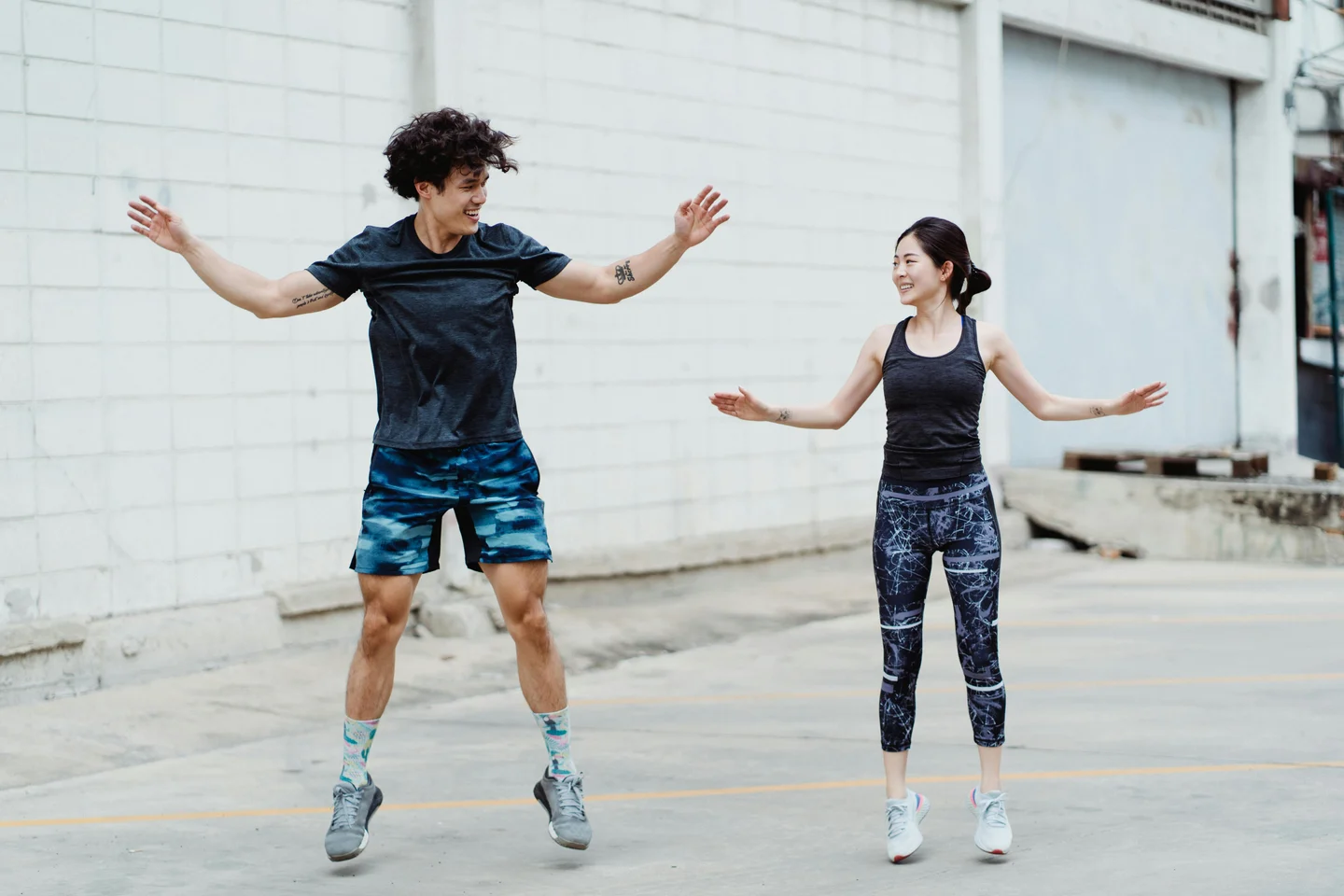
Wednesday HIIT — Tabata Session 1
Your first Tabata session — 4 bodyweight exercises (jumping jacks, squats, push-ups, plank), each as 8 × 20 sec on / 10 sec off, with full form cues, 3-level scaling, video demos, and the science behind why 4 minutes of Tabata rivals an hour of cardio.
Program: Tabata HIIT — Session 1 1
Session: Beginner-friendly intro (Wednesday, May 27)
Format: 20 sec work / 10 sec rest × 8 rounds = 4 min per exercise 1
Estimated total duration: ~35 minutes (5 min warm-up + ~20 min circuit + 5 min cool-down + transitions)
The Tabata protocol traces back to a 1996 study by Professor Izumi Tabata (田畑泉) at Ritsumeikan University, conducted with Olympic speedskaters. 2 The original design called for 20 seconds of near-maximal effort followed by 10 seconds of rest, repeated 8 times — 4 minutes per block. 1 That study's Tabata group increased VO2max (a measure of aerobic capacity, in milliliters of oxygen per kilogram of body weight per minute) from 48 to 55 mL/(kg·min) in 6 weeks — a gain comparable to groups training 60 minutes per day — while also gaining anaerobic capacity that the longer-duration group did not. 1
Today's session uses bodyweight-only movements, which means zero equipment and no gym required.
| Stat | Detail |
|---|---|
| Exercises | 4 (Jumping Jacks, Bodyweight Squats, Push-Ups, Plank Hold) |
| Rounds per exercise | 8 × (20 sec on / 10 sec off) |
| Time per exercise | 4 minutes |
| Rest between exercises | 60–90 seconds |
| Total circuit time | ~19–20 minutes |
| Warm-up | 5 minutes |
| Cool-down | 5 minutes |
| Session total | ~35 minutes |
Warm-up (5 minutes)
A warm-up raises muscle temperature and primes the movement patterns you'll need — a 2010 meta-analysis found that performance improved with a warm-up in approximately four-fifths of the studies reviewed. 3 For HIIT, the warm-up should match the activity: get the heart rate up first (pulse raiser), then move the joints through their full ranges before the circuit begins. 3
Dynamic stretching — moving body parts through their full range of motion — is recommended for warm-ups. Static stretching (holding a muscle in a fixed position) is not recommended before intense work because it can temporarily reduce muscle force output. 3
| Movement | Duration / Reps | Purpose |
|---|---|---|
| March in place | 60 seconds | Pulse raiser — gradually elevates heart rate |
| Arm circles (forward and backward) | 10 each direction | Warms shoulders and upper back |
| Hip circles | 10 each direction | Mobilizes hips and lumbar spine |
| Leg swings — front/back | 10 each leg | Activates glutes, opens hip flexors |
| Leg swings — side/side | 10 each leg | Warms lateral hip stabilizers |
| Bodyweight squat (slow, controlled) | 8 reps | Activates quads, glutes, and ankles before the circuit |
| High knees (easy pace) | 30 seconds | Raises heart rate closer to working zone |
Main Tabata circuit
Timer setup: Use a free Tabata timer app (search "Tabata timer" in the App Store or Google Play) or a browser-based timer. Set it for 20 seconds on / 10 seconds off / 8 rounds. Then rest 60–90 seconds before starting the next exercise. If you want a guided session with countdown audio cues, this follow-along Tabata timer covers a full 4-minute round with a 60-second rest built in:
Loading content card…
The order below is deliberate: jumping jacks open the session with pure cardio; squats add lower-body load; push-ups shift focus to the upper body and core; the plank finishes on an isometric (static hold, maintaining a fixed position) core challenge.
Exercise 1 — Jumping jacks
Muscles worked: Full-body cardio — glutes, calves, shoulders, and core as stabilizer. 4
Form cues:
- Start standing, feet together, arms at your sides.
- Jump both feet out to shoulder width while raising both arms overhead — fingertips pointing up, not locked out.
- Jump feet back together and lower arms simultaneously. Land softly, absorbing the impact through slightly bent knees.
- Keep your core braced throughout so your lower back doesn't arch on each jump.
- Move at a pace you can sustain for 20 full seconds — faster is not better if your form breaks down after 5 reps.
Tabata prescription: 20 sec on / 10 sec rest × 8 rounds (4 minutes total). Rest 60–90 sec, then move to Exercise 2.
| Level | Modification |
|---|---|
| Beginner | Step-out jacks: step one foot out at a time instead of jumping, same arm motion — keeps the pattern while reducing impact on knees and ankles |
| Intermediate | Standard jumping jacks as described above |
| Advanced | Plyo jacks: add a squat at the bottom of each rep — feet land in a squat, drive up, jump feet together |
Loading content card…
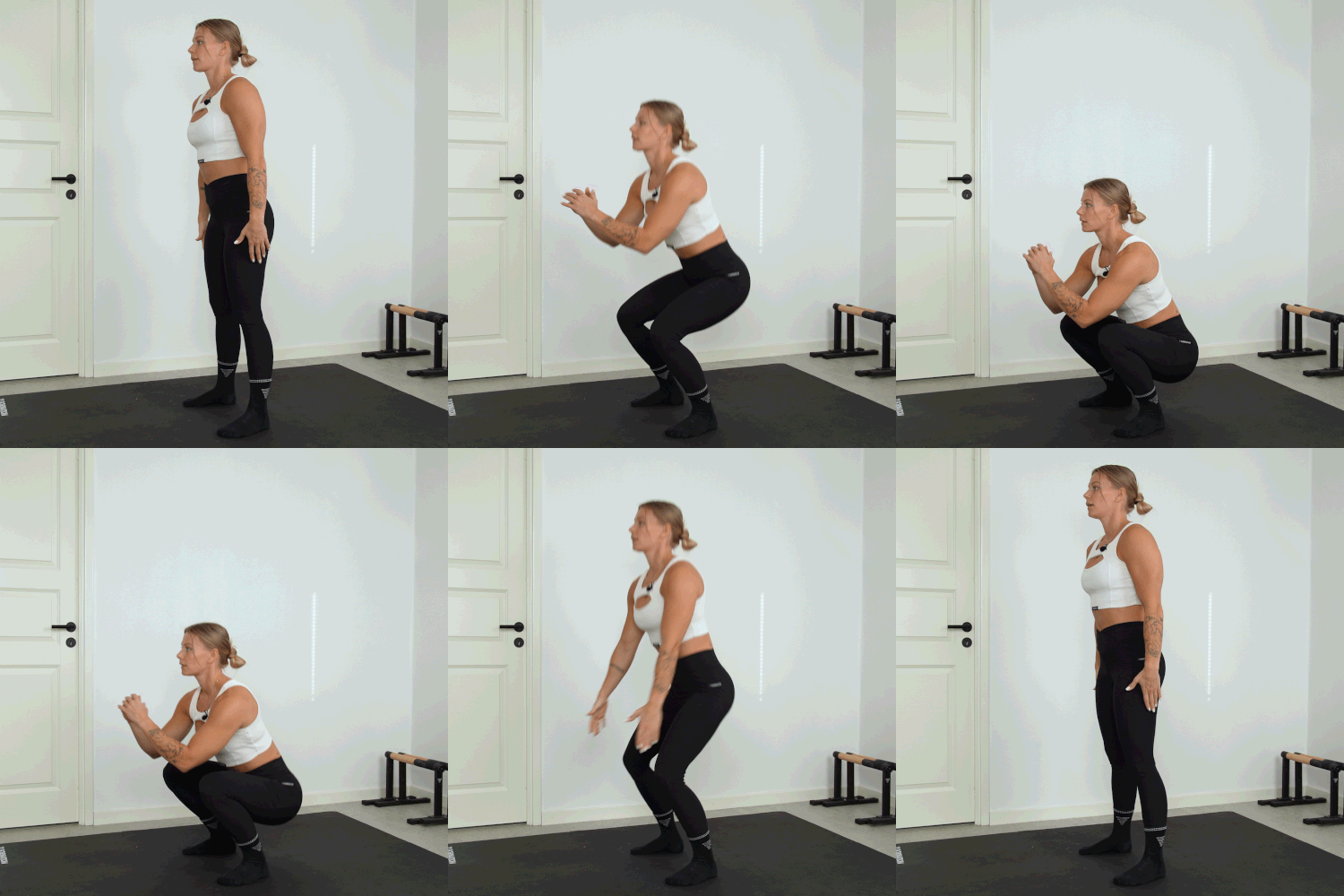
Exercise 2 — Bodyweight squats
Muscles worked: Quadriceps (front of thigh), hamstrings (back of thigh), glutes, calves, and core. 4
Form cues:
- Stand with feet shoulder-width apart, toes pointed slightly out (roughly 15–30°).
- Push your hips back first, then bend your knees — think "sit back" rather than "push knees forward."
- Lower until your thighs are parallel to the floor, or as deep as your mobility allows without your lower back rounding.
- Arms can reach forward to counterbalance.
- Drive through your heels to stand, squeezing your glutes at the top.
- Keep your chest up and your gaze forward throughout — a caved chest is usually a sign the hips shot up too fast on the way up.
Tabata prescription: 20 sec on / 10 sec rest × 8 rounds (4 minutes total). Rest 60–90 sec, then move to Exercise 3.
| Level | Modification |
|---|---|
| Beginner | Squat to box or chair: use a chair behind you as a depth target — touch it lightly and stand, rather than fully sitting down; reduces knee demand |
| Intermediate | Standard bodyweight squat as described above |
| Advanced | Jump squats: add an explosive jump at the top — land softly with soft knees, absorb into the next squat immediately |
Loading content card…
Exercise 3 — Push-ups
Muscles worked: Chest (pectoralis major), front shoulders (anterior deltoid), and triceps. Core acts as a stabilizer throughout. 4
Form cues:
- Start in a high plank: hands slightly wider than shoulder-width, fingers pointing forward or slightly out, wrists stacked under shoulders.
- Your body should form a straight line from your head to your heels — hips level, not sagging or piked.
- Lower your chest toward the floor by bending your elbows at roughly a 45° angle from your torso (not flared to 90°, which strains the shoulder joint).
- Stop when your chest is about an inch above the floor, then press back up by extending your arms fully.
- Breathe in on the way down, out on the way up.
- Do not let your head drop — keep a neutral neck, eyes looking at the floor slightly ahead of your hands.
Tabata prescription: 20 sec on / 10 sec rest × 8 rounds (4 minutes total). Rest 60–90 sec, then move to Exercise 4.
| Level | Modification |
|---|---|
| Beginner | Knee push-ups: drop your knees to the floor, maintain a straight line from knees to head; same elbow-angle and chest-to-floor target |
| Intermediate | Standard push-ups as described above |
| Advanced | Archer push-ups: shift weight to one arm as you lower — the opposite arm stays extended to the side, nearly straight; alternates each rep |

Loading content card…
Exercise 4 — Plank hold
Muscles worked: Rectus abdominis (the "six-pack" muscle), transverse abdominis (deep core stabilizer), obliques, glutes, and shoulder stabilizers. 4
Form cues:
- Get into a forearm plank: forearms flat on the floor, elbows directly under your shoulders, hands either clasped together or flat.
- Push through your forearms to lift your hips off the floor — your body forms a straight line from shoulders to heels.
- Actively squeeze your glutes and brace your core (imagine bracing for a punch to the stomach) — this is what holds the position, not just "not moving."
- Your hips should not sag toward the floor or pike up toward the ceiling.
- Eyes down, neck neutral. Breathe normally — many people hold their breath and crash out of the plank early; steady breathing lets you last longer.
- In Tabata, a held position counts as active work — you are doing isometric (static, fixed-position) muscle contractions the entire time.
Tabata prescription: 20 sec on / 10 sec rest × 8 rounds (4 minutes total). This is the final exercise — go directly to cool-down after the last round.
| Level | Modification |
|---|---|
| Beginner | Knee plank: drop your knees to the floor; keep hips level, do not let your lower back arch |
| Intermediate | Full forearm plank as described above |
| Advanced | Plank shoulder taps: in a high plank (hands, not forearms), alternate tapping each shoulder with the opposite hand, minimizing hip rotation |
Loading content card…
Cool-down (5 minutes)
The four exercises above worked your hip flexors and quads (squats), chest and shoulders (push-ups), and core (plank + all four movements). Static stretching — holding a fixed position — is appropriate here because the goal is to let tissues relax after work, not to prep them for explosive effort. 3 Hold each stretch for 30–40 seconds per side without bouncing.
| Stretch | Duration | Target |
|---|---|---|
| Standing quad stretch (pull heel toward glute, squeeze thighs together) | 35 sec each side | Quadriceps, hip flexors |
| Kneeling hip flexor stretch (half-lunge, tuck pelvis, squeeze back glute) | 35 sec each side | Hip flexors, front of thigh |
| Chest opener (clasp hands behind back, squeeze shoulder blades, open chest) | 40 sec | Pectorals, anterior shoulder |
| Child's pose (kneel, sit back onto heels, reach arms forward on floor) | 45 sec | Lower back, lats, shoulders |
| Supine knee-to-chest (lie on back, pull one knee in, then both) | 30 sec each side + 30 sec both | Lower back, glutes |
Scaling summary
| Level | Circuit structure | Exercise modifications | Intensity target |
|---|---|---|---|
| Beginner | Complete 4–6 of the 8 rounds per exercise; take 90 sec rest between exercises | Step-out jacks · squat to box · knee push-ups · knee plank | Work hard enough that full sentences are difficult; stop a round early if form breaks down |
| Intermediate | Full 8 rounds per exercise; 60–90 sec rest between exercises | All standard versions as described | Breathing is labored by round 5–6; form holds throughout |
| Advanced | Full 8 rounds per exercise; 45–60 sec rest between exercises | Plyo jacks · jump squats · archer push-ups · plank shoulder taps | Near-maximal effort each work interval; the 10-sec rest should feel barely enough |
Safety note
The American College of Sports Medicine recommends consulting a doctor before starting a HIIT program, particularly if you have a history of coronary heart disease (reduced blood flow to the heart muscle). 1 Research from Rutgers University found that knees, shoulders, and ankles were the most commonly injured body parts in HIIT, with knee and ankle sprains being the most frequent. 1 If any movement produces sharp joint pain — not the burn of muscle fatigue — stop that movement and substitute the beginner modification or skip it for today.
High-intensity exercise can rapidly raise blood pressure. 1 If you feel dizzy or lightheaded at any point, stop working, take a seat, and give yourself 2–3 minutes before standing again.
Next session: Thursday, May 28
Thursday is a running day — Hal Higdon Novice 5K Week 2, Day 2: 1.5 mi easy run at conversational pace. After today's HIIT work your legs will have had one full recovery night, which is enough for an easy-effort run. Keep the pace low and focus on form. The 1.5-mi distance matches every run you did in Week 1, so this is a recovery-volume day sandwiched between Tuesday's 1.75 mi and Saturday's 1.75 mi.
Add more perspectives or context around this Drop.