JWST instrument suite at a glance
Four instruments covering 0.6–28 μm with operating temperatures between 6.7 K and 39 K
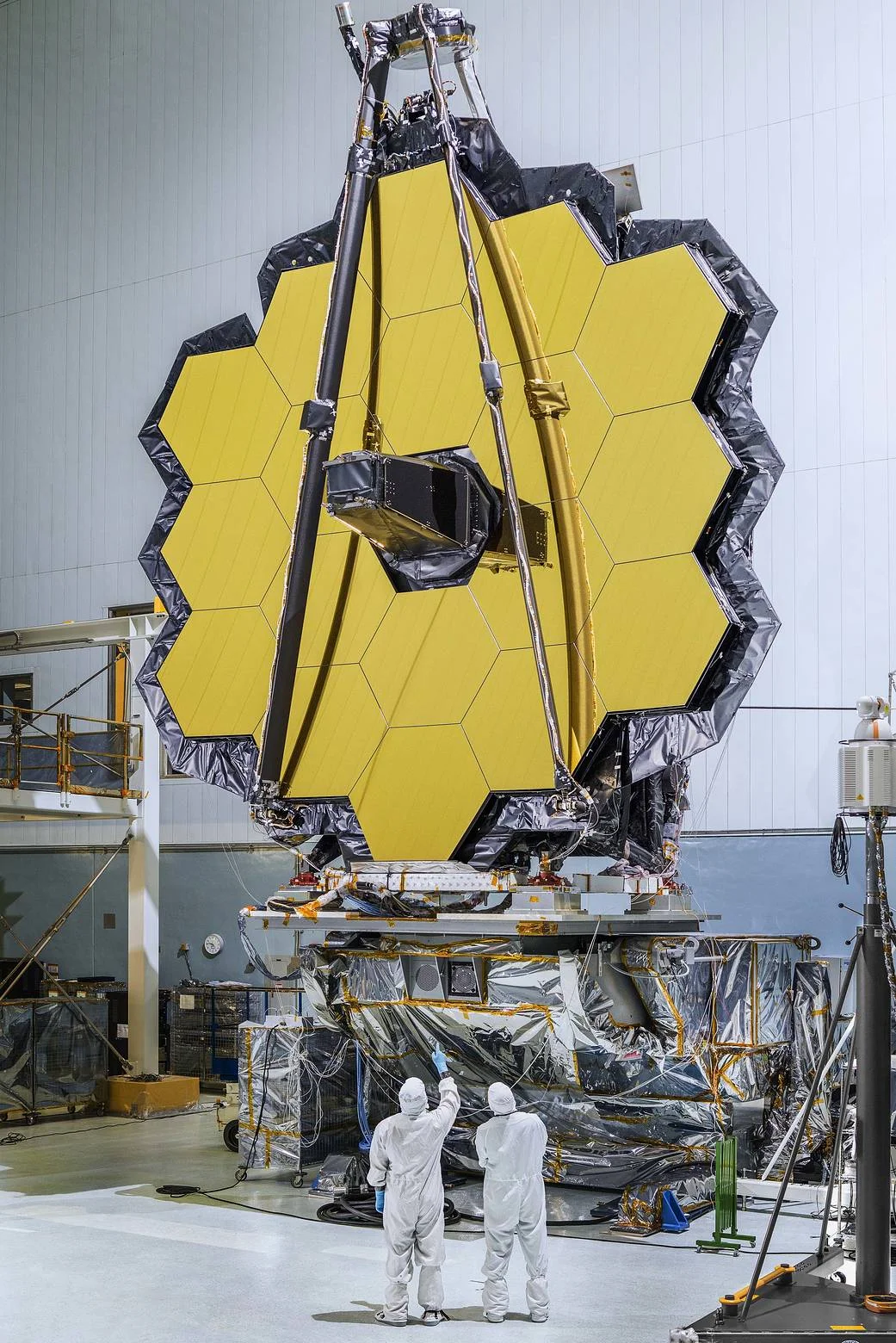
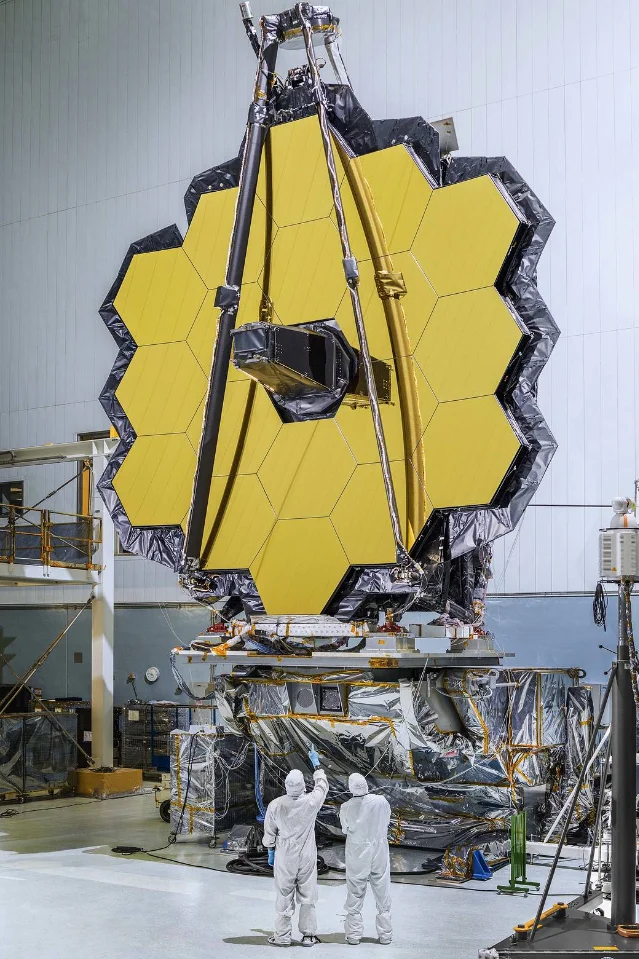
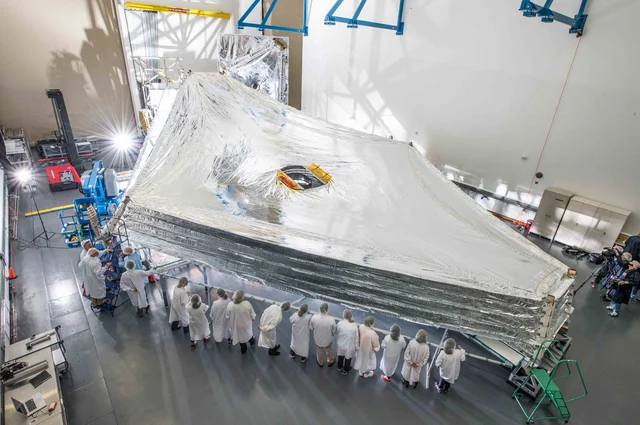
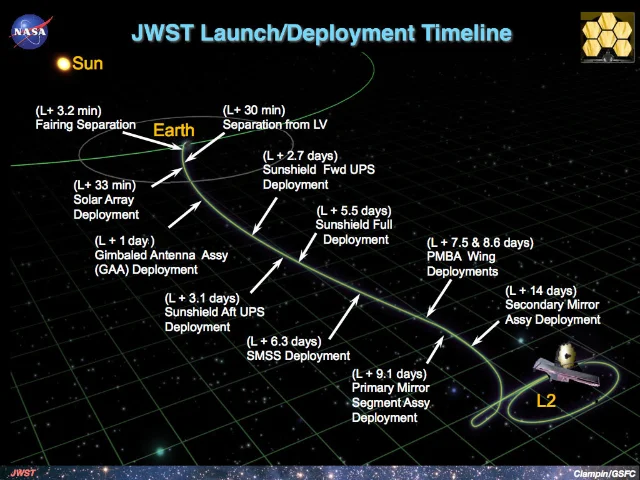
JWST's defining engineering constraint — no servicing possible at L2, 1.5 million km from Earth — cascaded into every subsystem: an actuated 18-segment beryllium mirror that could self-correct if mis-aligned, a 5-layer Kapton sunshield that had to fold and deploy perfectly once, a $150M cryocooler for MIRI's 6.7 K detectors, and 344 single-point deployment steps executed flawlessly. A precision Ariane 5 launch left enough propellant for ~20 years of science. Cycle 5 is now underway, with results reshaping cosmology.

| Parameter | Value |
|---|---|
| Primary mirror diameter | 6.5 m, 18 hexagonal beryllium segments |
| Collecting area | 25.4 m² |
| Mirror total mass | 705 kg |
| Per-segment mass (bare) | 20.1 kg |
| Gold coating thickness | 100 nm (48.25 g total gold) |
| Optical design | Three-mirror anastigmat (TMA), f/20.2, 131.4 m focal length |
| Secondary mirror | 0.74 m diameter |
| Primary mirror actuators | 126 (primary) + 6 (secondary) = 132 total |
| Actuator step precision | 10 nm (5 nm fine steps) |
| Wavefront alignment target | 50 nm rms |
| Sunshield dimensions | 21.197 m × 14.162 m |
| Sunshield layers | 5 × Kapton E; Layer 1: 0.05 mm; Layers 2–5: 0.025 mm each |
| Sunshield coatings | 100 nm Al all layers; 50 nm doped Si on Layers 1–2 (Sun-facing) |
| Hot-side temperature | ~383 K (Layer 1 max) |
| Cold-side temperature | ~36 K (Layer 5 min) |
| Instrument operating temperature | Near-IR: ~39 K; MIRI: 6.7 K |
| Wavelength coverage | 0.6–28.5 μm (NIRCam/NIRSpec/NIRISS: 0.6–5 μm; MIRI: 5–28 μm) |
| Observatory mass at launch | 6,500 kg |
| Orbit | Sun–Earth L2 halo orbit, 1.5 M km from Earth, 250,000–832,000 km radius |
| Station-keeping Δv budget | 93 m/s total; ~2.5 m/s/year |
| Propellant at launch | 159 L hydrazine + 79.5 L NTO |
| Solar array power | 2 kW |
| Data downlink | Ka-band, up to 28 Mbps; 458 gigabits/day |
| Onboard storage | 68 GB solid-state (degrades to ~60 GB over 10 years) |
| Launch vehicle | Ariane 5 ECA+ (VA256), December 25, 2021, 12:20 UTC |
| Launch site | ELA-3, Guiana Space Centre, Kourou |
| Total NASA lifecycle cost | ~$9.7 billion |
Add more perspectives or context around this Post.