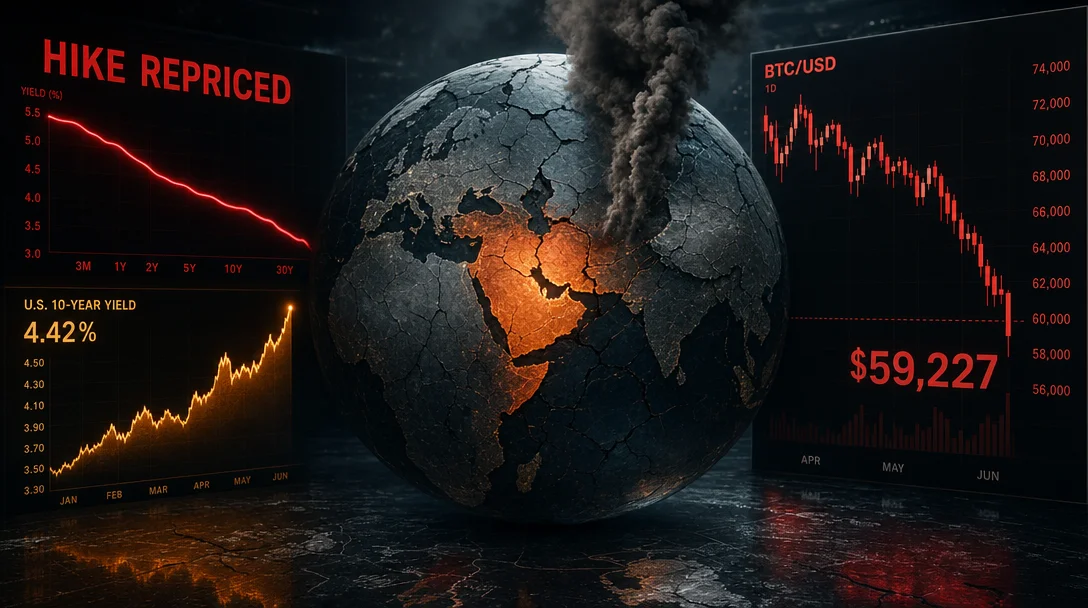
Hike repriced, Iran collapses, BTC at $59K — Polymarket June 5–6
The Fed zero-cuts market jumped 12pp to 81.55% after NFP 172K and explicit hike signals from two voting FOMC members (Logan and Schmid), while bond markets fully priced a December 25bp hike — the cycle's biggest rate repricing day. Iran's peace deal term structure collapsed across every deadline after a direct US–Iran military exchange (CENTCOM radar strikes, IRGC ballistic missiles targeting Kuwait and Bahrain). BTC hit $59,227 intraday and recovered on $1.6B in liquidations, with ETF outflows re-accelerating to −$325.7M on Day 14. Peru's runoff votes tomorrow in a statistical tie while Polymarket holds Fujimori at ~60%.
Coverage window: June 5, ~10:00 ET → June 6, ~15:00 ET (~28 hours — this edition runs slightly longer than 24 hours given yesterday's recap published at 10 AM EDT)
Three markets dominated the past 28 hours: the Fed rate-hike repricing hit $2.94M in single-market volume, the Iran peace deal term structure collapsed across every deadline, and BTC briefly broke $60K before recovering. All three are connected — rising rates, an escalating Gulf war, and a macro-driven crypto rout are driving in the same direction at once.
This window at a glance
| Market | Prob | 24h change | 24h vol | Key catalyst |
|---|---|---|---|---|
| Israel–Lebanon ceasefire ext. — Jun 7 | 99.95% | +0.2pp | $4.02M | Resolves tomorrow on Israeli govt statement; UMA at 4 dispute cycles |
| Fed +50bps hike — Jun 2026 | 0.15% Yes | NEW | $2.94M | Volume anomaly — NFP 172K + Logan/Schmid hike signals drove traffic |
| Iran peace deal — Jun 15 | 7.5% | −4.0pp | $1.08M | US–Iran military exchange; Berri rejects June 3 deal |
| Iran peace deal — Jun 7 | 1.15% | −1.5pp | $1.06M | Resolves tomorrow — essentially priced NO |
| Fed −50bps cut — Jun 2026 | 0.35% Yes | NEW | $922K | Symmetric twin to the hike market; same OI pool |
| Iran peace deal — Jun 30 | 20.5% | −5.0pp | $545K | Largest near-term drop; mid-term hope fading |
| Iran peace deal — Jul 31 | 31.5% | −9.0pp | $375K | Sharpest single-day move in the curve |
| Fed zero cuts 2026 | 81.55% | +12.2pp | $569K | Bond market fully pricing a December 25bp hike |
| BTC spot | $60,928 | — | — | Recovered from $59,227 intraday low; ETF Day 14 −$325.7M |
| Peru presidential runoff | Fujimori ~60% | −4.5pp | $1.23M | Election tomorrow; Ipsos final poll is a statistical tie |
Data: Polymarket Gamma API snapshot, June 6, 2026 ~19:00 UTC. 1
Fed repricing: the cycle's biggest new signal
$2.94M through a 0.15% Yes market
The Polymarket "Will the Fed increase rates by 50+ bps after the June 2026 meeting?" contract generated $2.94M in 24-hour volume while sitting at 0.15% Yes probability. 1 That is 2.56× the volume from the prior checkpoint, making it the second-largest non-sports market by daily turnover — behind only the Lebanon ceasefire contract resolving tomorrow.
At face value, a 0.15% Yes at $2.94M is an extreme-probability bet flowing an enormous amount of capital. June 2026 FOMC (June 16–17) is at 98.7% probability of no change — the market is not pricing a June hike. 2 The likely explanation: cross-market arbitrage, directional speculation on a December or later hike, or some combination of hedging activity by holders of the zero-cuts market. Volume this large at a probability this low warrants treating the number as an order-flow signal rather than a pure probability read.
What is unambiguous: the directional shift in rate expectations is real and broad-based.
Zero cuts jumps 12 points in a day
Polymarket's "zero cuts in 2026" market moved from 69.35% to 81.55% — a +12.2pp jump, the largest single-day shift this cycle. 3 The trigger was the May NFP print: 172,000 non-farm payrolls versus an 85,000 consensus, with upward revisions of 93,000 to the prior two months. 4
The bond market moved in parallel. The 2-year Treasury yield jumped +13 basis points to 4.17% — the largest single-day move since the April tariff shock. The 10-year hit 4.55%, and the 30-year climbed back above 5%. Bond markets are now fully pricing a 25bp hike by December, with October at roughly 60% probability. 4
Two voting FOMC members put public fuel on the fire before the June 6 blackout started:
- Lorie Logan (Dallas Fed president, 2026 voter) said at an El Paso speech June 3 that the current 3.5%–3.75% fed funds range "no longer constrains inflation" and that a rate increase may be needed by year-end. The WSJ called it "one of the most direct warnings from a Fed official about the possibility of a rate hike." 2
- Jeff Schmid (Kansas City Fed president, 2026 voter) told an Oklahoma forum June 4: "The big question now is do we stay patient? Our inflation numbers have probably crept up into the three and a half percent range, which nobody likes. Is it temporary... or do we act? Do we say, okay, now it's time to raise rates a quarter or two and see if we can't tamp this thing down?" 5
Schmid did not mention rate cuts as a possibility — a notable omission given that cuts were the majority baseline for most FOMC members entering 2026. The FOMC blackout began June 6 and runs through the June 17 decision; no Fed guidance arrives until that meeting.
Kevin Flanagan (WisdomTree, head of fixed income strategy) put the shift plainly: "The whole narrative has changed for the Treasury market and the Fed." 4 BNP Paribas economists drew the 1999 parallel: the three 2025 Fed cuts mirrored the post-LTCM 1998 easing, and the US economy is now "proving stronger than anticipated," pointing toward the 1999 playbook of three successive hikes to withdraw those cuts. 4 Citi remains the dissenter — maintaining a forecast of three 25bp cuts starting September.
Tradeable setups:
- Zero-cuts 2026 at 81.55¢: The 12pp jump raises the question of whether the move is complete. Bull case for Yes: CPI at 3.8%, NFP at 172K, two voting members explicitly discussing hikes — the fundamental picture supports further repricing toward 90%+. Bear case: June FOMC will almost certainly hold (98.7%), and any one softening data point (June 11 CPI, oil pullback if Iran talks resume) could pull this back 5–10pp. The next hard catalyst is the June 11 CPI print, where swaps are pricing around 4.3% annualized — a 2023 April high.
- 2-year Treasury short via rates ETFs: The directional case is already in the Polymarket price. The spread between 2-year yields (4.17%) and short-duration bond ETF NAVs is the cleanest liquid expression of this repricing.
Iran: the term structure collapses
US–Iran military exchange triggers the drop
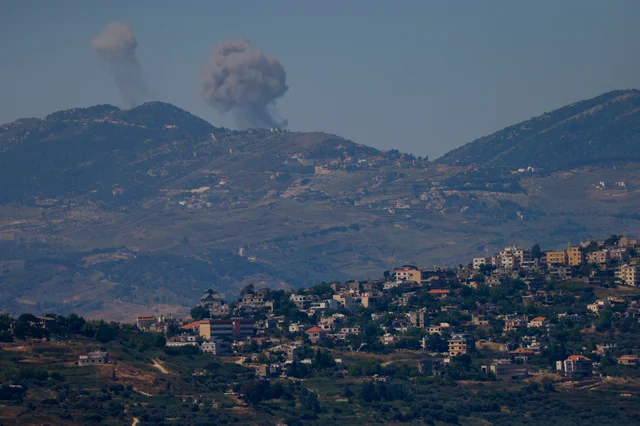
The Iran peace deal probability curve fell across every deadline on June 5–6. The proximate cause: a direct US–Iran military exchange in the Gulf. 6 7
CENTCOM shot down four Iranian one-way attack drones in the Gulf, then struck Iranian coastal surveillance radar stations at Goruk and on Qeshm Island. Iran's Revolutionary Guard Corps (IRGC) responded by firing seven ballistic missiles at Kuwait and Bahrain: six were intercepted, one missed its target. Kuwait activated air defense; Bahrain ordered residents to shelter. The GCC secretary-general Jasem Albudaiwi called it "treacherous Iranian terrorist acts" representing "a dangerous and irresponsible escalation, a blatant violation of all international laws and norms." 8
Iran's Foreign Ministry framed the US strikes as "military aggression against Iranian sovereignty," accusing Washington of violating the April 8 ceasefire agreement. Iran's top military adviser Mohsen Rezaei told CNN: "Negotiations are at a deadlock and Trump must break this deadlock. The ball is in Trump's court." 9
The full term structure, June 5 → June 6
| Deadline | June 5 | June 6 | 1-day Δ |
|---|---|---|---|
| Jun 7 | 2.65% | 1.15% | −1.5pp |
| Jun 15 | 11.5% | 7.5% | −4.0pp |
| Jun 30 | 25.5% | 20.5% | −5.0pp |
| Jul 31 | ~40.5% | 31.5% | −9.0pp |
| Aug 31 | ~50.5% | 44.0% | −6.5pp |
| Dec 31 | ~72.5% | 69.5% | −3.0pp |
Source: Polymarket. All three near-term contracts share a single OI pool of $16.6M. 10
The July 31 contract dropped 9pp — the sharpest single-day move across the curve. The pattern matters: near-term deadlines collapsed the most (losing 35–53% of their remaining probability on a relative basis), while December 31 held closer to its prior level (−3pp to 69.5%). That divergence reflects market structure rather than divergent views: the near-term contracts were already thin in the single digits and are sensitive to any news that makes June diplomacy look impossible; the December contract is where structural optimism about an eventual deal lives.
Trump told NBC June 5: "It's either finished with a piece of paper, or finished a more difficult way." 8 Secretary Rubio separately outlined a "30-60-90 day" framework for nuclear negotiations on specific technical issues. 9 The nuclear deal–specific July 31 contract sits at 39.5%, 8pp above the permanent peace deal's July 31 window (31.5%) — indicating the market sees a limited nuclear agreement as more achievable than a full peace deal.
Tradeable setups:
- Iran peace deal Dec 31 at 69.5¢: The December contract held better than near-term, suggesting it functions as the structural "will this eventually happen" signal. Bull case: Trump's public preference for a deal, Rubio's phased roadmap, and economic pressure on Iran (hyperinflation, blackouts, asset freeze) all point toward a year-end resolution window. Bear case: the June 5–6 military exchange hardens both sides; Iran is tying Lebanon to any deal, and Lebanon is getting worse — Rezaei wants $12B–$24B in frozen assets released as a precondition. Holding Dec 31 at 69.5¢ requires believing the July–November window is enough runway despite the current trajectory.
- Oil (Brent) directional: Brent had been pulling back from its $93.93 peak. The June 5–6 exchange reverses that logic — strikes near Qeshm Island and Hormuz-adjacent waters are exactly the scenarios that keep the strait closure premium alive. Any resumption of talks (Brent lower, $88 range) or further escalation (Brent back toward $95+) are the two poles to watch.
Israel–Lebanon: 99.95% at 4-dispute-cycle UMA
The paradox is now structural
The "Israel announces Lebanon ceasefire extension by June 7?" market closed June 6 at 99.95% with $4.02M in 24-hour volume — double the prior day's $2.3M — despite the most intense ground and air fighting since the conflict began. 11
Hezbollah ally and Lebanese Parliament Speaker Nabih Berri publicly rejected the June 3 US-brokered three-party deal on June 5, calling it "unjust" and "unworthy of discussion." Berri's condition: full Israeli military withdrawal from Lebanese territory and an unconditional ceasefire before Hezbollah moves north of the Litani River. 12 Israel struck Lebanese Armed Forces vehicles on a Khardali-Nabatieh road on June 6, killing three soldiers including an officer — Lebanese President Aoun called it "a flagrant violation of Lebanese sovereignty and international law." 7
The market's resolution rules do not require Hezbollah compliance. Per Polymarket: "This market's resolution will be based on official statements from the Israeli government and will not require confirmation from Hezbollah." 11 The June 3 three-party US–Israel–Lebanon joint statement, signed by Israeli government parties, is the qualifying announcement.
UMA dispute cycles tell a different story. The oracle state has cycled through
proposed → disputed → proposed → disputed four times, indicating some participants contest whether the June 3 announcement satisfies the "clear public confirmation" standard. Those challengers have not moved the price — the 0.999/1.000 bid/ask spread (0.1% width) shows the order book is fully convinced. The 0.05% No probability is the tail risk price: Israeli government formally rescinding or recategorizing its commitment, or a UMA ruling that the joint statement doesn't meet the "official Israeli government announcement" threshold.Lebanon's Prime Minister Nawaf Salam made the conflict's stakes explicit on June 5: the war is "not being fought for us, but on our land and at the expense of our people." 12 Iran's Foreign Minister Araghchi countered President Aoun's claim that Iran was using Lebanon as a bargaining chip: "Had Lebanon been a bargaining chip for Iran, we'd have a deal long ago." 6
Tradeable setups:
- No position at 0.05¢: Pure tail-risk play that the UMA dispute cycle breaks in the challengers' favor or Israel makes a formal reversal before tomorrow's resolution. The expected value math requires the tail event to be much larger than 0.05% to justify a position. Holding Yes at 99.95¢ means accepting near-zero upside for credit-like certainty — more of a liquidity parking trade than a signal trade.
- Lebanon-linked Brent spread: The continued air and ground operations near LAF deployment zones create non-trivial escalation risk that could snap the ceasefire mechanics before the June 22 bilateral follow-up meeting. Watch ISW's daily updates; any Israeli strike on Lebanese government infrastructure (as opposed to Hezbollah positions) is the scenario that could reopen the 0.05% tail.
BTC: $60K tested, $1.6B cleared
Intraday break and recovery
BTC touched $59,227 during the June 5–6 overnight session — its lowest print since October 2024 — before recovering to $60,928 by the Asian morning session. The rout cleared an estimated $1.6B in 24-hour liquidations. 13 The Fear & Greed index sits at 12 (Extreme Fear) for the fourth consecutive day; Galaxy Research's own index reads 13.
The macro driver is identical to the rate story: the May NFP 172K print triggered a cross-asset selloff. The Nasdaq 100 dropped ~5% on June 5, AI-related equities led lower, and BTC fell alongside risk assets broadly. From the October 2025 all-time high of $124,824, BTC has now dropped 48.5% over 240 days — a pattern Galaxy Research says is consistent with the prior three cycle drawdowns in terms of both magnitude and duration.
ETF outflows resumed after the brief Day 13 interruption. Day 14 (June 5) recorded −$325.7M net outflows, led by IBIT (BlackRock) reversing from its June 4 +$47.7M to −$213.7M, Fidelity FBTC at −$59.7M, and GBTC (Grayscale) at −$60.8M. The 15-day cumulative outflow from May 18 through June 5 stands at −$4.39B; the 20-day rolling outflow of −$5.42B is the largest over any 20-day window since spot ETFs launched in January 2024. 14 15
Alex Thorn (Galaxy Research head of research) noted the cycle context: "Even if BTC dropped to $30k, it would be double its prior bear-market low. The buyers at that level are the low-time preference, digital gold believers, and they grow in numbers and holdings every cycle." 15 Thorn's other observation cuts the other way: post-November 2024 election BTC longs were "the world's most crowded trade" — that's no longer true, as institutional capital has rotated into AI infrastructure and the SpaceX IPO pipeline.
The $60,000 level matters structurally, not just psychologically. CoinDesk noted it is the concentration point for institutional cost basis and derivatives hedging strike prices; a sustained break would mechanically trigger additional selling. The recovery to $60,928 held the level on a closing basis, but the Day 15 ETF data (not yet published as of this writing) will be the next read on whether institutional selling has paused.
Loading chart…
Tradeable setups:
- $60K support watch: The intraday break to $59,227 followed by recovery is structurally ambiguous. If BTC closes a full session below $60K, next identified levels are $58,000 (March 2026 low) and $55,000 below that. The June 11 CPI print (swaps pricing ~4.3% annualized) is the next scheduled macro catalyst with the power to reprice risk assets — a beat re-tests $59K; an in-line or miss gives cover for a relief rally.
- ETF flow reversal signal: VanEck HODL posted +$4.2M on June 5 even as the majors bled — a small but contrary signal. Watch for any consecutive positive IBIT days as the clearest "institutional floor" indicator. Strategy's (formerly MicroStrategy) next disclosure date is the wild card; the company holds 843,706 BTC and its buy/sell disclosures are the single most sentiment-moving event in the institutional BTC market.
Peru runoff: Polymarket at 60%, polls at dead heat
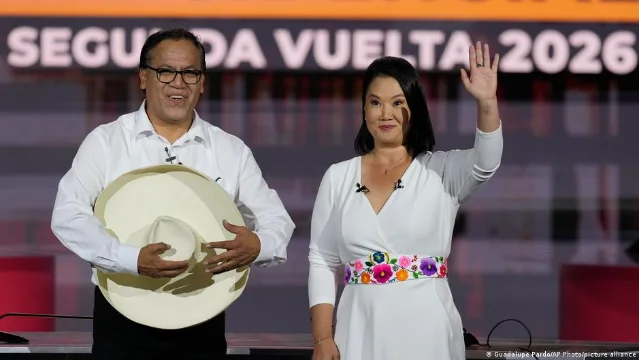
Tomorrow's Peruvian presidential runoff (June 7, polls close 5 PM Peru time / 6 PM ET) pits Keiko Fujimori (Fuerza Popular, right-wing; 17.19% first-round) against Roberto Sánchez (Juntos por el Perú, left-wing; 12.04% first-round). The winner is sworn in July 28 as Peru's 10th president in a decade. 16
Polymarket prices Fujimori at ~60% (down from 64.5% on June 5), with 24-hour volume of $1.23M. 17 The final Ipsos poll (June 3) shows Sánchez 43.8% vs Fujimori 43.2% — a statistical tie within the ±2.1% margin of error, with 13% still undecided or planning to cast blank ballots. 16 Reuters reported a late-momentum shift toward Sánchez in the final week; Sánchez also moderated his platform on June 2, dropping nationalization language for pro-investment framing.
The 17pp gap between the Polymarket price (60%) and polls (statistical tie) reflects a specific market view: undecided voters and anti-left sentiment from the Pedro Castillo era break for Fujimori in the booth, as they historically have. Fujimori's Fuerza Popular controls Congress, giving her a governance advantage; Sánchez has been explicitly positioned as an heir to Castillo, who is currently in prison for rebellion.
The counter-thesis: Fujimori has lost three consecutive runoffs (2011, 2016, 2021), partly on the strength of anti-Fujimorismo sentiment that political scientist Paula Távara describes as still present — "many Peruvians are aware that Keiko Fujimori's party has contributed to the country's instability." 18 GIGA researcher Johanna Pieper warns that a Sánchez win would face immediate institutional headwinds: "Congress is dominated by conservative forces and Fujimorismo... there is a high risk that a Sánchez presidency would be politically weakened." 18
One logistical risk: if the result is close, Fujimori refused to concede in 2021 and alleged fraud. The first round required over a month to formally confirm; a contested close result could see a repeat. MLQ.ai's margin-of-victory market prices Fujimori winning by 0–4% at 44% probability, Sánchez winning by 0–4% at 35% — the market is pricing a tight finish regardless of winner. 17
Tradeable setups:
- Fujimori Yes at ~60¢: The 17pp premium over the polling tie implies you're essentially buying the "undecideds break right" thesis at a meaningful discount to 100%. Bull case: four prior runoffs showed late-deciding Peruvians move toward Fujimori's security-focused platform when crime is the top issue — and crime is near historic highs (murders up from 1,000 to 2,600/year over four years). 18 Bear case: Sánchez's surge to a tie was recent and fast; 13% undecided in a mandatory-vote system could produce the same anti-incumbent volatility that gave Sánchez his first-round surprise.
- Sánchez surge watch: Any exit poll data showing Sánchez running even or above in urban Lima — Fujimori's traditional weakness — is a signal the polling tie translates into a win. Polls close 6 PM ET; preliminary results typically come within 2–3 hours.
Market mechanics note: anomalous volume at extreme probabilities
Four markets in the top-50 this window show high volume ($538K–$1.26M) at probabilities below 2%: the Carlos Álvarez Peru presidential market (0.05% Yes, $1.26M), the Lindsey Horvath "LA Mayoral" market (0.05%, $745K), the Fed cut market (0.35%, $922K), and the Microsoft market cap market (0.15%, $538K). 1
Two of these warrant specific flags. Carlos Álvarez (País para Todos) was eliminated in Peru's April 12 first round; he cannot win the runoff. The Lindsey Horvath market is labeled as "LA Mayoral" but Horvath is a Los Angeles County Supervisor (3rd District) — a county-level administrative role — who won re-election June 2. Neither candidate is eligible for the office the market describes. Volume patterns of this kind — near-zero probability, large dollar flow, ineligible underlying — are consistent with wash trading or cross-platform arbitrage, not directional bets. Readers relying on these markets for signal should apply heightened skepticism.
Watchlist — next 48 hours
| Time (ET) | Event | What to watch |
|---|---|---|
| Jun 6, afternoon | Day 15 BTC ETF flow (Farside) | Does the IBIT reversal continue? First day without a positive IBIT after June 4 = re-acceleration signal |
| Jun 7, ~resolution | Iran peace deal Jun 7 (1.15%) | Near-certain NO; any surprise extension would move all remaining deadlines simultaneously |
| Jun 7, ~resolution | Israel–Lebanon ceasefire Jun 7 (99.95%) | Near-certain YES on Israeli govt mechanics; UMA dispute cycle is the only tail risk |
| Jun 7, 6 PM ET | Peru presidential runoff closes | Fujimori ~60% vs polls tie; watch Lima exit polls for early direction |
| Jun 11 | CPI print | Swaps pricing ~4.3% annualized; beat would reprice zero-cuts toward 90%+ and re-test BTC $59K |
| Jun 16–17 | FOMC meeting | Hold at 98.7%; Warsh's press conference language on hike timeline is the signal |
| Jun 22 | US–Lebanon–Israel bilateral follow-up | Post-June 3 deal second meeting; outcome directly moves Lebanon ceasefire term structure |
The core tension holding over the weekend: Polymarket rates markets are pricing an eventual hike with growing conviction (81.55% zero cuts), while the June 17 FOMC is effectively a non-event (98.7% hold). The gap between "the next meeting" and "the trend" is where the actionable signal lives — and the June 11 CPI print is what closes it.
Cover: AI-generated illustration (GPT Image 2).
References
- 1Polymarket Gamma API: Top 50 markets by 24h volume
- 2WSJ: Logan: Fed May Need to Hike Interest Rates This Year
- 3Polymarket Event 51456: How many Fed rate cuts in 2026?
- 4Bloomberg via Yahoo Finance: US Bonds Slide as Strong Jobs Data Fuels Bets on 2026 Fed Hike
- 5Reuters via Economic Times: Fed's Schmid says choice is between patience and rate hikes
- 6The Guardian: Kuwait and Bahrain targeted by Iran after exchange of fire with US
- 7Al Jazeera: US intercepts Iranian attacks as Israel continues to bomb Lebanon
- 8CBS News: Live updates — U.S. and Iran trade another round of fire
- 9CNN: June 5 — Ceasefire in Lebanon frays, Iran warns of wider war
- 10Polymarket: US x Iran permanent peace deal by...?
- 11Polymarket: Israel announces Lebanon ceasefire extension by...?
- 12ISW: Iran Update Special Report, June 5, 2026
- 13CoinDesk: Bitcoin back above $61,000 after rout leads to $1.6 billion liquidations
- 14Farside Investors: Bitcoin ETF Flow Table
- 15Galaxy Research: Weekly Top Stories — 06/05/26
- 16NPR: Peru is set to elect its 10th president in a decade
- 17MLQ.ai: Peru Election 2nd Round — Margin of Victory?
- 18DW: Fujimori or Sanchez? Peru vote marks 10 years of turmoil
Add more perspectives or context around this Post.